1)
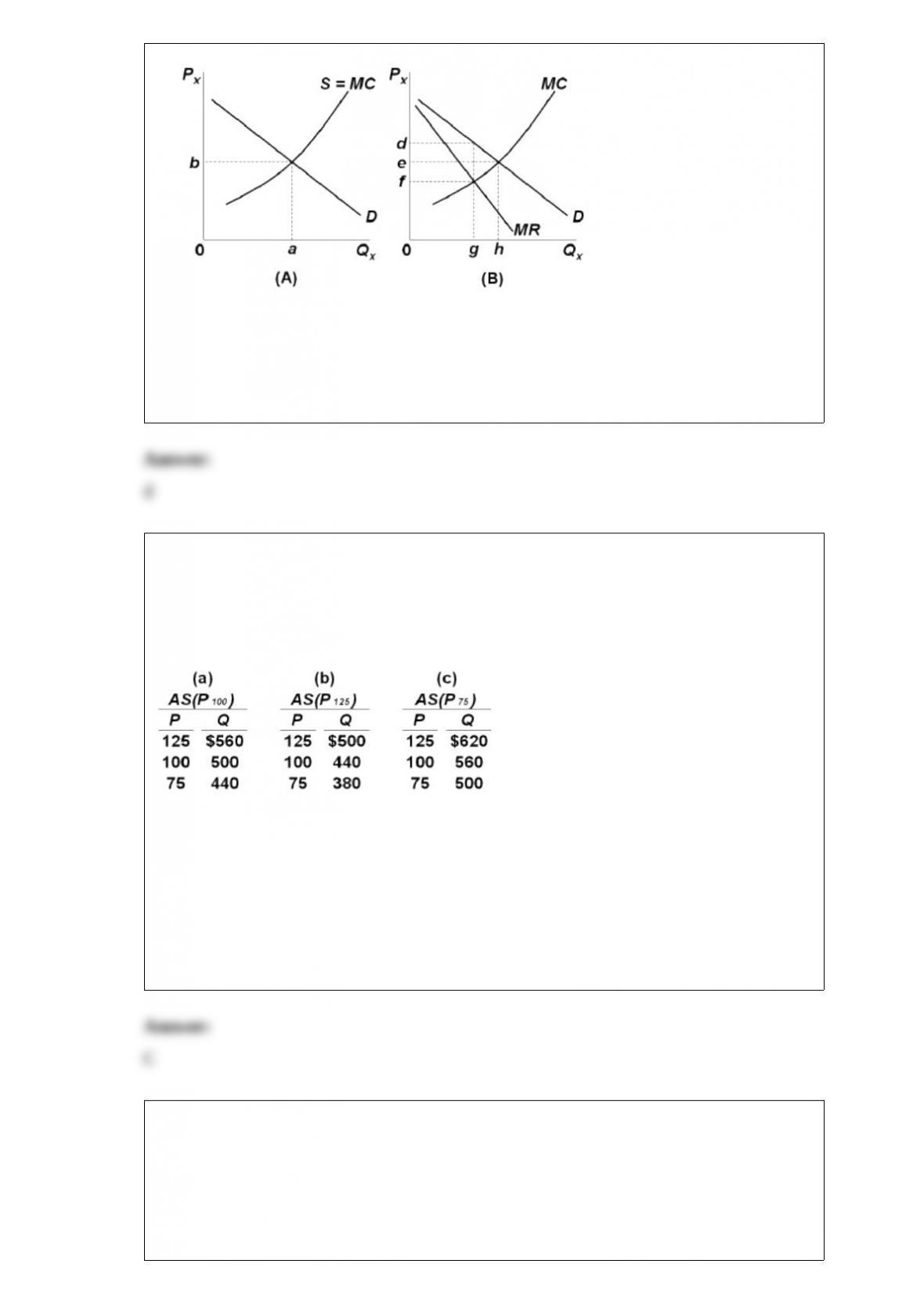
refer to the above diagrams. in diagram (b) the profit-maximizing quantity is:
a.g and the profit-maximizing price is e
b.h and the profit-maximizing price is e
c.g and the profit-maximizing price is f
d.g and the profit-maximizing price is d
2) Suppose the full employment level of real output (Q) for a hypothetical economy is
$500, the price level (P) initially is 100, and that prices and wages are flexible both
upward and downward. Use the following short-run aggregate supply schedules to
answer the next question(s).
Refer to the information above. In the long run, a fall in the price level from 100 to 75
will:
A.decrease real output from $500 to $440.
B.increase real output from $500 to $620.
C.change the aggregate supply schedule from (a) to (c) and produce an equilibrium
level of real output of $500.
D.change the aggregate supply schedule from (a) to (b) and produce an equilibrium
level of real output of $500.
3)
Which of the following statements is correct?
A.If the profit-maximizing rule is fulfilled, it necessarily follows that the
cost-minimization rule is being fulfilled.
B.The profit-maximizing and the cost-minimizing rules are such that the fulfilling of
one has no bearing on the fulfilling of the other.

C.If the profit-maximizing rule is fulfilled, the cost-minimization rule may or may not
be fulfilled.
D.If the cost-minimization rule is fulfilled, it necessarily follows that the
profit-maximizing rule is being fulfilled.
4) the u.s. food stamp program, which provides coupons that allow low-income
individuals to buy food, is an illustration of:
a.public provision of a suitable legal framework for the market system.
b.the redistributional function of government.
c.a government action designed to enhance competition.
d.the stabilization function of government.
5) the emigration of software designers from india to the united states best illustrates
a(n):
a.trade flow.
b.resource flow.
c.financial flow.
d.information flow.
6) a positive statement is concerned with:
a.some goal that is desirable to society.
b.what should be.
c.what is.
d.the formulation of economic policy.
7) use the list below to answer the following questions:
1. improvements in technology
2. increases in the supply (stock) of capital goods
3. purchases of expanding output
4. obtaining the optimal combination of goods, each at least-cost production
5. increases in the quantity and quality of natural resources
6. increases in the quantity and quality of human resources
which set of items in the above list would shift an economy’s production possibilities
curve outward?
a.2, 5, and 6 only
b.2, 4, 5, and 6 only
c.1, 2, 5, and 6 only
d.1, 3, 4 only
8) Stagflation refers to:
A.an increase in inflation accompanied by decreases in real output and employment.
B.a decline in the price level accompanied by increases in real output and employment.
C.a simultaneous increase in real output and the price level.
D.a simultaneous reduction in real output and the price level.
9)
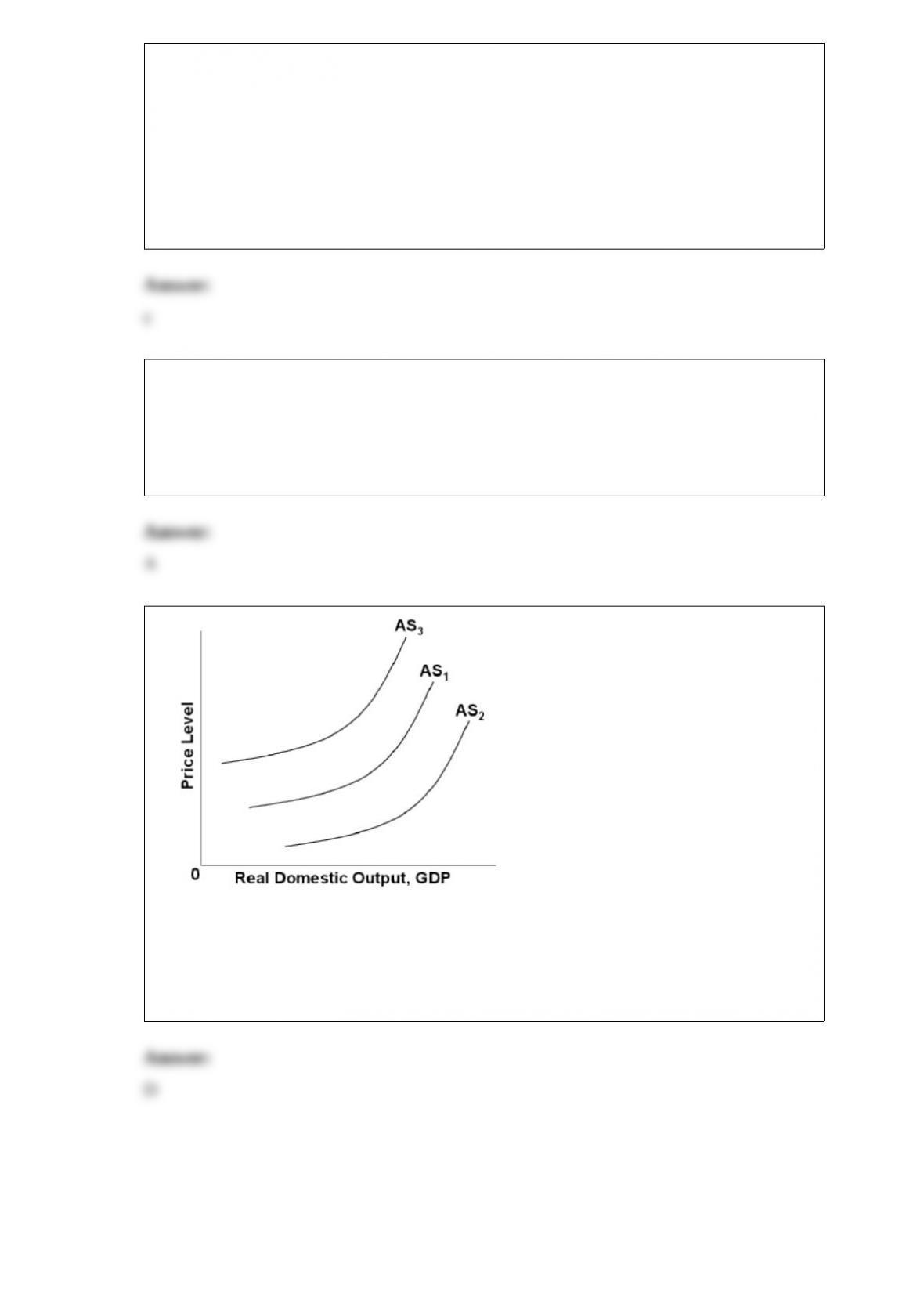
In the above diagram, a shift from AS3 to AS2might be caused by an increase in:
A.business taxes and government regulation.
B.the prices of imported resources.
C.the prices of domestic resources.
D.productivity.
10)
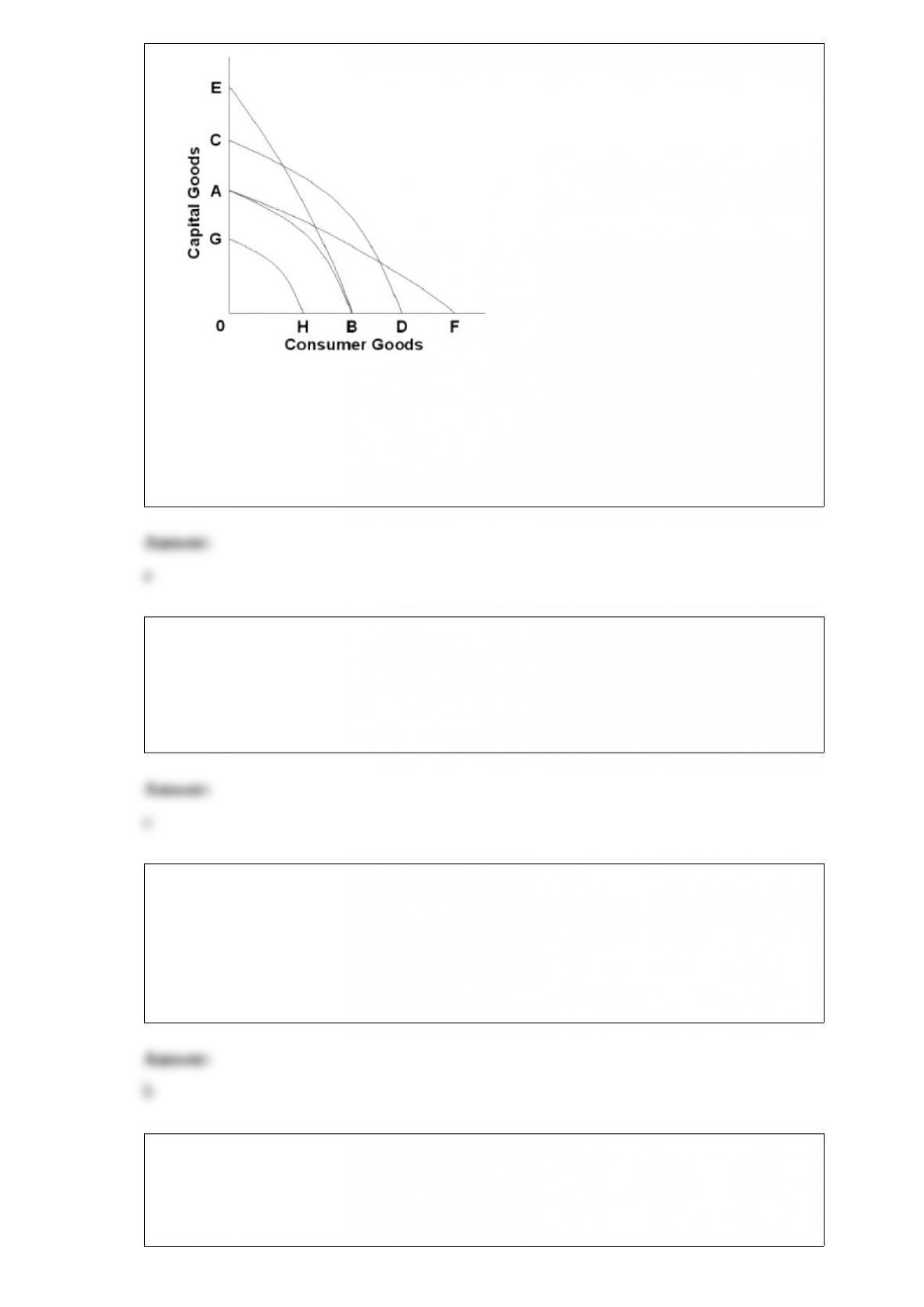
refer to the above diagram. technological advance in producing both capital goods and
consumer goods is shown by the shift of the production possibilities curve from ab to:
a.cd.
b.eb.
c.af.
d.gh.
11) which of the following is a distinguishing feature of a market system?
a.public ownership of all capital.
b.central planning.
c.wide-spread private ownership of capital.
d.a circular flow of goods, resources, and money.
12) supporters of trade adjustment assistance claim that it benefits an economy because
it:
a.keeps domestic firms competitive in international markets.
b.increases political acceptance of trade barrier reductions.
c.raises the prices of imports competing with domestic firms.
d.does all of these.
13) allocative efficiency occurs only at that output where:
a.marginal benefit exceeds marginal cost the by the greatest amount.
b.consumer surplus exceeds producer surplus by the greatest amount.
c.the combined amounts of consumer surplus and producer surplus are maximized.

d.the areas of consumer and producer surplus are equal.
14) (Consider This) The story about artist Pablo Picasso illustrates the point that:
A.the demand for labor is a derived demand.
B.geographical immobility impedes an efficient allocation of labor resources.
C.principal-agent problems can occur in unusual settings.
D.present skills reflect past accumulations of human capital.
15) use the list below to answer the following questions:
1. improvements in technology
2. increases in the supply (stock) of capital goods
3. purchases of expanding output
4. obtaining the optimal combination of goods, each at least-cost production
5. increases in the quantity and quality of natural resources
6. increases in the quantity and quality of human resources
refer to the above list. as distinct from the demand and efficiency factors of economic
growth, the supply factors of economic growth are:
a.2, 5, and 6 only.
b.2, 4, 5, and 6 only.
c.1, 2, 5, and 6 only.
d.1, 3, 4 only.
16) an income tax is progressive if the:
a.absolute amount paid as taxes varies directly with income.
b.percentage of income paid as taxes is the same regardless of the size of income.
c.percentage of income paid as taxes increases as income increases.
d.tax rate varies inversely with income.
17) The purchasing power of the dollar:
A.has been increasing in recent years because of economic growth.
B.varies directly with the cost-of-living index.

C.is inversely related to the level of aggregate demand.
D. is the reciprocal of the price level.
18) the two general types of economic systems that exist today are:
a.market systems and capitalism.
b.socialism and central planning.
c.market systems and command systems.
d.laissez faire systems and pure command systems.