
“To understand the decisions of regulatory bodies, you must first understand how the
decisions affect the regulators themselves.” The person who made this statement
probably believes in the __________ theory of regulation.
a. capture
b. public interest
c. social interest
d. public choice
e. none of the above
Suppose that a federal election is coming soon and the government has been running
persistent large budget deficits.Constitutional economists would most likely urge
___________________ in order to eliminate future budget deficits.
a. voters to vote for liberal candidates
b. voters to vote for conservative candidates
c. Congress to pass a law constraining them to spend no more than what they are
receiving in tax revenues
d. Congress to remove all constraints on spending and taxes.
To increase the wages of its members, a labor union might attempt to
a. lower the elasticity of demand for its labor.
b. increase the demand for union labor.
c. increase the supply of union labor.
d. a and b
e. all of the above
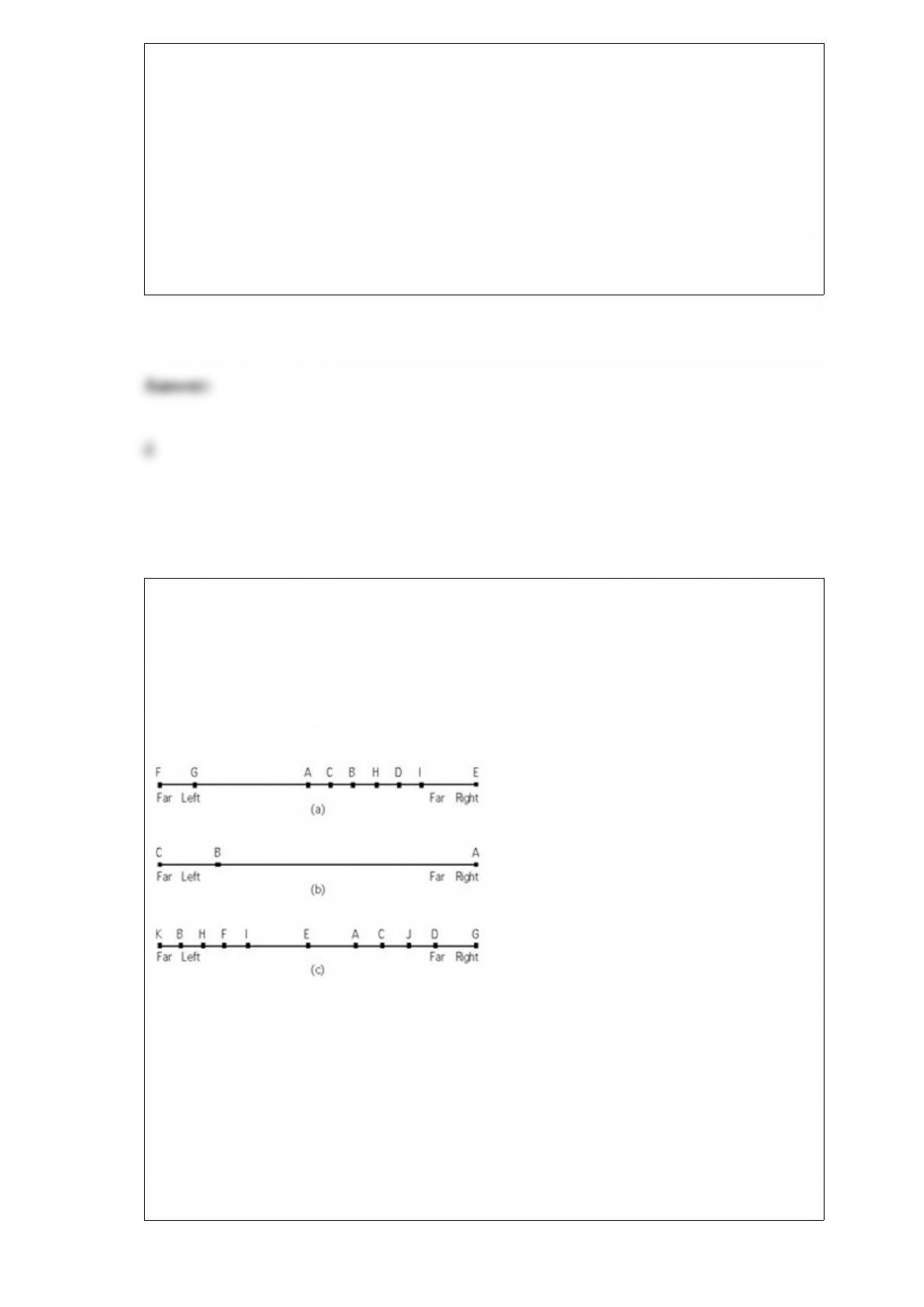
Refer to Exhibit 32-2-(b). Two candidates are competing for an electorate consisting of
3 voters labeled A, B, and C shown positioned with respect to their ideological stands
on issues. The median voter theory would predict that candidates will assume the
ideological position(s)
Exhibit 32-2
a. of voter B.
b. of voters C and A, respectively.
c. halfway between voter C and voter A.
d. halfway between voter B and voter A.
e. halfway between voter C and voter B, for one candidate, and of voter A for the other.
If tobacco is a normal, income inelastic good, it follows that a 10 percent decrease in
income will __________ quantity demanded by __________ than 10 percent.
a. increase; less
b. increase; more
c. decrease; less
d. decrease; more
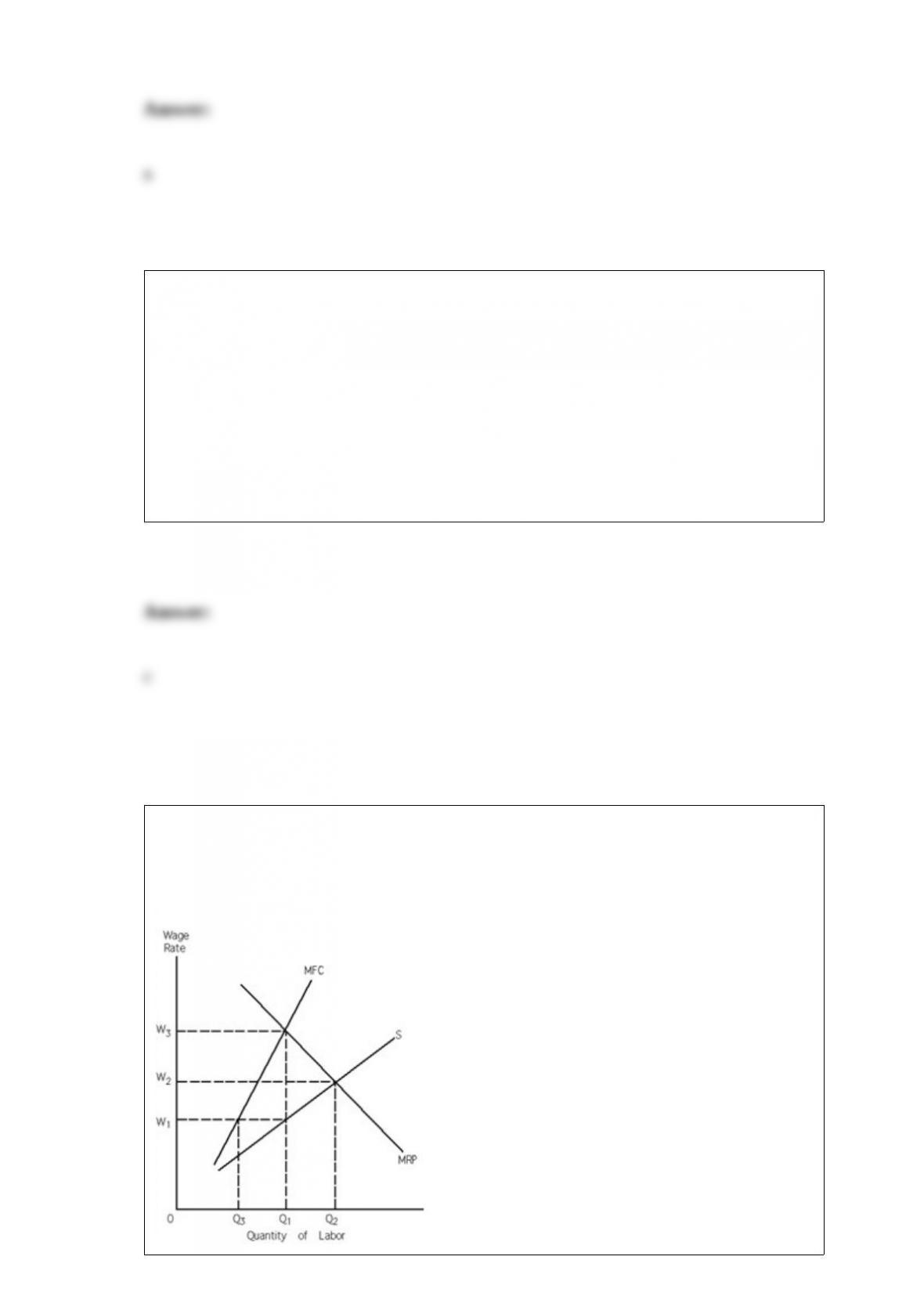
Refer to Exhibit 28-3. Consider the monopsony setting. In the absence of collective
bargaining, what quantity of labor does the profit-maximizing monopsonist hire?
Exhibit 28-3

a. Q1
b. Q2
c. Q3
d. none of the above
A product price searcher (monopolist, oligopolist, or monopolistic competitive firm)
will hire more factor units as long as
a. MRP > MFC.
b. MRP > VMP.
c. MRP = MFC.
d. VMP = MFC.
e. c and d
Which of the following is inconsistent with the burglary crime model presented in the
textbook?
a. The burglary rate rises during recessions.

b. The burglary rate declines during recessions.
c. The burglary rate remains does not change because of a recession.
d. The anguish cost of committing a burglary is directly related to the expected cost of
committing a burglary.
e. a and d
Which of the following would NOT be considered a macroeconomic topic?
a. the reasons for a decline in the price of crude oil
b. the cause of a downturn in the economy
c. the effect of the government budget deficit on inflation
d. the causes of inflation and unemployment
Refer to Exhibit 28-8. Suppose that initially there is no collective bargaining and the
monoposonist maximizes profit. Then the workers form a union and negotiate a wage of
W3. What will happen to the total wage bill?
Exhibit 28-8
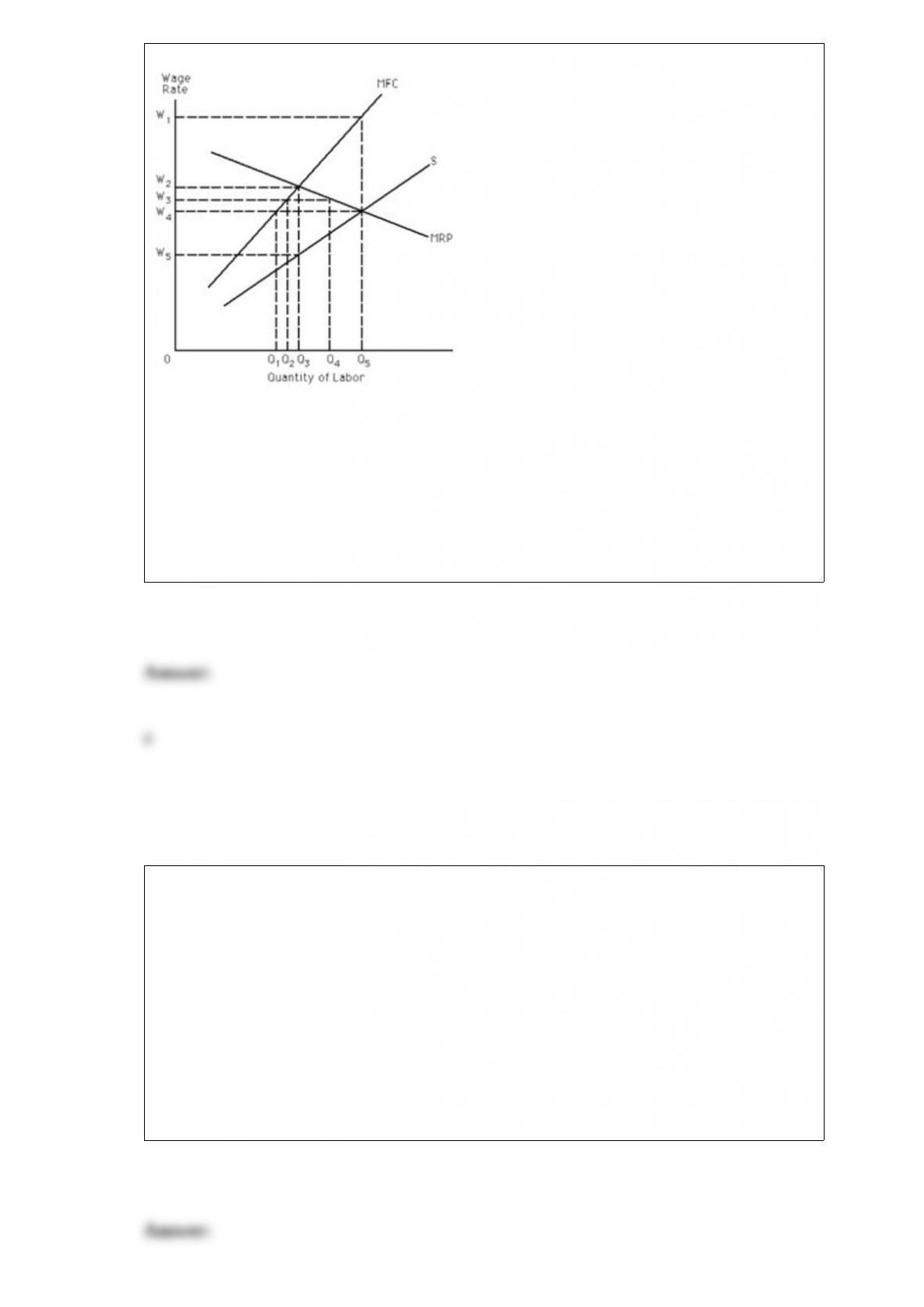
a. It will definitely rise.
b. It will definitely fall.
c. It will definitely stay the same.
d. It may rise, fall, or remain the same.
An increase in the supply of corn will lower the total revenue from corn if
a. the demand curve for corn is inelastic between the current and new price of corn.
b. the demand curve for corn is elastic between the current and new price of corn.
c. there are many substitutes for corn.
d. there are only a few substitutes for corn.
e. none of the above

If a demand curve shifts rightward, this means
a. quantity demanded is greater only at one particular price.
b. quantity demanded is greater at every price.
c. buyers are willing and able to purchase more of the good at every price.
d. buyers are willing and able to purchase less of the good at every price.
e. b and c
The difference between the amount a seller receives for a good and the lowest amount
for which he would sell the good is called
a. producers’ surplus.
b. windfall gain.
c. consumers’ surplus.
d. excess profit.
Suppose you go to a high school and identify groups of students sitting at different
lunch tables. To you it appears that everyone on the football team sits at one table,
everyone who gets really high grades sits at another table, everyone who is in the drama
club sits at another table, and so on.This outcome could be
a. the result of everyone preferring to sit at a table with dissimilar students, but not want
to be at a table if he or she is in a 30 percent minority or less.
b. because people naturally discriminate against (and make feel unwelcome) those
people who are not like them.
c. because the school authorities have instituted a one-week experimental plan to keep
students segregated (at lunch) according to certain key interests.
d. b and c
e. all of the above
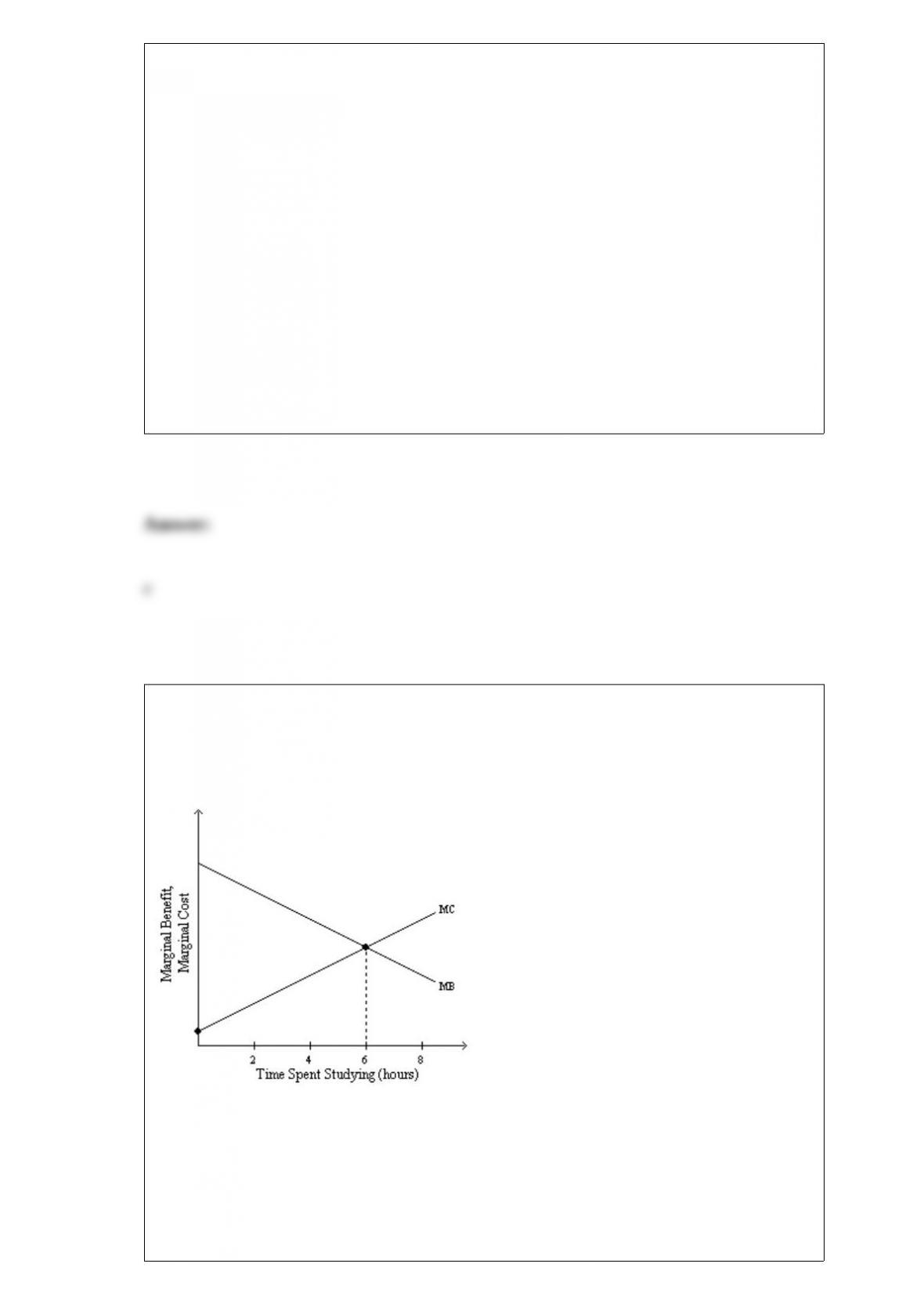
Refer to Exhibit 1-1.If the student whose study habits are illustrated here is currently
studying for the 2nd hour she should
Exhibit 1-1
a. cut back on the number of hours she is studying because the marginal benefit of
studying for the 2nd hour is less than the marginal cost of doing so.
b. cut back on the number of hours she is studying because the marginal benefit of
studying for the 2nd hour is greater than the marginal cost of doing so.
c. increase the number of hours she is studying because the marginal benefit of studying
for the 2nd hour is less than the marginal cost of doing so.
d. increase the number of hours she is studying because the marginal benefit of studying
for the 2ndhour is greater than the marginal cost of doing so.