1) Economic profit is most closely associated with:
A.the process of saving and investing.
B.monopoly, innovation, and uninsurable risks.
C.long-run competitive equilibrium.
D.a static economy.
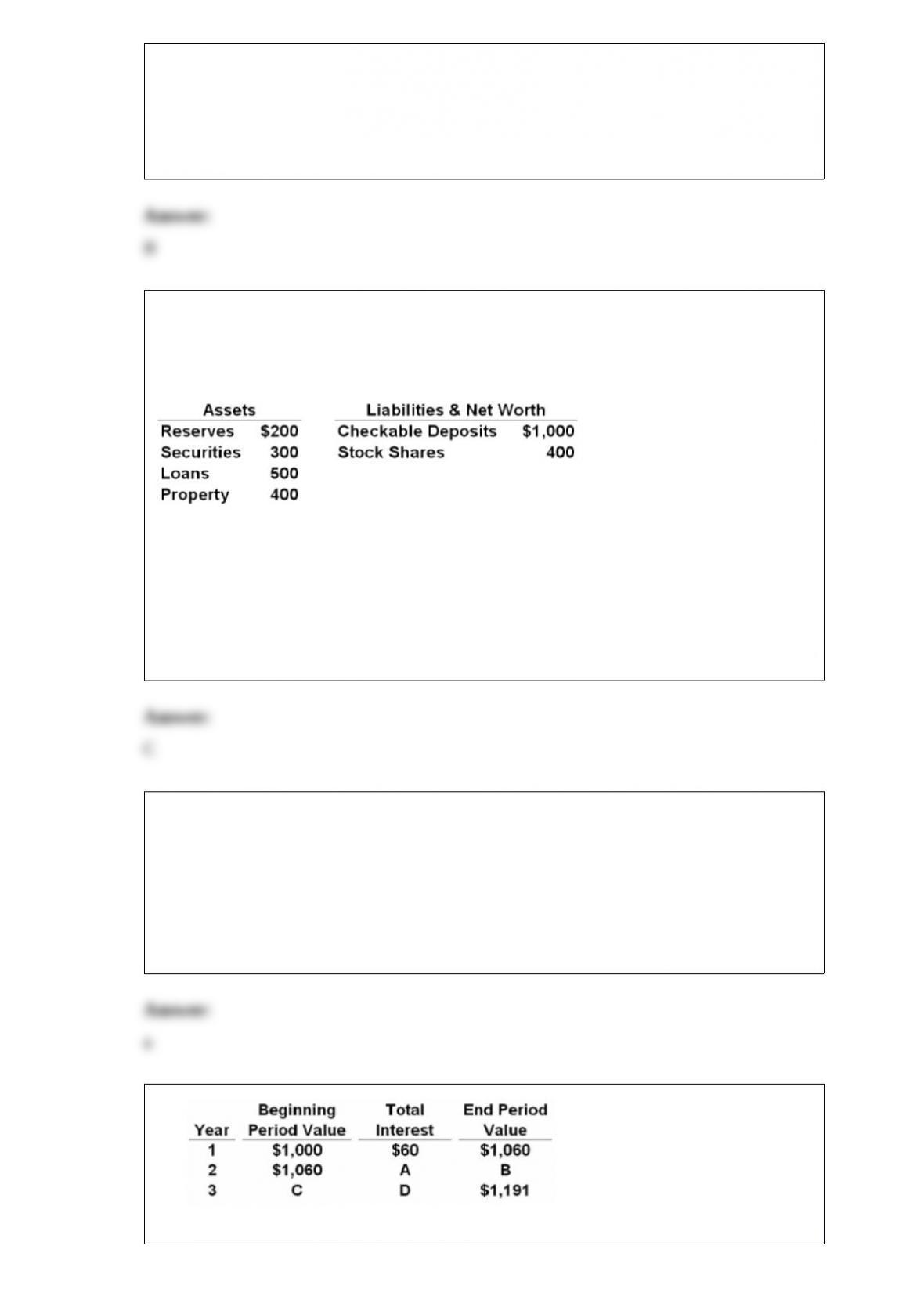
2) The following consolidated balance sheet of the commercial banking system.
Assume that the reserve requirement is 20 percent. All figures are in billions and each
question should be answered independently of changes specified in all preceding ones.
Refer to the above data. If the Fed increased the reserve requirement from 20 percent to
25 percent, a deficiency of reserves in the commercial banking system of _____ would
occur and the monetary multiplier would fall to ____.
A.$50 billion; 5
B.$10 billion; 4
C.$50 billion; 4
D.$10 billion; 8
3) the essential difference between sales and excise taxes is that:
a.sales taxes apply to a wide range of products, while excise taxes apply only to a select
group of products.
b.excise taxes apply to a wide range of products, while sales taxes apply only to a select
list of products.
c.sales taxes are consumption taxes, while excises are not.
d.excise taxes are consumption taxes, while sales taxes are not.
4)
Refer to the above table representing Darcy’s bank account. Assuming that $1000 was
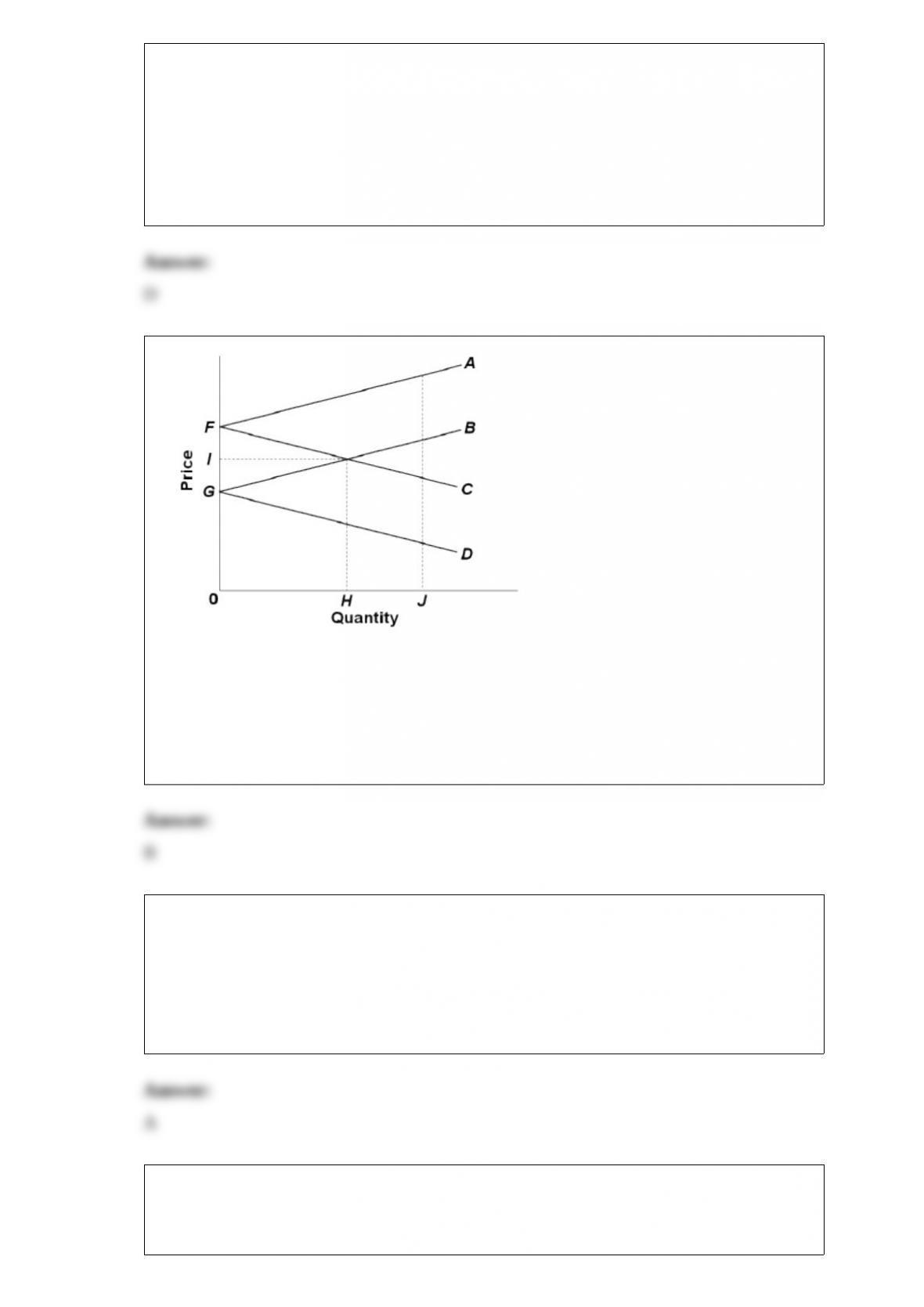
deposited into her account at the beginning of year 1, and no further deposits or
withdrawals were made, which cell(s) represents the future value of the initial deposit if
the money remains in the account for two years?
A.Cell B only
B.Cell A only
C.Cells A and D
D.Cells B and C
5)
Refer to the above diagram pertaining to two nations and a specific product. The
equilibrium world price occurs at:
A.F
B.I
C.G
D.J
6) Suppose that a bank’s actual reserves are $5 million, its checkable deposits are $5
million, and its excess reserves are $3 million. The reserve requirement must be:
A.40 percent.
B.20 percent.
C.10 percent.
D.5 percent.
7) State right-to-work laws:
A.have been enacted by over one-half of the states in the nation.
B.make yellow dog contracts illegal.
C.allow for union shops while prohibiting closed shops.
D.make union and agency shops illegal.
8) Answer the next question(s) on the basis of the following information: An economy
is employing 2 units of capital, 5 units of raw materials, and 8 units of labor to produce
its total output of 640 units. Each unit of capital costs $10, each unit of raw materials,
$4, and each unit of labor, $3.
Refer to the above information. If the per unit price of raw materials rises from $4 to $8
and all else remains constant, the aggregate:
A.supply curve would shift to the left.
B.supply curve would shift to the right.
C.demand curve would shift to the left.
D.demand curve would shift to the right.
9)
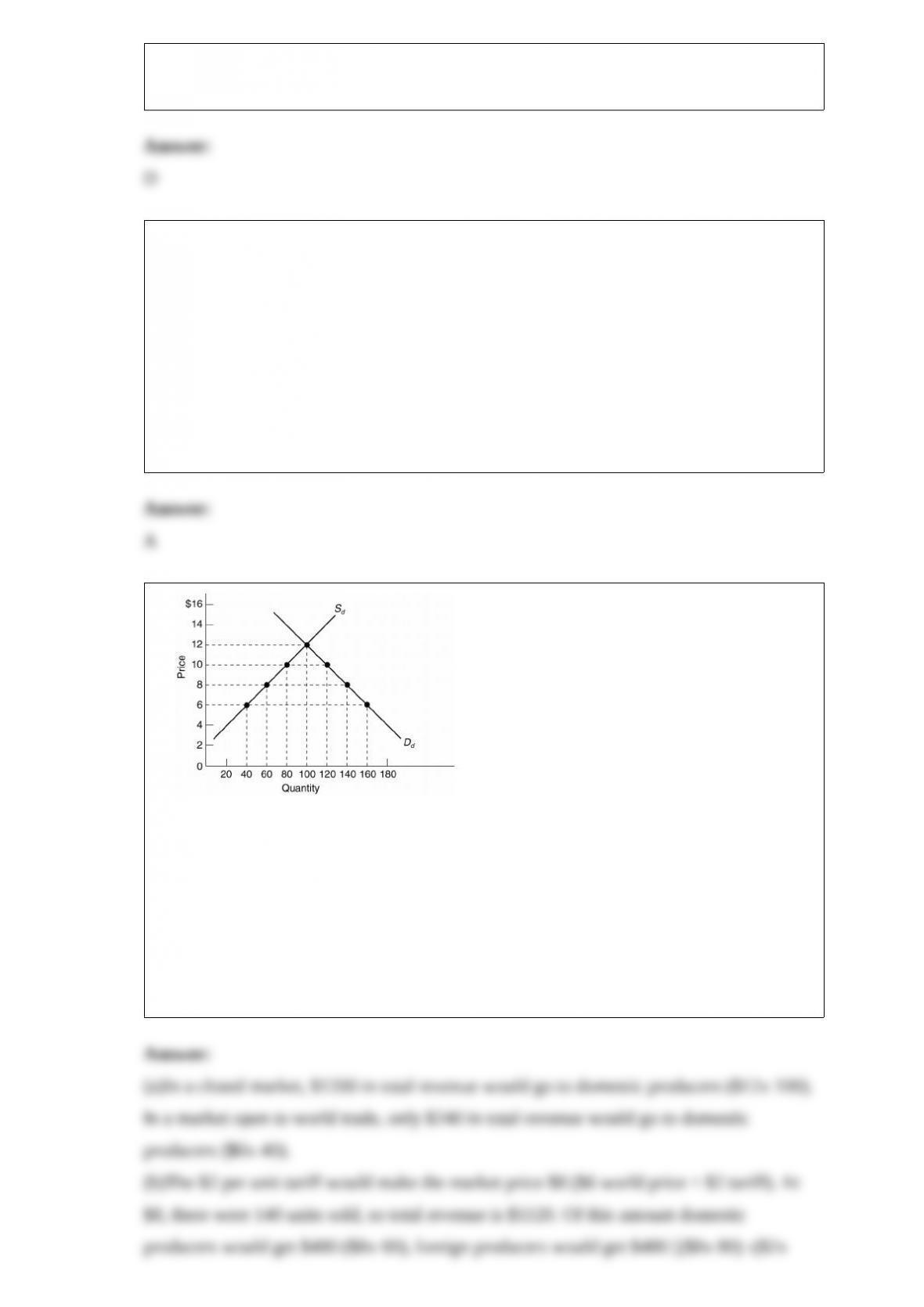
The next three questions refer to the below graph, where Sd and Dd are the domestic
supply and demand for a product. The world price of the product is $6.
(a)How much total revenue would go to domestic producers if the market were closed
to international trade compared to a market open to international trade? Explain.
(b)If the economy is open to trade, but a $2 per unit tariff were applied, what would be
the total revenue going to domestic producers, foreign producers (after-tax revenue),
and to the government? Explain.
(c)What would be the difference in revenue with a tariff of $2 per unit versus a quota of
80 units?

10) In terms of absolute dollar volume, the top 3 leaders in world exports are:
A.Japan, China, and the European Union.
B.the United States, England, and Canada.
C.Germany, England, and the United States.
D.Germany, the United States, and China.
11) Which of the following would we expect to have the highest poverty rate?
A.white households headed by males
B.elderly white households
C.white households headed by females
D.African-American households headed by females
12)
The rent paid for the pasture land used to graze cattle would increase if:
A.the productivity of the land increased.
B.people decided to consume more beef.
C.oil deposits were discovered on the land.
D.any of the above occurred.
13) Given a fixed upsloping AS curve, a rightward shift of the AD curve will:
A.cause cost push inflation.
B.increase real output but not the price level.
C.increase the price level but not real output.
D.increase both the price level and real output.
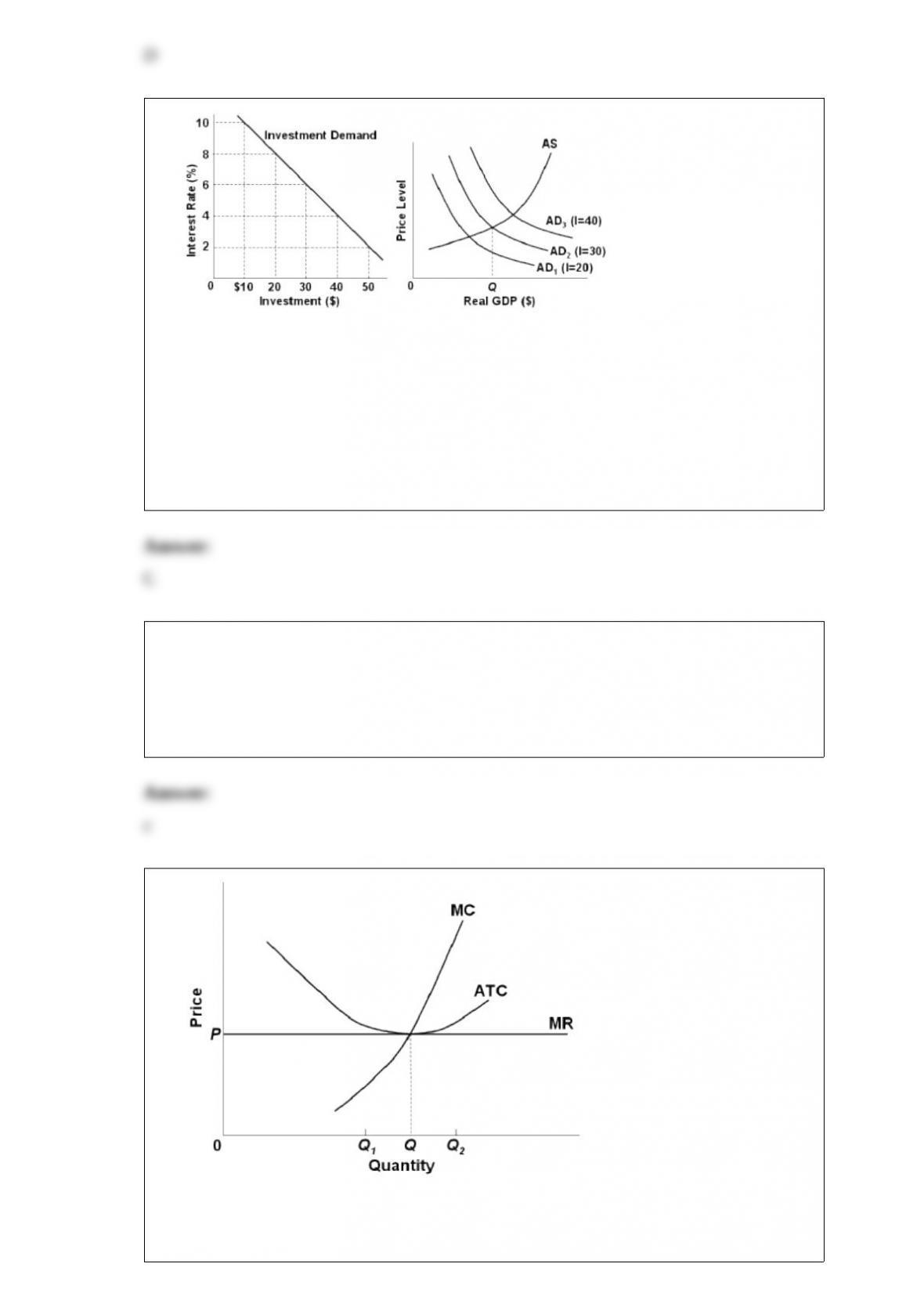
14)
Refer to the above diagrams. The numbers in parentheses after the AD1, AD2, and
AD3, labels indicate the levels of investment spending associated with each curve,
respectively. All numbers are in billions of dollars. If the interest rate is 8 percent and
the goal of the Fed is full-employment output of Qf, it should:
A.increase the interest rate from 8 percent to 10 percent.
B.decrease the interest rate from 8 to 4 percent.
C.decrease the interest rate from 8 to 6 percent.
D.maintain the interest rate at 8 percent.
15) the supply curve of a one-of-a-kind original painting is:
a.relatively elastic.
b.relatively inelastic.
c.perfectly inelastic.
d.perfectly elastic.
16)
the above diagram portrays:
a.a competitive firm that should shut down in the short run.
b.the equilibrium position of a competitive firm in the long run.

c.a competitive firm that is realizing an economic profit.
d.the loss-minimizing position of a competitive firm in the short run.
17) An employer whose discrimination coefficient is zero will:
A.refuse to hire African-Americans at any wage rate.
B.hire only whites if African-American and white wages are the same.
C.randomly hire African-American and white workers if the actual
African-American-white wage differential is also zero.
D.refuse to hire whites at any wage rate.
18) the minimum efficient scale of a firm:
a.is realized somewhere in the range of diseconomies of scale.
b.occurs where marginal product becomes zero.
c.is in the middle of the range of constant returns to scale.
d.is the smallest level of output at which long-run average total cost is minimized.