
1) marginal revenue is the:
a.change in product price associated with the sale of one more unit of output.
b.change in average revenue associated with the sale of one more unit of output.
c.difference between product price and average total cost.
d.change in total revenue associated with the sale of one more unit of output.
2) which of the following is a consequence of rent controls established to keep housing
affordable for the poor?
a.less rental housing is available as prospective landlords find it unprofitable to rent at
restricted prices.
b.the quality of rental housing declines as landlords lack the funds and incentive to
maintain properties.
c.apartment buildings are torn down in favor of office buildings, shopping malls, and
other buildings where rents are not controlled.
d.all of the above are consequences of rent controls.
3) The exports of the DVCs consist largely of:
A.high-technology goods.
B.raw materials and farm products.
C.manufactured goods.
D.services and financial capital.
4) (last word) which of the following has to do with the idea that generalizations that
apply to individuals are also always valid for a group?
a.the law of large numbers.
b.the law of averages.
c.the fallacy of composition.
d.the post hoc, ergo propter hoc fallacy.
5) When current tax revenues exceed current government expenditures and the
economy is achieving full employment:
A.the standardized budget has neither a deficit nor a surplus.
B.the standardized budget may have either a deficit or a surplus.
C.the standardized budget has a surplus.
D.nominal GDP and real GDP are equal.
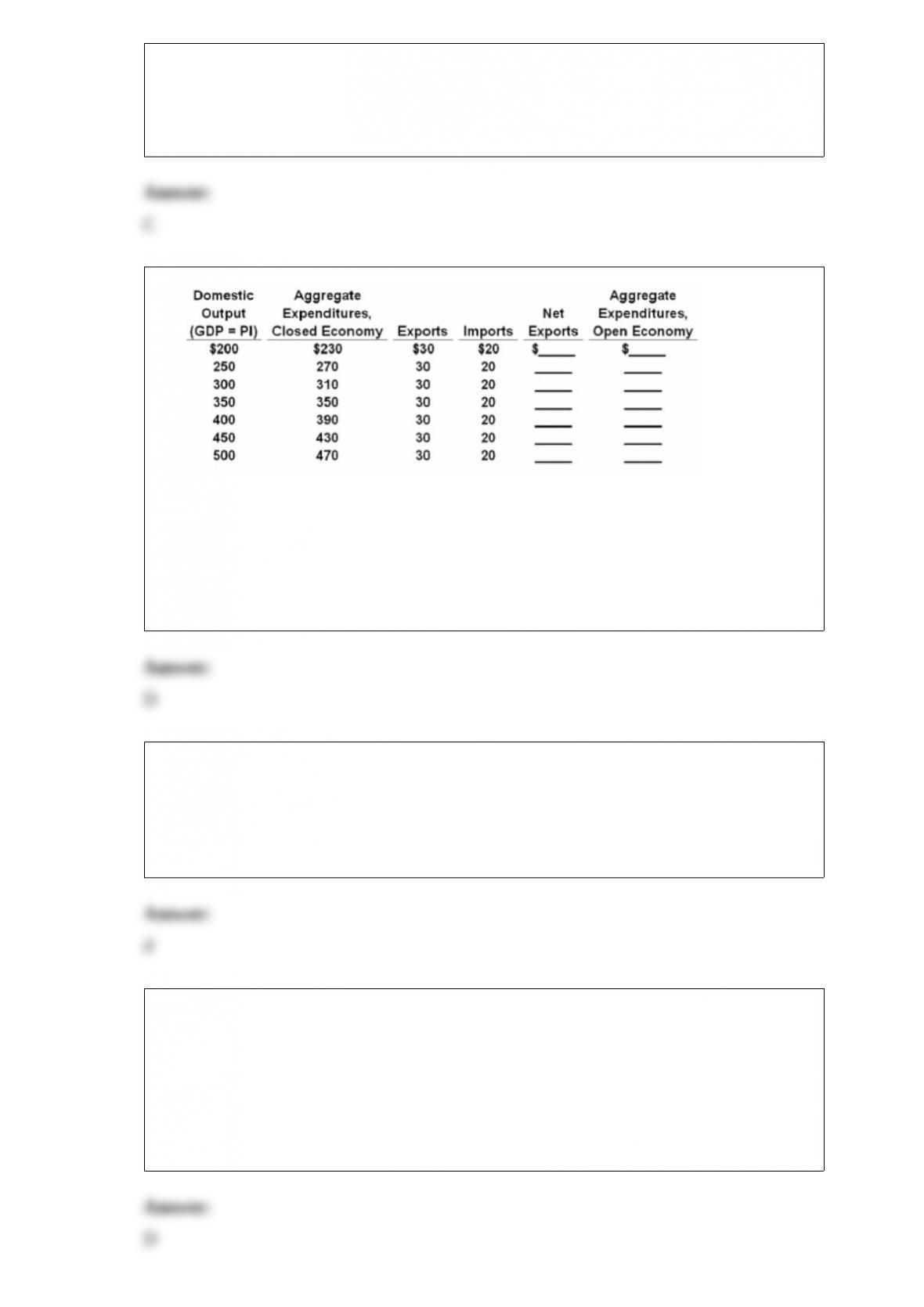
6)
If the above economy was closed to international trade, the equilibrium GDP and the
multiplier would be:
A.$300 and 5.
B.$350 and 4.
C.$400 and 4.
D.$350 and 5.
7) elasticity can be thought of as degree of relative:
a.video brightness.
b.price bounce.
c.audio volume.
d.quantity stretch.
8) New scientific knowledge mainly comes from university and government
laboratories, not private firms, because:
A.large corporations do not have funds available to channel toward basic research.
B.government pays scientists higher salaries than do private firms.
C.entrepreneurs find it difficult to secure venture capital to finance innovation.
D.basic scientific principles, as such, cannot be patented and do not always have
commercial applicability.
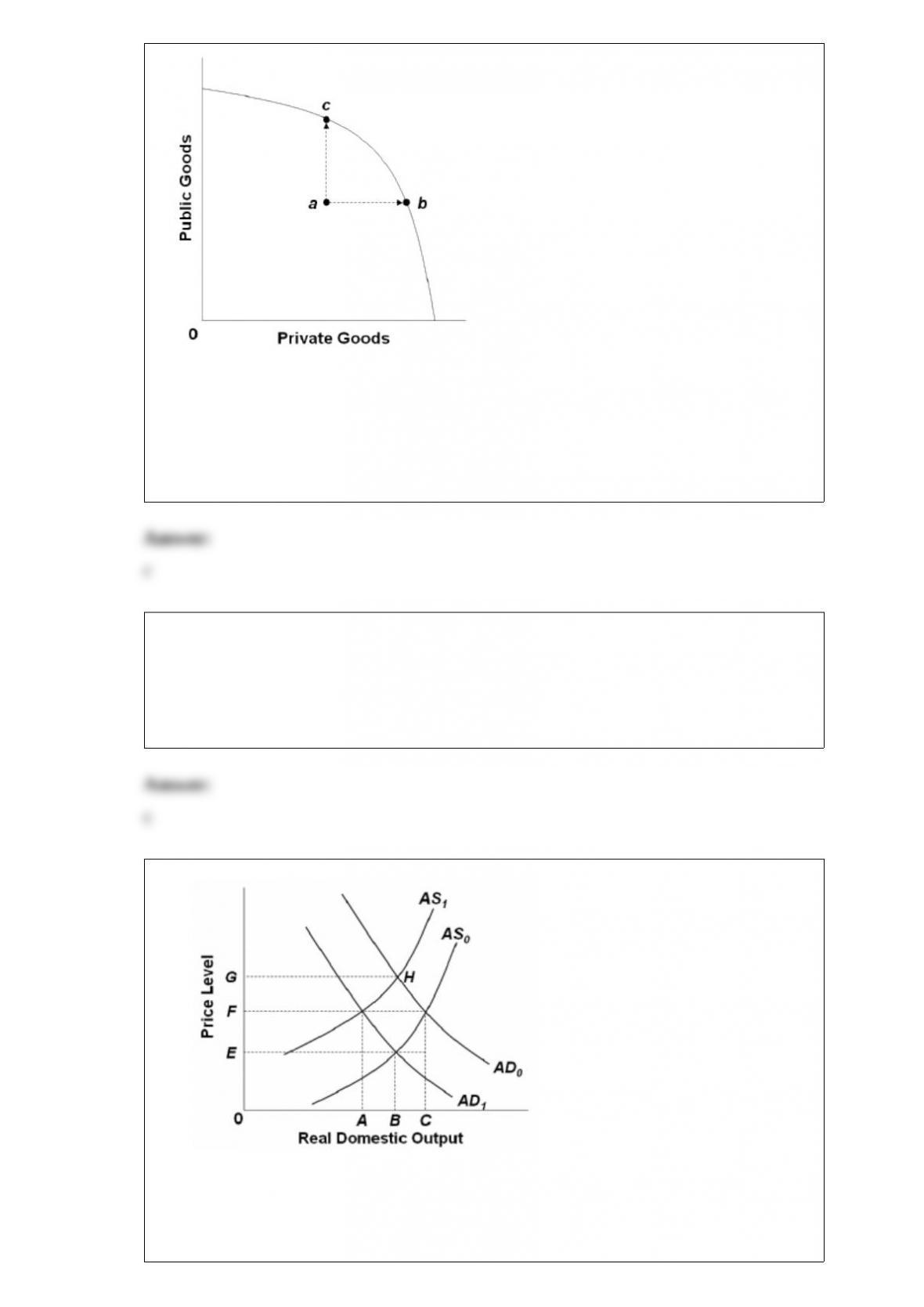
9)
refer to the above diagram. the movement from point a to point c can best be achieved
by:
a.increasing taxes and increasing government spending.
b.increasing taxes and decreasing government spending.
c.decreasing taxes and increasing government spending.
d.decreasing taxes and decreasing government spending.
10) the demand schedules for such products as eggs, bread, and electricity tend to be:
a.perfectly price elastic.
b.of unit price elasticity.
c.relatively price inelastic.
d.relatively price elastic.
11)
Refer to the above diagram. If the aggregate supply curve shifted from AS0 to AS1, we
could say that:
A.aggregate supply has increased, equilibrium output has decreased, and the price level
has increased.
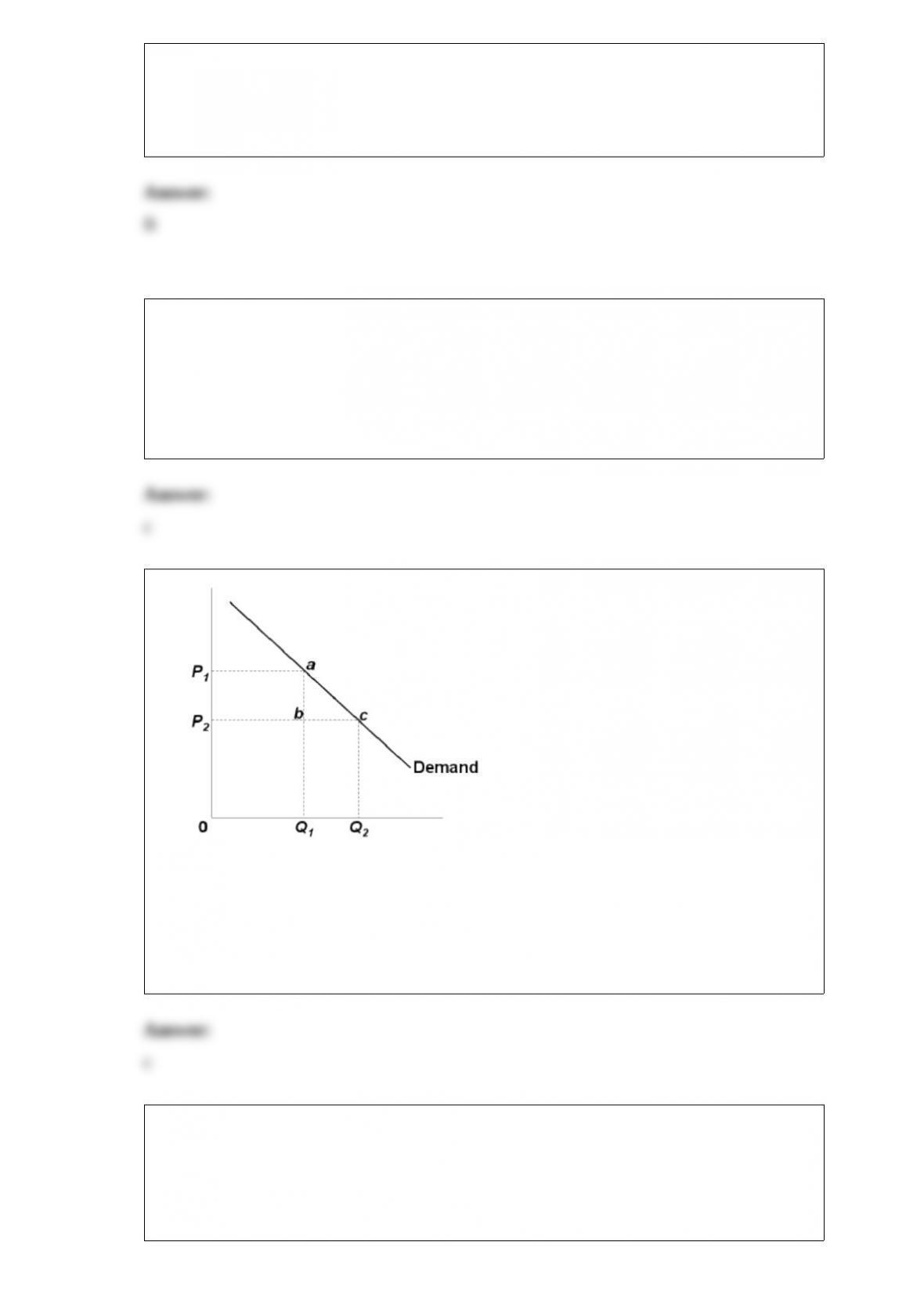
B.aggregate supply has decreased, equilibrium output has decreased, and the price level
has increased.
C.an increase in the amount of output supplied has occurred.
D. aggregate supply has increased and the price level has risen to G.
12) if actual gdp is $340 billion and there is a positive gdp gap of $20 billion, potential
gdp is:
a.$360 billion.
b.$660 billion.
c.$320 billion.
d.$20 billion.
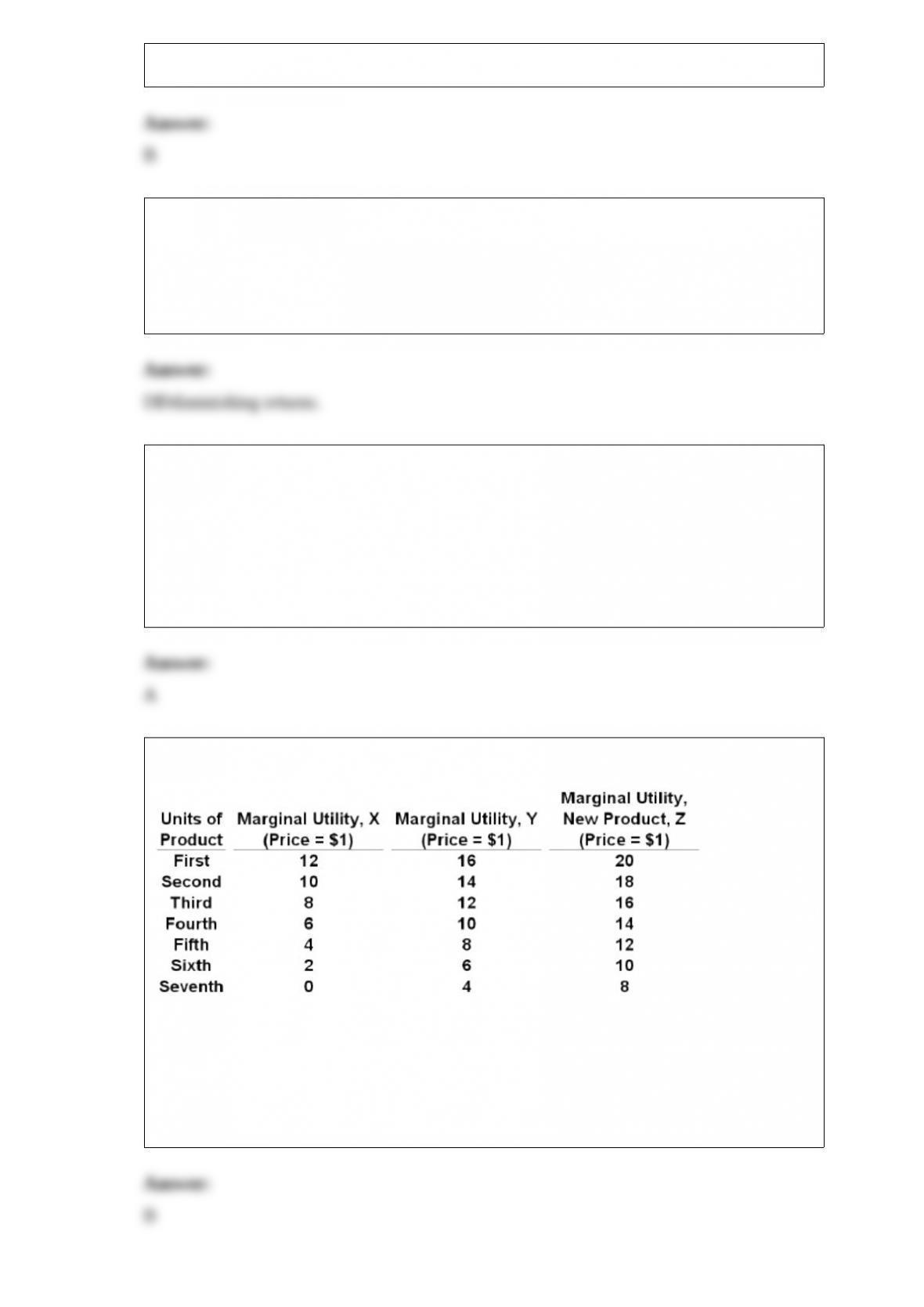
13)
refer to the above diagram. the quantitative difference between areas q1bcq2 and
p1p2ba in the above diagram measures:
a.marginal cost.
b.total revenue.
c.marginal revenue.
d.average revenue.
14) A manufacturer using both capital and labor decides to use more labor and less
capital because of an increase in the price of capital. This is likely the result of:
A.capital and labor being complementary inputs.
B.capital and labor being substitute inputs.
C.the output effect being greater than the substitution effect.
D.diminishing returns being applicable to capital but not to labor.
15) The marginal cost to society of reducing pollution rises with increases in pollution
abatement because of the law of:
A.diminishing marginal utility.
B.conservation of matter and energy.
C.demand.
16) A recessionary expenditure gap is:
A.the amount by which the full-employment GDP exceeds the level of aggregate
expenditures.
B.the amount by which equilibrium GDP falls short of the full-employment GDP.
C.the amount by which investment exceeds saving at the full-employment GDP.
D.the amount by which aggregate expenditures exceed the full-employment level of
GDP.
17) Consumer’s income = $12
Refer to the above data. In equilibrium, the introduction of new product Z has increased
this consumer’s total utility by:
A.42 utils.
B.54 utils.
C.60 utils.
D.66 utils.

18) The basic policy-making body in the U.S. banking system is the:
A.Federal Open Market Committee (FOMC).
B.Board of Governors of the Federal Reserve.
C.Federal Monetary Authority.
D.Council of Economic Advisers.
19) an increase in demand means that:
a.given supply, the price of the product will decline.
b.the demand curve has shifted to the right.
c.price has declined and consumers therefore want to purchase more of the product.
d.the demand curve has shifted to the left.
20) Suppose that the Federal government suddenly declared that wheat was to be used
as money. What is a possible outcome of that decision?
A.The value of the “wheat dollar” would be unstable depending on crop yields from
year to year.
B.Farmers would replace corn and soy crops with wheat.
C.Wheat would function as money so long as people accept it in exchange for goods
and services.
D.All of these are possible outcomes.