1) Which of the following was not a contributing cause of the decline in investment and
thus the recessionary expenditure gap occurring during the U.S. recession of 2001?
A.overcapacity in major industries
B.pessimism relating to the stock market crash
C.the collapse of numerous Internet-related start-up firms
D.low interest rates
2)
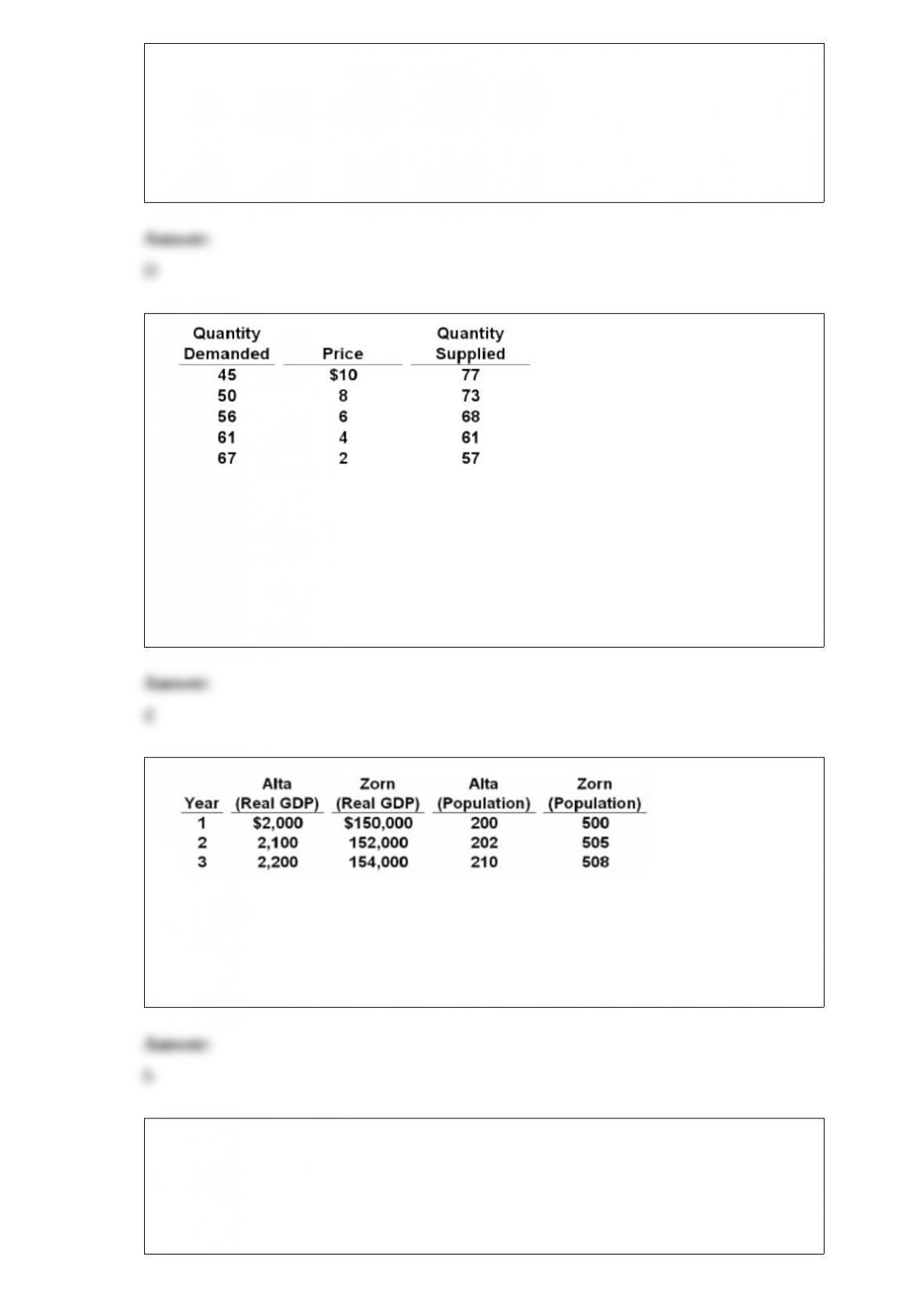
refer to the above data. suppose quantity demanded increased by 12 units at each price,
changing the equilibrium price in a direction and an amount for you to determine. over
that price range, supply is:
a.perfectly elastic.
b.perfectly inelastic.
c.elastic.
d.inelastic.
3)
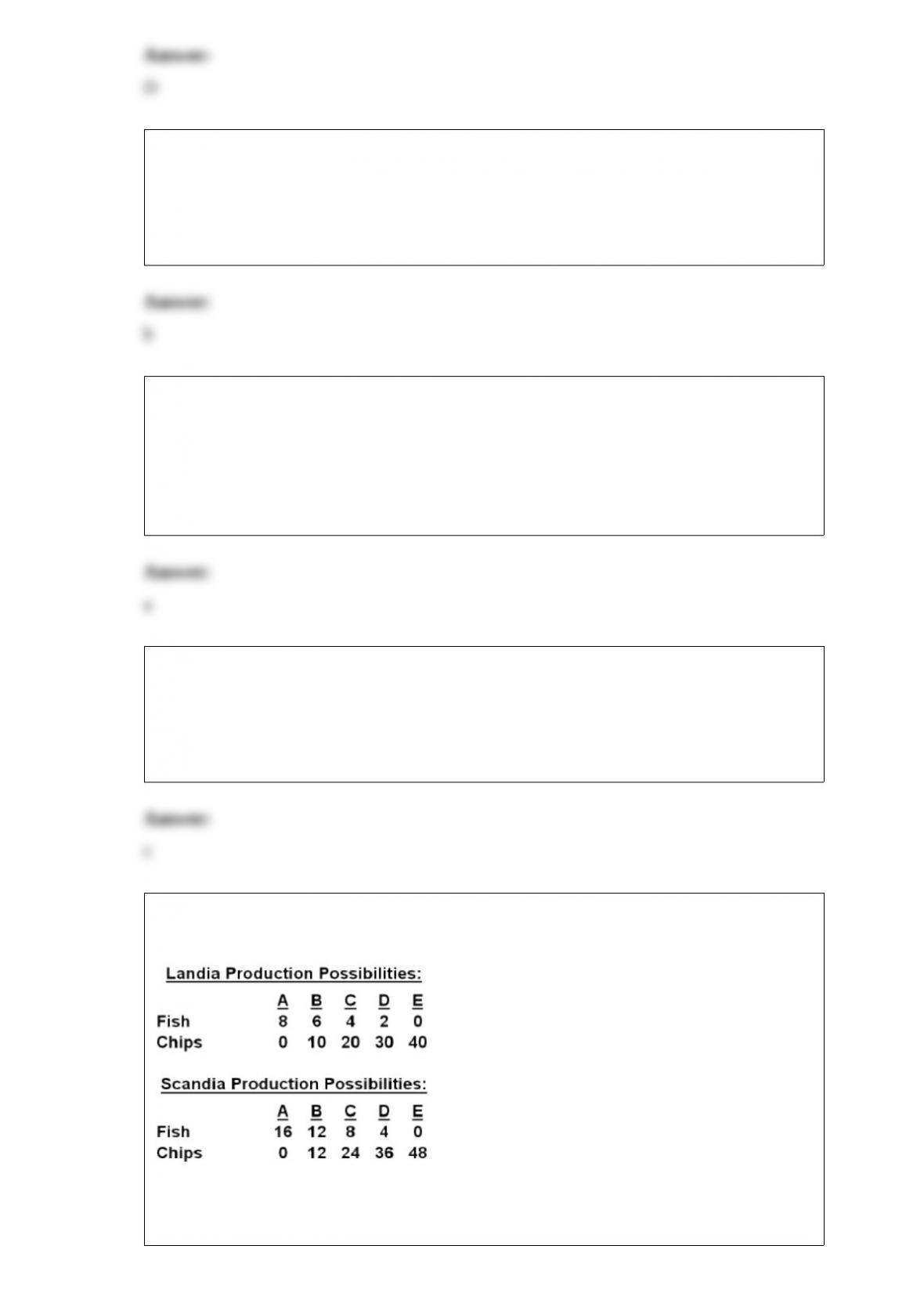
refer to the above table. per capita gdp was about:
a.$105 in year 3 in alta.
b.$303 in year 3 in zorn.
c.$200 in year 1 in zorn.
d.$5 in year 2 in alta.
4) Population growth remains high in most DVCs because:
A.religious and sociocultural considerations favor large families.
B.children may provide economic security for aging parents.
C.children provide agricultural labor in rural areas.
D.all of these reasons.
5) to maximize utility a consumer should allocate money income so that the:
a.elasticity of demand on all products purchased is the same.
b.marginal utility obtained from the last dollar spent on each product is the same.
c.total utility derived from each product consumed is the same.
d.marginal utility of the last unit of each product consumed is the same.
6) if the price of hand calculators falls from $10 to $9 and, as a result, the quantity
demanded increases from 100 to 125, then:
a.demand is elastic.
b.demand is inelastic.
c.demand is of unit elasticity.
d.not enough information is given to make a statement about elasticity.
7) (last word) the fallacy of composition states that:
a.generalizations relevant to microeconomics never apply to macroeconomics.
b.expectations give rise to self-fulfilling prophesies.
c.generalizations pertaining to individuals always apply to the group.
d.quantifiable economic goals are always incompatible with one another.
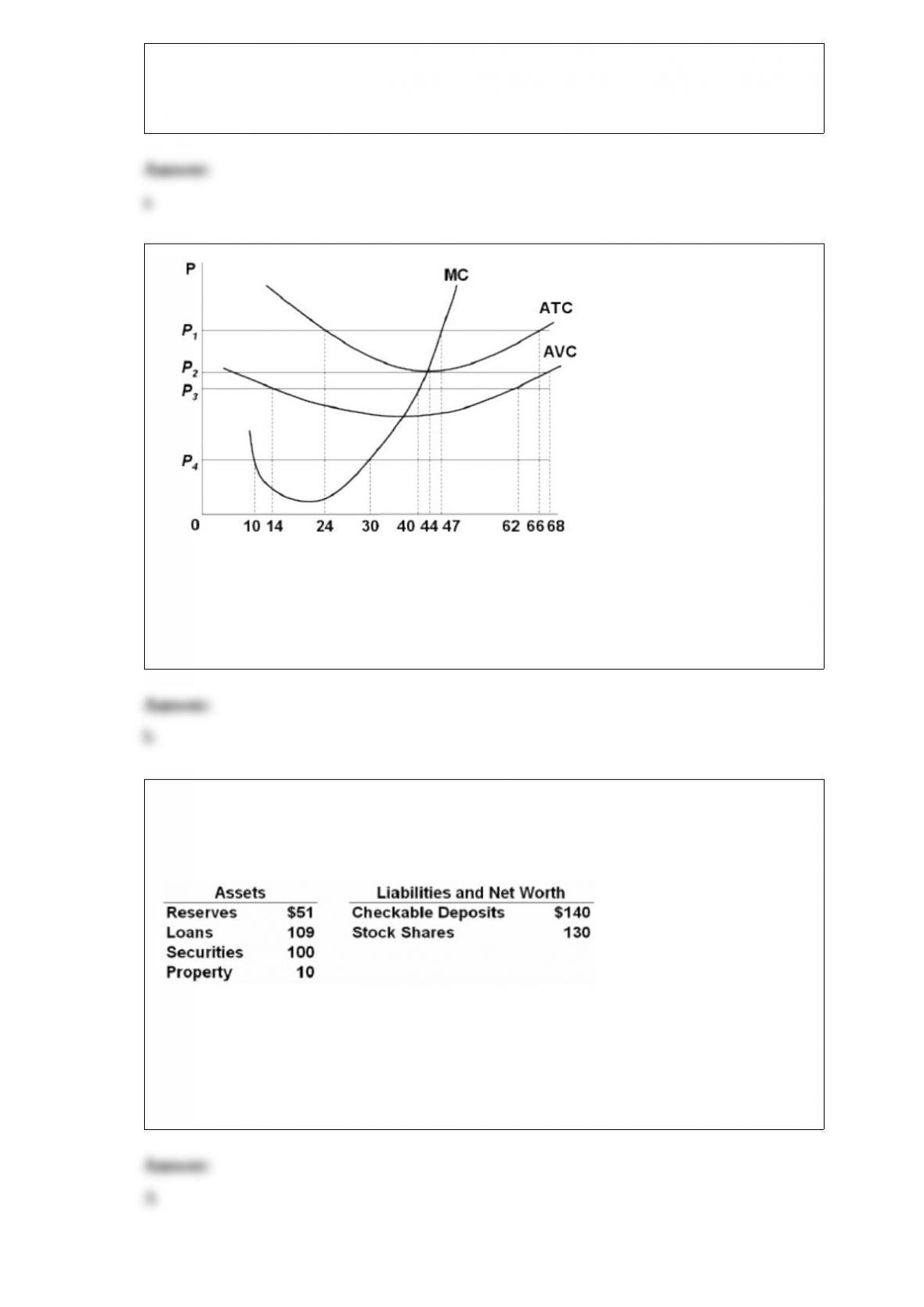
8) the following production possibilities data for landia and scandia:
refer to the above data. which of the following would be feasible terms of trade between
landia and scandia?
a.1 fish for 4 chips
b.1 fish for 6 chips
c.1 fish for 7 chips
d.2 fish for 4 chips
9)
refer to the above diagram. at p1, this firm will produce:
a.47 units and break even.
b.47 units and realize an economic profit.
c.66 units and earn only a normal profit.
d.24 units and earn only a normal profit.
10) The following consolidated balance sheet for the commercial banking system.
Assume the required reserve ratio is 30 percent. All figures are in billions.
Refer to the above data. The commercial banking system has excess reserves of:
A.$9 billion.
B.$7 billion.
C.$6.1 billion.
D.$5 billion.

11) Assume the Ajax Mining Company hires 80 percent of the nonunion labor force of
Mother Lode, New Mexico. Also, suppose that this labor force is highly immobile.
Economists would describe this employer as a:
A.monopolist.
B.oligopolist.
C.monopsonist.
D.monopolistic competitor.
12) farmers often find that large bumper crops are associated with declines in their
gross incomes. this suggests that:
a.farm products are normal goods.
b.farm products are inferior goods.
c.the price elasticity of demand for farm products is less than 1.
d.the price elasticity of demand for farm products is greater than 1.
13) in the resource market:
a.businesses borrow financial capital from households.
b.businesses sell services to households.
c.households sell resources to businesses.
d.firms sell raw materials to households.
14) consumers spend their incomes to get the maximum benefit or satisfaction from the
goods and services they purchase. this is a reflection of:
a.resource scarcity and the necessity of choice.
b.purposeful behavior.
c.marginal costs that exceed marginal benefits.
d.the tradeoff problem that exists between competing goals.
15) black markets are associated with:
a.price floors and the resulting product surpluses.
b.price floors and the resulting product shortages.
c.ceiling prices and the resulting product shortages.
d.ceiling prices and the resulting product surpluses.