
1) given the annual rate of economic growth, the “rule of 70” allows one to:
a.determine the accompanying rate of inflation.
b.calculate the size of the gdp gap.
c.calculate the number of years required for real gdp to double.
d.determine the growth rate of per capita gdp.
2) Compensation paid in proportion to the number of units of personal output best
describes:
A.royalties.
B.profit-sharing.
C.bonuses.
D.piece rates.
3) the fact that nominal gdp has risen faster than real gdp:
a.suggests that the base year of the gdp price index has been shifted.
b.tells us nothing about what has happened to the price level.
c.suggests that the general price level has fallen.
d.suggests that the general price level has risen.
4) A protective tariff will:
A.increase the sales of foreign exporters.
B.increase the price and sales of domestic producers.
C.increase the welfare of domestic consumers.
D.create an efficiency gain in the domestic economy.
5) The goldsmith’s ability to create money was based on the fact that:
A.withdrawals of gold tended to exceed deposits of gold in any given time period.
B.consumers and merchants preferred to use gold for transactions, rather than paper
money.
C.the goldsmith was required to keep 100 percent gold reserves.
D.paper money in the form of gold receipts was rarely redeemed for gold.

6) If a firm faces an upsloping labor supply curve (and there is no union or minimum
wage), its:
A.MRC curve is also upsloping.
B.MRC curve is perfectly elastic.
C.MRP curve is perfectly inelastic.
D.MRP curve is also uploping.
7) The claims of the owners of a firm against the firm’s assets are called:
A.working capital.
B.assets.
C.net worth.
D.liabilities.
8) Creative destruction is not automatic because:
A.there are major obstacles to the entry of new innovative firms into concentrated
industries.
B.consumer tastes are highly unstable.
C.corporate takeovers increase dynamic competition.
D.large firms rarely are technologically progressive.
9) if an effective ceiling price is placed on hamburgers then:
a.the quantity demanded will exceed the quantity supplied.
b.a black market for hamburger may evolve.
c.consumers may want government to ration hamburger.
d.all of these are likely outcomes.

10)
Refer to the above diagram which relates to Firm A. Which of the following would shift
A’s average total cost curve from ATC1 to ATC2?
A.an increase in the price of a key component used by A in producing its product
B.a decrease in the incomes of A’s customers
C.a move along A’s total product curve (not shown)
D.an improved production method that shifts A’s total product curve upward
11) the vertical distance between a firm’s atc and avc curves represents:
a.afc, which increases as output increases.
b.afc, which decreases as output increases.
c.marginal costs, which decrease as output decreases.
d.marginal costs, which increase as output increases.
12) a pure monopolist is producing an output such that atc = $4, p = $5, mc = $2, and
mr = $3. this firm is realizing:
a.a loss that could be reduced by producing more output.
b.a loss that could be reduced by producing less output.
c.an economic profit that could be increased by producing more output.
d.an economic profit that could be increased by producing less output.
13) assume an economy that is producing only one product. output and price data for a
three-year period are as follows. answer the next question(s) on the basis of these data.
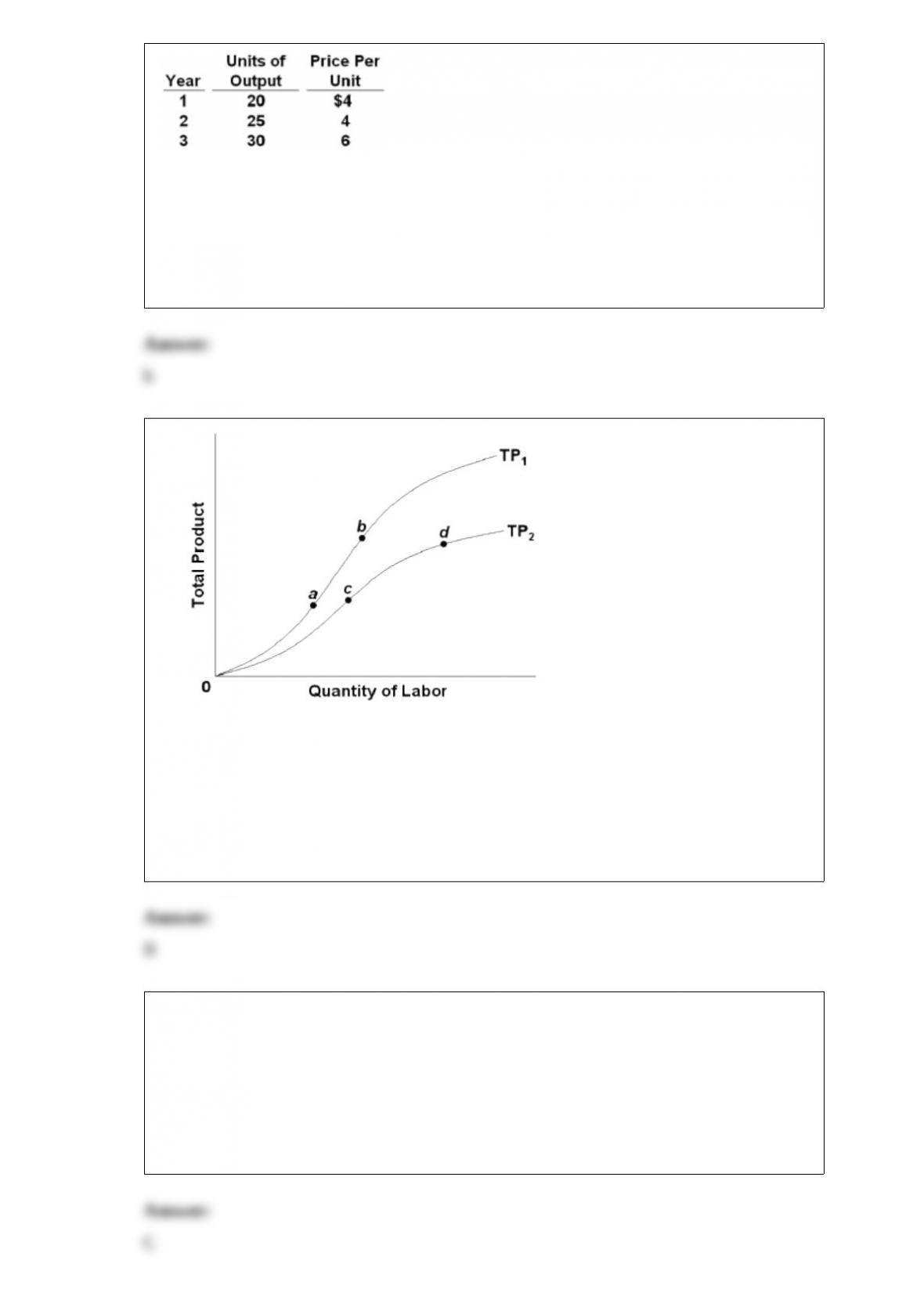
refer to the above data. if year 2 is chosen as the base year, the price index for year one
is:
a.80.
b.100.
c.120.
d.20.
14)
Refer to the above diagram that relates to Firm X. Suppose X implements an innovative
new production method that shifts its total product curve from TP2 to TP1. Other things
equal:
A.the average product of X’s labor would fall.
B.the average total cost of X’s output would decline.
C.X would supply less output at each product price than before.
D.the demand curve for X’s product would shift to the right.
15) The public interest theory of industrial regulation contends that:
A.while industrial regulation is sound in theory, bureaucrats allow monopolists to
obtain excessive profits.
B.regulated monopolies are tantamount to legal cartels.
C.the objective of regulation is to protect the public from the market power inherent in
natural monopolies.
D.firms in some industries want to be regulated.
16) According to economist Abba Lerner (1903-1982), fiscal and monetary policy is
analogous to:
A.automobile brakes.
B.a steering wheel in an automobile.
C.a string that can be pushed or pulled.
17)
Refer to the above diagram for a private closed economy. In this economy investment:
A.decreases as GDP increases.
B.increases as GDP increases.
C.is $40 billion at all levels of GDP.
D.is $60 billion at all levels of GDP.
18) if the price of hand calculators falls from $10 to $9 and, as a result, the quantity
demanded increases from 100 to 125, then:
a.demand is elastic.
b.demand is inelastic.
c.demand is of unit elasticity.
d.not enough information is given to make a statement about elasticity.
19) children are charged less than adults for admission to professional baseball games
but are charged the same prices as adults at the concession stands. which of the
following conditions of price discrimination explain why this occurs?
a.the seller must have some monopoly power; that is, it must be able to set the product
price.

b.the seller must be able to identify buyers by group characteristics such as age or
income.
c.groups must have different elasticities of demand for the product.
d.the items cannot be bought by people in the low-price group and transferred to
members of the high-price group.