1) in certain industries, japanese employers do not lay off workers. therefore, they
sometimes have excess supplies of goods that they cannot sell on the home market
without lowering prices. to hold down losses, they sell goods in overseas markets at
prices well beneath those in japan. this practice is best referred to as:
a.orderly marketing
b.trigger pricing
c.domestic content pricing
d.dumping
2) which of the following is not a condition of the international gold standard? that a
nation must:
a.convert gold into paper currency, and vice versa, at a stipulated rate
b.permit gold to be freely imported and exported
c.tolerate wide fluctuations in its exchange rate
d.define its monetary unit in terms of a stipulated amount of gold
3) which of the following would best explain why foreign direct investment might be
attracted to the united states?
a.u.s. price ceilings that hold down the price of energy
b.u.s. wage rates exceeding the productivity of u.s. labor
c.artificially high prices being charged for the stock of u.s. firms
d.anticipations of future reductions in u.s. tariff levels
4) the maastricht treaty of 1991 established a blueprint for economic union and
monetary union for european union members.
a.true
b.false
5) the demand schedule for swiss francs is always downsloping while the supply
schedule of francs is always upsloping.
a.true
b.false
6) to promote stability in commodity markets, international commodity agreements
have utilized production and export controls, buffer stocks, and multilateral contracts.
a.true
b.false
7) currency arbitrage tends to result in identical yen/dollar exchange rates in new york
and in tokyo.
a.true
b.false
8) to offset an appreciation of the dollar against the yen, the federal reserve would:
a.sell dollars on the foreign exchange market and lower domestic interest rates
b.sell dollars on the foreign exchange market and raise domestic interest rates
c.buy dollars on the foreign exchange market and lower domestic interest rates
d.buy dollars on the foreign exchange market and raise domestic interest rates
9) as long as it is assumed that a nation accounts for a negligible portion of international
trade, its levying an import tariff necessarily increases its overall welfare.
a.true
b.false
10) as a profit-maximizing cartel, the organization of petroleum exporting countries
would produce a greater output and charge a lower price than what would occur in a
competitive market.
a.true
b.false
11) if a nation has an open economy, it means that the nation allows private ownership
of capital.
a.true
b.false
12) established in 1995, the world trade organization took charge of administering the
new global trade rules agreed in the uruguay round of multilateral trade negotiations.
a.true
b.false
13) international trade in goods and services and flows of productive factors are
substitutes for each other.
a.true
b.false
14) if a customs union includes the low-cost supplier of the world, there would be no
adverse trade-diversion effect that would counteract the positive trade-creation effect.
a.true
b.false
15) on the balance-of-payments statements, merchandise imports are classified in the:
a.current account
b.capital account
c.unilateral transfer account
d.official settlements account
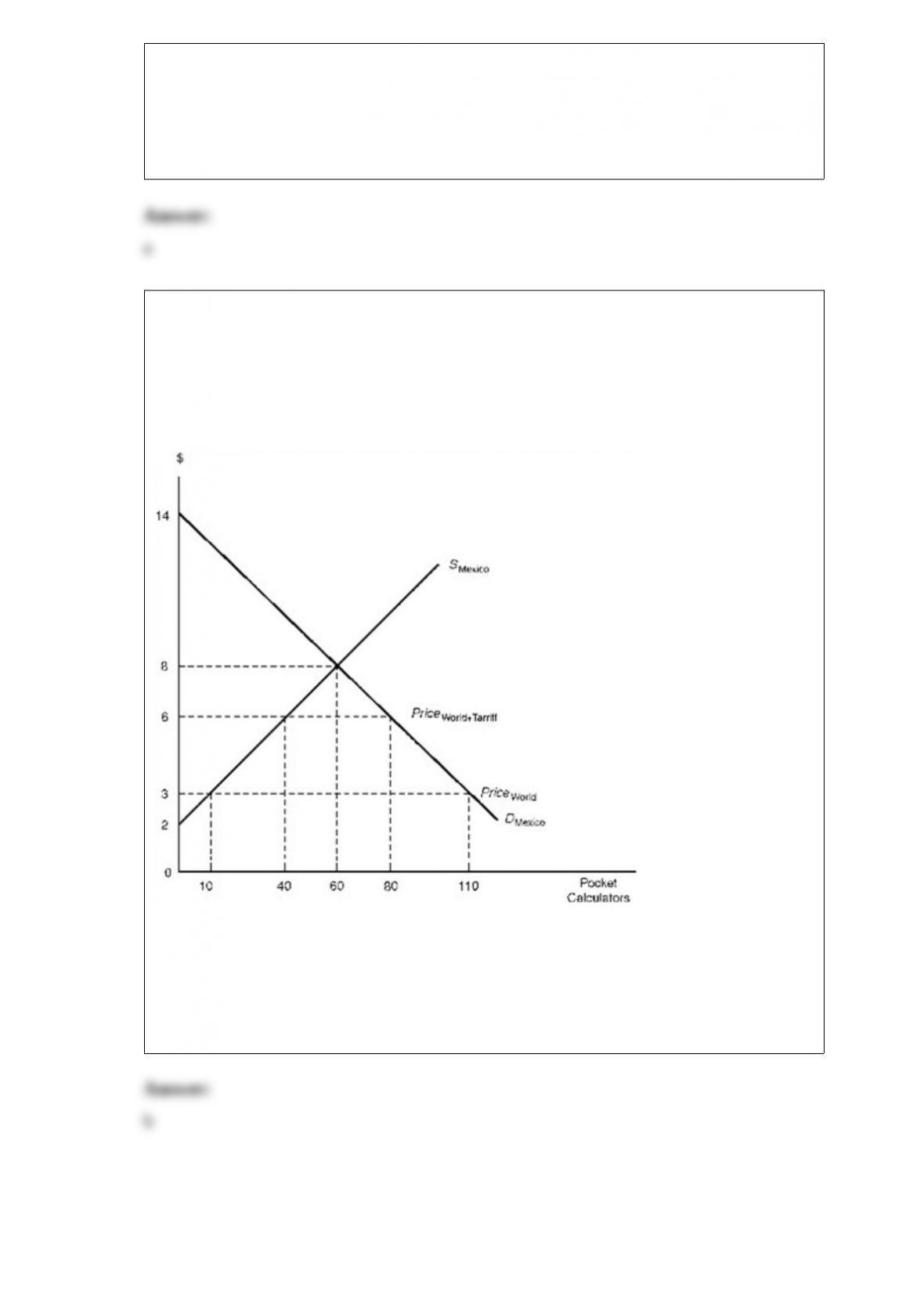
16) figure 4.1 illustrates the demand and supply schedules for pocket calculators in
mexico, a ‘small” nation that is unable to affect the world price.
figure 4.1. import tariff levied by a ‘small” country
consider figure 4.1. in the absence of trade, mexico’s producer surplus and consumer
surplus respectively equal:
a.$120, $240
b.$180, $180
c.$180, $320
d.$240, $240