The Glow-in-the-Dark Lamp Company produces 3.2 million light bulbs per year at a
per unit cost of $0.50. If its total variable cost is $1.2 million, its
a. marginal cost is $0.375.
b. total fixed cost is $400,000.
c. average variable cost is $0.50.
d. total cost is $6.4 million.
e. average fixed cost is $0.40.
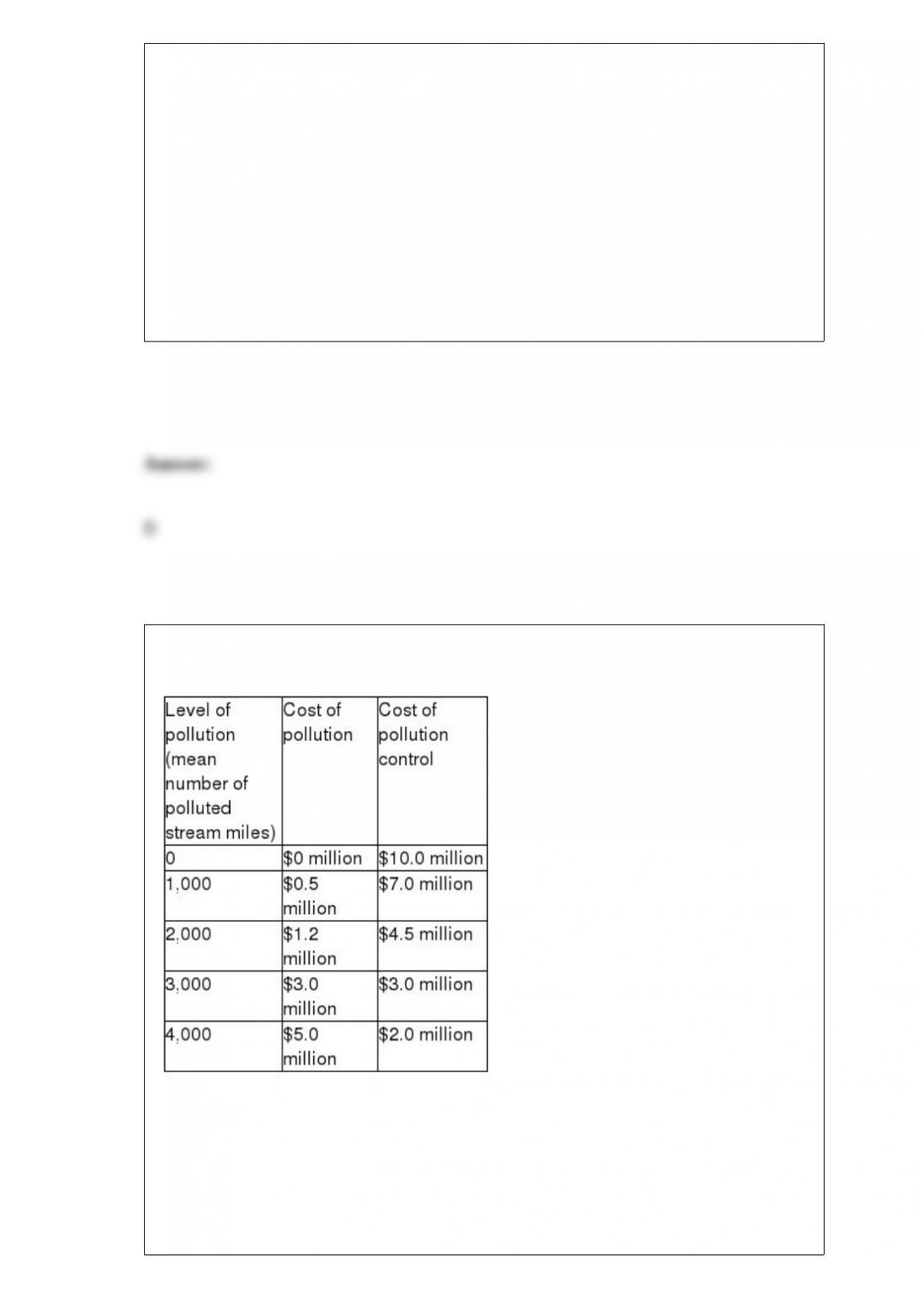
The table above shows the cost to society of allowing a given pollution level (in terms
of polluted stream miles) and the cost of pollution control (in millions of dollars). How
many polluted stream miles should be tolerated to minimize the total costs of pollution?
a. 0

b. 1,000
c. 2,000
d. 3,000
e. 4,000
For a market to exhibit excess supply
a. demand must exceed supply.
b. the market must be growing.
c. demand must increase.
d. the equilibrium price must be too high to clear the market.
e. the actual price must be above the equilibrium price.
During the Clinton administration, fiscal policy was
a. successful in keeping the unemployment rate at about 4 percent.
b. the primary policy tool used to combat inflation.
c. exercised through the monetary authorities.

d. focused on reducing both tax rates and government spending.
e. dominated by a desire to reduce budget deficits.
If price elasticity of demand is 1.7, the demand for the commodity is
a. of unitary elasticity.
b. price postelastic.
c. price elastic.
d. price inelastic.
e. price preelastic.
The main criticism most contemporary economists would make of the Bretton Woods
agreement is that it
a. was inherently inflexible and thus not adaptable to changing economic conditions.
b. was based on the false assumption that the ability of one country to compete with
another changes over time.
c. depended too heavily on adherence to the gold standard.

d. demanded a fundamental realignment of currencies for which most countries were
unprepared.
e. meant that the only way to balance imports and exports was through the use of tariffs
and quotas.
Since World War II, the M1 (narrowly defined) money supply has
a. decreased steadily.
b. remained unchanged on balance but differed from year to year.
c. increased at a constant yearly rate.
d. increased at an average rate of 5 to 10 percent per year.
e. increased at an average yearly rate of above 10 percent.
A controversial element of the Social Security program is that
a. participation is mandatory.
b. the Social Security payments are withheld dollar for dollar.
c. to collect any Social Security benefits, workers must retire at 65.
d. it is run strictly like an ordinary insurance system that ties the level of benefits

directly to the amount of an individual’s contributions.
e. the Social Security tax is progressive.
According to Michael Harrington in the video, the primary reason why the poor are
those most affected by inflation is that they
a. tend to be unskilled.
b. are not organized.
c. do not really wish to work.
d. are not being reached by government programs.
e. are socially necessary so that rich people can behave charitably.
According to the more sophisticated quantity theory of money, if the money supply is
increased
a. the velocity of circulation will fall.
b. both nominal and real GDP will rise if the economy is at less than full employment.
c. nominal GDP will fall.
d. nominal GDP will rise, but real GDP will fall if the economy is below full

employment.
e. nominal GDP will remain the same.
The fiscal policy recommendations of the Reagan administration generally advocated
a. small changes in existing government tax and spending programs.
b. significant increases in defense spending, coupled with increased taxes.
c. holding taxes constant while significantly increasing both defense and nondefense
spending.
d. increases in nondefense spending matched dollar for dollar by decreases in defense
spending.
e. reductions in both taxes and non-defense-related government programs.
The purpose of the British Corn Laws was to
a. maintain the high profits of the British landlords.
b. prevent British farmers from exporting corn to other nations.
c. prevent British farmers from growing grain.
d. encourage grain imports from France and Germany.

e. encourage the British to substitute corn for meat.
The following questions are based on the following demand schedule for a monopolist:
If the monopolist wished to sell 4 units, the marginal revenue of the fourth unit would
be
a. greater than the marginal revenue of the third unit.
b. less than the price necessary to sell 4 units.
c. greater than the total revenue earned by selling 4 units.
d. equal to the demand curve for selling 4 units.
e. impossible to calculate.

In the long run, the aggregate supply curve is vertical because
a. in the long run, potential output is less than actual output.
b. input prices and output prices are unaffected by changes in aggregate demand.
c. aggregate demand becomes horizontal.
d. input prices change by the same proportion as product prices, leaving output levels
unchanged.
e. excess capacity allows firms more resource flexibility.
When companies and newscasters say that any additional excise tax will just be “passed
on to the consumer,” they are correct only if
a. the quantity demanded is completely insensitive to the price.
b. the amount of the tax is relatively small.
c. producers do not want to absorb any of the tax themselves.
d. the government allows firms to do that.
e. the tax reduces the equilibrium quantity of the good.
A union that negotiates higher wages without directly limiting the labor supply or trying
to increase labor demand
a. creates an excess demand for labor.
b. has the effect of creating a price floor in that labor market.

c. is able to secure jobs for all of its members.
d. violates the Landrum-Griffin Act.
e. is guilty of a lockout.
Why did the automatic stabilizers have more of an effect on our economy during the
Eisenhower presidency than they did during the 1930s when Roosevelt was president?
a. We had shifted from an agricultural economy to an industrial economy.
b. We had learned more about controlling inflation and unemployment, so less
adjustment was needed.
c. As the classical economists predicted, inflation and unemployment had begun to
balance each other out.
d. The size of the federal government had increased dramatically since the 1930s.
e. In reality, the opposite is true; the automatic stabilizers had a greater impact in the
1930s than in the 1950s.
Sales taxes are typically considered to be
a. regressive.

b. proportional.
c. progressive.
d. indirect.
e. indivisible.
If the multiplier is 3, a $1 billion decrease in government spending will
a. lower equilibrium GDP by one-third.
b. lower equilibrium GDP by 3.
c. raise equilibrium GDP by one-third.
d. raise equilibrium GDP by 3.
e. leave equilibrium GDP unchanged but change intended spending by one-third.
A firm’s demand curve for labor is
a. backward bending, especially in the short run.
b. its value of labor’s marginal product curve.
c. equal to the price of labor times its productivity.

d. calculated by dividing total output per day by the number of workers.
e. derived from the supply of labor.
If equal increments of an input are added, the quantities of other inputs being held
constant, the resulting increments of product will decrease beyond some point. This
sentence is a statement of the law of
a. supply.
b. demand.
c. diminishing marginal returns.
d. optimal thermodynamics.
e. indifference.