
If float is predicted to increase because of bad weather, the manager of the trading desk
at the New York Fed bank will likely conduct ________ open market operations to
________ reserves.
A) defensive; inject
B) defensive; drain
C) dynamic; inject
D) dynamic; drain
Answer:
State whether the following statement is true or false AND explain why: “A decrease in
the discount rate will always cause a decrease in the federal reserve funds rate.”
Answer:
State whether the following statement is true or false AND explain why: “An increase
in the interest rate paid on excess reserves will always cause an increase in the federal
reserve funds rate.”

Answer:
A rise in autonomous planned investment spending causes the equilibrium level of
aggregate output to ________ and shifts the ________ curve to the ________,
everything else held constant.
A. rise; LM; right
B. rise; IS; right
C. fall; IS; left
D. fall; LM; left
Answer:
When the economy is hit by a negative demand shock and the central bank pursues
policies to increase aggregate demand to its initial level, then
A. inflation will be lower.
B. output will be at its potential.

C. output will be lower.
D. inflation will be unchanged.
E. both B and D.
Answer:
Assuming initially that the required reserve ratio = 10%, the currency-deposit ratio =
40%, and the excess reserve ratio = 0, a decrease in the required reserve ratio to 5%
causes the M1 money multiplier to ________, everything else held constant.
a. increase from 2.8 to 3.11
b. decrease from 3.11 to 2.8
c. increase from 2 to 2.22
d. decrease from 2.22 to 2
Answer:
If a central bank does not want to see its currency ________ in value, it may pursue
contractionary monetary policy to raise the domestic interest rate, thereby ________ its
currency.
A) fall; strengthening

B) fall; weakening
C) rise; strengthening
D) rise; weakening
Answer:
According to Tobin’s q theory, if q is ________, new plant and equipment capital is
________ relative to the market value of business firms, so companies can buy a lot of
new investment goods with only a ________ issue of stock.
A. high; dear; large
B. high; cheap; large
C. high; cheap; small
D. low; cheap; large
E. low; cheap; small
Answer:
IPOs have become very important in the U.S. economy because they are a major source
of financing for

A. so-called “blue-chip” companies.
B. hedge funds.
C. internet companies.
D. mutual funds.
Answer:
The typical shape for a yield curve is
A. gently upward sloping.
B. mound shaped.
C. flat.
D. bowl shaped.
Answer:
An increase in the money supply shifts the LM curve to the right, causing the interest
rate to ________ and output to ________, everything else held constant.
A. rise; rise
B. rise; fall

C. fall; rise
D. fall; fall
Answer:
________ in the foreign interest rate causes the demand for domestic assets to
________ and the domestic currency to appreciate, everything else held constant.
A. An increase; increase
B. An increase; decrease
C. A decrease; increase
D. A decrease; decrease
Answer:
The FOMC finally moved to ________ on January 25, 2012, when it issued its
“Statement on Long-Run
Goals and Monetary Policy Strategy.”
A. inflation targeting
B. zero inflation policy

C. “just do it” policy
D. monetary targeting
Answer:
Potential weaknesses of nominal GDP targeting include
A. it requires accurate estimates of potential GDP growth, which are not easy to
achieve.
B. real GDP growth that is below potential or inflation that is below the inflation
objective will encourage more expansionary monetary policy.
C. it is more complicated to explain to the public than inflation targeting and thus the
public might be confused about the objectives of the central bank.
D. both A and C.
Answer:
An increase in an asset’s expected return relative to that of an alternative asset, holding
everything else constant, ________ the quantity demanded of the asset.
A. increases
B. decreases

C. has no effect on
D. erases
Answer:
Everything else held constant, if consumption expenditure increases by 65 for a 100
increase in disposable income, the mpc is
A. 0.
B. 0.5.
C. 0.65.
D. 1.
Answer:
In the long-run ISLM model and with everything else held constant, the long-run effect
of a fall in net exports is to ________ real output and ________ the interest rate.
A. increase; increase
B. increase; not change
C. not change; increase

D. not change; decrease
Answer:
The argument that econometric policy evaluation is likely to be misleading if
policymakers assume stable economic relationships is known as
A. the monetarist revolution.
B. the Lucas critique.
C. public choice theory.
D. new Keynesian theory.
Answer:
Suppose that from a new checkable deposit, First National Bank holds eight million
dollars on deposit with the Federal Reserve, one million dollars in required reserves,
and faces a required reserve ratio of ten percent. Given this information, we can say
First National Bank has ________ million dollars in vault cash.
A. two
B. eight
C. nine

D. ten
Answer:
Which of the following are TRUE of fixed payment loans?
A. The borrower repays both the principal and interest at the maturity date.
B. Installment loans and mortgages are frequently of the fixed payment type.
C. The borrower pays interest periodically and the principal at the maturity date.
D. Commercial loans to businesses are often of this type.
Answer:
When the Federal Reserve engages in a repurchase agreement to offset a withdrawal of
Treasury funds from the Federal Reserve, the open market operation is said to be
A. defensive.
B. offensive.
C. dynamic.
D. reactionary.

Answer:
Everything else held constant, the interest rate on municipal bonds rises relative to the
interest rate on Treasury securities when
A. income tax rates are lowered.
B. income tax rates are raised.
C. municipal bonds become more widely traded.
D. corporate bonds become riskier.
Answer:
Allowing individuals to manage a portion of their Social Security funds is
A. socialization.
B. privatization.
C. democratization.
D. regeneration.
Answer:

If the expected path of 1-year interest rates over the next five years is 2 percent, 4
percent, 1 percent, 4 percent, and 3 percent, the expectations theory predicts that the
bond with the lowest interest rate today is the one with a maturity of
A. one year.
B. two years.
C. three years.
D. four years.
Answer:
Everything else held constant, when the government has higher budget deficits
A. the demand curve for bonds shifts to the left and the interest rate rises.
B. the demand curve for bonds shifts to the left and the interest rate falls.
C. the supply curve for bonds shifts to the right and the interest rate falls.
D. the supply curve for bonds shifts to the right and the interest rate rises.
Answer:

If an individual moves money from a small-denomination time deposit to a demand
deposit account
A. M1 increases and M2 stays the same.
B. M1 stays the same and M2 increases.
C. M1 stays the same and M2 stays the same.
D. M1 increases and M2 decreases.
Answer:
If the expected path of 1-year interest rates over the next four years is 5 percent, 4
percent, 2 percent, and 1 percent, then the expectations theory predicts that today’s
interest rate on the four-year bond is
A. 1 percent.
B. 2 percent.
C. 3 percent.
D. 4 percent.
Answer:

If American college students decide that drinking Mexican-brewed beer helps one get
noticed, net exports will tend to fall, causing aggregate demand to ________ and the
________ curve to shift to the left, everything else held constant.
A. fall; LM
B. fall; IS
C. rise; LM
D. rise; IS
Answer:
In the 1950s the interest rate on three-month Treasury bills fluctuated between 1 percent
and 3.5 percent; in the 1980s it fluctuated between ________ percent and ________
percent.
A. 5; 15
B. 4; 5
C. 4; 18
D. 5; 10
Answer:

Other things being equal, a decrease in the default risk of corporate bonds shifts the
demand curve for corporate bonds to the ________ and the demand curve for Treasury
bonds to the ________.
A. right; right
B. right; left
C. left; right
D. left; left
Answer:
Forty or so dealers establish a “market” in these securities by standing ready to buy and
sell them.
A. secondary stocks
B. surplus stocks
C. U.S. government bonds
D. common stocks
Answer:
The Dodd-Frank Wall Street Reform and Consumer Protection Act of 2010 authorized

investors to bring lawsuits against credit-rating agencies for a reckless failure to get the
facts when providing a credit rating. This is an example of which remedy of conflicts of
interest?
A. regulate for transparency
B. supervisory oversight
C. leave it to the market
D. socialization of information production
Answer:
Banks face the problem of ________ in loan markets because bad credit risks are the
ones most likely to seek bank loans.
A. adverse selection
B. moral hazard
C. moral suasion
D. intentional fraud
Answer:
The market where one currency is converted into another currency is called the

________ market.
A. stock
B. bond
C. derivatives
D. foreign exchange
Answer:
If actual output is less than equilibrium output, firms will ________ output to keep from
________ inventories.
A. increase; accumulating
B. increase; depleting
C. decrease; depleting
D. decrease; accumulating
Answer:
Which of the following criteria need NOT be satisfied for choosing a policy
instrument?

A. The variable must be measurable.
B. The variable must be controllable.
C. The variable must be predictable.
D. The variable must be transportable.
Answer:
Would it make sense to buy a house when mortgage rates are 14% and expected
inflation is 15%? Explain your answer.
Answer:
Use demand and supply analysis to explain why an expectation of Fed rate hikes would
cause Treasury prices to fall.
Answer:

Using T-accounts show what happens to reserves at Security National Bank if one
individual deposits $1000 in cash into her checking account and another individual
withdraws $750 in cash from her checking account.
Answer:
The monetary base increased by 20% during the contraction of 1929-1933, but the
money supply fell by 25%. Explain why this occurred. How can the money supply fall
when the base increases?
Answer:

Assume that a fixed exchange rate is overvalued. Describe the situation of a speculative
crisis against this currency. What can the central bank do to defend the currency? Why
might the alternative of devaluation be preferable?
Answer:
The Federal Reserve increases interest rates when it wants to reduce aggregate demand
to fight inflation. How do increases in the interest rate reduce aggregate demand?
Answer:
Explain two reasons why the Fed does not have complete control over the level of bank
deposits and loans. Explain how a change in either factor affects the deposit expansion
process.
Answer:
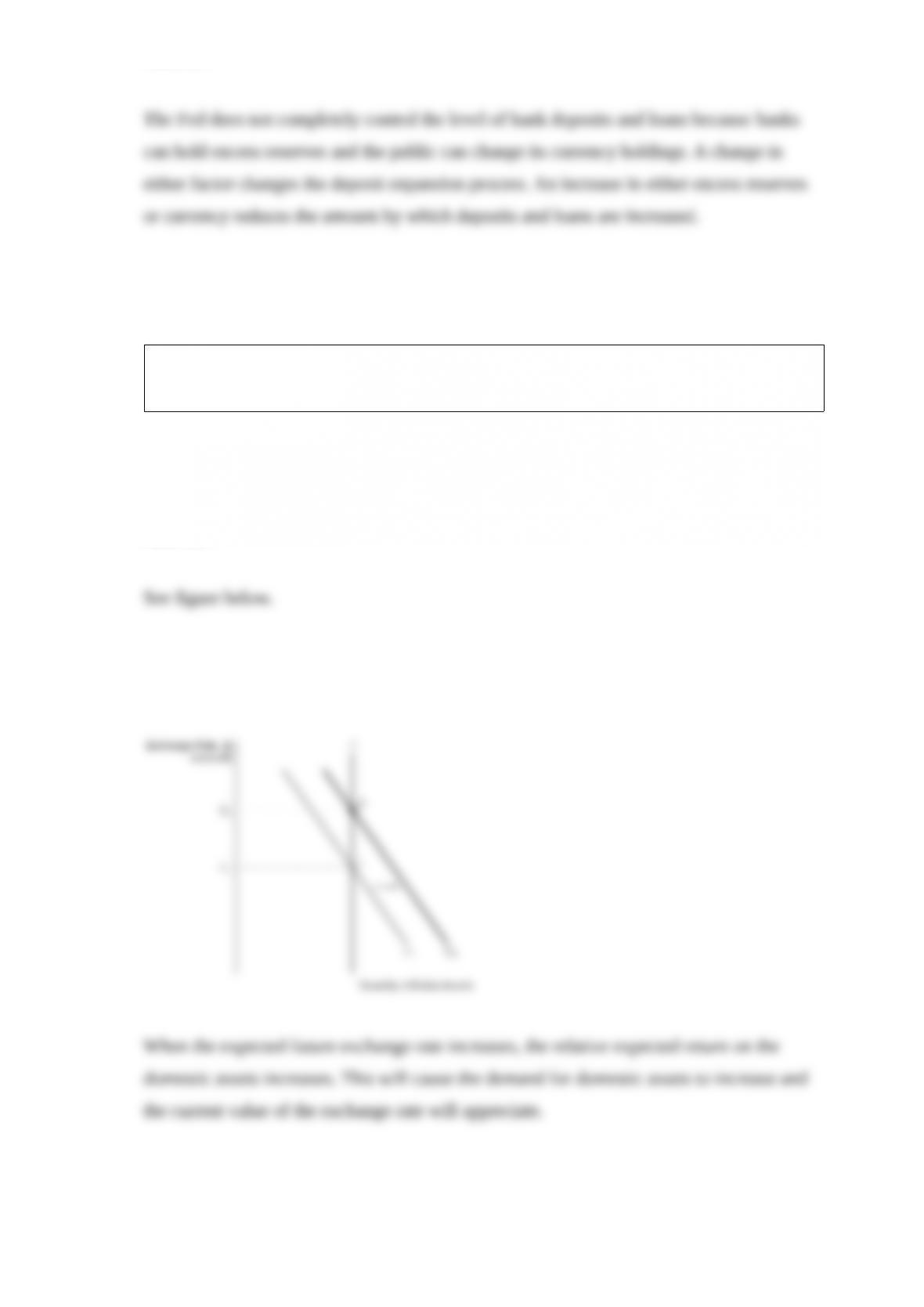
Explain and show graphically the effect of an increase in the expected future exchange
rate on the equilibrium exchange rate, everything else held constant.
Answer:

How does collateral help to reduce the adverse selection problem in credit market?
Answer:
Explain the problems that necessitate insurance management, and three methods
insurance companies use to address these problems. Identify the problem that each
practice addresses.
Answer:

Explain why the Social Security system faces problems. Discuss the possible solutions
to these problems.
Answer:
Describe what is meant by economies of scope and explain how financial institutions’
realizing economies of scope has led to an increase in conflicts of interest.
Answer:

Your best friend calls and gives you the latest stock market “hot tip” that he heard at the
health club. Should you act on this information? Why or why not?
Answer:
Assume that no banks hold excess reserves, and the public holds no currency. If a bank
sells a $100 security to the Fed, explain what happens to this bank and two additional
steps in the deposit expansion process, assuming a 10% reserve requirement. How
much do deposits and loans increase for the banking system when the process is
completed?
Answer:
The government safety net creates both an adverse selection problem and a moral
hazard problem. Explain.

Answer:
If the federal government where to raise the income tax rates, would this have any
impact on a state’s cost of borrowing funds? Explain.
Answer:
How did the increase in the interest rates in the early 80s contribute to the S&L crisis?
Answer: