
Under autarky, consumer surplus is represented by the area
A) above the supply curve and below the equilibrium price.
B) above the supply curve and below the demand curve.
C) below the demand curve and above the equilibrium price.
D) above the demand curve and below the supply curve.
The following equations represent the demand and supply for bottles of nail polish.
QD = 25 – P
QS = -15 + 3P What is the equilibrium price (P) and quantity (Q – in thousands) of
bottles of nail polish?
A) P = $5; Q = 20 thousand
B) P = $15; Q = 30 thousand
C) P = $20; Q = 5 thousand
D) P = $10; Q = 15 thousand
Let MP = marginal product, P = output price, and W = wage; then the equation that
represents a situation where a competitive firm should lay off some workers to
maximize profits is
A) P MP = W.

B) P MP > W.
C) P MP < W.
D) MP W = P.
By making exchange ________, money allows for ________ and higher ________.
A) harder; specialization; costs
B) easier; specialization; productivity
C) harder; generalization; productivity
D) easier; specialization; costs
Generally with bond ratings, the lower the rating, the ________ the interest rate an
investor will receive and the ________ the the risk that the issuer of the bond will
default.
A) higher; higher
B) higher; lower
C) lower; higher
D) lower; lower

An increase in a perfectly competitive firm’s demand for labor could be caused by
A) a decrease in the market wage rate.
B) an increase in the amount of human capital among the labor force.
C) an increase in the supply of labor.
D) a decrease in the market price of the product the firm produces.
What do Sony, Microsoft, and Nintendo have in common?
A) Each achieved a dominant position in its industry because it owned a key input in
the production of its product.
B) The industry in which each firm competes is an oligopoly because of
government-imposed barriers to entry.
C) Each company was founded in the same state.
D) The profitability of each firm depends on its interactions with other firms.

A product is considered to be rival if
A) you can keep those who did not pay for the item from enjoying its benefits.
B) you cannot keep those who did not pay for the item from enjoying its benefits.
C) your consumption of the product reduces the quantity available for others to
consume.
D) it is jointly owned by all members of a community.
According to the saving and investment equation, if net foreign investment falls by $35
million,
A) national saving in excess of domestic investment will decrease by $35 million.
B) national savings will rise by $35 million.
C) domestic investment will fall by $35 million.
D) national saving in excess of domestic investment will rise by $35 million.
An increase in investment causes the price level to ________ in the short run and
________ in the long run.
A) increase; increase further
B) increase; decrease
C) decrease; decrease further
D) decrease; increase
Consider a U-shaped long-run average cost curve that has a minimum efficient scale at
6,000 units of output. In this case, this industry would be
A) perfectly competitive if the market quantity demanded is 20,000 units.
B) monopolistically competitive if the market quantity demanded is 12,000 units.
C) an oligopoly if the market quantity demanded is 18,000 units.
D) an oligopoly if the four-firm concentration ratio is more than 10 percent.
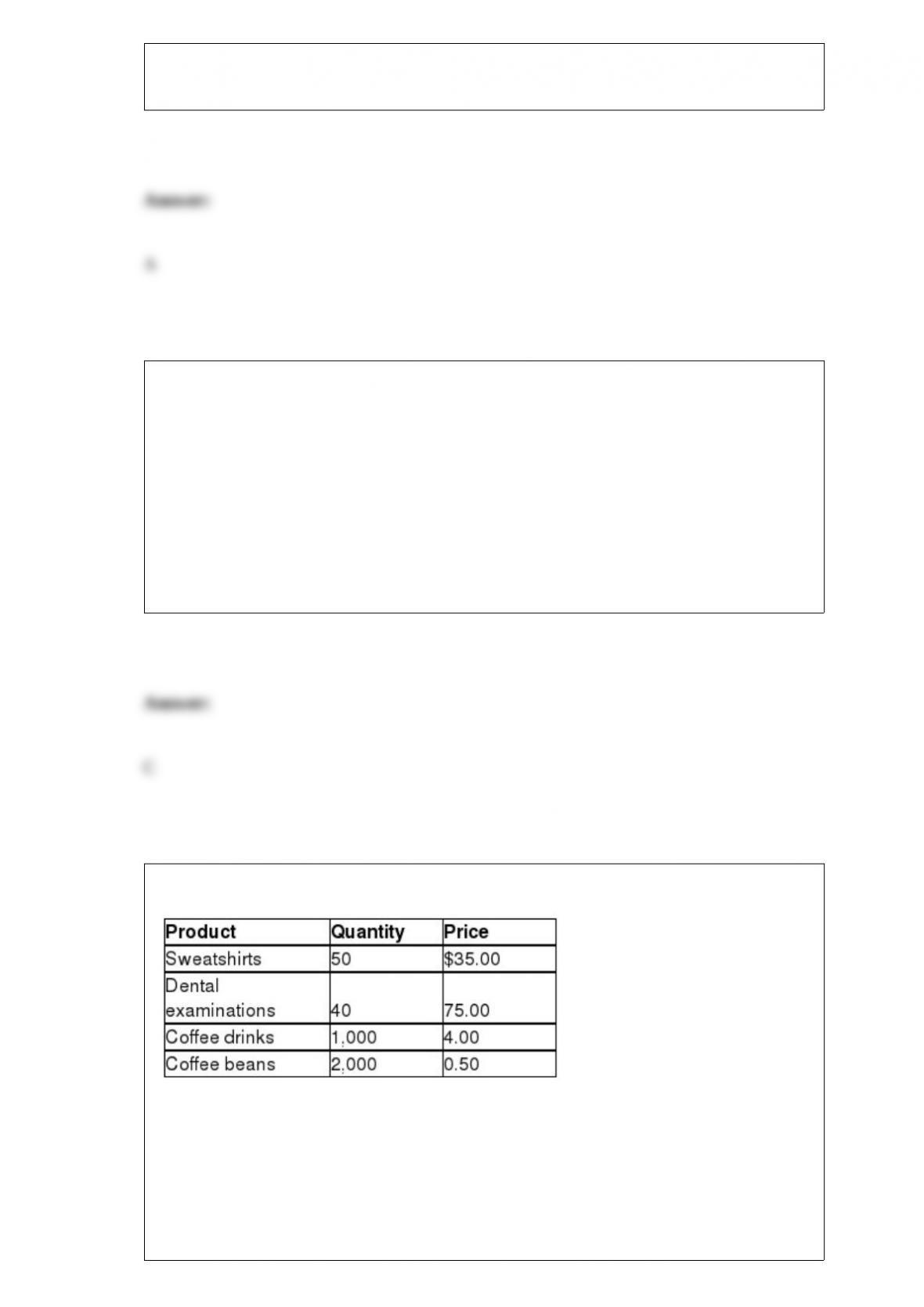
Table 8-1
Suppose that a simple economy produces only four goods and services: sweatshirts,
dental examinations, coffee drinks, and coffee beans. Assume all of the coffee beans are
used in the production of the coffee drinks. Using the information in the above table,
nominal GDP for this simple economy equals
A) 3,090 units.
B) $7,250.
C) $8,750.
D) $9,750.
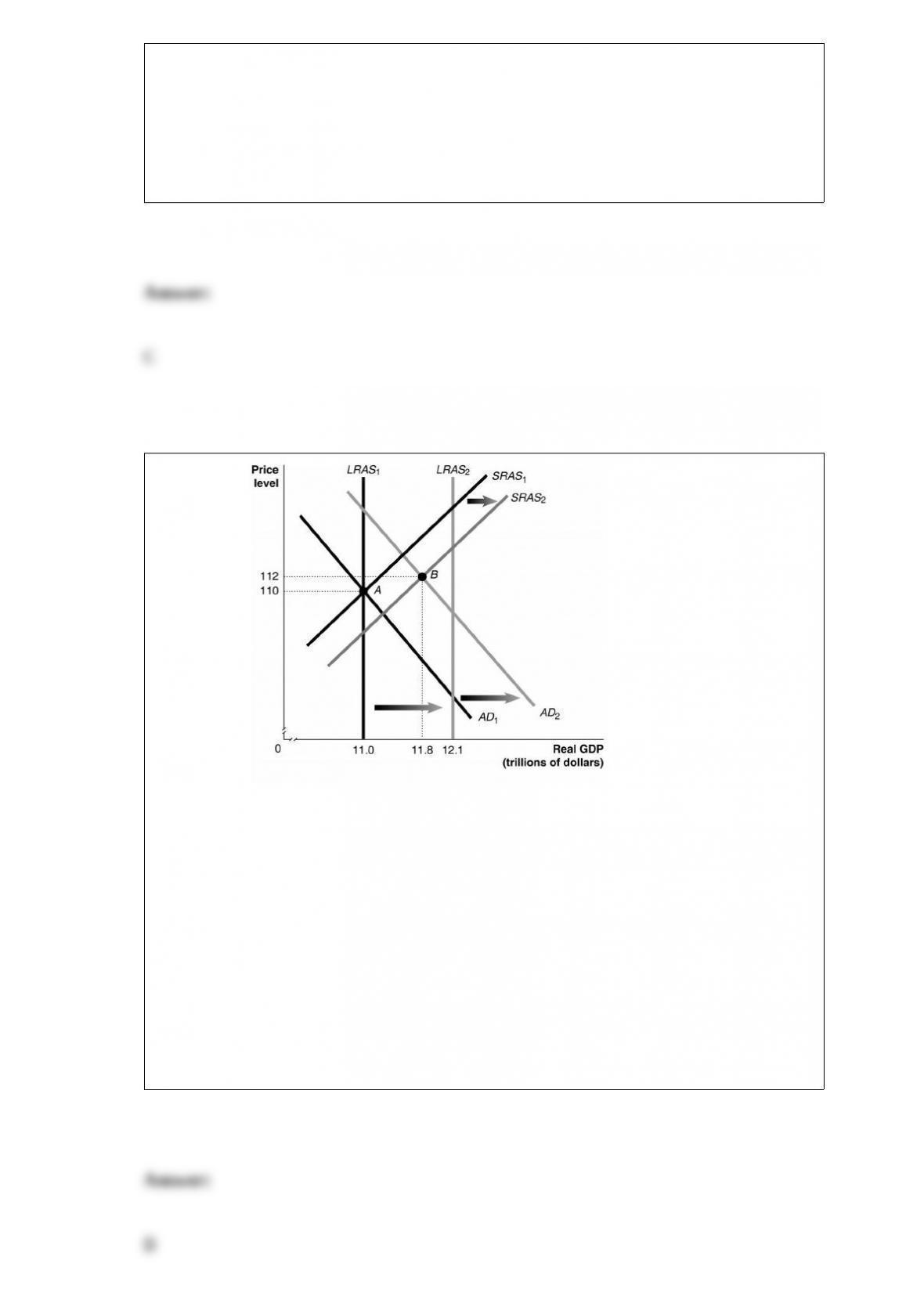
Figure 24-4
In the figure above, AD1, LRAS1 and SRAS1 denote AD, LRAS and SRAS in year 1,
while AD2, LRAS2 and SRAS2 denote AD, LRAS and SRAS in year 2. Given the
economy is at point A in year 1, what is the actual growth rate in GDP in year 2?
A) 2.5%
B) 7.3%
C) 8.0%
D) 10.0%

Examples of comparative advantage show how trade between two countries can make
each better off. Compared to their pre-trade positions, trade makes both countries better
off because in each country
A) total employment is greater.
B) total consumption of goods is greater.
C) wages are higher.
D) total welfare is greater.
Assume a closed economy with fixed taxes and the marginal propensity to consume is
equal to 0.9. What is the government spending multiplier?
A) 10
B) 9
C) 5
D) 1