1) when average fixed costs are falling:
a.average total cost must be falling.
b.average variable cost may be either rising or falling.
c.marginal cost must be falling.
d.average variable costs must be rising.
2) a person will be more likely to migrate the:
a.greater the distance they will have to travel from their country of origin.
b.greater the wages in their prospective new country relative to wages in their home
country.
c.fewer the number of beaten paths that exist to their prospective new country.
d.greater the number of children they have.
3) in national income accounting, government purchases include:
a.purchases by federal, state, and local governments.
b.purchases by the federal government only.
c.government transfer payments.
d.purchases of goods for consumption, but not public capital goods.
4) a typical concave (to the origin) production possibilities curve implies:
a.that economic resources are unlimited.
b.that society must choose among various attainable combinations of goods.
c.decreasing opportunity costs.
d.that society is using a market system to allocate resources.
5) assume the price of product y (the quantity of which is on the vertical axis) is $15
and the price of product x (the quantity of which is on the horizontal axis) is $3. also
assume that money income is $60. the absolute value of the slope of the resulting
budget line:
a.is 5.
b.is 1/5.
c.is 4.
d.is 20.
6) Available research suggests that the union wage advantage diminishes the national
output by:
A.10 percent.
B.15 percent.
C.5 percent.
D.less than 1 percent.
7) Suppose Slow Ketchup requires that, as a condition of purchase, all restaurants using
its product must buy and make available its new sales product. This arrangement is an
example of:
A.price fixing.
B.an interlocking directive.
C.a tying contract.
D.price discrimination.
8) If a $20 billion increase in government expenditures increases equilibrium GDP by
$50 billion then:
A.the multiplier is 2.
B.the MPC for this economy is .6.
C.inflation is occurring.
D.the MPS for this economy is .6.
9) Which of the following would, other things equal, increase the demand for U.S. farm
products?
A.bumper crops abroad
B.depreciation of the U.S. dollar
C.deteriorating trade relations with China and Russia
D.increases in foreign tariffs on imported farm products
10)
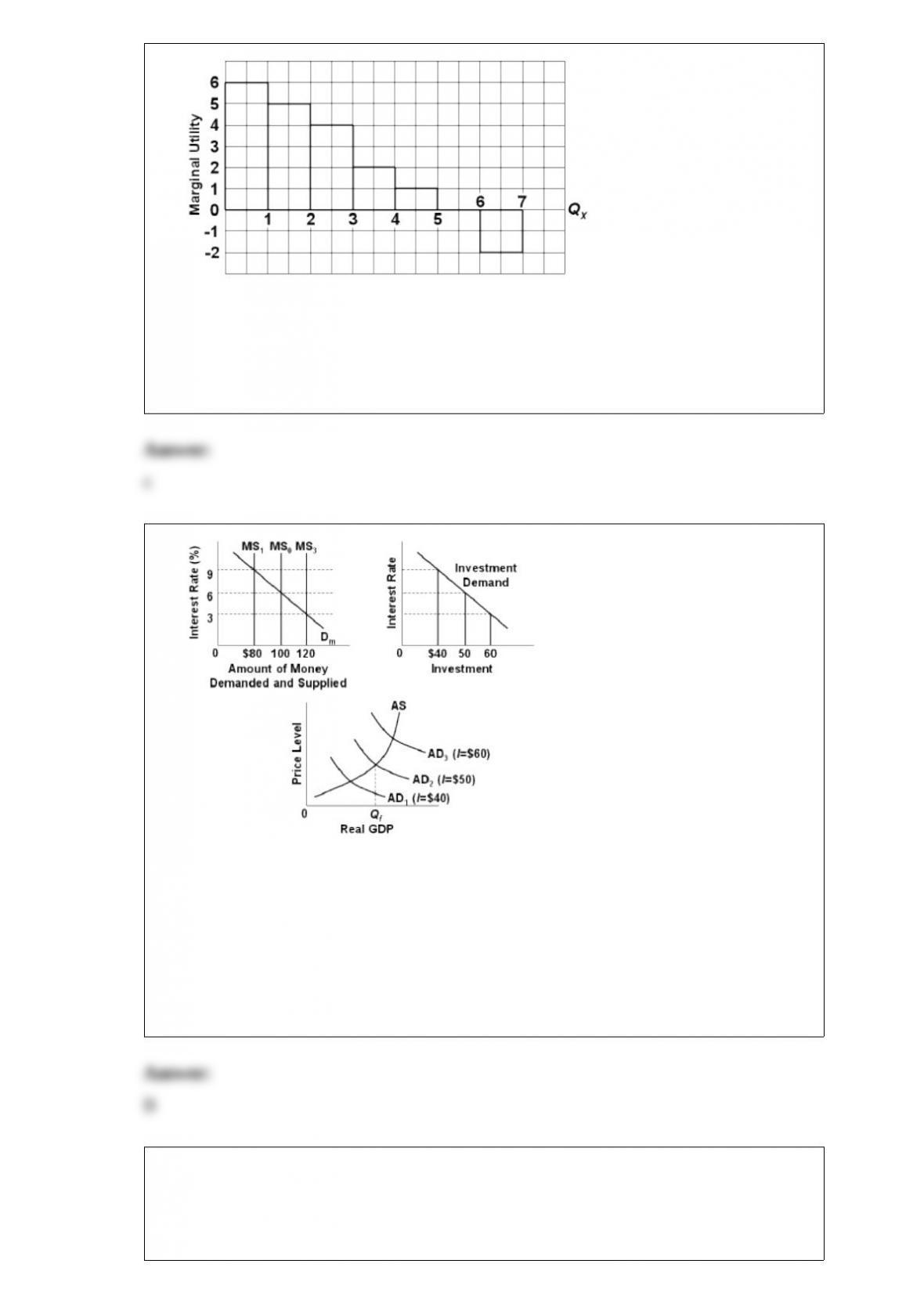
refer to the above diagram. the total utility yielded by 4 units of x is:
a.4
b.15
c.17
d.18
11)
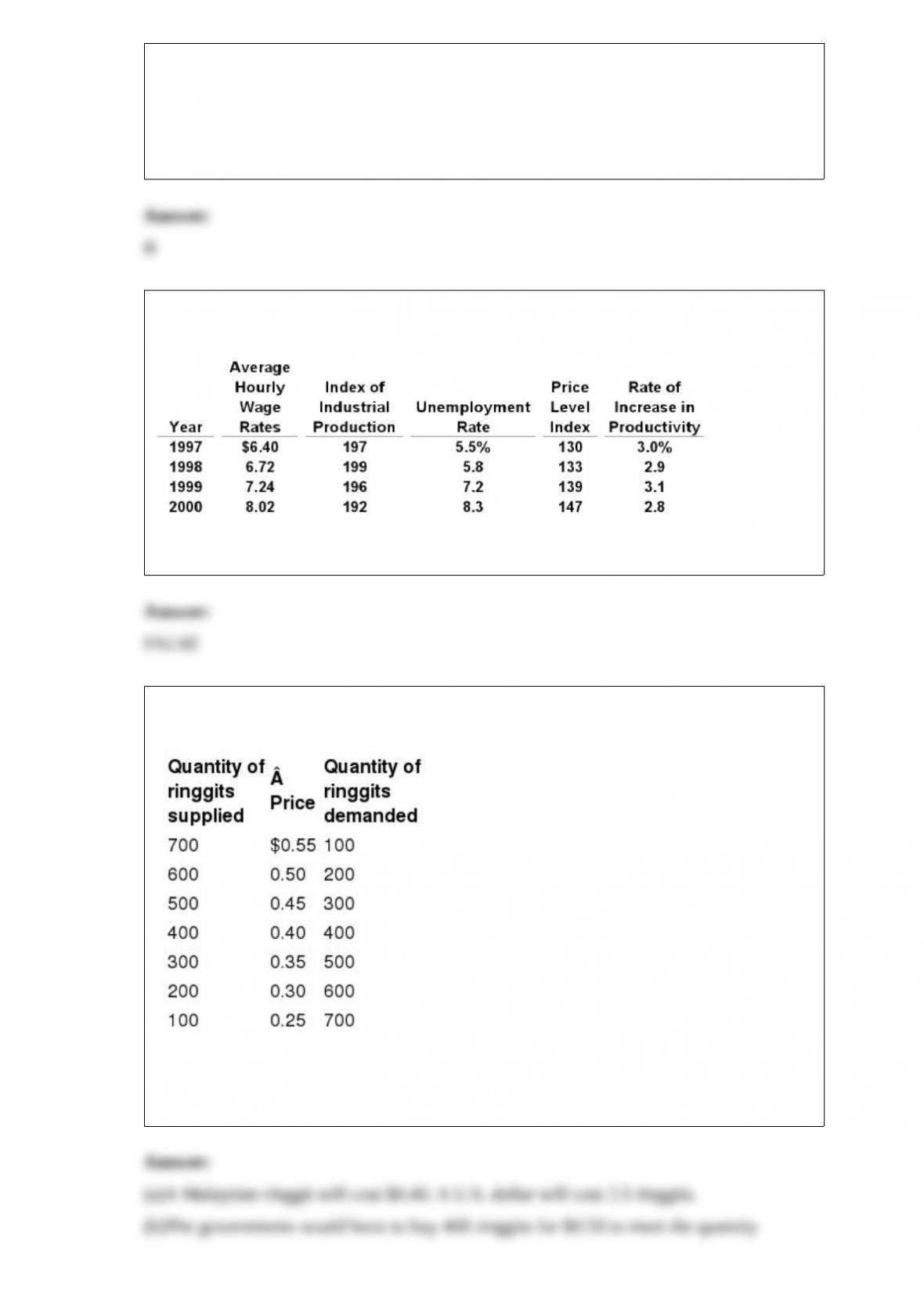
Refer to the above diagrams. The numbers in parentheses after the AD1, AD2, and AD3
labels indicate the levels of investment spending associated with each curve. All figures
are in billions. Which of the following would shift the money supply curve from MS1
to MS3?
A.an increase in the discount rate
B.purchases of U.S. securities by the Fed in the open market
C.sales of U.S. securities by the Fed in the open market
D.an increase in the reserve ratio
12) A bumper crop of farm products causes:
A.only a slight decline in the price of farm products because the demand for farm
products is income inelastic.
B.a large decline in the price of farm products because the demand for farm products is
price inelastic.
C.only a slight decline in the price of farm products because the demand for farm
products is income elastic.
D.a large decline in the price of farm products because the demand for farm products is
price elastic.
13) The following economic data for a hypothetical economy:
Refer to the above data. It would be appropriate stabilization policy to raise interest
rates, raise taxes, and reduce government expenditures.
14) In the table below are the supply and demand schedules for Malaysian ringgits.
(a)What will be the rate of exchange for the Malaysian ringgit and for the U.S. dollar?
(b)What would happen if the U.S. and Malaysian governments wanted to fix or peg the
price of a ringgit at $0.50?
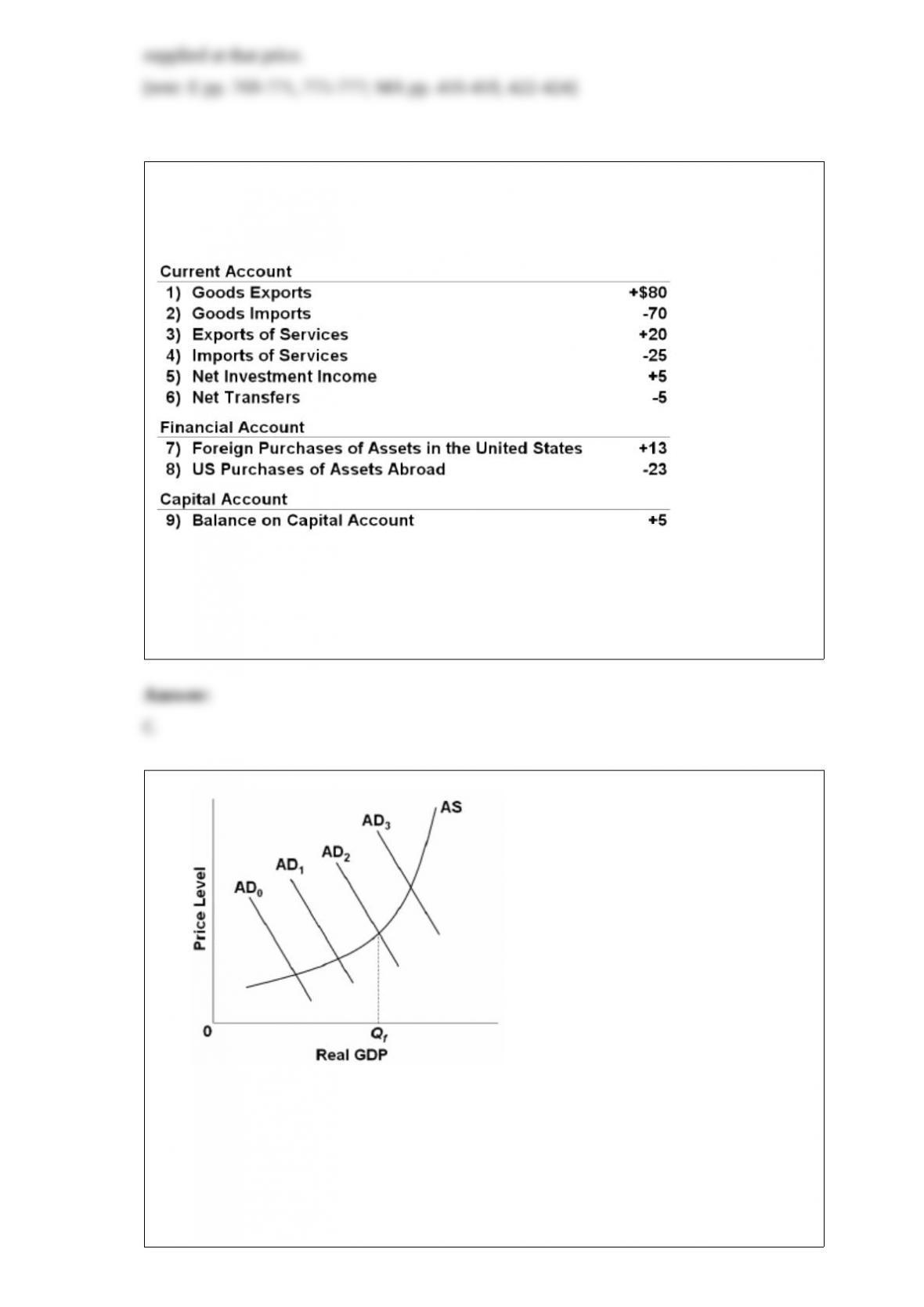
15) The following 2006 balance of payments data (+ and -) for the hypothetical nation
of Zabella. All figures are in billions of dollars.
Refer to the above data. Zabella has a balance of trade (goods):
A.deficit of $10 billion.
B.surplus of $5 billion.
C.surplus of $10 billion.
D.deficit of $5 billion.
16)
Refer to the above diagram, in which Qf is the full-employment output. If the
economy’s current aggregate demand curve is AD3, it would be appropriate for the
government to:
A.reduce government expenditures and taxes by equal-size amounts.
B.reduce government expenditures or increase taxes.
C.increase government expenditures or reduce taxes.
D.reduce unemployment compensation benefits.

17) Which of the following is most likely to be an example of monopsony?
A.the market for fast-food workers in a large summer resort town.
B.the market for card dealers in Las Vegas.
C.the market for major league baseball umpires.
D.the market for retail sales clerks in a major city.