1) The appeal to government for special benefits at taxpayers’ or someone else’s
expense is the paradox of voting.
2) When you use money to purchase groceries, money is functioning as a store of value.
3) A business firm will purchase additional capital goods if the real rate of interest in
the economy is less than the expected rate of return from the investment.
4) Using a debit card is like writing a check; the amount will be deducted from one’s
checking account.
5) A monopolist will try to charge the highest price that it can charge.
6) There are two common measures of economic growth: (1) increases in real GDP over
some period of time and (2) increases in real GDP per capita over some time period.
7) Businesses are the main economic investors, while households are the main savers.
8) If aggregate expenditures rise by $200 billion and real GDP consequently rises by
$500 billion, then the MPC in the economy must be 0.4.
9) As it relates to oligopoly, game theory focuses on the strategic behavior of rival
firms.
10) In the very short run, demand shocks will tend to change the level of output but
have little effect on prices.
11) The “principal-agent problem” often arises in public choice when politicians pursue
the best interests of their constituents.
12) Behavioral economics recognizes that people frequently make errors, but these
errors generally cancel out in such a way that neoclassical models are sufficient for
predicting economic outcomes.
13) Money performs its function as a store of value very well, because it protects one
against the erosion of purchasing power from inflation.
14) Even if prices are fixed and competition is restricted by the government, the
“invisible hand” will still work in the economy and lead to economic efficiency.
15) Total U.S. health care spending in 2011 was approximately:
A.$847 billion.
B.$1.1 trillion.
C.$2.7 trillion.
D.$4.1 trillion.
16) If Congress passed new laws significantly increasing the regulation of business, this
action would tend to:
A.Increase per-unit production costs and shift the aggregate supply curve to the left
B.Increase per-unit production costs and shift the aggregate supply curve to the right
C.Increase per-unit production costs and shift the aggregate demand curve to the left
D.Decrease per-unit production costs and shift the aggregate supply curve to the left
17) Property taxes are:
A.Collected primarily at the Federal level
B.The largest source of tax revenue for local governments
C.The primary source of Federal revenue sharing funds
D.Used primarily by states to finance state welfare programs
18)
Refer to the table above for a certain product’s market in Econland. If the world price of
the product were $6 and an import quota of 400 units were imposed on the product,
then the equilibrium price in Econland would be:
A.$6 and the total quantity available in Econland would be 2,200 units
B.$6 and the total quantity available in Econland would be 1,800 units
C.$7 and the total quantity available in Econland would be 2,000 units
D.$7 and the total quantity available in Econland would be 1,800 units
19)

Refer to the figure above. A nation that has an income distribution of perfect equality
would be represented by curve:
A.a
B.b
C.c
D.d
20) How might a nation expand its production possibilities?
A.By engaging in barter transactions to facilitate trade
B.By investing in new technology and business equipment
C.By engaging in direct production rather than roundabout production
D.By specializing in the production of a particular good
21) The simple immigration model assumes that the capital stock is constant in each
country. If this assumption is relaxed, then the:
A.Rise in business income in the low-wage country will increase the return on capital,
which will increase the demand for labor
B.Fall in business income in the low-wage country will decrease the return on capital,
which will decrease the demand for labor
C.Rise in business income in the low-wage country will decrease the return on capital,
which will decrease the demand for labor
D.Fall in business income in the low-wage country will increase the return on capital,
which will increase the demand for labor
22) Product variety is likely to be greater in:
A.monopolistic competition than in pure competition.
B.pure competition than in monopolistic competition.
C.homogeneous oligopoly than in monopolistic competition.
D.homogeneous oligopoly than in differentiated oligopoly.
23) The fact that high-income earners tend to earn a higher percentage of their incomes
from rent and dividends, in contrast to low-income earners, make the payroll taxes:
A.More progressive
B.Proportional
C.More regressive
D.A flat tax
24) According to the Taylor rule, when real GDP is equal to potential GDP and inflation
is equal to its target rate of 2 percent, the Federal fund rate should:
A.Be increased by 10 percent
B.Be decreased by 10 percent
C.Remain at about 4 percent
D.Remain at about 8 percent
25)
Refer to the figure above. A shift from AD1 shifts to AD2 would be consistent with what
economic event in U.S. history?
A.Demand-pull inflation in the late 1960s
B.Cost-push inflation in the mid-1970s
C.Full-employment in the late 1990s
D.Recession in 2007-09
26) Use the following diagrams for the U.S. economy to answer the following question.
Which of the diagrams best portrays the effects of a decrease in the availability of key
natural resources?
A.A.
B.B.
C.C.
D.D.
27) Assume that a consumer purchases only two products and there is a decrease in the
consumer’s income. The prices of the two products stay constant. The decrease in
income will result in a:
A.Shift of the budget line inward to the left
B.Shift of the budget line outward to the right
C.A decrease in the slope of the budget line
D.An increase in the slope of the budget line
28) The Supplemental Nutrition Assistance Program (SNAP):
A.was previously known as the food-stamp program.
B.added assistance to the food-stamp program by targeting children.
C.was created to supplement the food consumption of low-income Social Security
recipients.
D.has been subject to widespread fraud through the illegal reproduction of paper
food-stamp coupons.
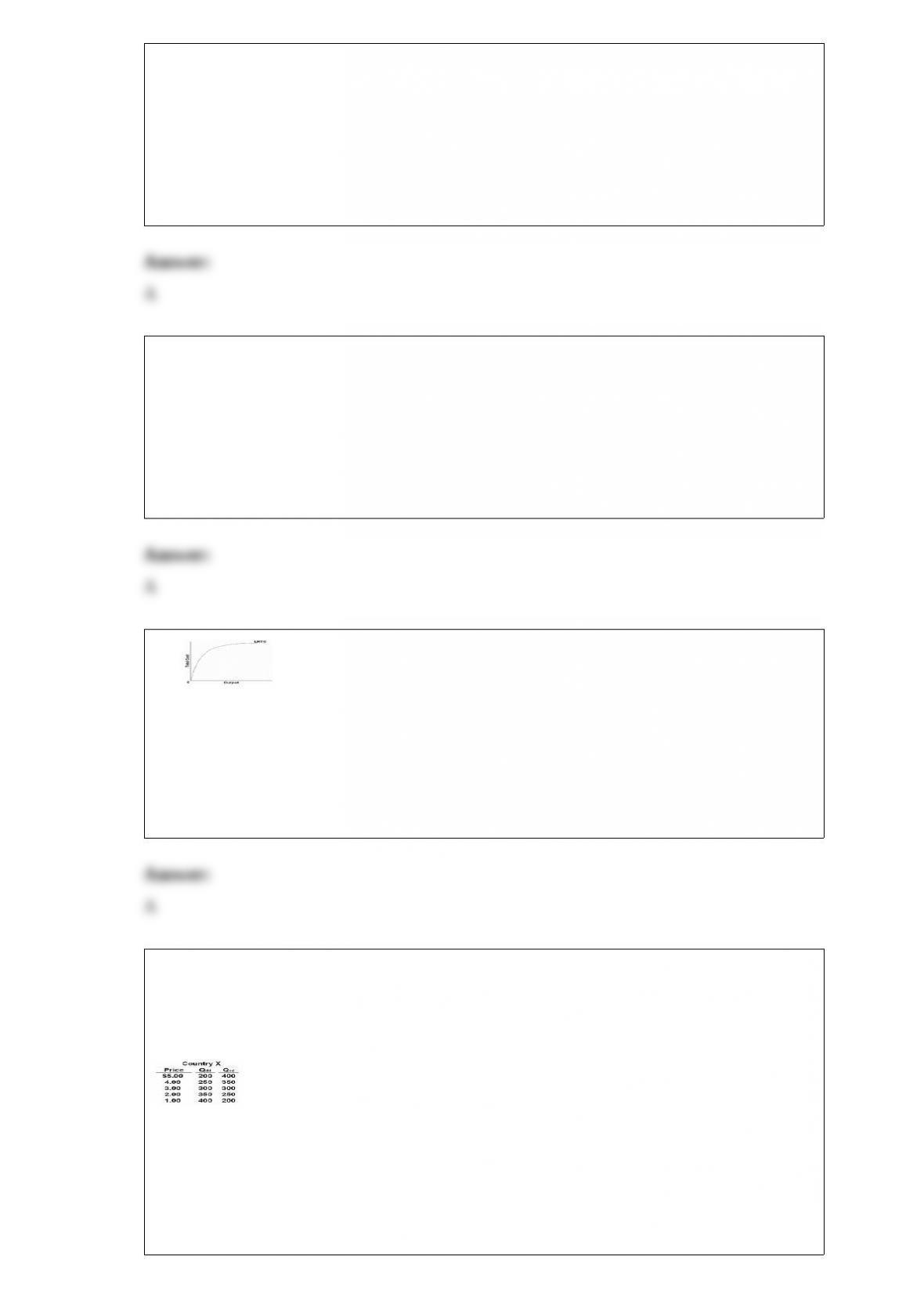
29)
In the graph above LRTC = long-run total cost. The firm is experiencing:
A.Economies of scale
B.Diseconomies of scale
C.Constant returns to scale
D.Minimum efficient scale
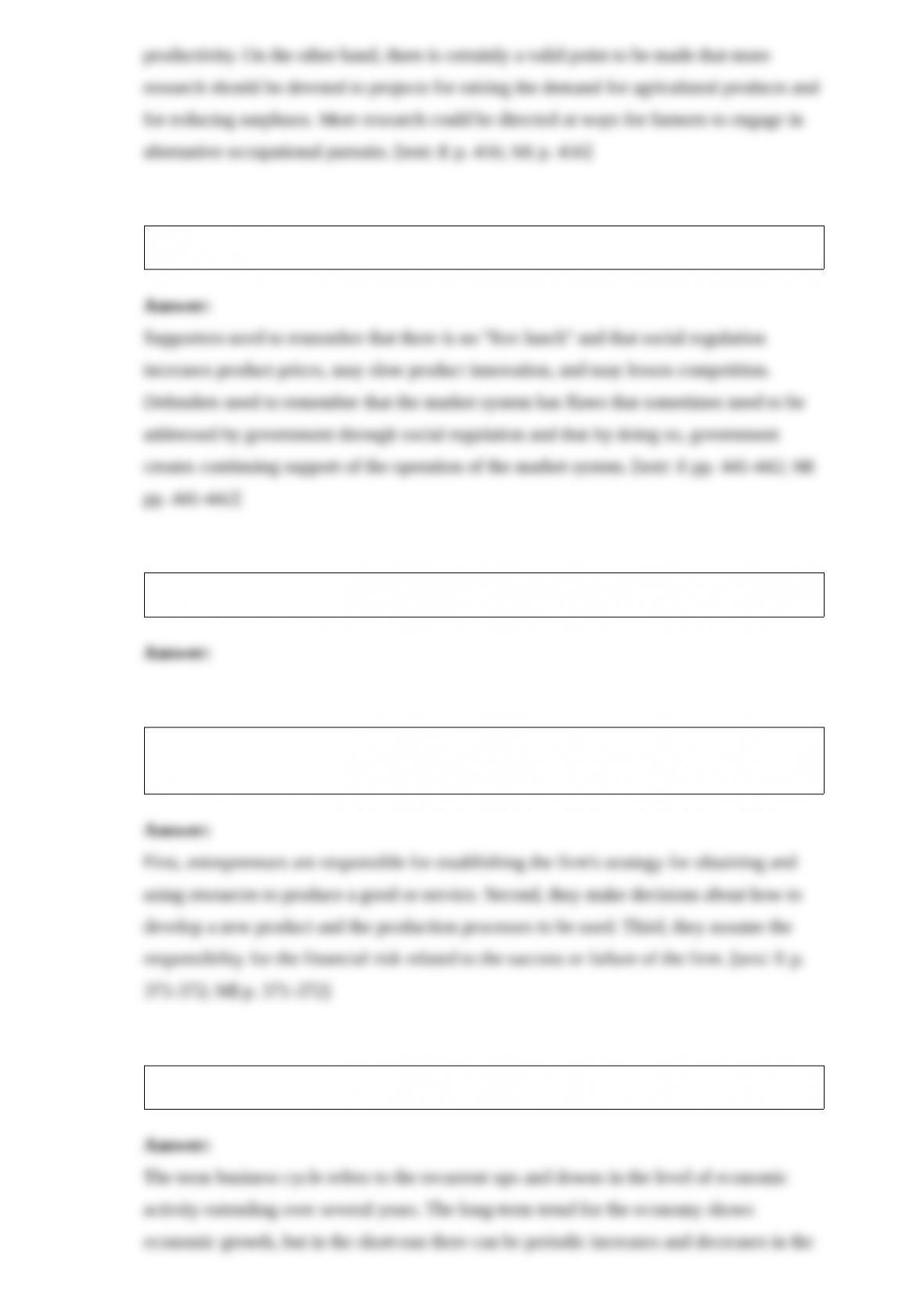
30) Use the following table for Country X to answer the question below. Column 1 of
the table is the price of a product. Column 2 is the quantity demanded domestically
(Qdd) and Column 3 is the quantity supplied domestically (Qsd).
Refer to the table above. If the world price is $5.00, there will be:
A.A domestic surplus of 100 units that will be exported
B.A domestic shortage of 100 units that will be imported
C.A domestic surplus of 200 units that will be exported
D.Neither a domestic surplus nor a shortage

31) Evaluate this statement “We should reduce federal spending on research and
development today. Those federal dollars are better spent by helping the poor.”
32)
33) What is the technology problem in DVCs?
34) “More research should be devoted to projects which will reduce rather than increase
agricultural surpluses.” Is this a sound approach? Explain.
35) What two reminders are needed in the debate over social regulation?
36)
37) What are the nonroutine decisions of entrepreneurs that involve substantial financial
risk?
38) What is meant by the term business cycle as described by economists?

39) Describe rising health care costs in the United States relative to GDP.