
The single-price monopolist produces the quantity of output at which marginal cost
equals marginal revenue and charges a price that is greater than marginal revenue.
a. True
b. False
If new legislation allowed patients to sue their health-maintenance organization (HMO),
we would expect the supply curve for HMO-provided health care to shift to the left and
the price of such coverage to rise.
a. True
b. False
Which of the following is an example of market coordination?
a. Bad weather wipes out half the pineapple crop in Hawaii, the price of pineapples
rises, and consumers cut back on their purchases of pineapples.
b. The manager of a grocery store notices that his customers are buying tomato soup
about as quickly as he puts it on the shelves, so he orders more tomato soup from the
wholesaler.
c. The manager of a grocery store tells her employees to put the sugar-free cereals on
the top shelf where adults can find them more easily.
d. a and b
e. a, b, and c

The profit-maximization rule is as follows:
a. Produce the quantity of output at which price equals average total cost (unit cost).
b. Produce as much output as can be sold.
c. Produce the quantity of output at which marginal revenue equals marginal cost.
d. Produce the quantity of output at which marginal revenue equals unit cost.
e. Produce the quantity of output at which total cost is minimized.
Consider a point on a market demand curve. The point represents
a. a single price and the quantity demanded by an individual buyer.
b. a single price and the sum of the quantities demanded by all buyers.
c. various prices and various quantities demanded.
d. a single price and the quantity demanded by an individual buyer at that price and all
other prices.
e. a and c

In a monopsony model of the labor market, as more labor is hired, the marginal factor
cost of labor
a. decreases.
b. becomes zero.
c. remains constant.
d. increases.
e. becomes identical to the wage rate.
Arguments made against free trade include all of the following except
a. national defense considerations justify producing certain goods domestically whether
the country has a comparative advantage in their production or not.
b. infant industries should be protected from free trade so that they may have time to
develop and compete on an even basis with older, more established foreign industries.
c. dumping is an unfair trade practice that puts domestic producers of substitute goods
at a disadvantage that they should be protected against.
d. free trade is inflationary and should be restricted in the domestic interest.
e. if foreign governments subsidize their exports, foreign firms that export are given an
unfair advantage that domestic producers should be protected against.

Macroeconomics deals with issues involving large corporations, while microeconomics
exclusively deals with issues involving small businesses.
a. True
b. False
Scientists prefer to advance irrefutable theories, rather than refutable theories.
a. True
b. False
Which of the following is a possible objective of labor unions?
a. employment for all union members
b. maximizing the total (union) wage bill
c. maximizing income for a limited number of union members
d. a and b
e. a, b, and c

The federal government began issuing inflation-indexed Treasury bonds in
a. 1913.
b. 1989.
c. 1997.
d. 2001.
Firms demand credit so that they can invest in capital goods and finance roundabout
methods of production.
a. True
b. False
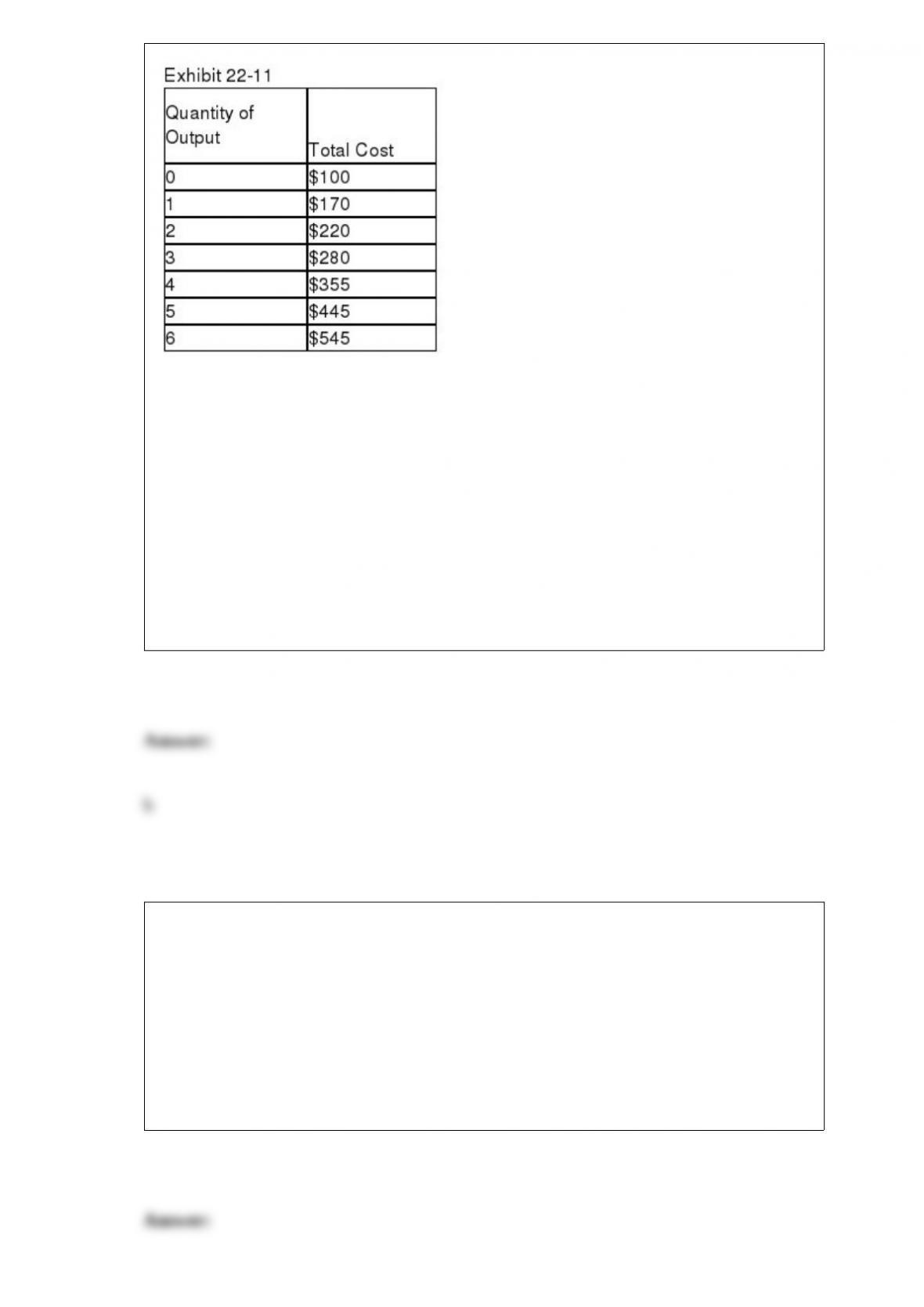
Average variable cost at two units of output is
a. $50.
b. $60.
c. $100.
d. $110.
e. There is not enough information provided to answer this question.
Which of the following is an example of a positive economic statement?
a. The U.S. public should devote more resources to education.
b. The poor should pay lower taxes and the rich should pay higher taxes.
c. Soap operas should be taken off television.
d. If you drop a ball from the top of a building, it will fall to the ground.

If the stock market quote in the newspaper reads 752 in the column headed €Vol 00s€, it
means that 752 shares of this stock were traded on this particular day.
a. True
b. False
It is possible for the government to remove individuals from a prisoner€s dilemma
setting and make them better off.
a. True
b. False
If the demand for living in and visiting New York City were to decrease, then the
following would happen in this order:
a. prices of goods and services would fall, and then land rents would decrease.
b. land rents would decrease, and then prices of goods and services would decrease.
c. land rents would decrease, and then prices of goods and services would fall, and
finally land rents would increase.
d. land rents would decrease, and then prices of goods and services would increase.

e. There is not enough information to answer the question.
To engage in price discrimination, it is necessary that
a. a seller be a price searcher.
b. there be no arbitrage.
c. a seller incur different costs for servicing different customers.
d. a and b
e. all of the above
Consider two straight-line PPFs. They have the same vertical intercept, but curve I is
flatter than curve II. The opportunity cost of producing the good on the vertical axis
a. is greater along curve I.
b. is greater along curve II.
c. is the same along both curves.
d. cannot be compared for the two curves without more information.

When a person is making a decision at the margin he or she is comparing the additional
benefit of that activity to the additional cost of the proposed action.
a. True
b. False