
Under the assumptions of the Fisher effect and monetary neutrality, if the money supply
growth rate rises, then
a. both the nominal and the real interest rate rise.
b. neither the nominal nor the real interest rate rise.
c. the nominal interest rate rises, but the real interest rate does not.
d. the real interest rate rises, but the nominal interest rate does not.
Money is the only asset that functions as a store of value.
a. True
b. False
There is an increase in government expenditures financed by taxes and its overall
short-run effect on output is larger than the change in government spending. Which of
the following is correct?
a. By themselves, both the change in output and the change in the interest rate increase
desired investment.
b. By themselves, both the change in output and the change in the interest rate decrease
desired investment.

c. By itself, the change in output increases desired investment spending and by itself the
change in the interest rate decreases desired investment spending.
d. By itself, the change in output decreases desired investment spending and by itself
the change in the interest rate increases desired investment spending.
A person who is risk averse might accept a 50% chance of losing $100 today in
exchange for a 50% chance of winning $125 in two years if the interest rate was
a. 9% but not 10%
b. 10% but not 11%
c. 11% but not 12%
d. None of the above is correct; a risk averse person would not accept any of the above
bets.
If the interest rate decreases
a. or if the price level increases, then people will want to hold more money.
b. or if the price level increases, then people will want to hold less money.
c. or if the price level decreases, then people will want to hold more money.
d. or if the price level decreases, then people will want to hold less money.

On which of these bonds is the prospect of default most likely?
a. a junk bond
b. a municipal bond
c. a U.S. government bond
d. a corporate bond issued by Proctor & Gamble Corporation
Most economists believe that fiscal policy
a. only affects aggregate demand and not aggregate supply.
b. primarily affects aggregate demand.
c. primarily effects aggregate supply.
d. only affects aggregate supply and not aggregate demand.

The Stock Market Boom of 2015
Imagine that in 2015 the economy is in long-run equilibrium. Then stock prices rise
more than expected and stay high for some time.
RefertoStockMarketBoom2015.In the short run what happens to the price level and
real GDP?
a. both the price level and real GDP rise.
b. both the price level and real GDP fall.
c. the price level rises and real GDP falls.
d. the price level falls and real GDP rises.
Which of the following methods of picking stocks is notconsistent with fundamental
analysis?
a. doing research such as thoroughly reading and analyzing companies’ annual reports
b. choosing mutual funds that are managed by individuals with good reputations
c. viewing individual stock prices as unpredictable
d. relying upon the advice of Wall Street analysts

The manager of the bank where you work tells you that the bank has $400 million in
deposits and $340 million dollars in loans. The Fed then raises the reserve requirement
from 5 percent to 10 percent. Assuming everything else stays the same, how much is the
bank holding in excess reserves after the increase in the reserve requirement?
a. $0
b. $20 million
c. $40 million
d. $60 million
Liquidity refers to
a. the ease with which an asset is converted to the medium of exchange.
b. the measurement of the intrinsic value of commodity money.
c. the measurement of the durability of a good.
d. how many time a dollar circulates in a given year.
The deviation of unemployment from its natural rate is called
a. the normal rate of unemployment.

b. deviant unemployment.
c. cyclical unemployment.
d. fluctuating unemployment.
Sam deposits money into an account with a nominal interest rate of 4 percent. He
expects inflation to be 1.5 percent. His tax rate is 32 percent. Sam’s aftertax real rate of
interest
a. will be 1.2 percent if inflation turns out to be 1.5 percent; it will be higher if inflation
turns out to be lower than 1.5 percent.
b. will be 1.2 percent if inflation turns out to be 1.5 percent; it will be lower if inflation
turns out to be lower than 1.5 percent.
c. will be 1.7 percent if inflation turns out to be 1.5 percent; it will be higher if inflation
turns out to be lower than 1.5 percent.
d. will be 1.7 percent if inflation turns out to be 1.5 percent; it will be lower if inflation
turns out to be lower than 1.5 percent.
An aide to a U.S. Congressman computes the effect on aggregate demand of a $20
billion tax cut. The actual increase in aggregate demand is less than the aide expected.
Which of the following errors in the aide’s computation would be consistent with an
overestimation of the impact on aggregate demand?

a. The actual MPCwas larger than the MPCthe aide used to compute the multiplier.
b. The aide thought the tax cut would be permanent, but the actual tax cut was
temporary.
c. The increase in income shifted money demand less than the aide had anticipated.
d. The increase in income resulted in investment rising more than the aide had
anticipated.
Which of the following is one of the basic reasons why economists often appear to give
conflicting advice to policymakers?
a. similar opinions about the validity of economic theories
b. significant differences in education
c. differences in personal values
d. a reliance on normative statement for research theories
Figure 34-10
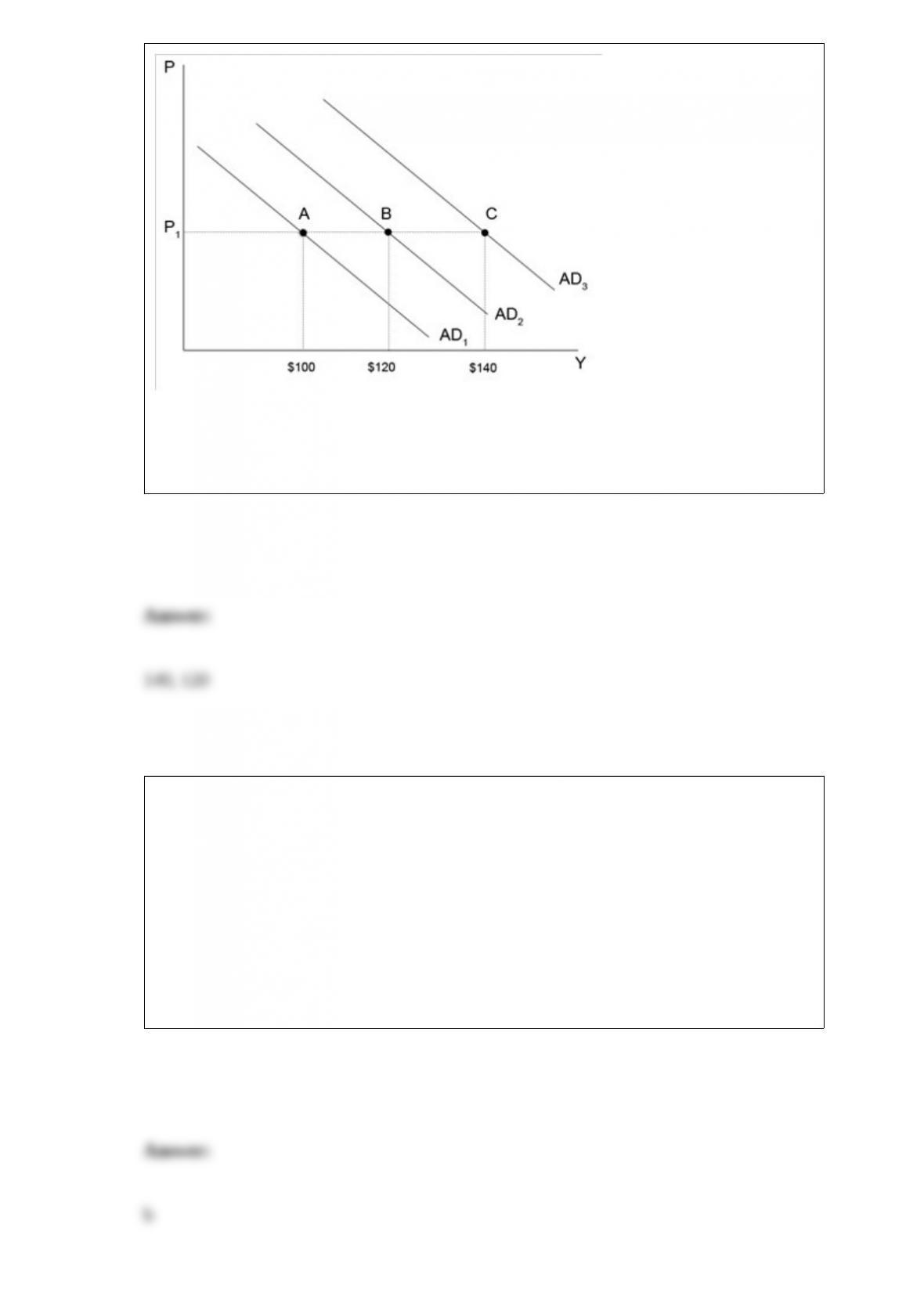
RefertoFigure34-10.Suppose the multiplier is 4 and the economy is currently at point
A. An increase in government purchases of $10 will increase aggregate demand to $if
there is no crowding-out. If crowding- out exists, then aggregate demand will likely to
increase to $.
When box office receipts are notcorrected for inflation, the most popular movie of all
time is
a. StaWars.
b. Avatar.
c. GoneWiththeWind.
d. TheDarkKnight.

The aggregate-demand curve shows that a decrease in the price level
a. decreases the dollar value of goods and services demanded in the economy.
b. decreases the real value of goods and services demanded in the economy.
c. increases the dollar value of goods and services demanded in the economy.
d. increases the real value of goods and services demanded in the economy.
The price level rises if either
a. money demand shifts rightward or money supply shifts leftward; this rise in the price
level is associated with a rise in the value of money.
b. money demand shifts rightward or money supply shifts leftward; this rise in the price
level is associated with a fall in the value of money.
c. money demand shifts leftward or money supply shifts rightward; this rise in the price
level is associated with a rise in the value of money.
d. money demand shifts leftward or money supply shifts rightward; this rise in the price
level is associated with a fall in the value of money.
Table 4-6

RefertoTable4-6.If these are the only four sellers in the market, then the market
quantity supplied at a price of $10 is
a. 3 units.
b. 11 units.
c. 25 units.
d. 44 units.
The goal of an economist who formulates new theories is to
a. provide an interesting framework of analysis, whether or not the framework turns out
to be of much use in understanding how the world works.
b. provoke stimulating debate in scientific journals.
c. contribute to an understanding of how the world works.
d. demonstrate that economists, like other scientists, can formulate testable theories.

When taxes decrease, consumption
a. increases, so aggregate demand shifts right.
b. increases, so aggregate supply shifts right.
c. decreases, so aggregate demand shifts left.
d. decreases, so aggregate supply shifts left.
Which of the following is correct?
a. A horizontal line has an infinite slope, and a vertical line has a zero slope.
b. A horizontal line has a slope of 1, and a vertical line has a slope of -1.
c. A horizontal line has a zero slope, and a vertical line has an infinite slope.
d. A horizontal line has a slope of -1, and a vertical line has a slope of 1.
If inflation expectations rise, the short-run Phillips curve shifts
a. right, so that at any unemployment rate inflation is higher in the short run than
before.
b. left, so that at any unemployment rate inflation is higher in the short run the before.
c. right, so that at any unemployment rate inflation is lower in the short run than before.
d. left, so that at any unemployment rate inflation is lower in the short run than before.
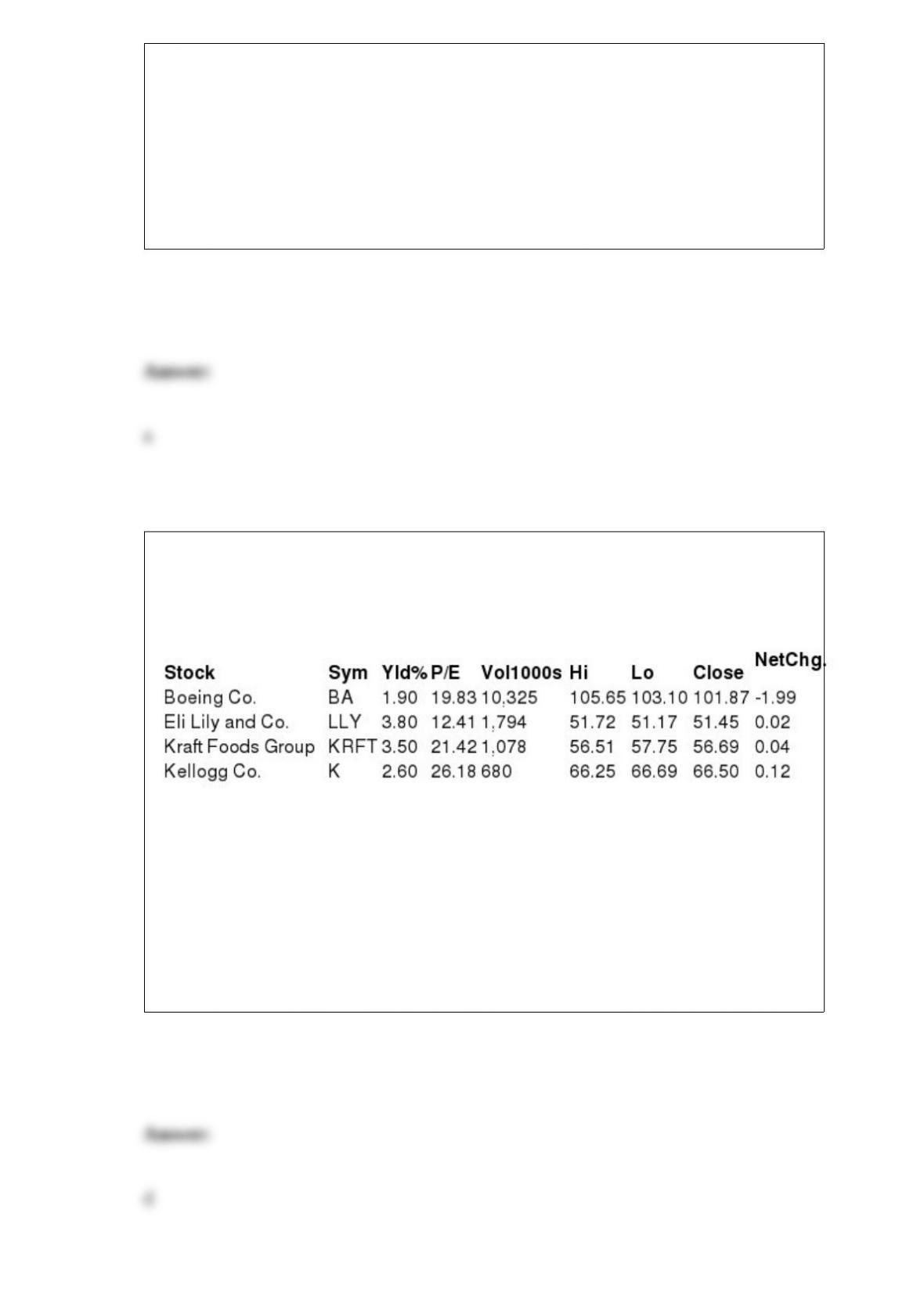
Table 26-2
RefertoTable26-2.Which company had the lowest dollar dividend per share?
a. Boeing Co.
b. Eli Lilly and Co.
c. Kraft
d. Kellogg Co.

Economists believe that production possibilities frontiers are often bowed because
a. trade-offs inevitably create unemployment.
b. resources are not completely adaptable.
c. opportunity costs are constant.
d. of improvements in technology.
If inflation expectations rise, the short-run Phillips curve shifts
a. left. If inflation remains the same, unemployment falls.
b. left. If inflation remains the same, unemployment rises.
c. right. If inflation remains the same, unemployment falls.
d. right. If inflation remains the same, unemployment rises.
Which of the following statements is correct?
a. Human capital per worker is a determinant of productivity.
b. A nation cannot be highly productive in producing goods and services without
abundant quantities of natural resources.

c. Human capital and technological knowledge are the same thing.
d. All technological knowledge is proprietary.
Tax increases
a. and increases in government expenditures shift aggregate demand right.
b. and increases in government expenditures shift aggregate demand left.
c. shift aggregate demand right while increases in government expenditures shift
aggregate demand left.
d. shift aggregate demand left while increases in government expenditures shift
aggregate demand right.
A tire manufacturer produces 400 tires valued at $20 each. Three hundred tires are sold
to a tire shop, which then sells them to households for $50 each. The remaining tires are
unsold and are added to the tire manufacturer’s inventory. How much is added to GDP?
a. $8,000
b. $15,000
c. $17,000
d. $13,000

Which of the following best illustrates the human capital of a survivor stranded on an
island?
a. the fishing poles she has produced
b. the invention of a better fishing lure
c. the fresh fruit and fish on and around the island
d. her previous training in a survival course