
An increase in a fixed exchange rate from $2.00 per pound to $2.10 per pound is called
a(n) ________ of the pound.
A) devaluation
B) depreciation
C) appreciation
D) revaluation
A quota is
A) a limit placed on the quantity of goods that can be imported into a country.
B) a tax imposed by a government on goods imported into a country.
C) a subsidy granted to importers of a vital input.
D) a health and safety restriction imposed on an imported product.
When the market value of the dollar rises relative to other currencies around the world,
we say that
A) the dollar has appreciated.
B) the dollar has depreciated.
C) the demand for dollars has increased.
D) the supply of dollars has increased.
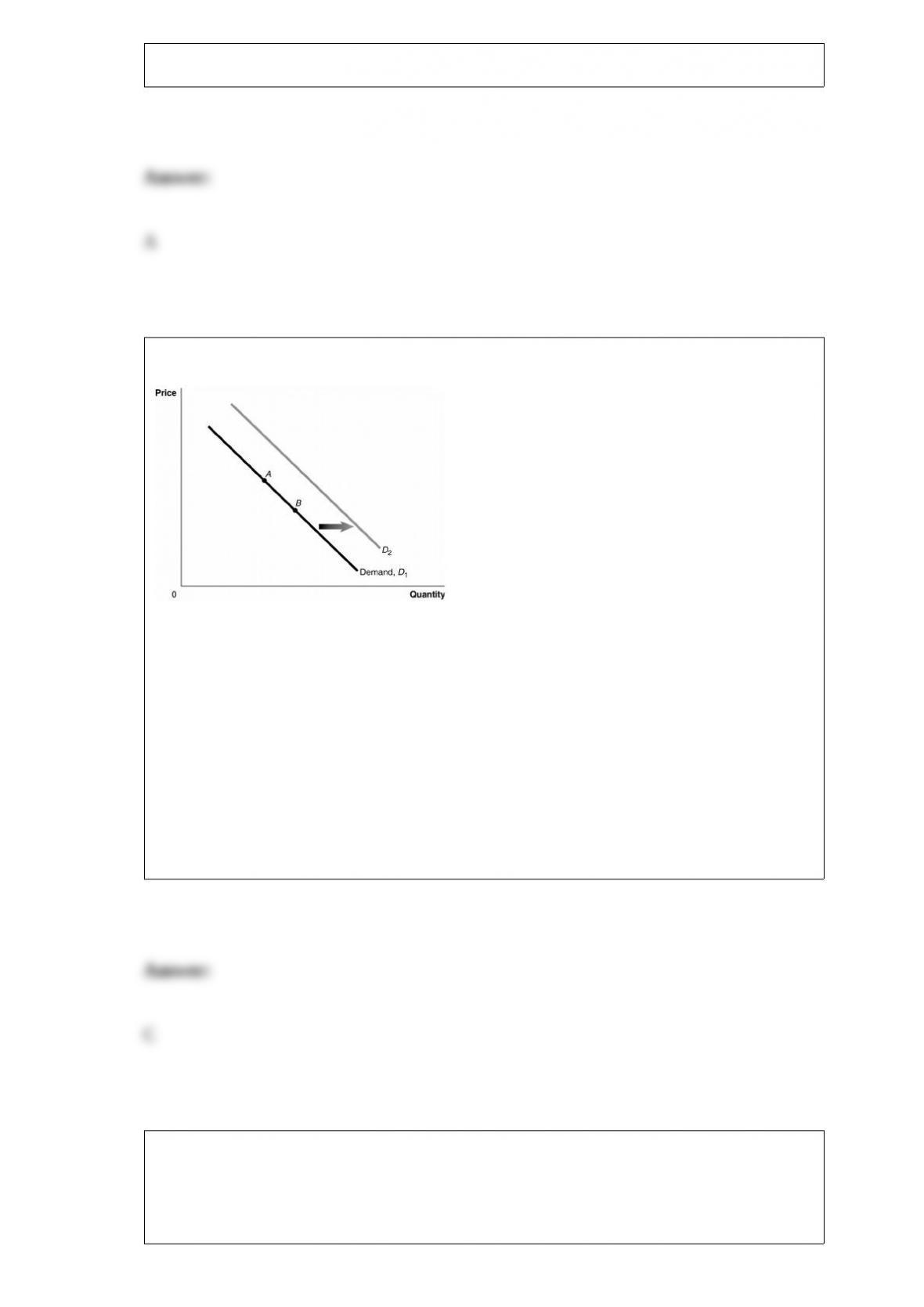
Figure 3-1
An increase in the expected future price of the product would be represented by a
movement from
A) A to B.
B) B to A.
C) D1 to D2.
D) D2 to D1.
The economic analysis of monopolistic competition shows that market forces eliminate
profits in the long run. However, it is possible for a firm to continue to earn economic
profits if the firm
A) expands its marketing budget.
B) adopts new technologies that enable it to lower its cost of production.
C) expands its product offerings to appeal to a wider range of consumers.
D) reduces its price to expand its market.
Professor Parallax chooses two students in his economics class, Jasmine and Cassandra,
to participate in the ultimatum game. He chooses Jasmine to be the allocator and
Cassandra to be the recipient. He gives Jasmine $50 and as the allocator, she gets to
decide how to split the money with Cassandra. If Cassandra decides to accept the
amount allocated to her by Jasmine, both students get to keep the money. If Cassandra
decides to reject her allocation, neither student gets to keep the money. How much will
each student end up with if each student acts as if fairness is important? How much will
each student end up with if only Cassandra acts as if fairness is important? How much
will each student end up with if neither student cares about fairness?
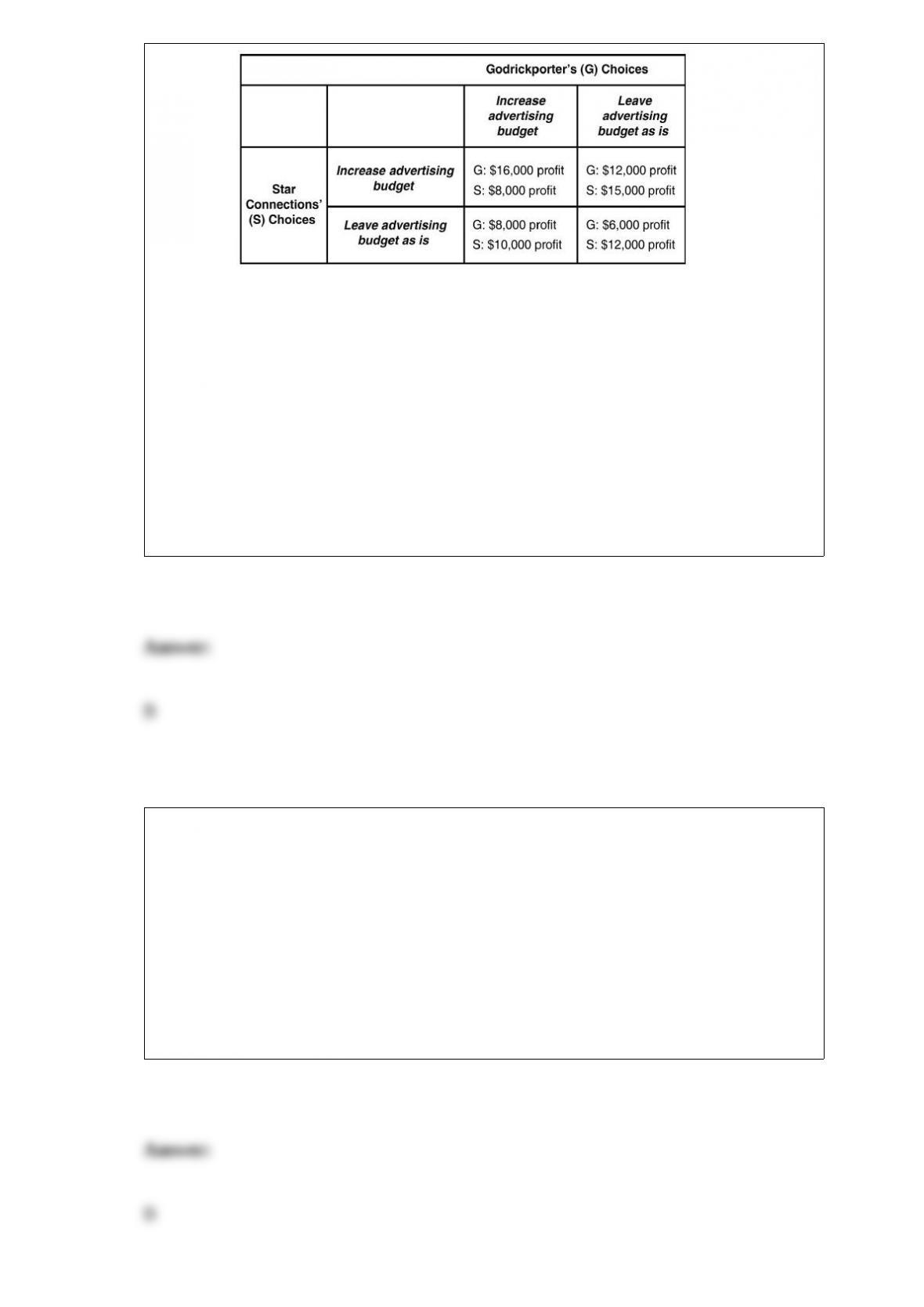
Table 14-1 Godrickporter
and Star Connections are the only two airport shuttle and limousine rental service
companies in the mid-sized town of Godrick Hollow. Each firm must decide on whether
to increase its advertising spending to compete for customers. Table 14-1 shows the
payoff matrix for this advertising game. What is the Nash equilibrium in this game?
A) There is no Nash equilibrium.
B) Godrickporter increases its advertising budget, but Star Connections does not.
C) Star Connections increases its advertising budget, but Godrickporter does not.
D) Both Godrickporter and Star Connections increase their advertising budgets.
Monetarism is a school of thought put forth by Milton Friedman. He argued that the
economy would most likely
A) be below potential GDP.
B) be at potential GDP.
C) be unstable.
D) be above potential GDP.
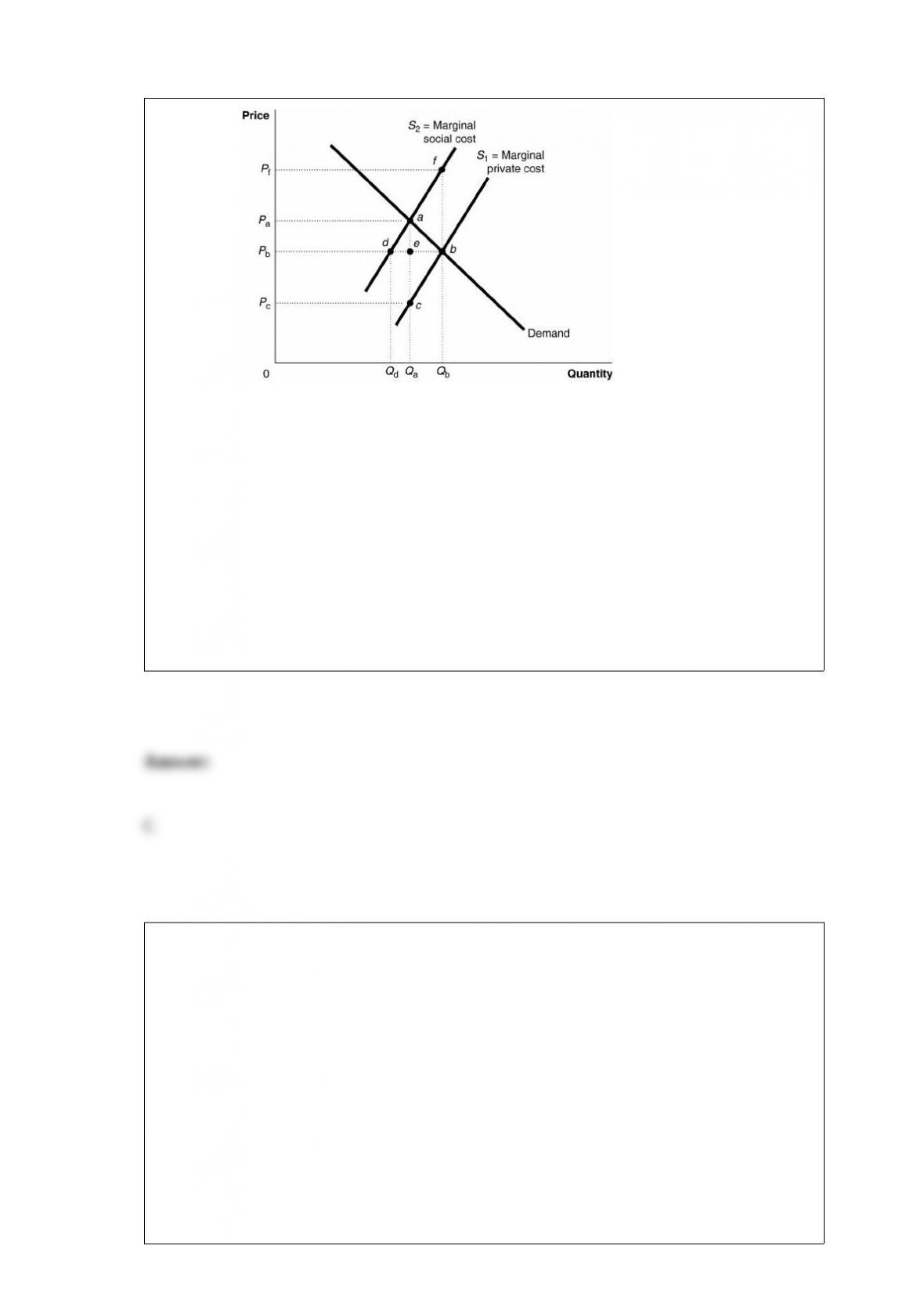
Figure 5-2 Figure 5-2 shows a
market with a negative externality.
The efficient output level is
A) Qd.
B) Q.
C) Qa.
D) Q – Qd.
According to a New York Times article, shoppers from New York City have played a
game of “retail arbitrage” by shopping at malls in Northern New Jersey, a state where
there is no tax on clothing and shoes. Even after accounting for transaction costs,
shoppers could still save money on their clothing and footwear purchases.
Source: Ken Belson and Nate Schweber, “Sales Tax Cut in City May Dim Allure of
Stores Across Hudson,” New York Times, January 18, 2007. Is the term “arbitrage”
correctly used here?
A) Yes, because shoppers were able to purchase items at lower prices even after
deducting their transaction costs.
B) No, “arbitrage” means buying at a low price and reselling at a higher price, but no
resale takes place here.
C) Yes, arbitrage applies even if no resale takes place; in this case the profits are
pocketed by the customers themselves.
D) No, “arbitrage” does not apply to markets that are not in the same geographic area.
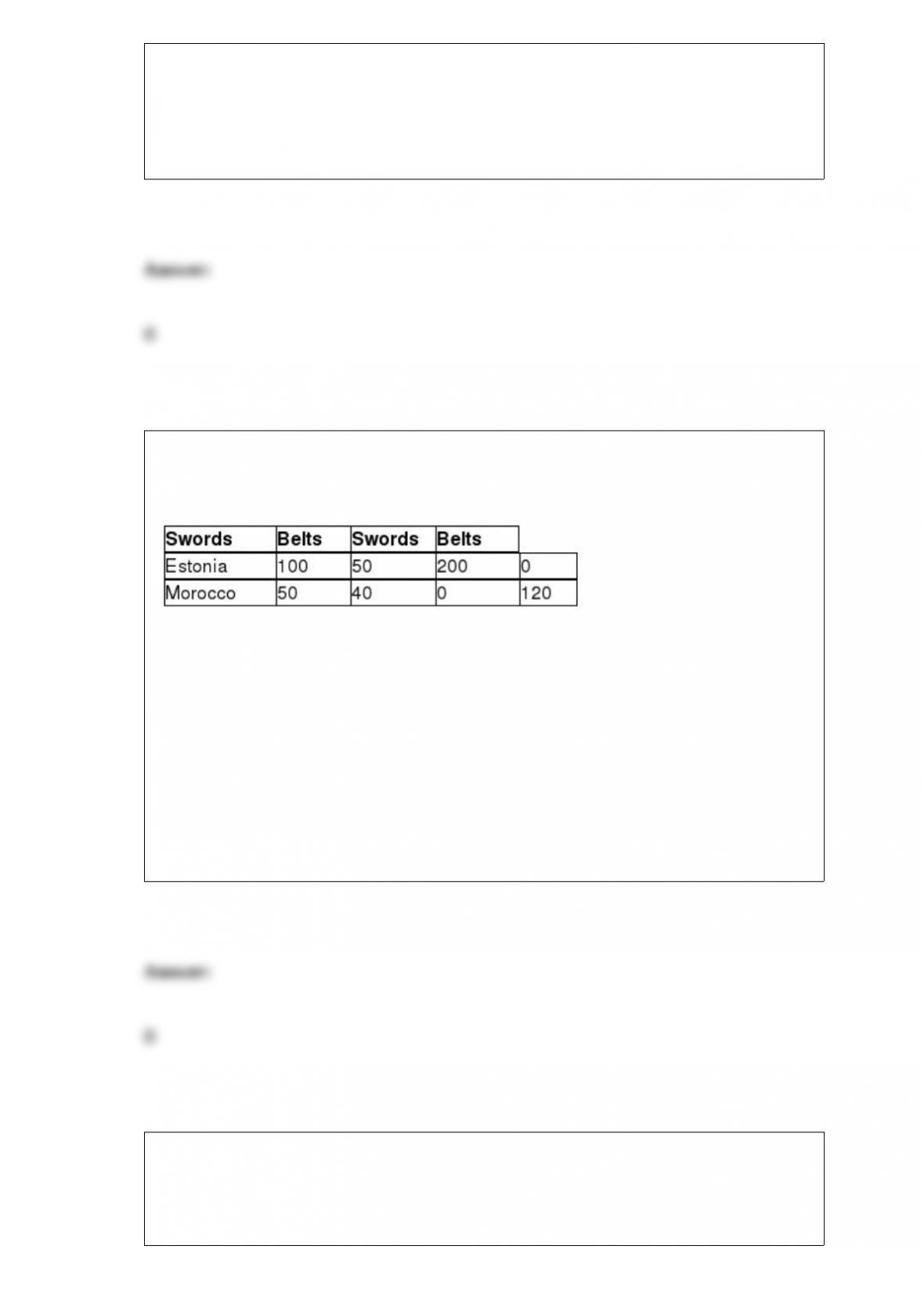
Table 7-6 Production and
Consumption Production
Without Trade With Trade
Estonia and Morocco can produce both swords and belts. Table 7-6 shows the
production and consumption quantities without trade, and the production numbers with
trade. Prior to trade, what was the opportunity cost to produce 1 sword in Morocco?
A) 1/2 of a belt
B) 4/5 of a belt
C) 1.25 belts
D) 2 belts
Which of the following statements is true about optimal two-part tariff and perfect price
discrimination for a given demand curve?
A) The total revenue received under the two pricing schedules is the same.

B) The total revenue received under an optimal two-part tariff exceeds that received
under perfect price discrimination.
C) The total revenue received under an optimal two-part tariff is less than that received
under perfect price discrimination.
D) The total revenue received under an optimal two-part tariff could be greater than,
less than or equal to that received under perfect price discrimination, depending on the
fixed-fee portion of the two-part tariff.
The GDP deflator is the
A) difference between real GDP and nominal GDP multiplied by 100.
B) difference between nominal GDP and real GDP divided by 100.
C) ratio of real GDP to nominal GDP multiplied by 100.
D) ratio of nominal GDP to real GDP multiplied by 100.
The slope of a typical isoquant is negative because to produce a given output, a
producer
A) will use more of one input only if it uses more of another.
B) can use less of one input only if the productivity of that input increases
C) can use less of one input only if it uses more of another.

D) will use more of one input only if the price of that input falls.