
The General Agreement on Tariffs and Trade (GATT) was formed to replace the World
Trade Organization (WTO) because the WTO was empowered only to reduce barriers
to trade in goods. The GATT is an agreement to reduce barriers to trade in goods,
services and intellectual property.
If bankers become more uncertain regarding future deposits and withdrawals and
choose to hold more excess reserves against deposits, the money multiplier will
increase.
In economics, technology only refers to the development of new products.
Ceteris paribus, a real depreciation of the dollar will decrease net exports in the United
States.

The Sarbanes-Oxley Act of 2002 requires that CEOs personally certify the accuracy of
financial reports.
In face of a negative supply shock, the Fed may avoid a rise in unemployment only if it
is willing to increase the rate of inflation.
Demand for staples such as dairy products and bread is likely to be both income and
price inelastic.
If Blake can pick more cherries in one hour than Cody, then Blake has a comparative
advantage in cherry picking.

A market failure arises when an entire sector of the economy (for example, the airline
industry) collapses because of some unforeseen event.
An easy way to determine if a currency is undervalued at a point in time is to use the
model of purchasing power parity.
In an increasing-cost industry, the long-run supply curve is upward sloping.
The size of the underground economy as a percent of GDP is larger in the United States
as compared to poorer countries such as Zimbabwe.

In the short run, if a firm shuts down its maximum loss equals the amount of its fixed
cost.
If consumption is defined as C = 2,400 + 0.9Y, then the marginal propensity to consume
is 0.9.
In cities with rent control, people have an incentive to list their apartments on sites such
as Airbnb at rents ________ the controlled rates, because rent control causes a
________ of apartments.
A) above; surplus
B) above; shortage
C) below; surplus
D) below; shortage

According to the marginal productivity theory of income
A) the greater the quantity of resources owned by an individual, the greater his
incentive to increase productivity and his income.
B) the average income received by an individual who supplies resources is influenced
by the resources owner’s marginal productivity.
C) the income received by an individual who supplies labor services equals the
incremental benefit generated to the firm by that individual’s labor.
D) the income received by an individual who supplies labor services equals the profit
generated to the firm by that individual’s labor.
Although some economists believe network externalities are important barriers to entry,
other economists disagree because
A) they believe that the dominant positions of firms that are supposedly due to network
externalities are to a greater extent the result of the efficiency of firms in offering
products that satisfy consumer preferences.
B) they believe that most examples of network externalities are really barriers to entry
caused by the control of a key resource.
C) network externalities are really negative externalities.
D) they believe that the dominant positions of firms that are supposedly due to network
externalities are to a greater extent the result of economies of scale.

The Sherman Act prohibited
A) marginal cost pricing.
B) setting price above marginal cost.
C) collusive price agreements among rival sellers.
D) selling below average total cost.
Suppose the cross-price elasticity of demand between DVDs at Amazon.com and DVDs
at Buy.com is 3.5. Based on this information, predict what happens when Amazon.com
lowers its DVD prices by 10 percent.
A) The quantity of DVDs demanded on Amazon.com will increase by 35 percent.
B) The quantity of DVDs demanded on Buy.com will increase by 35 percent.
C) The quantity of DVDs demanded on Amazon.com will decrease by 35 percent.
D) The quantity of DVDs demanded on Buy.com will decrease by 35 percent.
Figure 13-6
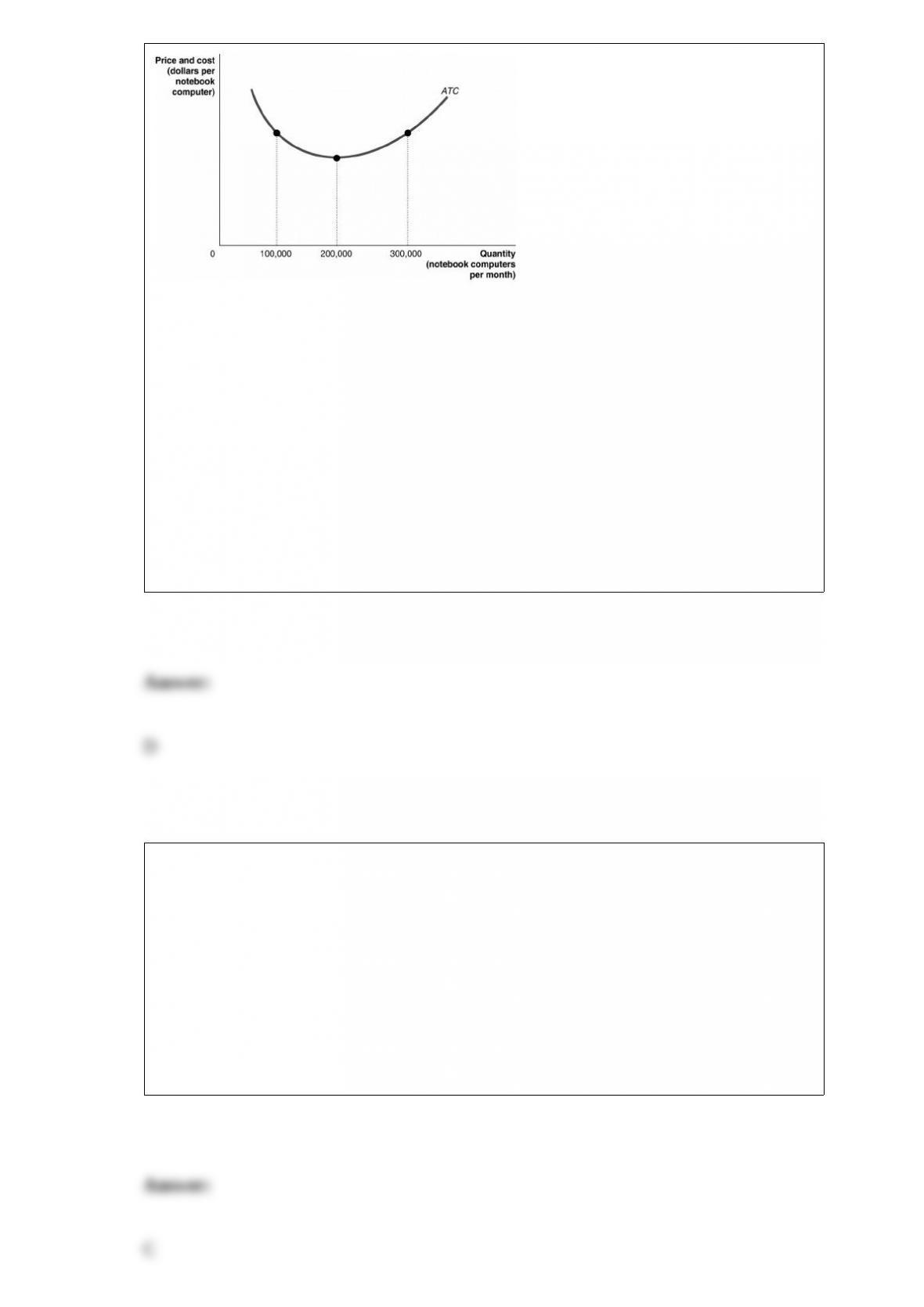
Suppose Dell finds the relationship between the average total cost of producing
notebook computers and the quantity of notebook computers produced is as shown by
Figure 13-2. Dell will maximize profits if it produces ________ notebook computers
per month.
A) 100,000
B) 200,000
C) 300,000
D) Not enough information is given to determine the profit-maximizing quantity.
Under a floating exchange rate, the exchange rate
A) will change whenever the price of gold changes.
B) is controlled by central bank intervention.
C) is determined by the interaction of supply of the currency and demand for the
currency.
D) is pegged against the euro.

Why do some economists point to a decline in the quality of labor as an explanation for
the productivity slowdown in the mid-1970s?
A) The average level of education of citizens of the United States rose dramatically
during this period of time.
B) The skill level required to perform many jobs increased during this period of time,
although the skills of the labor force did not increase as quickly.
C) Scores on standardized tests during that period of time began to rise.
D) Increases in the amount of capital available reduced labor quality.
If national saving decreases,
A) the sum of domestic investment and net exports must increase.
B) the sum of domestic investment and foreign investment must increase.
C) the sum of domestic investment and foreign investment must decrease.
D) foreign investment must increase to cover the loss.
The cost of producing cigarettes in the U.S. has increased and at the same time, more
and more Americans are choosing to not smoke cigarettes. Which of the following best
explains the effect of these events in the cigarette market?

A) The supply curve has shifted to the right and the demand curve has shifted to the
left. As a result there has been an increase in the equilibrium quantity and an uncertain
effect on the equilibrium price.
B) Both the supply and demand curves have shifted to the right. As a result, there has
been an increase in the equilibrium quantity and an uncertain effect on the equilibrium
price.
C) Both the supply and demand curves have shifted to the left. As a result, there has
been a decrease in the equilibrium quantity and an uncertain effect on the equilibrium
price.
D) The supply curve has shifted to the right and the demand curve has shifted to the
left. As a result, there has been an increase in the equilibrium price and an uncertain
effect on the equilibrium quantity.
Suppose that real GDP for 2012 was $10,000 billion and real GDP for 2013 was $9,500
billion. What is the rate of growth of real GDP between 2012 and 2013?
A) -10%
B) -5%
C) -2%
D) -1%
Table 14-7

The payoff matrix shown above assumes that Perfect Plants and Florabunda Florist
must decide whether to offer same-day delivery for their products. The matrix shows
how much profit each firm will earn if it does or does not offer same-day delivery. The
amount of profit for one firm depends on whether the other firm offers same-day
delivery.
Which of the following statements is true?
A) Given that Florabunda offers same-day delivery, Perfect’s best strategy is to not offer
same-day delivery.
B) Given that Perfect offers same-day delivery, Florabunda’s best strategy is to offer
same-day delivery.
C) Perfect and Florabunda will agree to collude in order to maximize their profits.
D) Neither Perfect nor Florabunda will offer same-day delivery; this decision will
decrease their costs and allow each firm to earn more than $1,800 million in profits.
With state and multistate lotteries, winners are typically given the choice between a
lump sum payment today or a 20 year series of annuities. How should a winner decide
which is better?
Suppose a doctor can earn an additional $10,000 in revenue per year from keeping her
office open on Saturdays. What must the additional cost of keeping the office open on
Saturdays be to make this decision economically rational?
Both the perfectly competitive firm and the monopolistically competitive firm produce
at the output where marginal revenue equals marginal cost (MR = MC) but only the
perfectly competitive firm achieves allocative efficiency. Explain why this is the case.

The growth rate of real GDP in the United States rises from 4.2% to 4.4%. Explain and
calculate how this increase in the growth rate of real GDP affects the number of years it
will take for real GDP to double.
How have U.S. imports and exports, as a fraction of GDP, changed from 1970 to the
present?
Assuming a fixed amount of taxes and a closed economy, calculate the value of the
government purchases multiplier, the tax multiplier, and the balanced budget multiplier
if the marginal propensity to consume equals 0.5.