
1) which of the following best defines national income?
a.income received by households less personal taxes
b.the before-tax income received by households
c.incomes earned by u.s. resource suppliers plus taxes on production and imports
d.the market value of the annual output net of consumption of fixed capital
2) The Federal gasoline tax is assessed on a per-gallon basis and the proceeds are used
for highway maintenance and improvements. This tax is consistent with the:
A.ability-to-pay principal of taxation.
B.benefits-received principal of taxation.
C.single-tax theory of taxation.
D.pay-as-you go theory of taxation.
3) corporations comprise about _____ percent of all businesses, but produce nearly
_____ percent of domestic output.
a.10; 90
b.25; 70
c.20; 85
d.85; 20
4) if the demand for product x is inelastic, a 4 percent increase in the price of x will:
a.decrease the quantity of x demanded by more than 4 percent.
b.decrease the quantity of x demanded by less than 4 percent.
c.increase the quantity of x demanded by more than 4 percent.
d.increase the quantity of x demanded by less than 4 percent.
5) In 2006, the average income for households in the United States was about:
A.$66,570.
B.$22,820.
C.$9,610.
D.$82,700.

6) every month harry decorates his front lawn with some type of seasonal or holiday
display. harry’s neighbors enjoy his displays and people come for miles each month to
drive by the house and view the decorations. based on this we could conclude that:
a.harry has created a public good.
b.harry’s decorations create substantial spillover benefits.
c.substantial negative externalities are created if those driving to see the decorations are
generating large amounts of pollution and/or congested traffic in the neighborhood.
d.all of the above are possible outcomes of harry’s decorations.
7) Which of the following best describes the built-in stabilizers as they function in the
United States?
A.The size of the multiplier varies inversely with the level of GDP.
B.Personal and corporate income tax collections automatically fall and transfers and
subsidies automatically rise as GDP rises.
C.Personal and corporate income tax collections and transfers and subsidies all
automatically vary inversely with the level of GDP.
D.Personal and corporate income tax collections automatically rise and transfers and
subsidies automatically decline as GDP rises.
8) When a commercial bank has excess reserves:
A.it is in a position to make additional loans.
B.its actual reserves are less than its required reserves.
C.it is charging too high an interest rate on its loans.
D.its reserves exceed its assets.
9) the demand for commodity x is represented by the equation p = 10 – 0.2q and supply
by the equation p = 2 + 0.2q.
refer to the above information. if demand changed from p = 10 – .2q to p = 7 – .3q, the
new equilibrium price is:
a.$2.
b.$4.
c.$6.
d.$7.
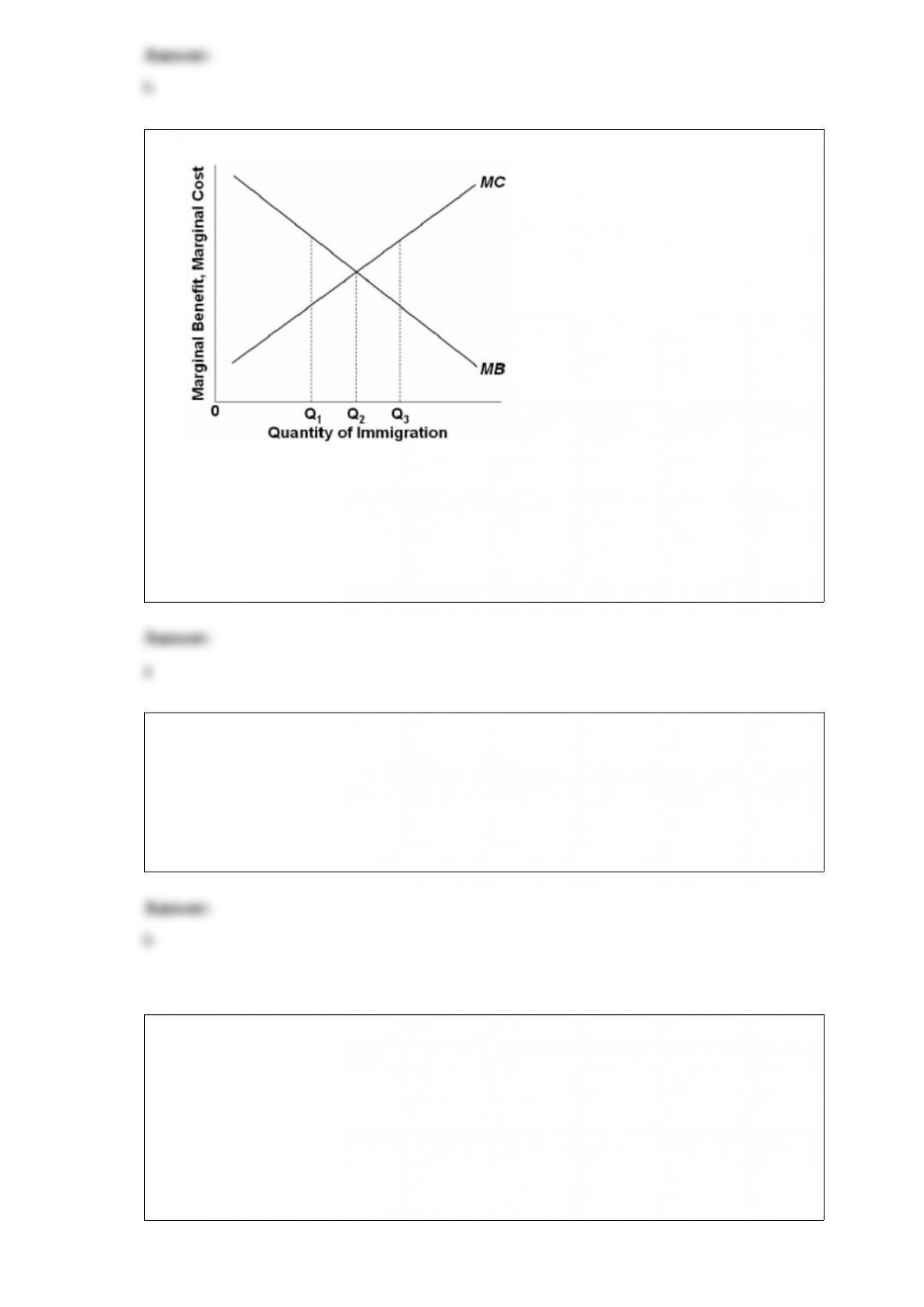
10)
refer to the above figure. a weaker economy, characterized by higher unemployment
rates, will:
a.reduce mb and increase mc, lowering the optimal quantity of immigrants.
b.increase mb and reduce mc, raising the optimal quantity of immigrants.
c.increase both mb and mc, and the effect on the optimal quantity is uncertain.
d.reduce both mb and mc, and the effect on the optimal quantity is uncertain.
11) if a purely competitive firm is producing at the p = mc output and realizing an
economic profit, at that output:
a.marginal revenue is less than price.
b.marginal revenue exceeds atc.
c.atc is being minimized.
d.total revenue equals total cost.
12) which of the following is not a valid generalization concerning the relationship
between price and costs for a purely competitive seller in the short run?
a.price must be at least equal to average total cost.
b.price times quantity produced must be equal to or greater than total variable cost for
some level of output or the firm will close down in the short run.
c.price may be equal to, greater than, or less than average total cost.
d.price must be equal to or greater than minimum average variable cost for the firm to
continue producing.
13) The velocity of money may be stated as:
A.PM/V.
B.nominal GDP/M.
C.QM/P.
D.PM/Q.
14) (Consider This) In part as a result of the U.S. government’s ethanol program,
between 2005 and 2007 the inflation-adjusted price of a bushel of corn:
A.rose 50 percent.
B.rose 200 percent.
C.fell 20 percent.
D.collapsed to only 5 percent of its pre-2005 level.
15) Over the next fifteen years, ___ out of 10 people added to the world’s population
will be born in developing countries.
A.6
B.7
C.8
D.9
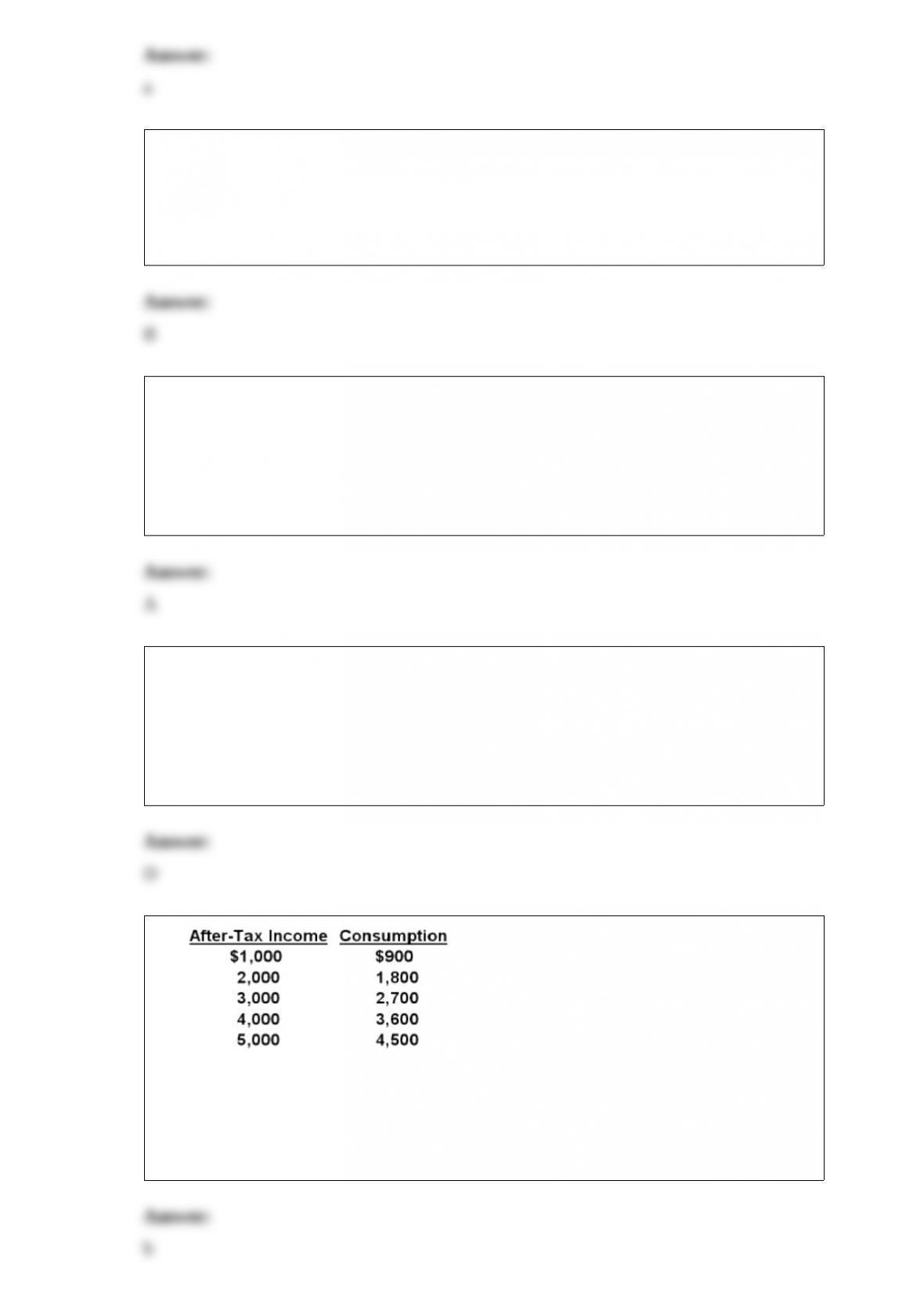
16)
the above data suggest that:
a.consumption varies inversely with after-tax income.
b.consumption varies directly with after-tax income.
c.consumption and after-tax income are unrelated.
d.a tax increase will increase consumption.
17) The marginal benefit to society of reducing pollution declines with increases in
pollution abatement because of the law of:
A.increasing costs.
B.diminishing returns.
C.diminishing marginal utility.
D.conservation of matter and energy.
18) an unexpected increase in total spending will cause an increase in gdp:
a.if prices are sticky.
b.if prices are fully flexible.
c.regardless of whether prices are sticky or fully flexible.
d.only if prices are stuck in the long term.
19) A doubling of Social Security benefits is likely to:
A.decrease the demand for loanable funds and increase the equilibrium interest rate.
B.increase the supply of loanable funds and decrease the equilibrium interest rate.
C.decrease the supply of loanable funds and increase the equilibrium interest rate.
D.increase the real interest rate but not the nominal interest rate.
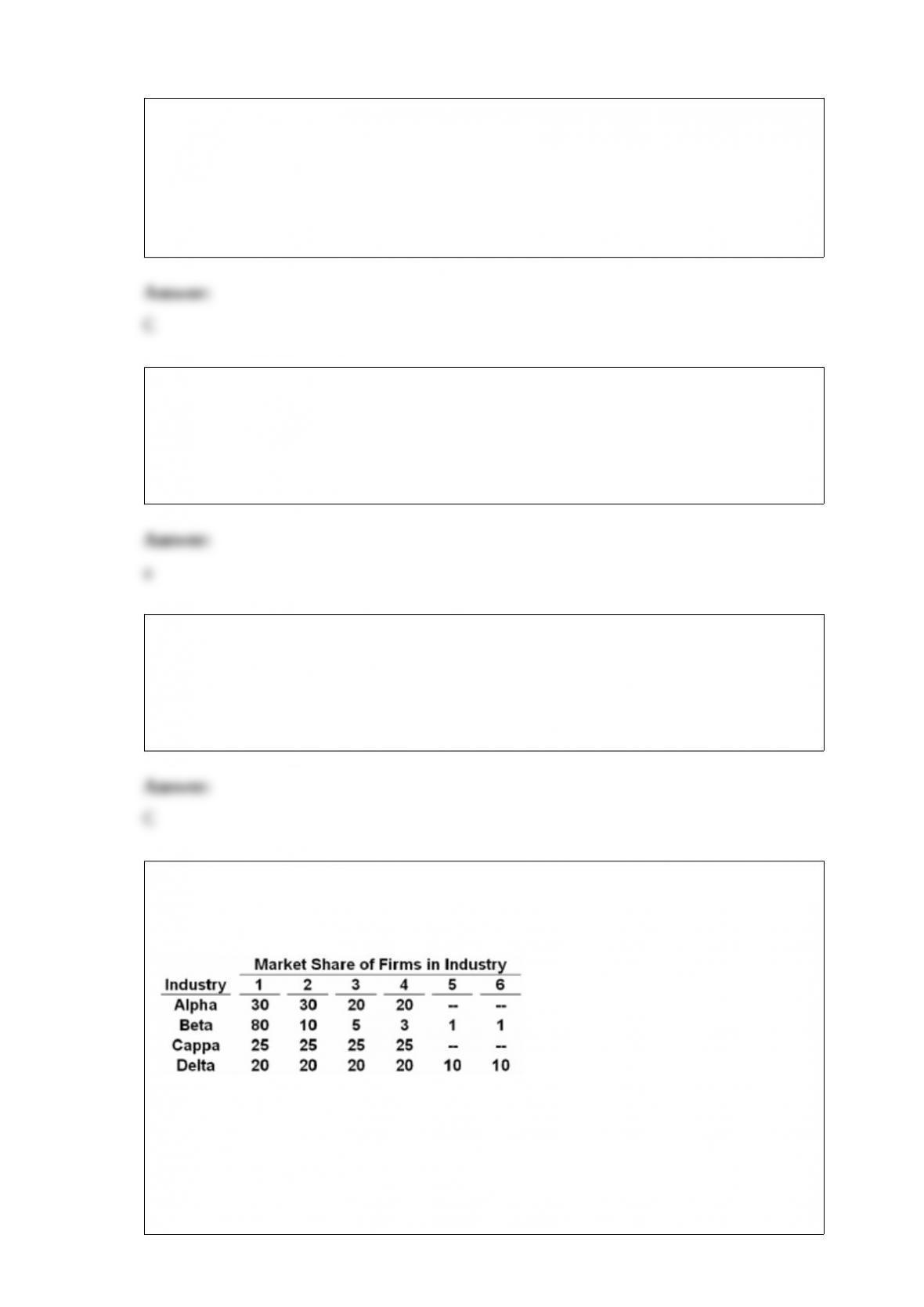
20) The basis of the following table shows market shares of firms in hypothetical
industries. Assume these are distinct industries with no buyer-seller relationships or
competition among them.
Refer to the above table. The industry with the greatest market power as measured by
the Herfindahl index is:
A.Alpha.
B.Beta.
C.Cappa.
D.Delta.