
1) A decline in the real interest rate will shift the investment demand curve to the right.
2) In a purely competitive labor market, a profit-maximizing firm will hire labor up to
the point where the marginal resource cost equals the wage rate.
3) Recognition heuristics help advertisers gain customers.
4) U.S. business firms channel a majority of their R&D expenditures to scientific
research.
5) The M1 money supply is composed of currency, checkable deposits, and savings
deposits.
6) Given that the demand for grains is price-inelastic, we would expect that if the
harvest of grains increases significantly, other factors constant, then grain farmers’ total
revenues would increase.
7) Malthus argued that any increase in living standards would cause a decrease in
population growth.

8) Economic analysis is primarily concerned with marginal changes from the status
quo, as a result of a certain action or decision.
9) When a bank’s loan defaults, then the bank’s reserves will decrease.
10) The amount of investment in an economy is ultimately limited by the amount of
savings in that economy.
11) Prospect theory and the work of behavioral economists confirm that consumers are
economically rational.
12) A check for $10,000 drawn on Bank A and deposited at Bank B will increase the
excess reserves in Bank B by $10,000.
13) If changes in demand cause significant changes in equilibrium price, then supply
must be quite inelastic.
14) If the Fed buys government securities from commercial banks in the open market:
A.The Fed gives the securities to the commercial banks and increases the banks’
reserves
B.The Fed gives the securities to the commercial banks decreases the banks’ reserves
C.Commercial banks give the securities to the Fed, and the Fed increases the banks’
reserves

D.Commercial banks give the securities to the Fed, and the Fed decreases the banks’
reserves
15) When inflation occurs:
A.All prices are rising
B.Each dollar of income will buy more output than before
C.The purchasing power of money increases
D.The purchasing power of money decreases
16) In 2007, immigrants made up a larger portion of the labor force in the U.S. than that
in Canada.
17) In the long run, the representative firm in monopolistic competition tends to have:
A.Excess capacity
B.Economic profits
C.No product differentiation
D.A perfectly elastic demand curve
18) A government-set price floor on a product:
A.Does not interfere with the rationing function of price in a market system
B.Will drive resources away from the production of the product
C.Will attract more resources towards the production of the product
D.Is intended to benefit the buyers of the product
19) Autos and chemicals are in million of units in the following production possibilities
tables:

Refer to the tables above. Suppose that each nation specialized in producing the product
for which it has a comparative advantage, and the terms of trade were set at 3 units of
chemicals for 1 unit of autos. In this case, Germany could obtain and consume a
maximum combination of 8 million units of autos and:
A.12 million units of chemicals
B.24 million units of chemicals
C.36 million units of chemicals
D.48 million units of chemicals
20) The economy experiences a decrease in the price level and an increase in real
domestic output. Which is a likely explanation?
A.Consumer incomes and the quantity of labor have decreased
B.Business costs and wage rates have decreased
C.The prices of imported resources have increased
D.National income abroad has increased
21) Use the following graph to answer question about the labor resource market faced
by producers of good X:
Refer to the above graph. What will shift D1 to D2?
A.An increase in the price of a substitute input (if the output effect > substitution effect)
B.A decrease in the price of a substitute input (if the substitution effect > output effect)
C.A decrease in the price of a substitute input (if the output effect > substitution effect)
D.An increase in the price of a complementary resource
22) According to behavioral economists, the human brain:
A.makes most decisions based on careful calculation of benefits and costs.
B.uses evolutionary-developed heuristics to make many decisions.
C.only develops heuristics for decision making after the same decision has been made
multiple times using a rational framework of comparing benefits and costs.
D.employs heuristics in decision making that are slow but generally error-free.

23) The strategy of establishing a price that prevents the entry of new firms is called:
A.Cartel pricing
B.Limit pricing
C.Price leadership
D.Profit maximizing price
24) The market supply curve indicates the:
A.Minimum acceptable prices that sellers are willing to accept for the product
B.Maximum prices that buyers are willing and able to pay for the product
C.Total revenues that sellers would receive from selling various quantities of the
product
D.Total amount that buyers will pay in buying a given quantity of the product
25) The business cycle depicts:
A.fluctuations in the general price level.
B.the phases a business goes through from when it first opens to when it finally closes.
C.the evolution of technology over time.
D.short-run fluctuations in output and employment.
26) Demand-side market failures occur when:
A.the demand and supply curves don’t reflect consumers’ full willingness to pay for a
good or service.
B.the demand and supply curves don’t reflect the full cost of producing a good or
service.
C.government imposes a tax on a good or service.
D.a good or service is not produced because no one demands it.
27) The fundamental objective of monetary policy is to assist the economy in
achieving:

A.A rapid pace of economic growth
B.A money supply which is based on the gold standard
C.A full-employment, noninflationary level of total output
D.A balanced-budget consistent with full-employment
28) Answer the question on the basis of the following four tax schedules for the given
base of taxable income.
Which of the above tax schedules is a regressive tax schedule throughout?
A.A
B.B
C.C
D.None of the schedules
29) Immigrant entrepreneurs have founded what portion of semiconductor,
computer/communication, and software companies in the U.S.?
A.5% – 10%
B.10% – 20%
C.20% – 25%
D.25% – 35%
30) Which of the following statements about self-interest in a market system is false?
A.Self-interest usually motivates an individual to deliver something of value to others
B.Self-interest of entrepreneurs implies seeking maximum profits or minimum losses
C.Self-interest applies only to capitalists and entrepreneurs, not to workers employed by
others
D.In a market system, consumers are just like firms: self-interest is what motivates
them

31)
Refer to the graph above which shows the supply and demand for money where Dm1,
Dm2, and Dm3 represent different demands for money and Sm1, Sm2, and Sm3 represent
different levels of the money supply. The initial equilibrium point is A. What will be the
new equilibrium point following a decrease in the money supply?
A.B
B.E
C.F
D.I
32) The following table gives hypothetical data on the dollar price of Euros.
Refer to the table above. How many euros can be bought for $44 at the equilibrium
exchange rate?
A.10
B.20
C.30
D.40
33) The utility of a good or service:
A.is synonymous with usefulness.
B.is the satisfaction or pleasure one gets from consuming it.
C.is easy to quantify.
D.rarely varies from person to person.
34) Explain the two stabilization policies politicians use to smooth business cycles.
35) What do economists mean when they say that “there is no free lunch”? Give another
example to which this statement applies.
36)
37) Why do governments often intervene in international trade to restrict imports and
expand exports?
38)
39) In most industries increased spending is a sign of prosperity. Why is increased
spending a cause for alarm in the health care industry?
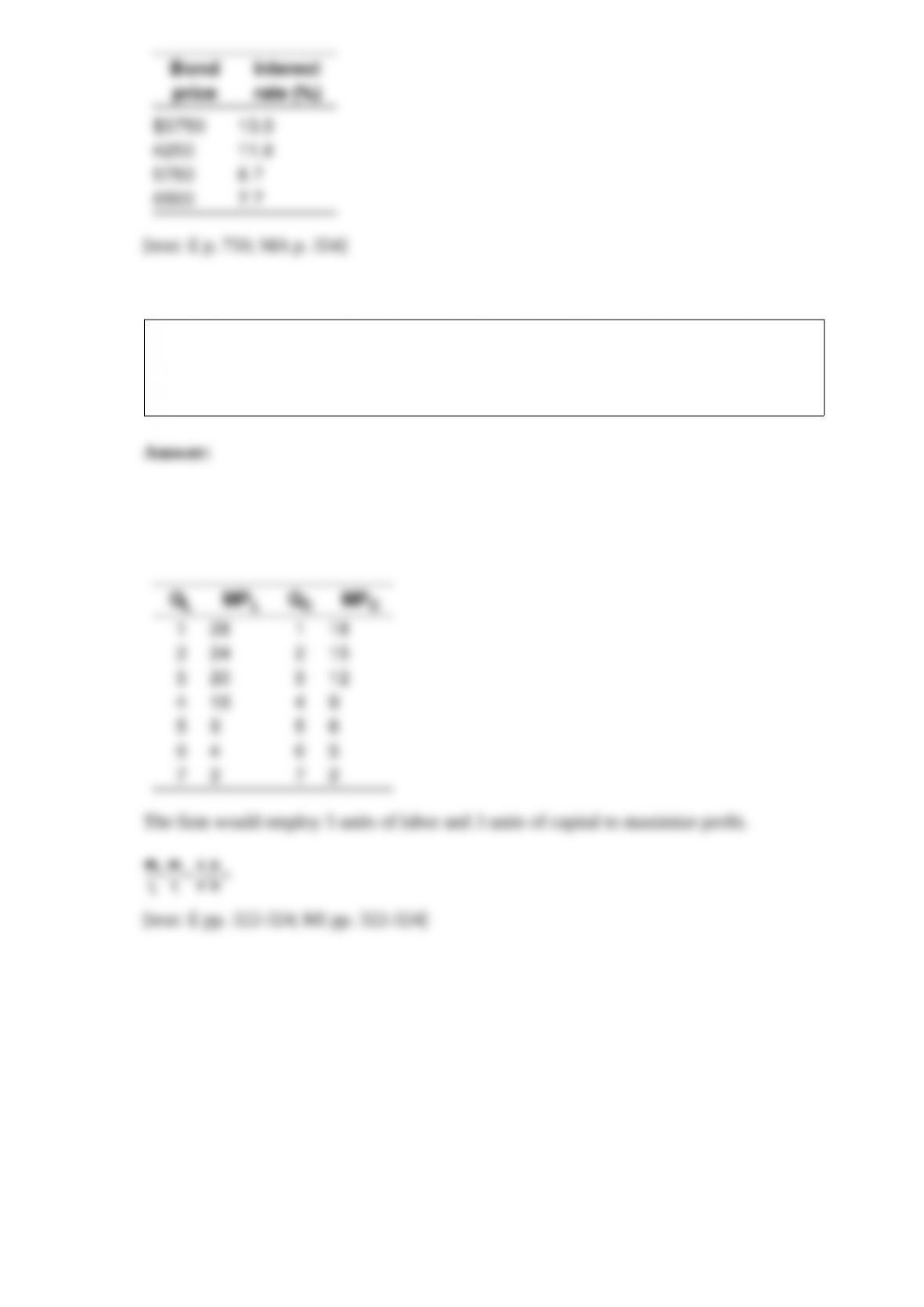
40) Suppose that a bond having no expiration date has a face value of $5000 and pays a
fixed amount of interest of $500 annually. Compute and enter in the spaces provided the
effective interest rate (to one decimal place) that a bond buyer could receive at the new
bond price.
41) A perfectly competitive firm in the factor and product markets sells its output for $1
and pays factors PL = $9 and Pc = $12. What is the profit-maximizing combination of
labor (L) and capital (C) for the firm?