
1) The United States has had significant trade and current account surpluses in recent
years.
2) if a good’s production creates substantial negative externalities, then too little of it
will be produced unless firms are subsidized.
3) Barriers to free trade impair efficiency in the international allocation of resources.
4) at zero units of output a firm’s variable costs are zero.
5) User cost is defined as the present value of the profit the company would earn if it
delayed extraction until next year.
6) A total fertility rate of 1.0 is necessary to keep the population constant over time.
7)
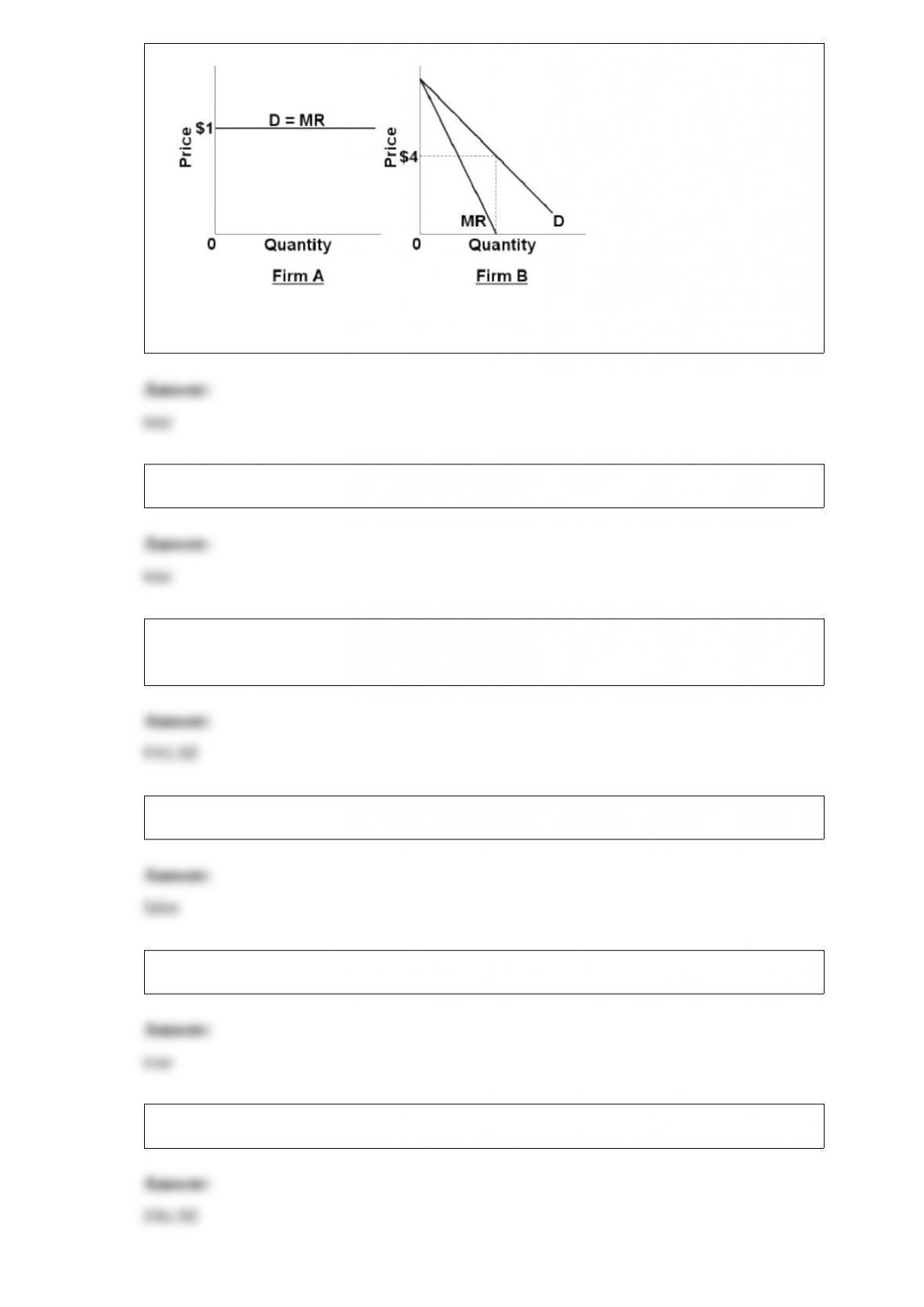
refer to the above diagrams. the demand for firm b’s product is elastic at all prices in
excess of $4.
8) there were over 1 million legal immigrants into the united states in 2007.
9) If two resources are complementary, a decrease in the price of one will reduce the
demand for the other.
10) real gdp per capita is found by dividing real gdp by the size of the labor force.
11) the major expenditure of local governments is for education.
12) Currency and coins held by banks are part of the M1 definition of money supply.
13) noncash gift giving involves value loss when the marginal utility of the gift to the
receiver is less than the product price.
14) Other things equal, the shorter the loan period and the larger the loan size, the
higher is the interest rate charged by the lender.
15)
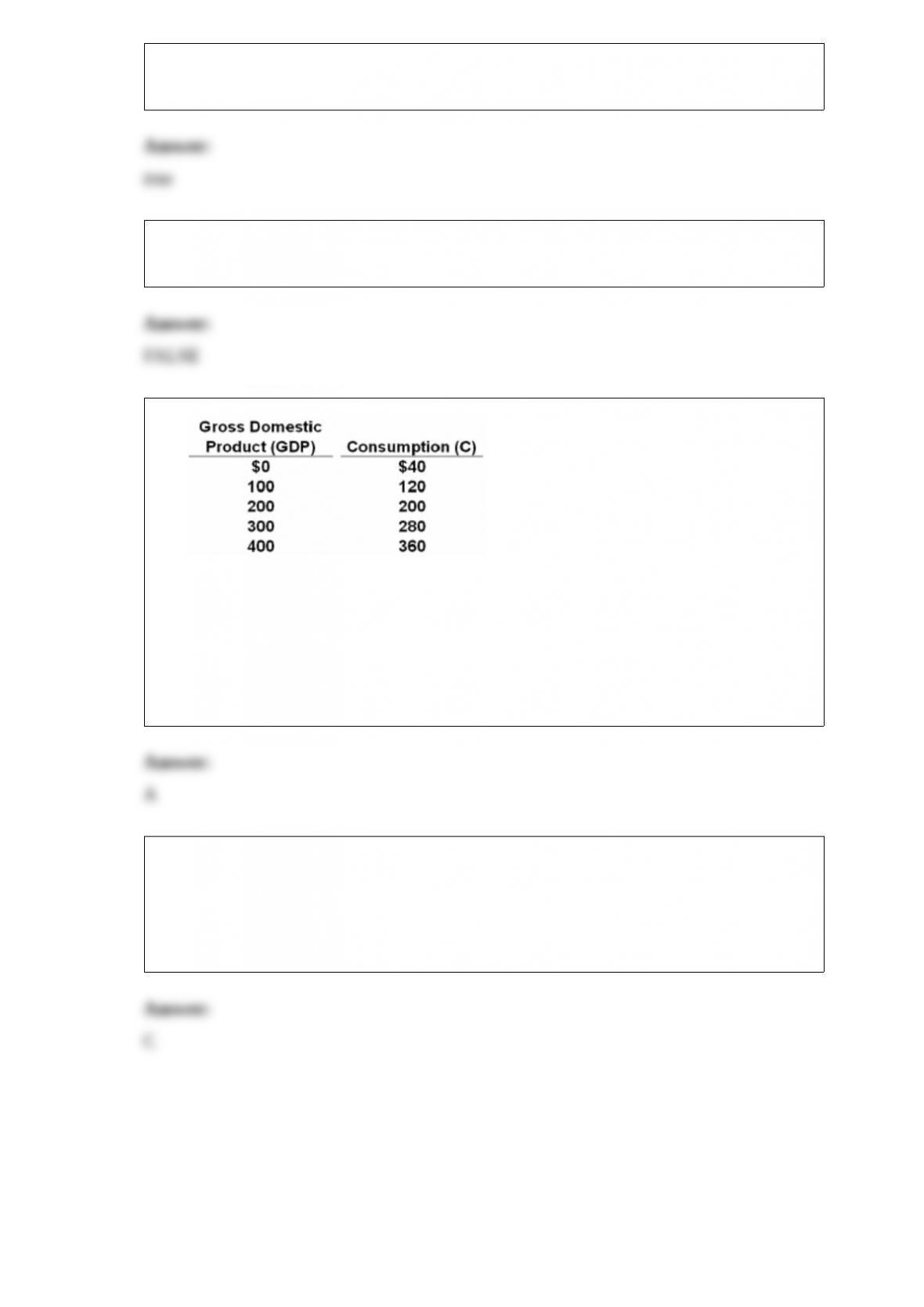
Refer to the above data. If a lump-sum tax (the same tax amount at each level of GDP)
of $40 is imposed in this economy, the tax system:
A.is regressive.
B.is proportional.
C.is progressive.
D.may be either proportional or progressive.
16) Resource demand has grown over time:
A.because of population growth only.
B.because of increased consumption per person only.
C.because of both increased population and greater consumption per person.
D.despite decreases in population and consumption per person.
17)
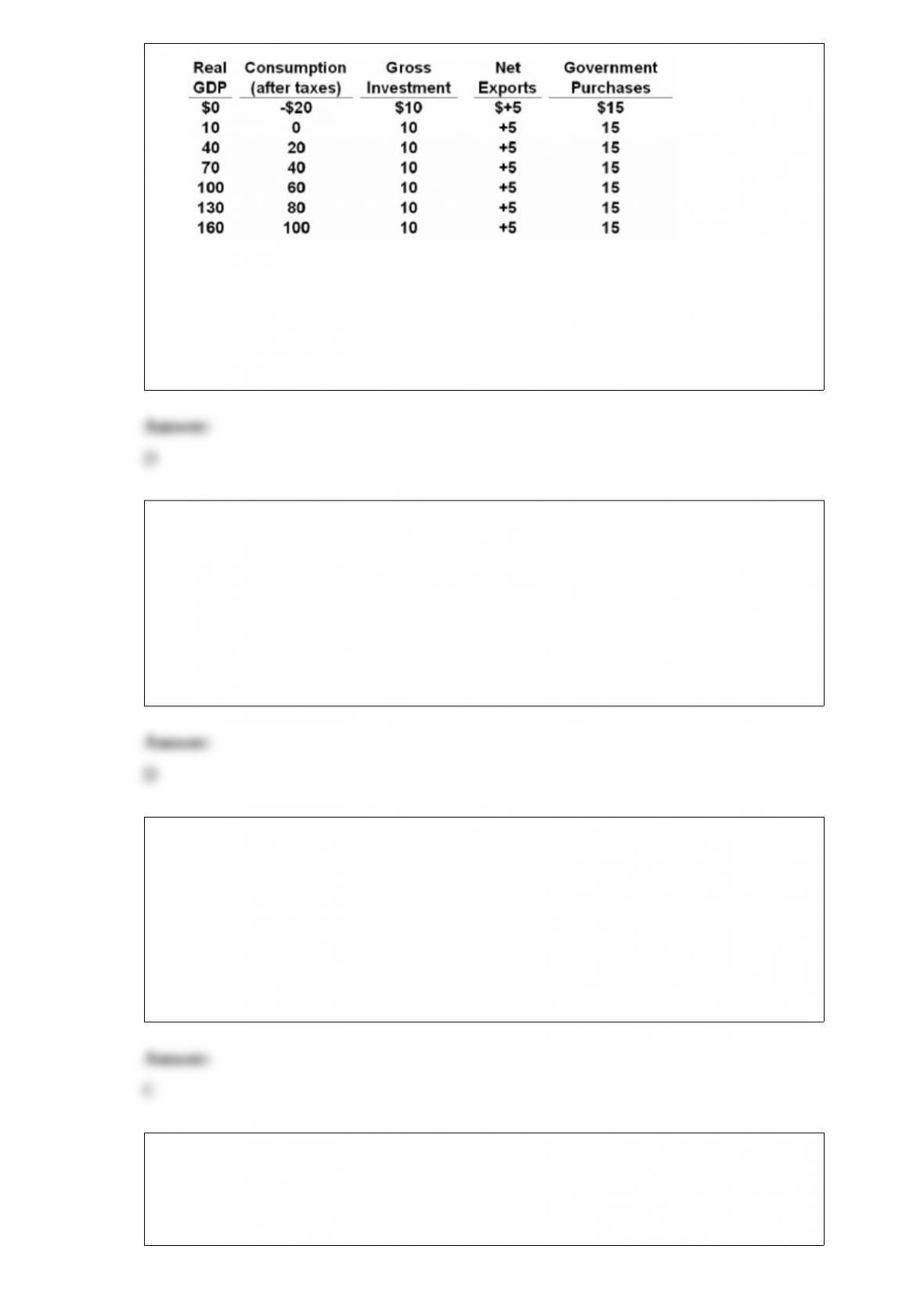
Refer to the above table. If the full-employment real GDP is $100 the:
A.inflationary expenditure gap is $30.
B.inflationary expenditure gap is $10.
C.recessionary expenditure gap is $20.
D.recessionary expenditure gap is $10.
18) Refer to the above diagram. Assume that nominal wages initially are set on the
basis of the price level P2 and that the economy initially is operating at its
full-employment level of output Qf. In the long run, demand-pull inflation could best be
shown as:
A.a move from b to c on AS2.
B.a move from b to f to d.
C.a change of aggregate supply from AS2 to AS1.
D.a move from b to d.
19) Assume a firm purchases resources a and b under purely competitive conditions and
combines these resources to produce X. Product X is sold in a purely competitive
market. The MP of a and b are 6 and 3 respectively and the prices of a and b are $12
and $6 respectively. If equilibrium exists, the price of X will be:
A.$1.
B.$.50.
C.$2.
D.$5.
20) most of the disagreement among economists involves:
a.facts.
b.principles.
c.positive statements.
d.normative statements.
21)
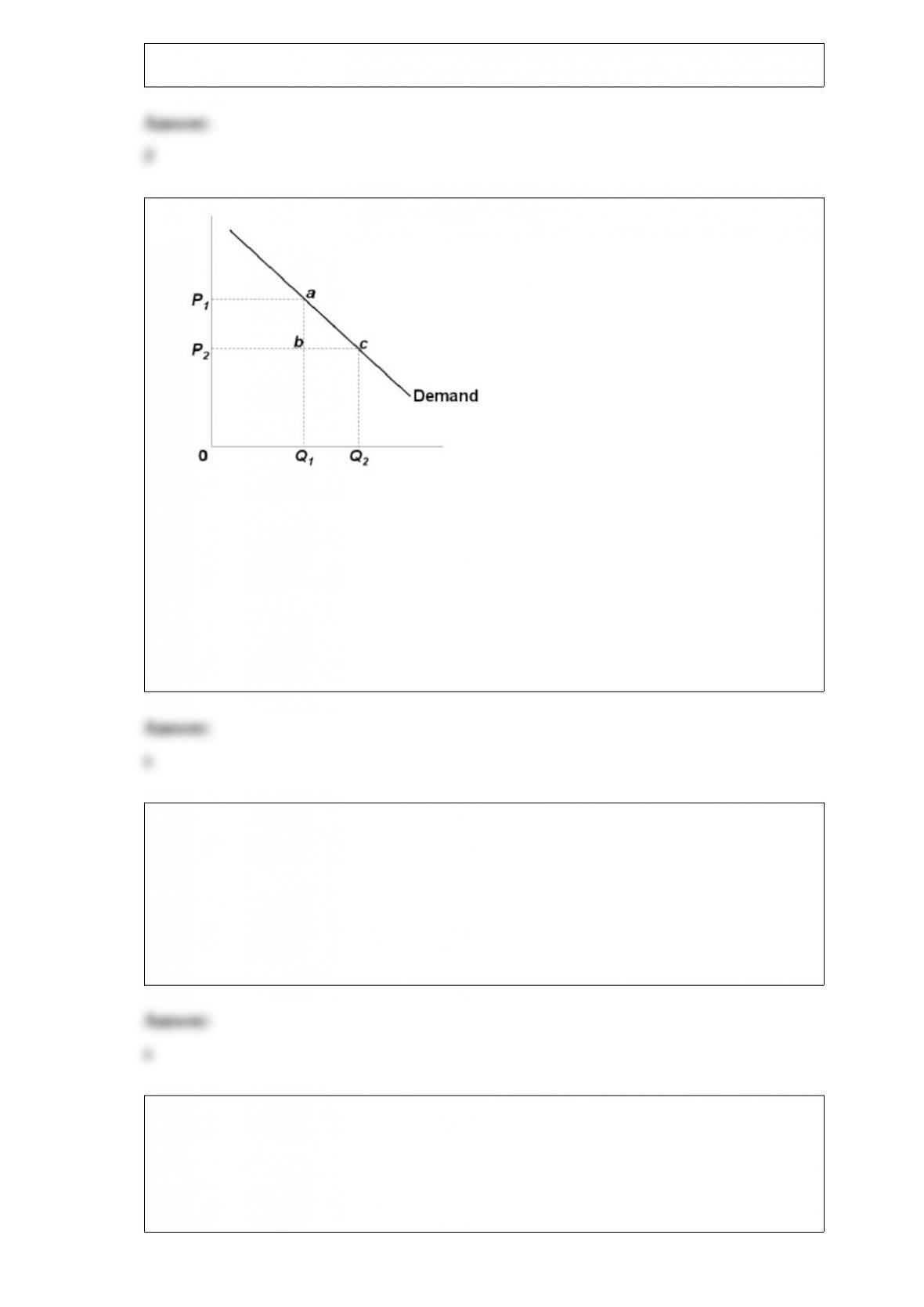
if the firm in the above diagram lowers price from p1 to p2, it will:
a.lose p1p2ba in revenue from the price cut but increase revenue by q1bcq2 from the
increase in sales.
b.lose p1p2ca in revenue from the price cut but increase revenue by q1acq2 from the
increase in sales.
c.incur a decline in total revenue because it is operating on the elastic segment of the
demand curve.
d.incur an increase in total revenue because it is operating on the inelastic segment of
the demand curve.
22) efficiency gains from migration:
a.will tend to be greater when workers migrate from nations with high unemployment
to nations experiencing full employment.
b.imply that all workers, domestic and migrant, are financially better off as a result of
migration.
c.will tend to be greater in countries experiencing “brain drain.”
d.usually benefit one nation at the expense of another.
23) an effective price floor on wheat will:
a.force otherwise profitable farmers out of business.
b.result in a shortage of wheat.
c.result in a surplus of wheat.
d.clear the market for wheat.

24) If an increase in aggregate expenditures results in no increase in real GDP we can
surmise that the:
A.economy is in a deep recession.
B.MPC equals 1.
C.economy is already operating at full employment.
D.price level has fallen.
25) in purchasing products a and b, a consumer is in equilibrium when:
a.mua/pa = mub/pb
b.mua/pb = mub/pa
c.mua – mub = pa/pb
d.mua pa = mub pb
26) the incentive problem under communist central planning refers to the idea that:
a.planners had to direct required inputs to each enterprise.
b.workers, managers, and entrepreneurs could not personally gain by responding to
shortages or surpluses or by introducing new and improved products.
c.the immediate effect of more investment was less consumption.
d.exports had to be equal to imports for a central plan to work.
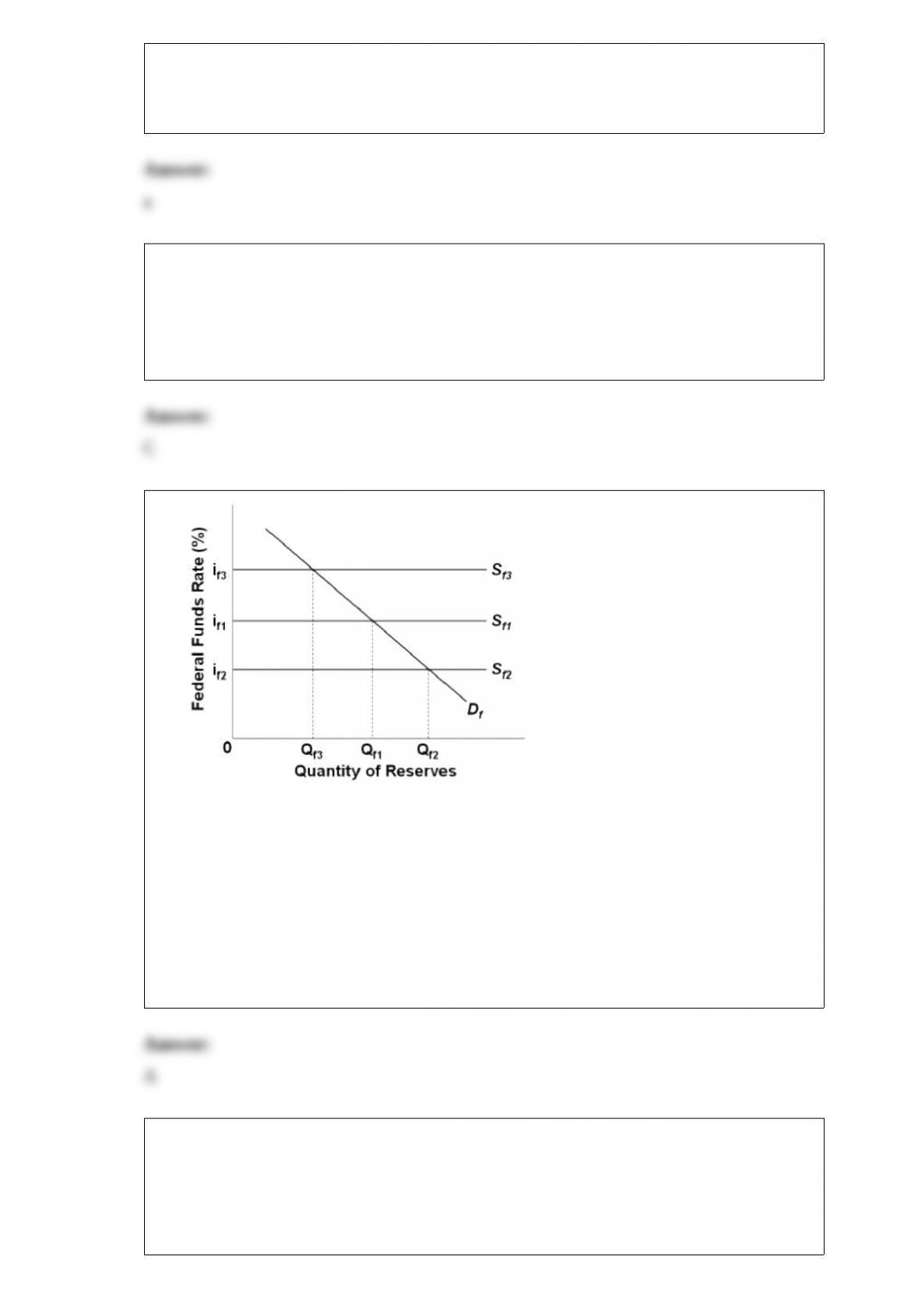
27) If the Fed wants to lower the Federal funds rate, it should:
A.increase the discount rate.
B.increase the reserve ratio.
C.buy government securities in the open market.
D.sell government securities in the open market.
28) in the 1990s, corporations attempted to address the principal-agent problem by:
a.providing stock or stock options as part of executive compensation.
b.hiring additional managers to oversee potentially unscrupulous agents.
c.supporting increased government oversight of corporate boards of directors.
d.firing a significant number of managers believed to be acting contrary to the owners’
interests.
29) Price supports in agriculture have been criticized because they:
A.have hastened the exodus of labor from agriculture.
B.subsidize consumers at the expense of farmers.
C.help large farmers more than small farmers.
D.create product shortages.
30)
The demand for Federal funds is
A.downward sloping because higher interest rates discourage commercial banks from
borrowing Federal funds.
B.downward sloping because higher interest rate encourage commercial banks to
borrow Federal funds.
C.upward sloping because higher interest rate encourage commercial banks to lend
Federal funds.
D.upward sloping because higher interest rates discourage commercial banks from
lending Federal funds.
31) Most mainstream macroeconomists oppose a strict requirement to balance the
Federal budget annually because they conclude that such a requirement would:
A.increase real interest rates and drive out investment spending.
B.eliminate monetary policy as a stabilization tool.
C.force government to undertake expansionary fiscal policy during inflation and
contractionary fiscal policy during recession.
D.expand the size of the Federal government.
32) Currency in circulation is part of:
A.M1 only.
B.M2 only.
C.neither M1 nor M2.
D.both M1 and M2.
33) What is the dilemma of regulation in the case of a regulated monopoly?
34) Identify at least two non-economic reasons used by critics to support their concerns
about illegal immigration.
35) What adjustments need to be made to go from national income to GDP?
36) Complete the table below by stating whether the direction of discretionary fiscal
policy was contractionary (C), expansionary (E), or neither (N), given the hypothetical
budget data for an economy.
37) What is national income? List its components.
38) The achievement of full employment is a sufficient condition for the achievement of
economic growth. Evaluate.