
Lead is an important input in the production of crystal. If the price of lead decreases,
then we would expect the supply of
a. crystal to be unaffected.
b. crystal to decrease.
c. crystal to increase.
d. lead to increase.
One way to characterize the difference between positive statements and normative
statements is as follows:
a. Positive statements tend to reflect optimism about the economy and its future,
whereas normative statements tend to reflect pessimism about the economy and its
future.
b. Positive statements offer descriptions of the way things are, whereas normative
statements offer opinions on how things ought to be.
c. Positive statements involve advice on policy matters, whereas normative statements
are supported by scientific theory and observation.
d. Economists outside of government tend to make normative statements, whereas
government-employed economists tend to make positive statements.

At which interest rate is the present value of $168.54 two years from today equal to
$150 today?
a. 4 percent
b. 5 percent
c. 6 percent
d. None of the above would give a present value within a cent of $162.24.
Which of the following would increase output in the short run?
a. an increase in stock prices makes people feel wealthier
b. government spending increases
c. firms chose to purchase more investment goods
d. All of the above are correct.
Figure 25-1.
On the horizontal axis, K/Lrepresents capital (K) per worker (L). On the vertical axis,
Y/Lrepresents output (Y) per worker (L).
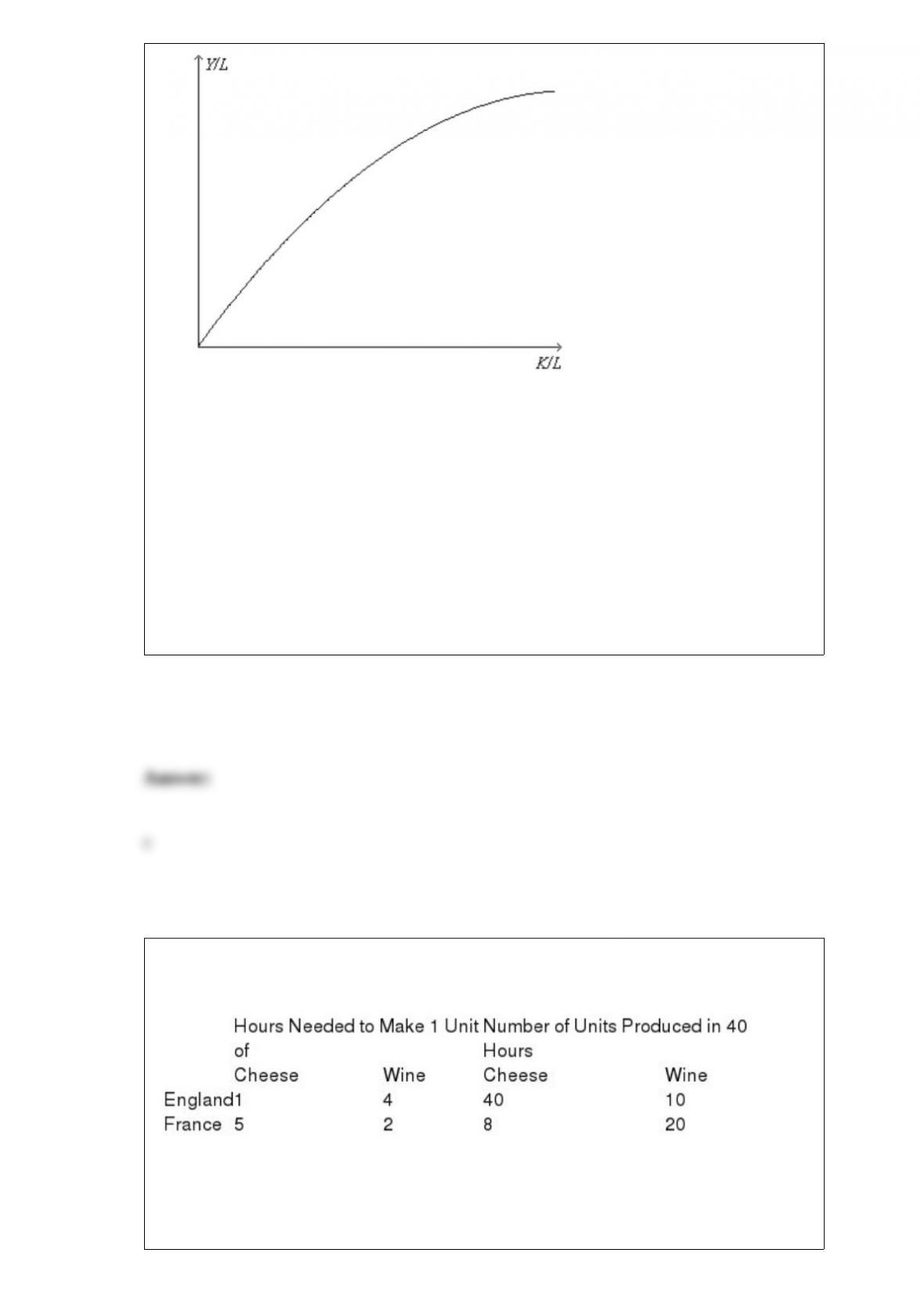
RefertoFigure25-1.The shape of the curve is consistent with which of the following
statements about the economy to which the curve applies?
a. In the long run, a higher saving rate leads to a higher growth rate of productivity.
b. In the long run, a higher saving rate leads to a higher growth rate of income.
c. Returns to capital become increasingly smaller as the amount of capital per worker
increases.
d. All of the above are correct.
Table 3-3
ProductionOpportunities
Refer to Table3-3. Assume that England and France each has 40 labor hours available.
If each country divides its time equally between the production of cheese and wine,
then total production is

a. 8 units of cheese and 10 units of wine
b. 24 units of cheese and 15 units of wine
c. 40 units of cheese and 20 units of wine
d. 48 units of cheese and 30 units of wine
According to classical macroeconomic theory, changes in the money supply change
nominal but not real variables.
a. True
b. False
If the exchange rate changes from 148 Kazakhstan tenge per dollar to 155 Kazakhstan
tenge per dollar, the dollar has
a. appreciated. Other things the same, it now takes fewer dollars to buy Kazakhstani
goods.
b. appreciated. Other things the same, it now takes more dollars to buy Kazakhstani
goods.
c. depreciated. Other things the same, it now takes fewer dollars to buy Kazakhstani
goods.

d. depreciated. Other things the same, it now takes more dollars to buy Kazakhstani
goods.
When the central bank of some country prints large quantities of money, that county’s
currency loses value both in terms of the goods and services it buys and in terms of the
amount of foreign currencies it can buy.
a. True
b. False
The key determinant of net capital outflow is the real interest rate.
a. True
b. False

When the interest rate increases, the opportunity cost of holding money
a. increases, so the quantity of money demanded increases.
b. increases, so the quantity of money demanded decreases.
c. decreases, so the quantity of money demanded increases.
d. decreases, so the quantity of money demanded decreases.
Liquidity preference refers directly to Keynes’ theory concerning
a. the effects of changes in money demand and supply on interest rates.
b. the effects of changes in money demand and supply on exchange rates.
c. the effects of wealth on expenditures.
d. the difference between temporary and permanent changes in income.
Which of the following shifts short-run aggregate supply left?
a. an increase in price expectations
b. an increase in the actual price level
c. a decrease in the money supply

d. a decrease in the price of oil
Economists have developed models of risk aversion using the concept of
a. utility and the associated assumption of diminishing marginal utility.
b. utility and the associated assumption of increasing marginal utility.
c. income and the associated assumption of diminishing marginal wealth.
d. income and the associated assumption of increasing marginal wealth.
In one month, Moira can knit 2 sweaters or 4 scarves. In one month, Tori can knit 1
sweater or 3 scarves. Moira’s opportunity cost of knitting scarves is lower than Tori’s
opportunity cost of knitting scarves.
a. True
b. False

The Stock Market Boom of 2015
Imagine that in 2015 the economy is in long-run equilibrium. Then stock prices rise
more than expected and stay high for some time.
RefertoStockMarketBoom2015.What happens to the expected price level and what
impact does this have on wage bargaining?
a. The expected price level falls. Bargains are struck for higher wages.
b. The expected price level falls. Bargains are struck for lower wages.
c. The expected price level rises. Bargains are struck for higher wages.
d. The expected price level rises. Bargains are struck for lower wages.
The inflation tax
a. is an alternative to income taxes and government borrowing.
b. taxes most those who hold the most money.
c. is the revenue created when the government prints money.
d. All of the above are correct.

Inflation induces people to spend more resources maintaining lower money holdings.
The costs of doing this are called shoeleather costs.
a. True
b. False
If the Japanese government raised its budget deficit, then the yen would
a. depreciate and Japanese net exports would rise.
b. depreciate and Japanese net exports would fall.
c. appreciate and Japanese net exports would rise.
d. appreciate and Japanese net exports would fall.
Suppose that in a closed economy GDP is equal to 11,000, taxes are equal to 1,000,
consumption equals 7,500, and government purchases equal 2,000. What is national
saving?
a. -500
b. 500

c. 2,000
d. None of the above is correct.
If the Canadian government raises it budget deficit, then Canada’s net capital outflows
will
a. increase, so its exchange rate will rise.
b. increase, so its exchange rate will fall.
c. decrease, so its exchange rate will rise.
d. decrease, so its exchange rate will fall.
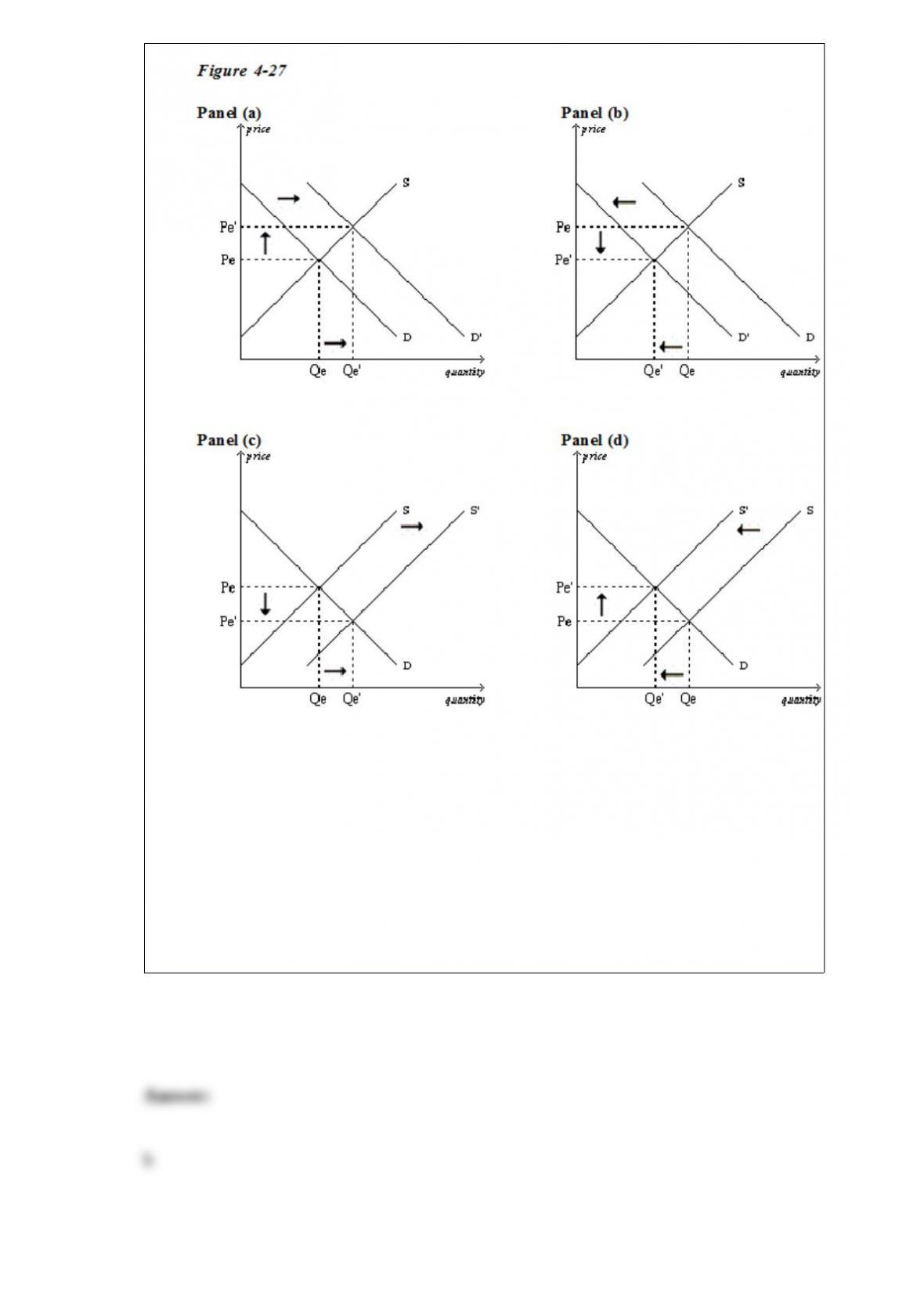
RefertoFigure4-27. Which of the four panels illustrates a decrease in quantity
supplied?
a. Panel (a)
b. Panel (b)
c. Panel (c)
d. Panel (d)

Figure 3-20
Refer to Figure3-20. If Canada and Mexico switch from each country dividing its time
equally between the production of Good X and Good Y to each country spending all of
its time producing the good in which it has a comparative advantage, then total
production of Good X will increase by
a. 3 units.
b. 6 units.
c. 9 units.
d. 12 units.
Which of the following shifts the short-run aggregate supply curve to the right?
a. a decrease in the actual price level
b. an increase in the actual price level
c. a decrease in the expected price level
d. an increase in the expected price level
The mathematical equation: quantity of output supplied = natural rate of output +

a(actual price level – expected price level), expresses
a. how the long run equilibrium adjusts to changes in money supply.
b. how output deviates in the short run from its long run natural rate.
c. how the short run aggregate supply curve shifts.
d. how adverse shifts in aggregate supply can cause stagflation.
Which of the following would cause the real exchange rate of the U.S. dollar to
appreciate?
a. the U.S. government budget deficit decreases
b. capital flight from the U.S.
c. the U.S. imposes import quotas
d. None of the above is correct.
Other things the same, another unit of capital will increase output by more in a poor
country than in a rich country.
a. True
b. False

In the U.S., taxes on capital gains are computed using
a. nominal gains. This is one way by which higher inflation discourages saving.
b. nominal gains. This is one way by which higher inflation encourages saving.
c. real gains. This is one way by which higher inflation discourages saving.
d. real gains. This is one way by which higher inflation encourages saving.
Most economist agree that money changes real GDP in both the short and long run.
a. True
b. False
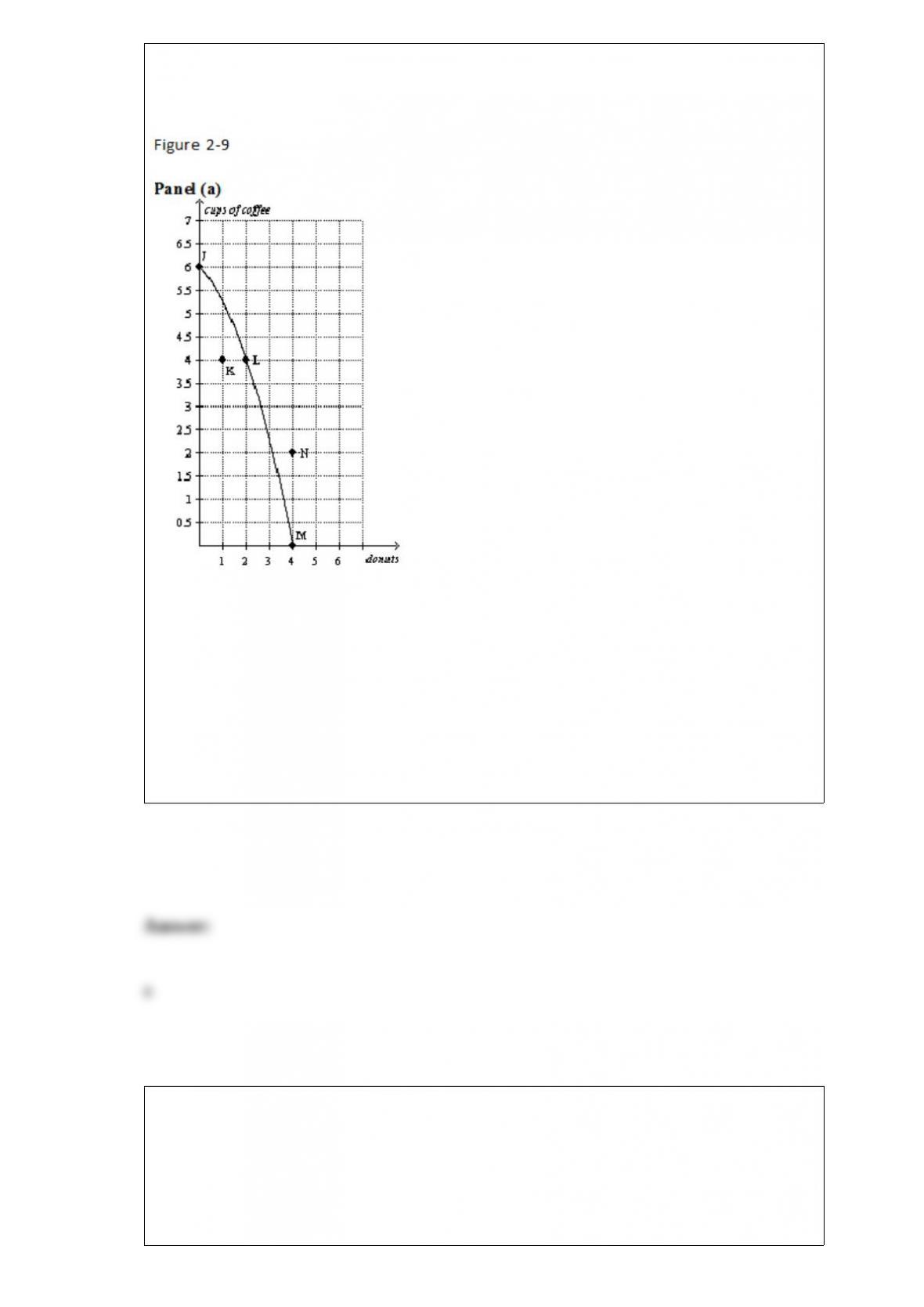
RefertoFigure2-9,Panel(a).The opportunity cost of moving from point M to point L is
a. 2 donuts.
b. 2 donuts and 4 cups of coffee.
c. 4 donuts.
d. 4 cups of coffee.
Table 23-11
The country of Batavia produces only chocolates and watches. Below is a table with
recent information on Batavia production and prices. The base year is 2009.
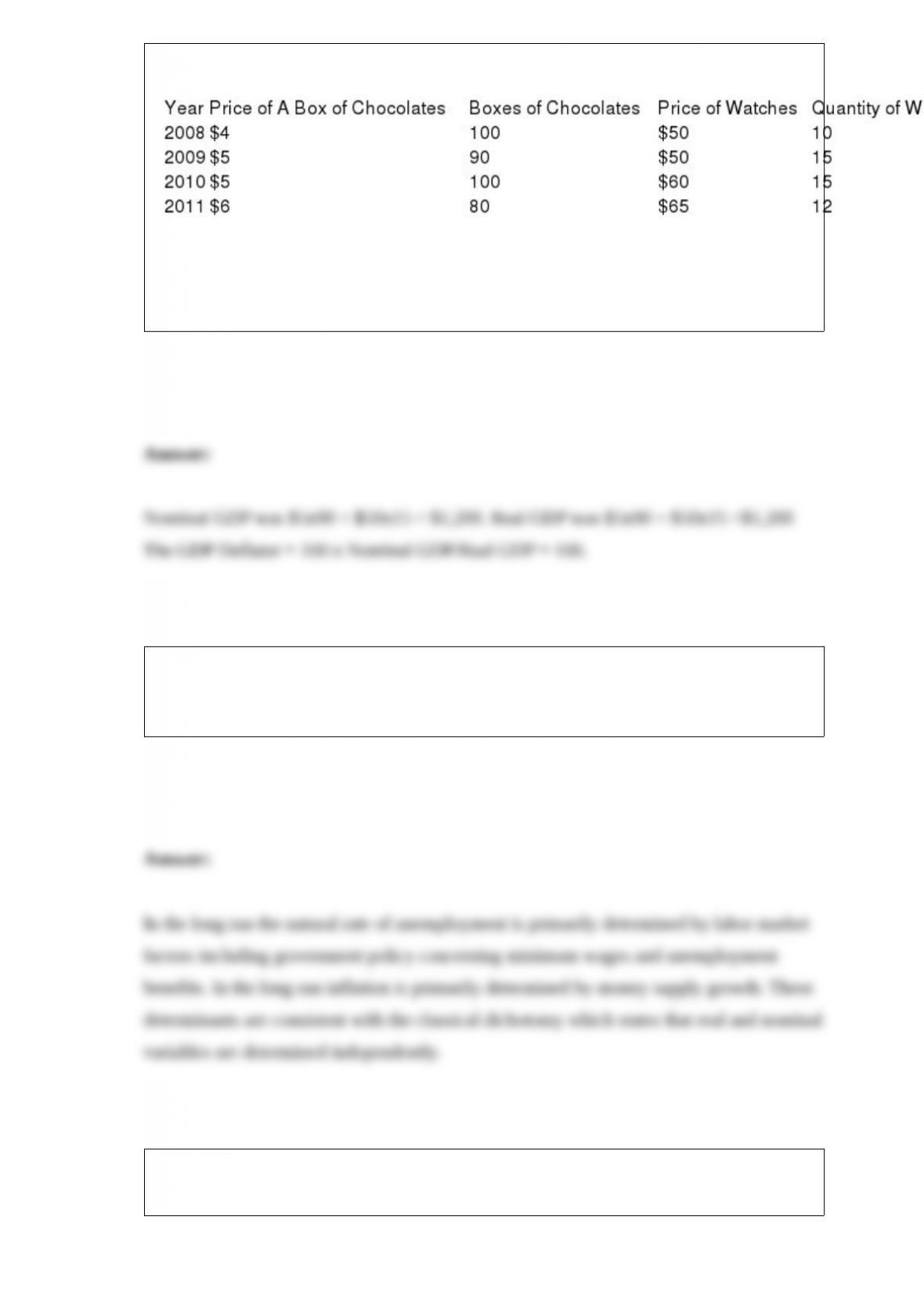
Prices and Quantities
Refer to Table 23-11.
What was nominal GDP, real GDP, and the GDP deflator for 2009? Show your work.
In the long run what primarily determines the natural rate of unemployment? In the
long run what primarily determines the inflation rate? How does this relate to the
classical dichotomy?
Scenario 27-1
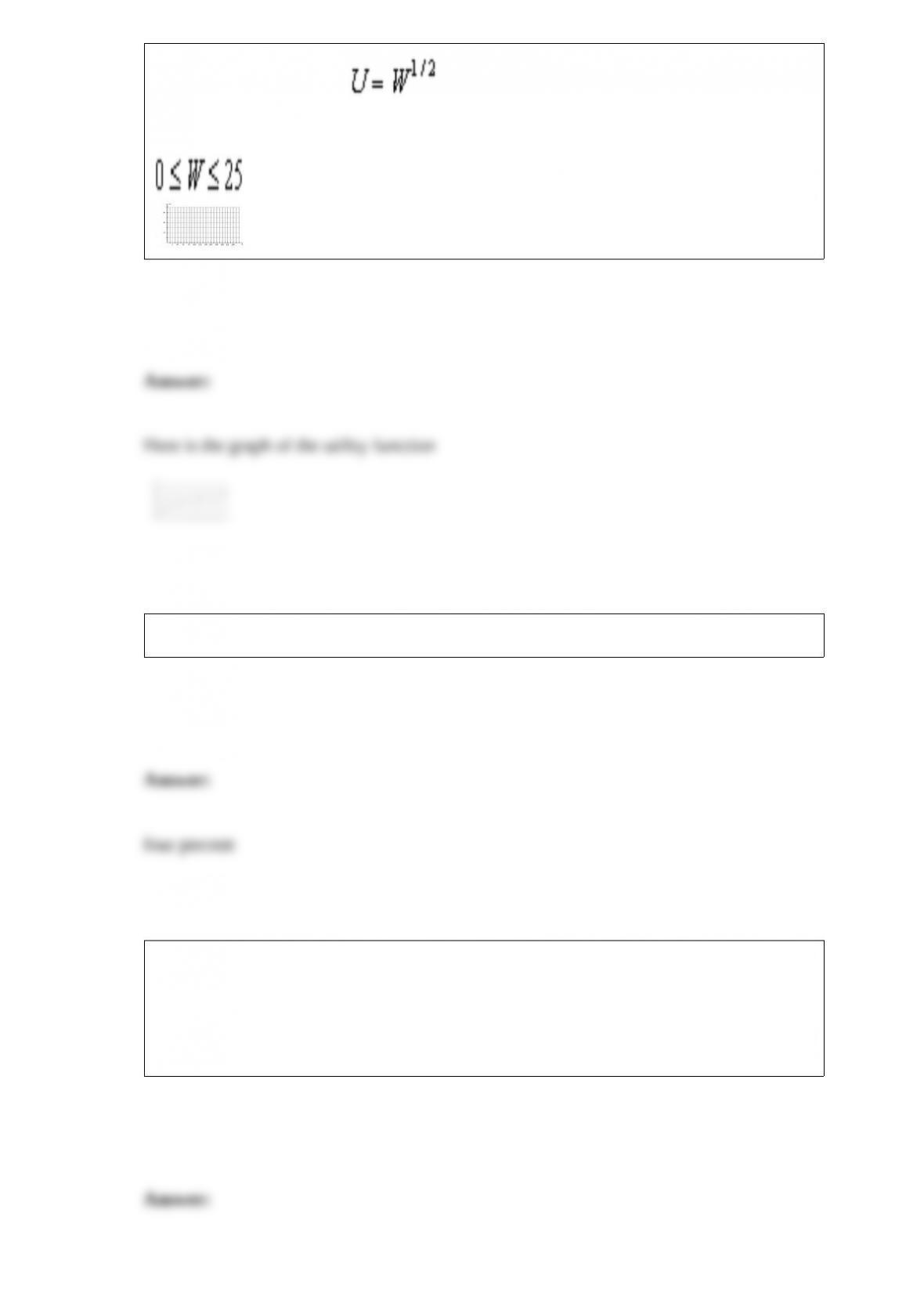
Lisa has a utility function where Wis Lisa’s wealth in millions of dollars
and Uis the utility she obtains.
RefetoScenario27-1.Use the following diagram to graph Lisa’s utility function for
.
The consumer price index increases from 200 to 208. What is the inflation rate?
Thompson Corporation is considering the purchase of a new piece of machinery.
Thompson expects the new machinery to increase its revenues by $70,000 at the end of
year 1, $60,000 at the end of year 2, and $50,000 at the end of year 3 at which point the
machinery will have exhausted its useful life. If the interest rate is 4%, what is the most
Thompson should be willing to pay today for this piece of machinery?
A European recession that reduces U.S. net exports by $50 billion may ultimately lead
to a $_____ billion reduction in aggregate demand if the MPC is 0.75.
List and define any two of the costs of high inflation.
Why does a nation’s standard of living depend on property rights?
An increase in the natural rate of unemployment shifts the short-run Phillips curve to
the. If the central bank sees the increase in the unemployment rate, but thinks the
natural rate has remained the same and so wants to reduce unemployment, it wouldthe
money supply growth rate. If it maintains this money supply growth rate, eventually the
short run Phillips curve will shiftand unemployment will be.
Scenario 4-1
Suppose the demand schedule in a market can be represented by the equation
, where is the quantity demanded and is the price. Also, suppose the
supply schedule can be represented by the equation , where is the quantity supplied.
RefertoScenario4-1. Suppose the supply curve shifts to . What
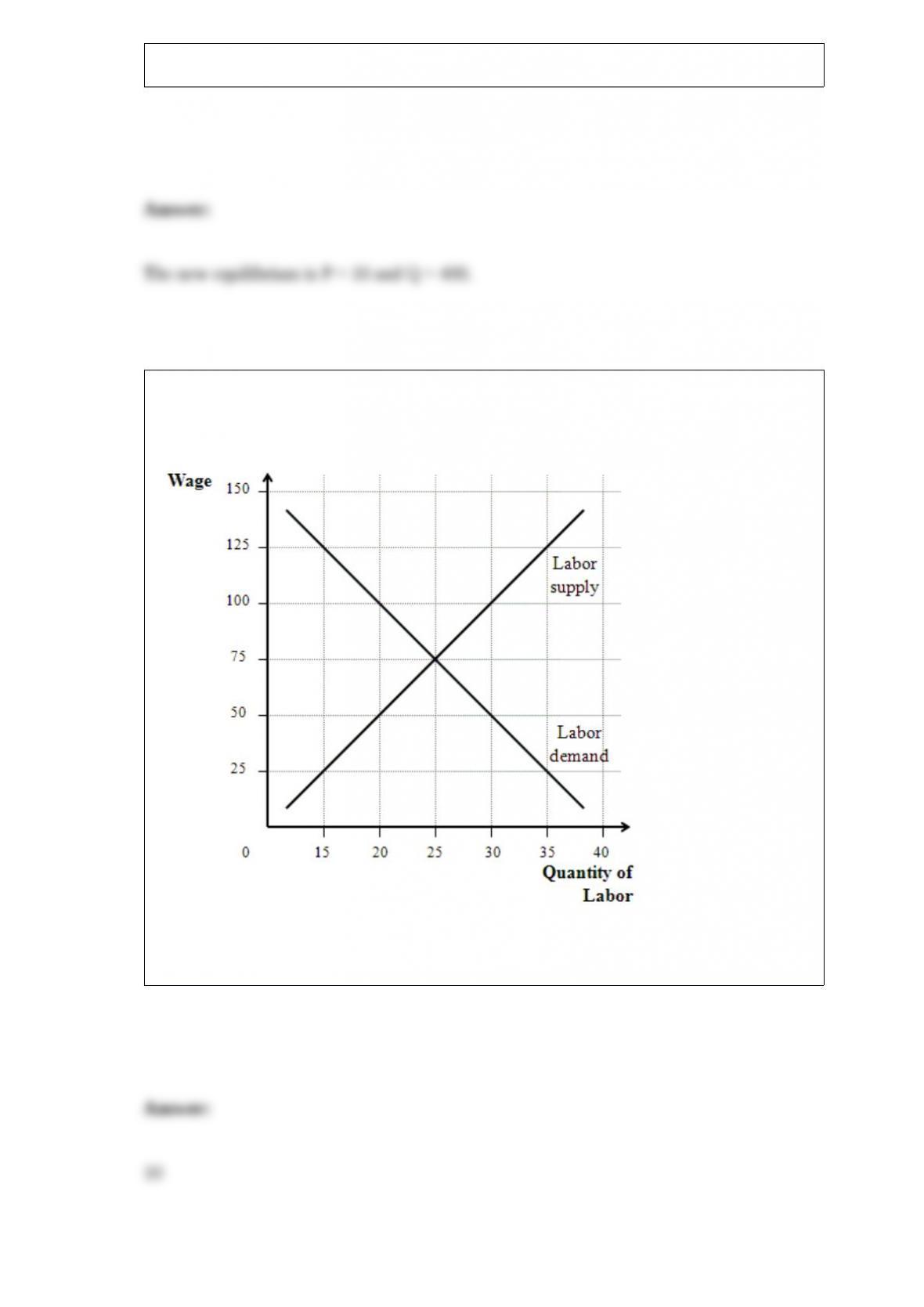
is the new equilibrium price and quantity in this market?
Figure 28-7
RefetoFigure28-7. If the minimum wage increases from $100 to $125, how many
additional workers will be unemployed?
A decrease in the overall price level (or falling prices) is called _____. An
extraordinarily high rate of inflation is called _____.
What is the difference between the Consumer Price Index and the Producer Price
Index?
The nominal interest rate is eight percent and the consumer price index rises from 140
to 147. What is the real interest rate?
If expected inflation falls but actual inflation remains the same, what happens to the
unemployment rate? Defend your answer.
A U.S.-owned automobile factory uses $50 million worth of materials produced in the
U.S. and $10 million worth of material purchased from foreign countries to produce
$100 million of automobiles. $70 million worth of these automobiles are purchased by
U.S. consumers, $25 million are sold in foreign countries, and $5 million are added to
inventory. How much of this production is included in U.S. GDP? By how much do
these transactions alone affect U.S. net exports?
Robert buys bonds. Rachel buys a new truck for her landscaping business. Identify both
as savers, investors, both, or neither.
If the CPI increased from 215 to 218 between the years 2012 and 2013, while the
nominal interest rate increased from 3.25% to 3.80%, what is the real interest rate in

2013?
As a substitute for laboratory experiments, economists use evidence available through
history’s