Which of the following information about fiat money is false? Fiat money
A) is backed by gold.
B) serves as a medium of exchange.
C) has little to no value except as money.
D) is authorized by a central bank or governmental body.
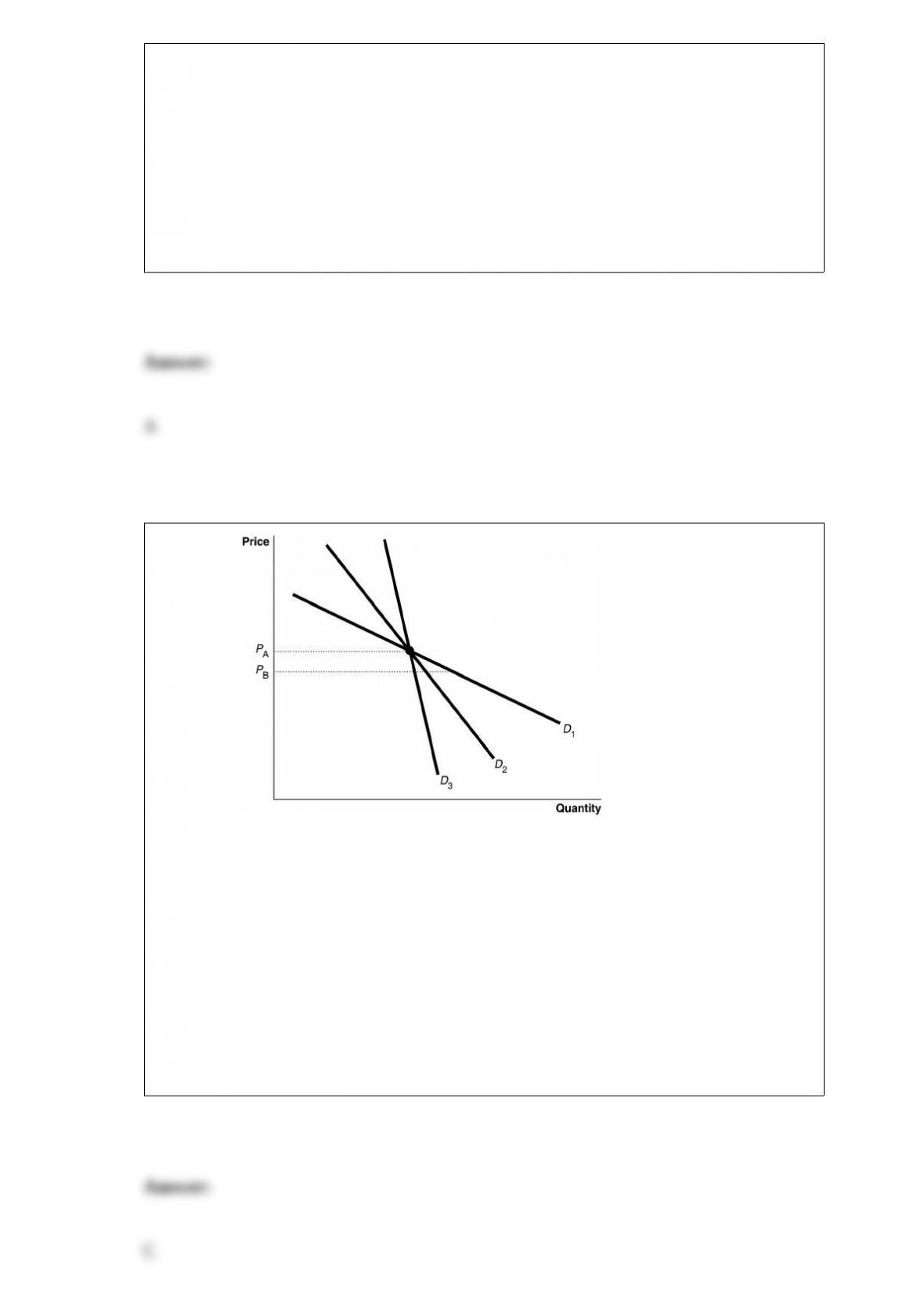
Figure 6-6
As price falls from PA to PB, the quantity demanded increases most along D1; therefore,
A) D1 is unit elastic.
B) D1 is more inelastic than D2 or D3.
C) D1 is more elastic than D2 or D3
D) D1 is elastic at PA but inelastic at PB.
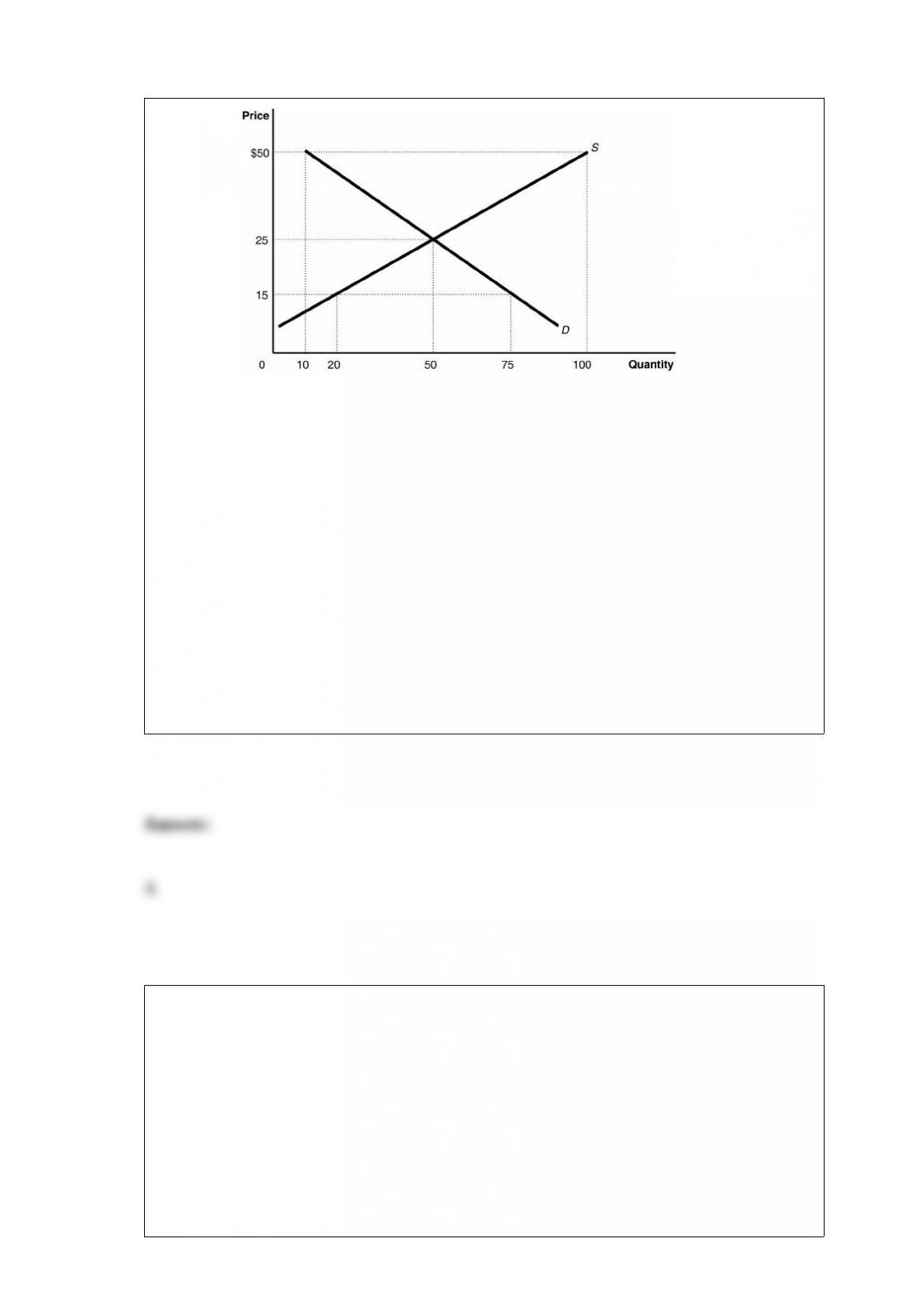
Figure 3-6
The figure above represents the market for canvas tote bags. Assume that the market
price is $35. Which of the following statement is true?
A) There is a surplus that will cause the price to decrease; quantity demanded will then
increase and quantity supplied will decrease until the price equals $25.
B) There is a surplus that will cause the price to decrease; quantity supplied will then
increase and quantity demanded will decrease until the price equals $25.
C) There will be a surplus that will cause the price to decrease; demand will then
increase and supply will decrease until the price equals $25.
D) There is a surplus that will cause the price to increase; quantity demanded will then
decrease and quantity supplied will increase until the price equals $25.
A tax rebate, which is expected to be offered in this and all future years, will
A) have a small positive effect on consumption and aggregate demand.
B) have no effect on consumption and aggregate demand.
C) have a significant positive effect on consumption and aggregate demand, with
aggregate demand growing by a multiple of the tax rebate.
D) increase aggregate supply and aggregate demand.
Total revenue equals
A) price per unit times quantity sold.
B) price per unit times quantity supplied.
C) price per unit times change in quantity sold.
D) change in price per unit times quantity sold.
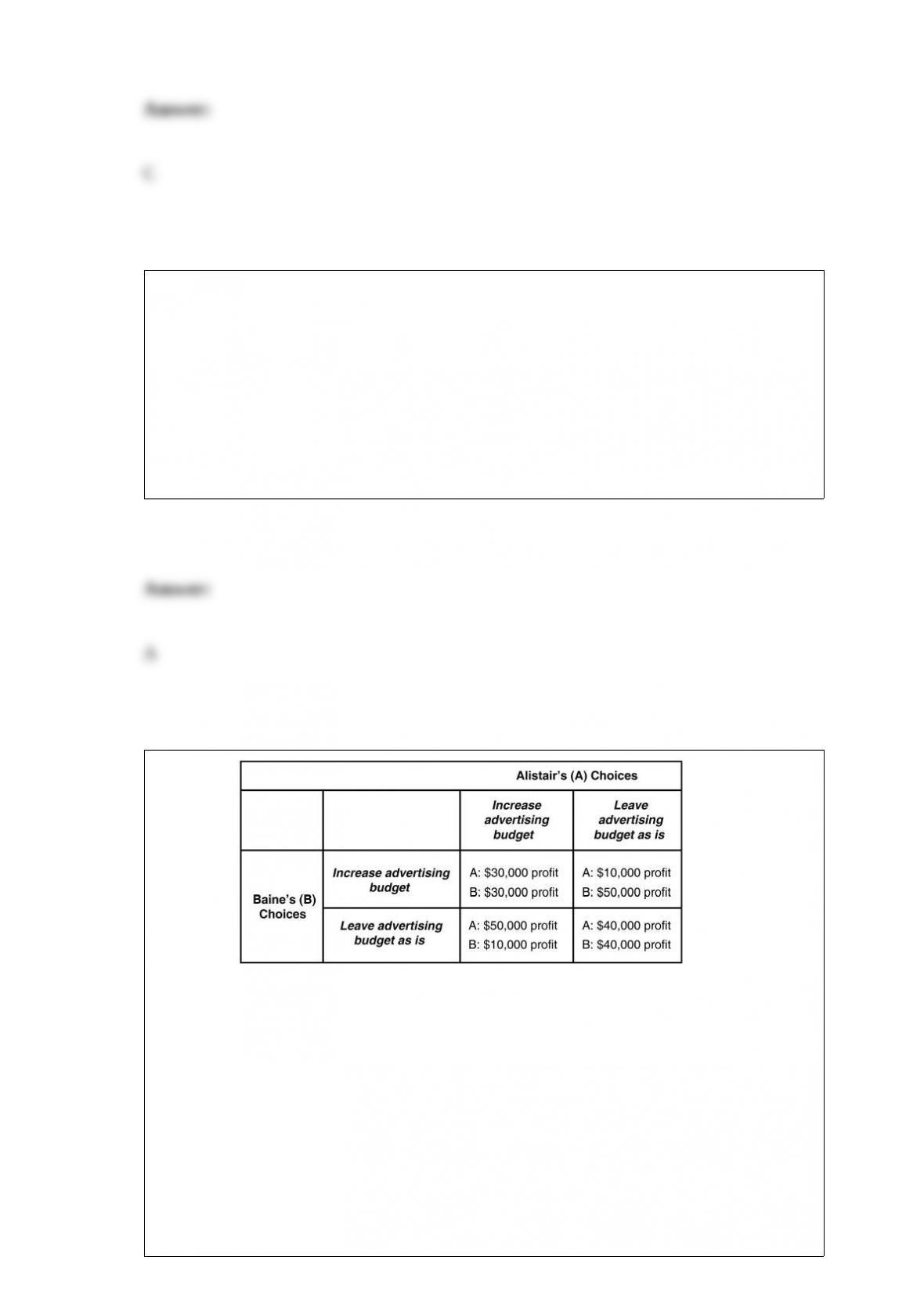
Table 14-4 Alistair Luggage
and Baine Baggage are the only firms selling luggage in the upscale town of Montecito.
Each firm must decide on whether to increase its advertising spending to compete for
customers. If one firm increases its advertising budget but the other does not, then the
firm with the higher advertising budget will increase its profit. Table 14-4 shows the
payoff matrix for this advertising game.
Does Baine have a dominant strategy and if so, what is it?
A) Yes, Baine should increase its advertising budget.
B) Yes, Baine should keep its advertising budget as is.

C) There are two dominant strategies: If Alistair increases its advertising budget, then
Baine’s best bet is to keep its budget the same, but if Alistair does not increase its
spending, then Baine should raise its advertising budget.
D) No, there is no dominant strategy.
How are the fundamental economic decisions determined in Cuba?
A) Individuals, firms, and the government interact in a market to make these economic
decisions.
B) These decisions are made by the country’s elders who have had much experience in
answering these questions.
C) The government decides because Cuba is a centrally planned economy.
D) The United Nations decides because Cuba is a developing economy.
A higher inflation rate can lead to lower unemployment if ________ mistakenly expect
the inflation rate to be lower than it turns out to be.
A) workers, but not employers
B) employers, but not workers
C) both workers and employers
D) neither workers nor employers

Most economists believe that the return of ________ during the 2007-2009 recession is
a key reason why the recession was so severe.
A) high tariffs
B) financial instability
C) rapid inflation
D) high interest rates
Which of the following statements is true?
A) As output increases, average fixed cost becomes smaller and smaller.
B) Average fixed cost does not change as output increases.
C) The marginal cost curve intersects the average fixed cost curve at its minimum point.
D) When marginal cost is greater than average fixed cost, average fixed cost increases.
When the Federal Reserve System was established in 1913, its main policy goal was

A) encouraging strong economic growth.
B) promoting price stability.
C) preventing bank panics.
D) keeping employment high.