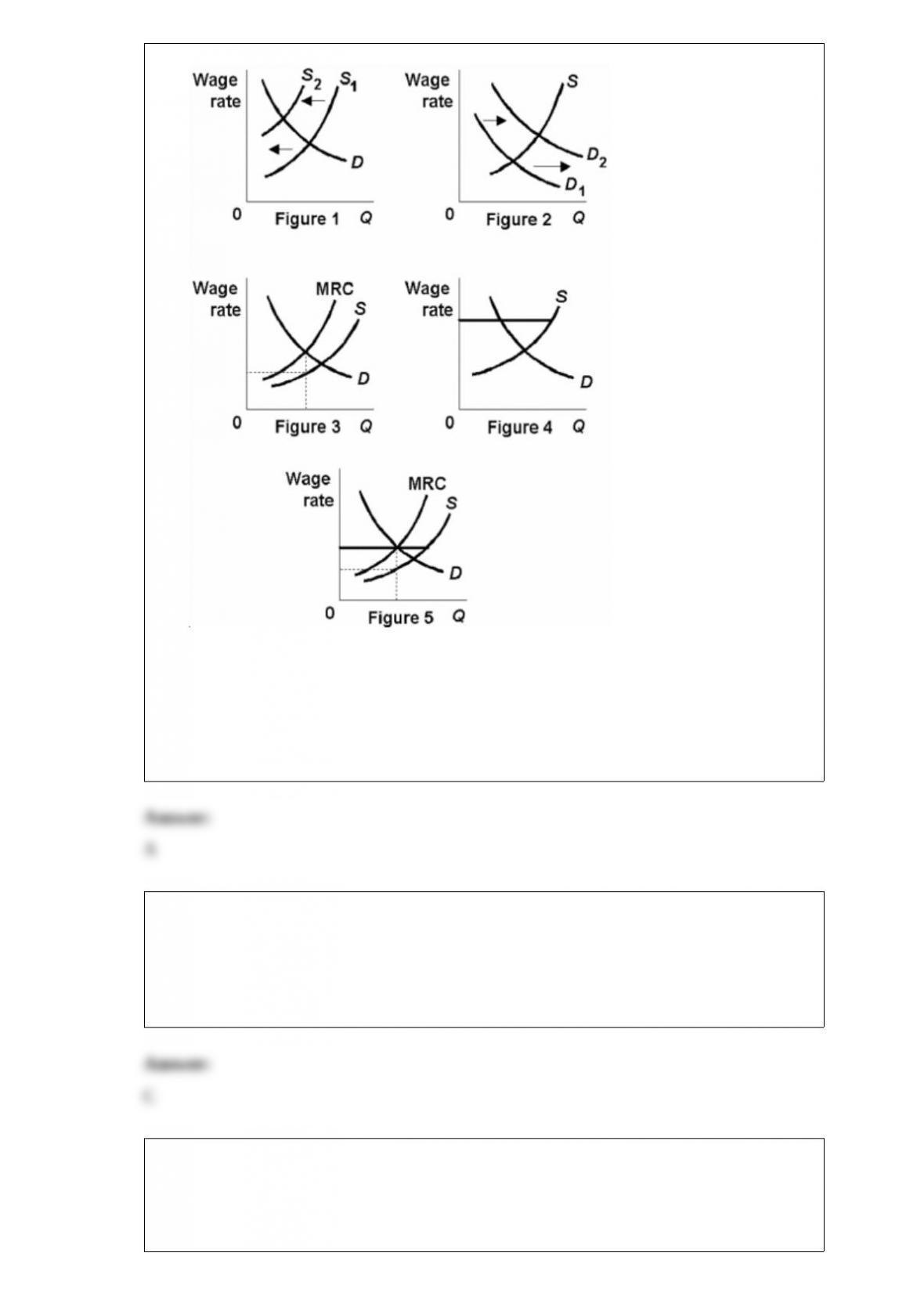
1)
Refer to the above labor market diagrams. The case of bilateral monopoly is represented
by Figure:
A.5
B.4
C.2
D.1
2) New classical economists say that a fully anticipated decrease in aggregate demand:
A.shifts the long-run aggregate supply curve to the right.
B.shifts the long-run aggregate supply curve to the left.
C.moves the economy down along its vertical long-run aggregate supply curve.
D.eventually results in a self-correcting increase in aggregate demand.
3) Assume there is an increase in government spending and a reduction in net taxes.
With a specific money supply, the consequent:
A.contractionary impact might be lessened by the resulting increase in the interest rate.
B.expansionary impact might be lessened by the resulting increase in the interest rate.
C.contractionary impact might be enhanced by the resulting decline in the interest rate.
D.expansionary impact might be enhanced by the resulting decline in the interest rate.
4) suppose that at 500 units of output marginal revenue is equal to marginal cost. the
firm is selling its output at $5 per unit and average total cost at 500 units of output is $6.
on the basis of this information we:
a.can say that the firm should close down in the short run.
b.can say that the firm can produce and realize an economic profit in the short run.
c.cannot determine whether the firm should produce or shut down in the short run.
d.can assume the firm is not using the most efficient technology.
5) if a technological advance increases a firm’s labor productivity, we would expect its:
a.average total cost curve to rise.
b.average total cost curve to fall.
c.total cost curve to rise.
d.average total cost curve to be unaffected.
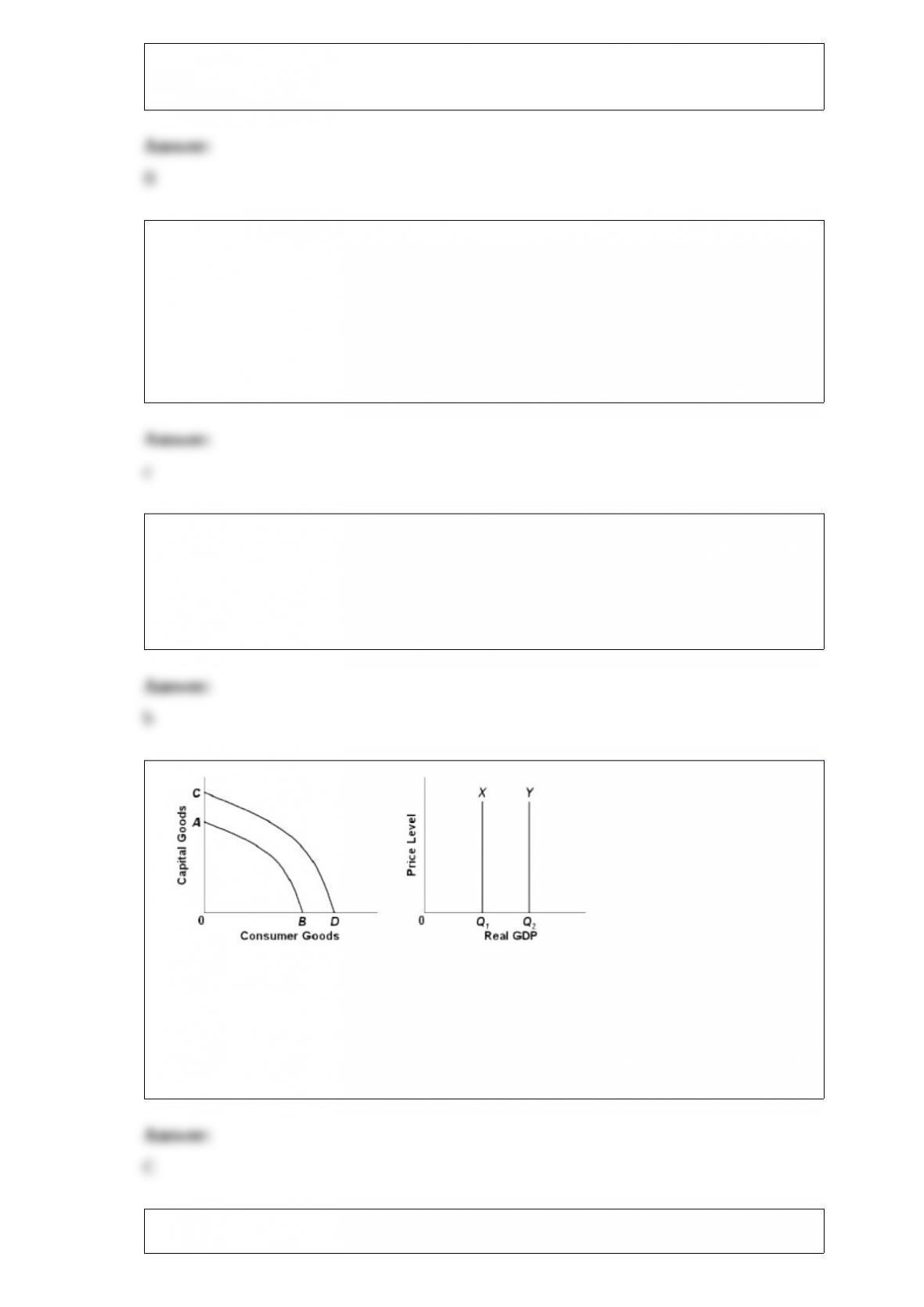
6)
Refer to the above graphs. An increase in an economy’s labor productivity would shift
curve:
A.AB to CD and shift curve Y to X
B.CD to AB and shift curve X to Y
C.AB to CD and shift curve X to Y
D.X to Y while leaving curve AB in place.
7) Answer the following questions based on the payoff matrix for a single-period,

two-firm game for firms, Capoc and Caroc. The numbers in the matrix indicate the
profit in billions of dollars for a national of regional strategy. The profit outcome cells
are A, B, C, and D
(a)Which strategies are the dominate ones for Capoc and Caroc?
(b)What is the Nash Equilibrium?
(c)What will be the total amount of profits for both firms if both firms decide their
strategy simultaneously?
(d)If Capoc makes a credible threat that determines the strategy for Caroc, which
combination of strategies will be selected and what will be the total amount of profits
for both firms?
8) which of the following types of unemployment is directly associated with insufficient
overall demand for goods and services?
a.search unemployment
b.wait unemployment
c.cyclical unemployment
d.frictional unemployment
9) Assume that you pay $10,000 of tax on a taxable income of $50,000. If your taxable
income were $150,000, your tax payment would be $25,000. This suggests the tax is:
A.progressive.
B.proportional.
C.regressive.
D.discriminatory.
10) eclectic enterprises is a single firm that sells goods and services in the markets for
health food, furniture, electric energy, and toys. eclectic enterprises is best described as
a(n):
a.conglomerate.
b.horizontally integrated firm.
c.vertically integrated firm.
d.industry.
11) The tax cut passed by Congress and the Bush administration in 2001 was motivated
primarily by:
A.the recession that began in March 2001.
B.the terrorist attacks on September 11, 2001.
C.the desire to distribute income and wealth more equally.
D.projections that actual budget surpluses would rise to $5 trillion by 2010.
12) Tying contracts which lessen competition are specifically illegal under provisions of
the:
A.Sherman Act.
B.Federal Trade Commission Act.
C.Celler-Kefauver Act.
D.Clayton Act.
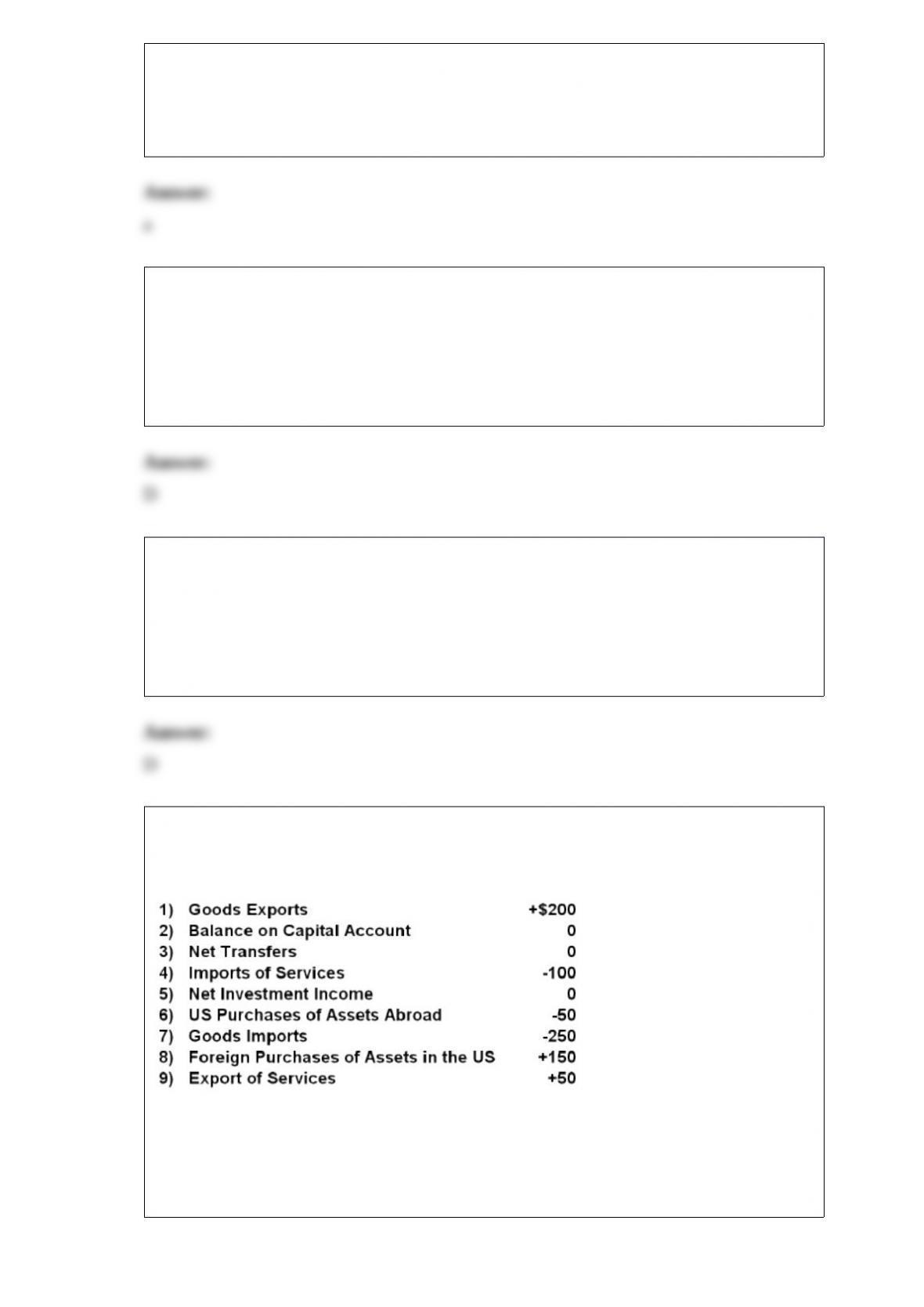
13) The plus items below are “export-type” entries and the minus items are
“import-type” entries in the balance of payments for the hypothetical country of Zippo.
Refer to the above information. Zippo has a:
A.current account deficit.
B.capital account deficit.
C.balance of payments deficit.
D.trade surplus on goods and services.
14) federal tax policy:
a.treats employer health insurance premiums as taxable income.
b.subsidizes health insurance and thereby increases the demand for health care.
c.subsidizes health insurance and thereby decreases the demand for health care.
d.corrects the overallocation of resources to the health care industry which would
otherwise exist.
15)
Refer to the above diagram. The location of curve B depends on the:
A.level of real GDP.
B.location of curve A only.
C.interest rate only.
D.interest rate together with the location of curve A.
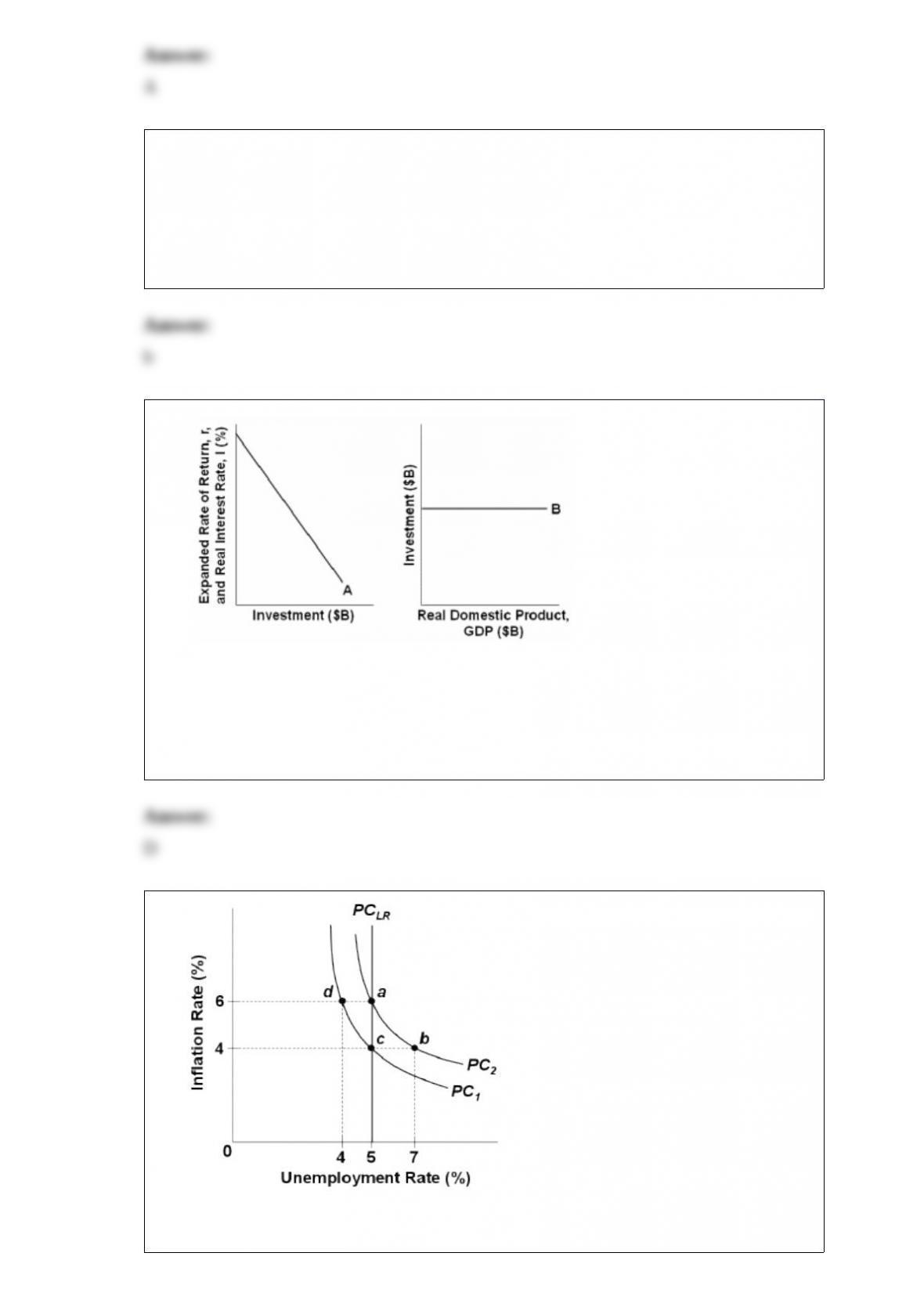
16)
Refer to the above diagram. Point b on short-run Phillips Curve PC1 represents a rate
of:
A.inflation below the natural rate.
B.inflation above the natural rate.
C.unemployment above the natural rate.
D.unemployment below the natural rate.
17)
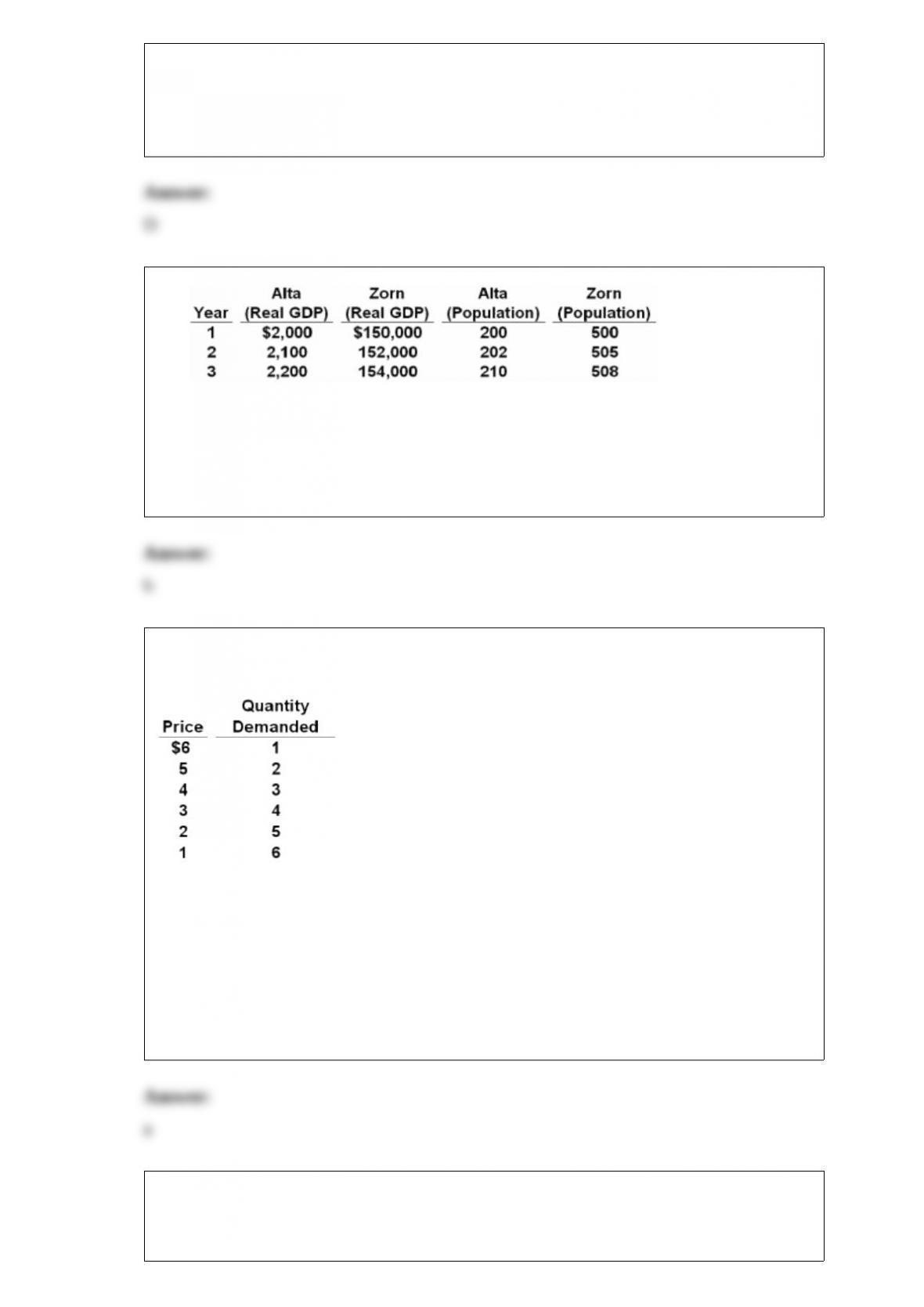
refer to the above table. per capita gdp was about:
a.$105 in year 3 in alta.
b.$303 in year 3 in zorn.
c.$200 in year 1 in zorn.
d.$5 in year 2 in alta.
18) the following demand schedule:
refer to the above data. which of the following is correct?
a.although the slope of the demand curve is constant, price elasticity declines as we
move from high to low price ranges.
b.although the slope of the demand curve is constant, price elasticity increases as we
move from high to low price ranges.
c.although the demand curve is concave to the origin, price elasticity of demand is
constant throughout.
d.a steep slope means demand is inelastic; a flat slope means demand is elastic.
19) Answer the next two questions on the basis of the below diagrams which show
identical marginal utility from income curves from person X and person Y.
(a)If $80,000 in income is distributed such that person X has only $20,000 to spend and
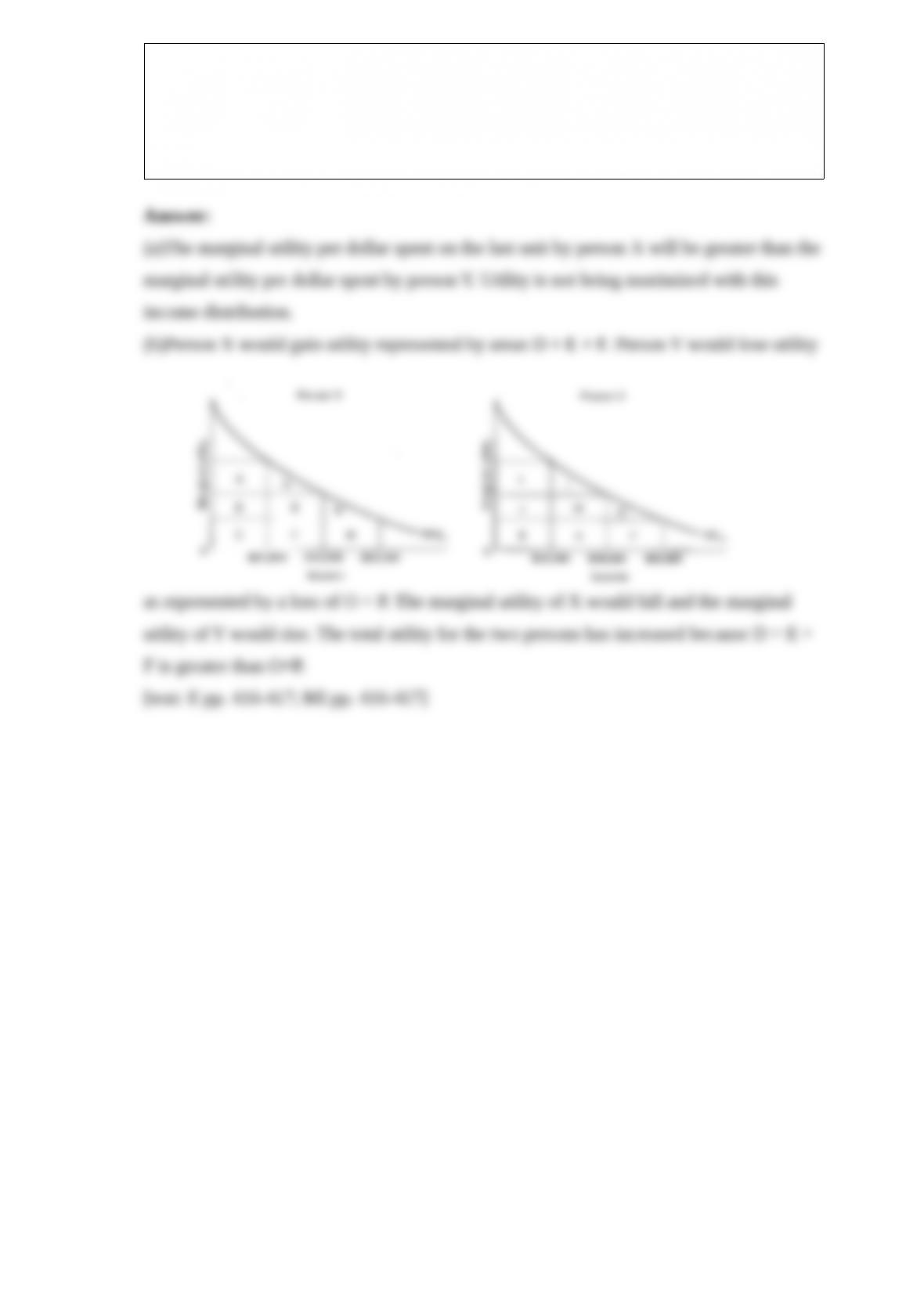
person Y has $60,000 to spend, what will be the effect on marginal utilities?
(b)If the $80,000 in income were redistributed from situation A where person X spends
$20,000 and person Y spends $60,000 to a situation B where they both spend $40,000,
what would the utility gain or loss be for persons X and Y? Answer by specifying the
areas in the graph.