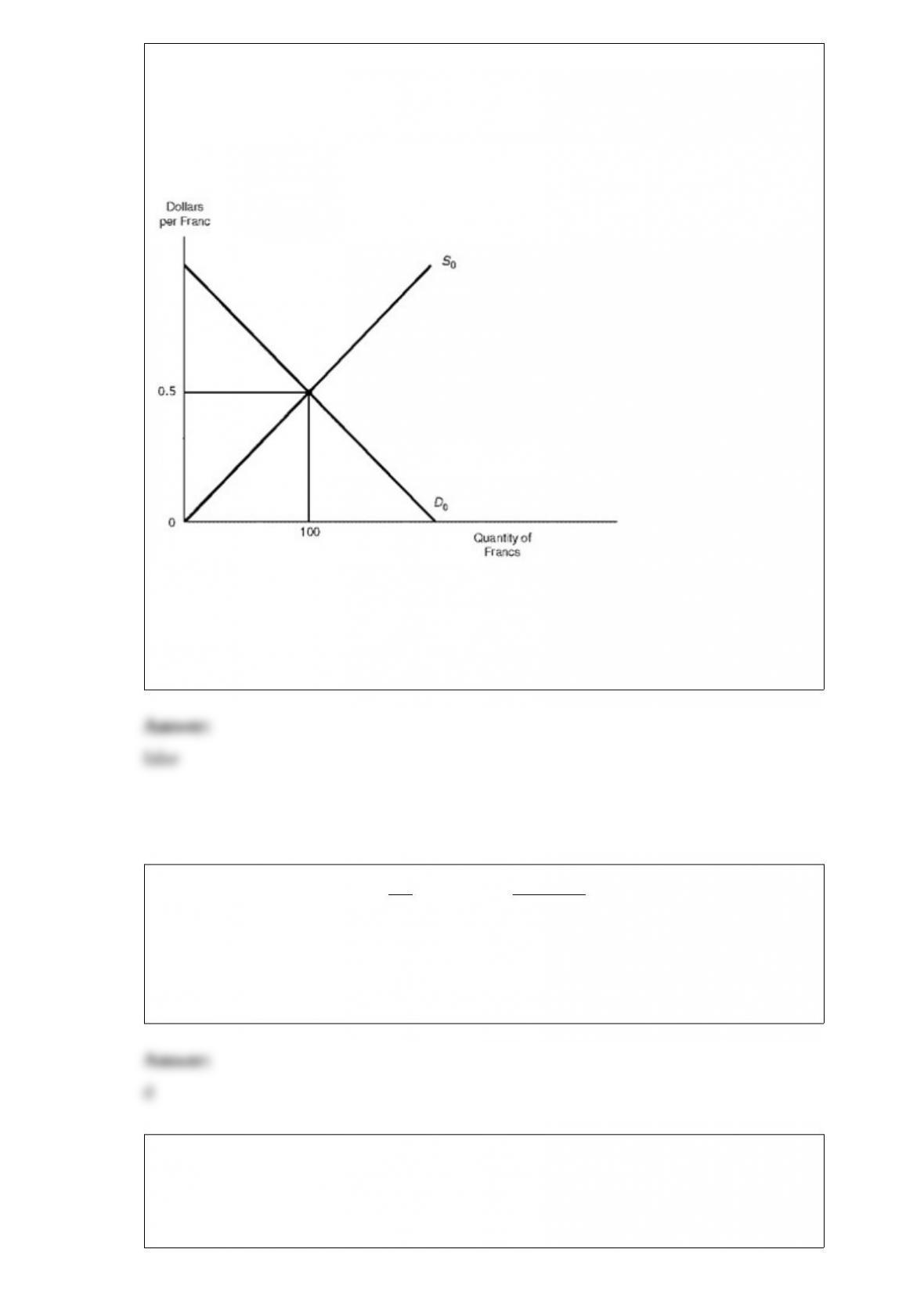
1) the figure below illustrates the supply and demand schedules of swiss francs under a
system of floating exchange rates.
figure 12.2. the market for swiss francs
refer to figure 12.2. if the rate of inflation in the united states is higher than the rate of
inflation in switzerland, the demand for francs decreases, the supply of francs increases,
and the dollar’s exchange value appreciates.
a.true
b.false
2) which of the following does not represent an automatic adjustment in
balance-of-payments disequilibrium? variations in:
a.domestic income
b.foreign prices
c.domestic prices
d.foreign par values
3) adam smith
a.was a leading advocate of free trade
b.developed the concept of absolute advantage
c.maintained that labor costs represent the major determinant of production cost
d.all of the above
4) suppose that canada has domestic firms that could supply its entire market for radios
at a price of $50, while u.s. firms could supply radios at $40 and mexico at $30.
suppose that canada initially has a 50 percent tariff on imports of radios and then forms
a free trade area with mexico. as a result, canada realizes:
a.trade creation, no trade diversion, and overall welfare gains
b.trade creation, no trade diversion, and overall welfare losses
c.trade diversion, no trade creation, and potential overall welfare losses
d.trade diversion, trade creation, and potential overall welfare gains
5) under the provisions of the world trade organization, canada would have the right to
impose countervailing duties on imports of south korean steel when the south korean
government provides export subsidies to its steelmakers.
a.true
b.false
6) exhibit 4.2
in the absence of international trade, assume that the equilibrium price and quantity of
motorcycles in canada is $14,000 and 10 units respectively. assuming that canada is a
small country that is unable to affect the world price of motorcycles, suppose its market
is opened to international trade. as a result, the price of motorcycles falls to $12,000 and
the total quantity demanded rises to 14 units; out of this total, 6 units are produced in
canada while 8 units are imported. now assume that the canadian government levies an
import tariff of $1,000 on motorcycles.
refer to exhibit 4.2. the tariff leads to an increase in canadian consumer surplus totaling
$11,000.
a.true
b.false
7) the purpose of “countervailing duties,” as levied by the domestic government, is to
neutralize import tariffs imposed by foreign governments.
a.true
b.false
8) given free trade, small nations tend to benefit the most from trade since they:
a.are more productive than their large trading partners
b.are less productive than their large trading partners
c.have demand preferences and income levels lower than their large trading partners
d.enjoy terms of trade lying near the opportunity costs of their large trading partners
9) foreign direct investment would occur if microsoft inc. of the united states purchased
securities of the french government.
a.true
b.false
10) economists have generally found that economic growth rates have a close relation
to:
a.openness to trade
b.education
c.communications infrastructure
d.all of these
11) the high point of u.s. protection culminated with the passage of the:
a.smoot-hawley act of 1930
b.general agreements on tariffs and trade in 1947
c.trade reduction act of 1962
d.adjustment assistance act of 1970

12) when pursued over the long run, a policy of increasing the domestic money supply
to offset an appreciation of the home country’s currency results in inflation and a
decrease in home-country competitiveness in key industries.
a.true
b.false
13) the principal benefit of tariff protection goes to:
a.domestic consumers of the good produced
b.domestic producers of the good produced
c.foreign producers of the good produced
d.foreign consumers of the good produced
14) exhibit 4.2
in the absence of international trade, assume that the equilibrium price and quantity of
motorcycles in canada is $14,000 and 10 units respectively. assuming that canada is a
small country that is unable to affect the world price of motorcycles, suppose its market
is opened to international trade. as a result, the price of motorcycles falls to $12,000 and
the total quantity demanded rises to 14 units; out of this total, 6 units are produced in
canada while 8 units are imported. now assume that the canadian government levies an
import tariff of $1,000 on motorcycles.
refer to exhibit 4.2. the tariff leads to a deadweight welfare loss for canada totaling
$1,000.
a.true
b.false