An allocation in which one person can be made better off only by making someone else
worse off is
A) inefficient.
B) efficient.
C) a partial equilibrium.
D) a general equilibrium.
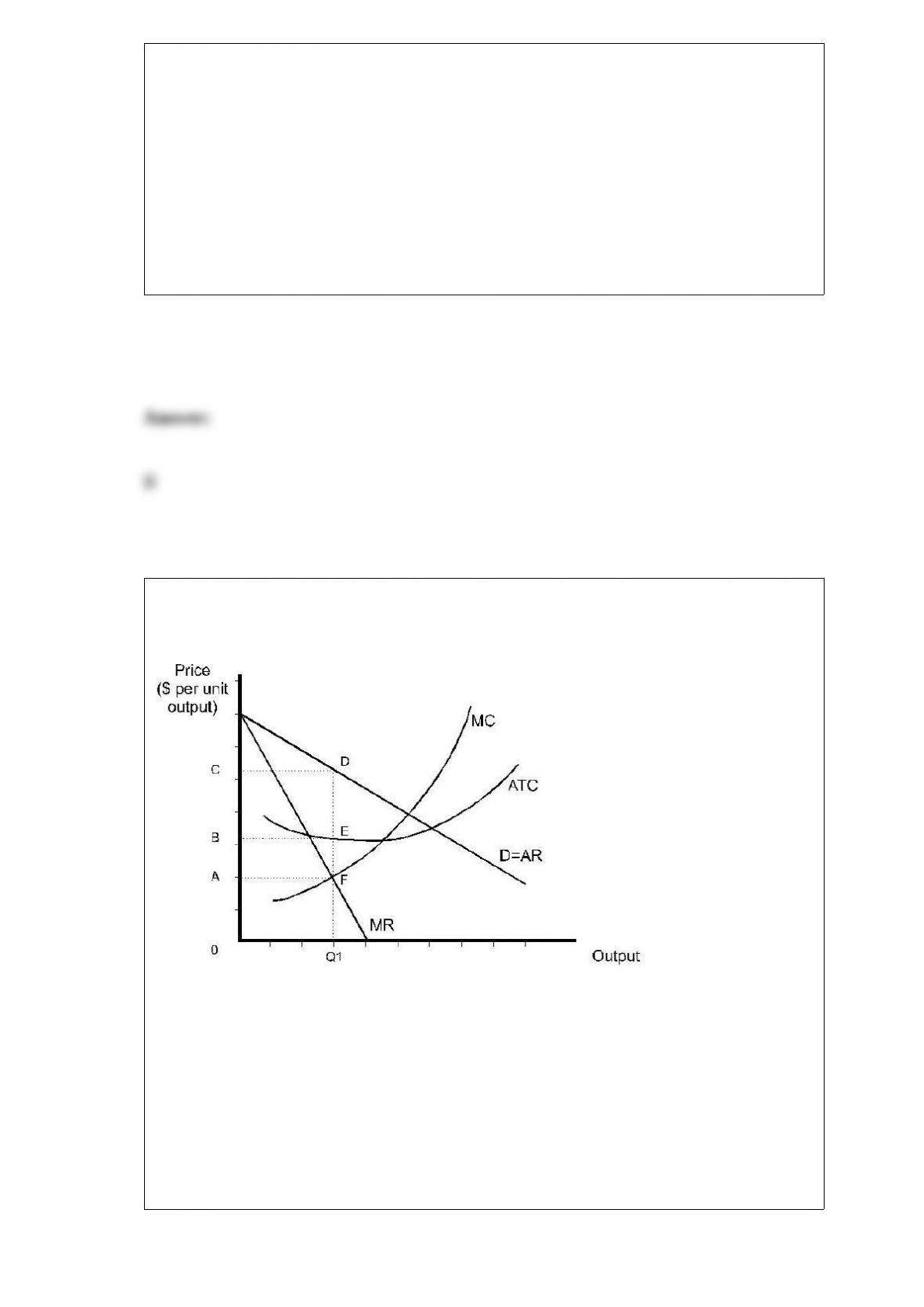
How much profit will the monopolist whose cost and demand curves are shown below
earn at output Q1?
A) 0CDQ1
B) 0BEQ1
C) 0AFQ1
D) ACDF
E) BCDE
Scenario 12.2:
You are studying a market for which the kinked demand curve model applies. The
kinked demand curve is as follows:
Q = 1200 – 5P for 0 Q < 150
Q = 360 – P for 150 Q
The marginal cost is given as:
MC = Q
Refer to Scenario 12.2. What is the profit maximizing level of output?
A) 43
B) 120
C) 150
D) all of the above
E) none of the above
A market with few entry barriers and with many firms that sell differentiated products is

A) purely competitive.
B) a monopoly.
C) monopolistically competitive.
D) oligopolistic.
Good A is a Giffen good. If the price of good A were to suddenly double, the income
effect would cause the purchases of good A to increase by
A) more than double.
B) exactly double.
C) less than double.
D) Any of the above are possible.
E) none of the above
Scenario 14.2:
A firm can hire labor at the minimum wage of $4.25 per hour. Assume that labor works
8 hours a day. The firm’s production function is as follows:
Number of Days Number of Units

of Labor of Output
0 0
1 8
2 15
3 21
4 26
5 30
Refer to Scenario 14.2. If each unit of output sells for $5, how many days of labor will
the firm hire to maximize profit?
A) 1
B) 2
C) 3
D) 4
E) 5
When negative network externalities are present
A) the demand curve is more elastic than otherwise.
B) the demand curve is less elastic than otherwise.
C) the demand curve shifts to the right.
D) the demand curve shifts to the left.

The income-consumption curve
A) illustrates the combinations of incomes needed with various levels of consumption
of a good.
B) is another name for income-demand curve.
C) illustrates the utility-maximizing combinations of goods associated with every
income level.
D) shows the utility-maximizing quantity of some good (on the horizontal axis) as a
function of income (on the vertical axis).
Which of the following actions is not an example of the production coordination
provided by firms?
A) Manage production activities of workers
B) Pay wages to workers
C) Establish industry safety regulations
D) Set the production schedule for each week

Consider the following information:
StowUrStuff Storage is located slightly below sea level in a coastal town. It could build
and maintain a flood control system around its property at an annual cost of $1000, and
if it did so, the probability of a flood’s doing $1,000,000 in damage during the year
would be .005. With no flood control system, the probability of such a flood would be .
01.
If the flood control system were in place, the firm could insure against a flood for an
annual premium of
A) $5,000.
B) $10,000.
C) $100,000.
D) $200,000.
E) $1,000,000.
The discussion of Figure 2.2 in the text indicates that quantity demanded for most
goods tends to increase as income rises. However, the quantity of bananas demanded in
the U.S. tends to decrease as income rises. Under this condition, we expect that an
increase in consumer income shifts the demand curve for bananas:
A) rightward
B) no shift.
C) leftward.
D) upward.

How would we compute the present discounted value of payments of $8,000 received
three years in the future and $10,000 received four years in the future? The interest rate
is expected to be 5 percent for the next four years.
A) 8,000/((1.05)3) + 10,000/((1.05)4)
B) 8,000/((1.5)3) + 10,000/((1.5)4)
C) 8,000/(1.05) + 10,000/(1.05)2)
D) 8,000/(1.03) + 10,000/(1.04)
When the price faced by a competitive firm was $5, the firm produced nothing in the
short run. However, when the price rose to $10, the firm produced 100 tons of output.
From this we can infer that
A) the firm’s marginal cost curve must be flat.
B) the firm’s marginal costs of production never fall below $5.
C) the firm’s average cost of production was less than $10.
D) the firm’s total cost of producing 100 tons is less than $1000.
E) the minimum value of the firm’s average variable cost lies between $5 and $10.

The weighted average of all possible outcomes of a project, with the probabilities of the
outcomes used as weights, is known as the
A) variance.
B) standard deviation.
C) expected value.
D) coefficient of variation.
The regulatory lag:
A) always benefits the regulated firm.
B) is likely to occur with rate-of-return regulation.
C) promotes economic efficiency.
D) all of the above

Constructing plastic containers produces air pollutants. Therefore, in the market for
plastic containers,
A) the marginal social cost curve is above and to the right of the demand curve.
B) the marginal social cost curve is below and to the left of the demand curve.
C) the marginal social cost curve is above and to the left of the supply curve.
D) the marginal social cost curve is below and to the right of the supply curve.
E) there is a gap between quantity supplied and quantity demanded in equilibrium.
Which of the following demand functions represents a price elasticity of demand equal
to -0.33 and an income elasticity of demand equal to 8 at all points along the curve?
A) Q = 3 – 0.33P + 0.8I
B) Q = 4.5 – 0.33 log(P) + 0.8I
C) log(Q) = 1.34 – 0.33 log(P) + 0.8I
D) log(Q) = 2.34 – 0.33 log(P) + 0.8 log(I)
In the Stackelberg model, suppose the first-mover has MR = 15 – Q1, the second firm
has reaction function Q2 = 15 – Q1/2, and production occurs at zero marginal cost. Why

doesn’t the first-mover announce that its production is Q1 = 30 in order to exclude the
second firm from the market (i.e., Q2 = 0 in this case)?
A) In this case, MR is negative and is less than MC, so the first-mover would be
producing less than the optimal quantity.
B) In this case, MR is negative and is less than MC, so the first-mover would be
producing too much output.
C) This is a possible outcome from the Stackelberg duopoly under these conditions.
D) We do not have enough information to determine if this is an optimal outcome for
this case.
A firm never operates
A) at the minimum of its ATC curve.
B) at the minimum of its AVC curve.
C) on the downward-sloping portion of its ATC curve.
D) on the downward-sloping portion of its AVC curve.
E) on its long-run marginal cost curve.
Which of the following are examples of perfectly competitive markets?
A) Wheat
B) Textiles
C) Gold
D) The stock market
E) all of the above
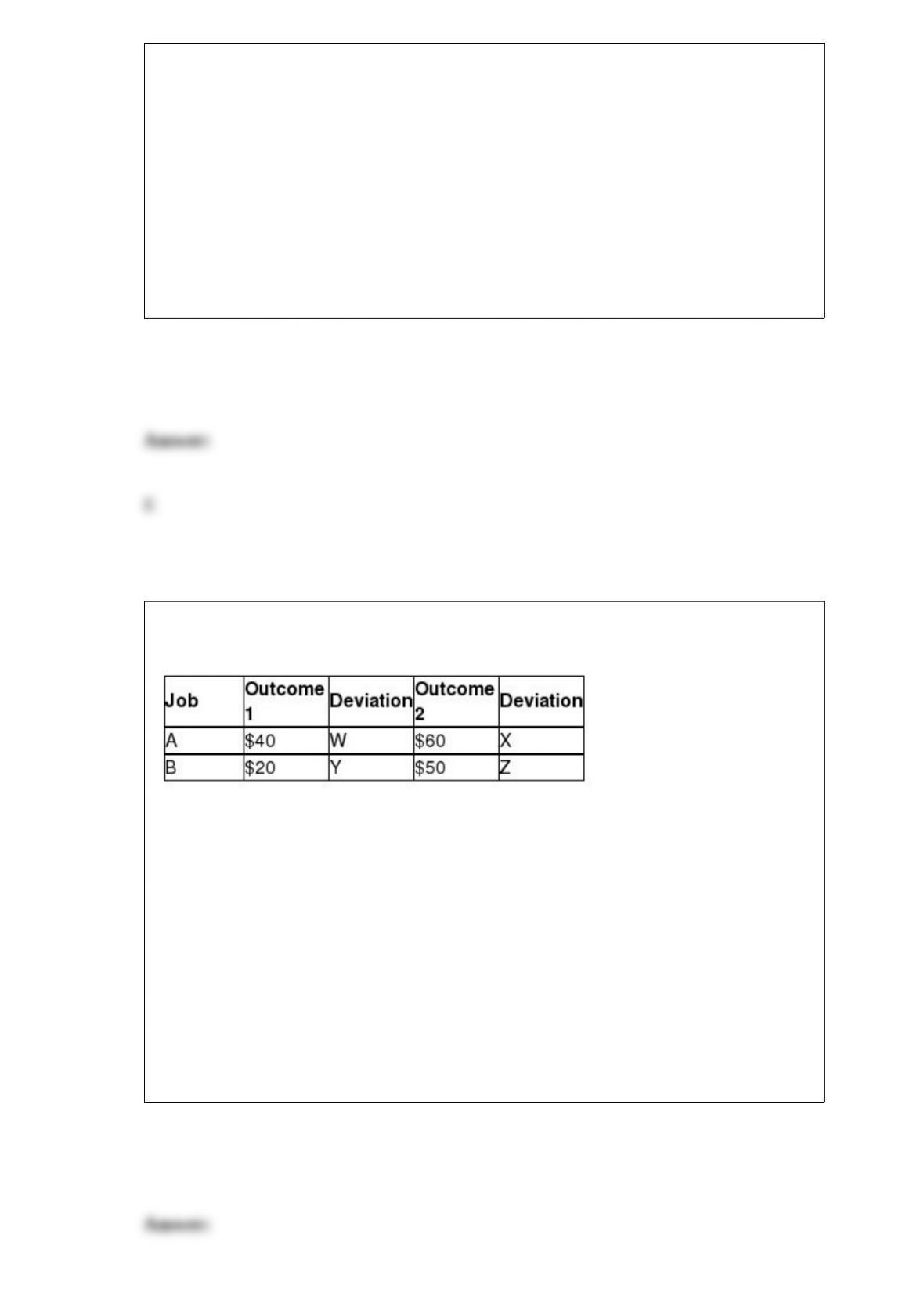
Table 5.4
Refer to Table 5.4. If outcomes 1 and 2 are equally likely at Job A, then in absolute
value
A) W = X = $10.
B) W = X = $20.
C) W = Y = $100.
D) W = Y = $200.
E) W = Y = $300.
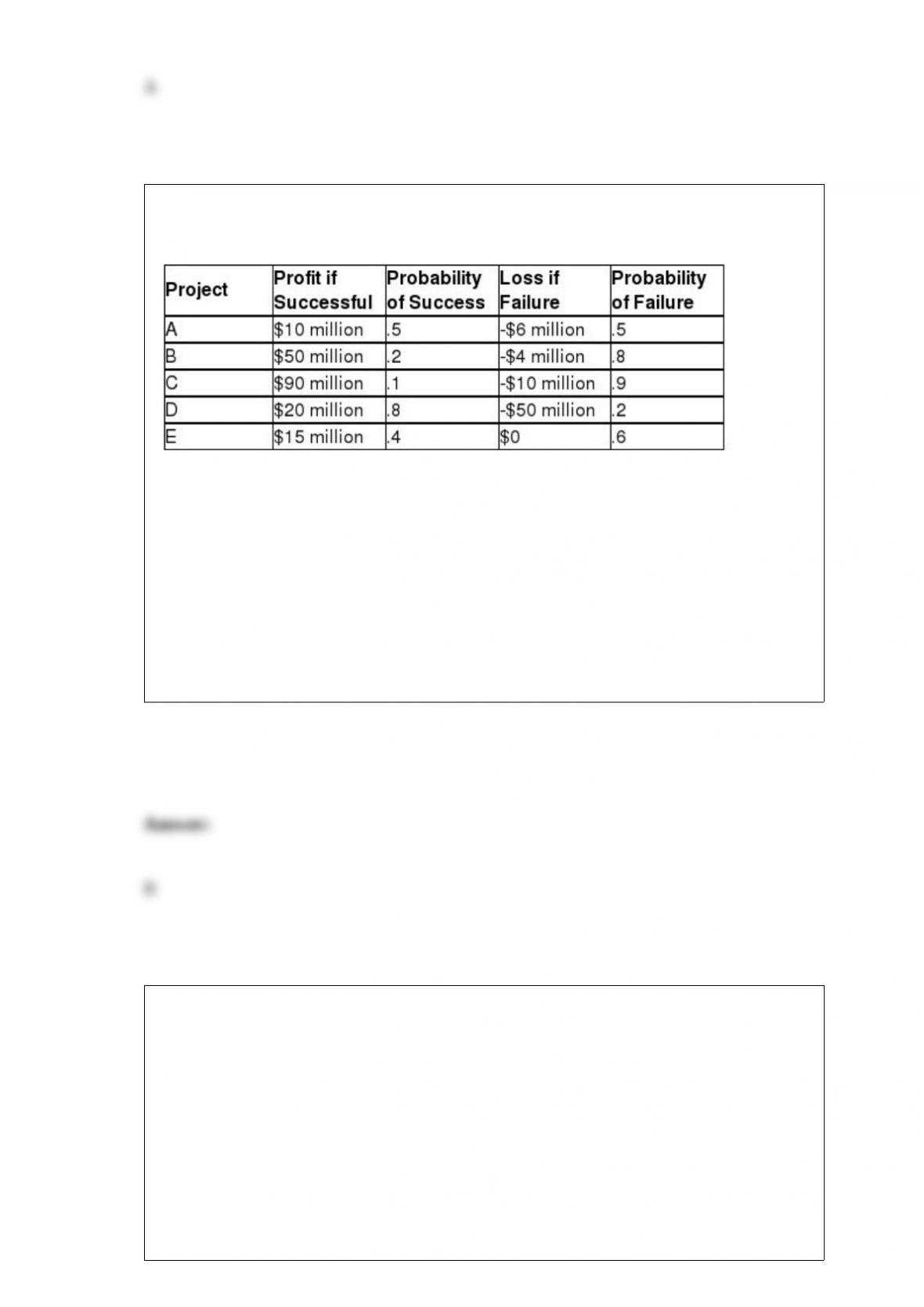
As president and CEO of MegaWorld industries, you must decide on some very risky
alternative investments:
The highest expected return belongs to investment
A) A.
B) B.
C) C.
D) D.
Use the following statements to answer this question:
I. The real rate of return on an investment is the nominal return minus the rate of
inflation.
II. The real rate of return on an investment cannot be negative.
A) I and II are true.
B) I is true and II is false.

C) II is true and I is false.
D) I and II are false.
Pedro buys market basket A that includes 10 books at a price of $20 per book and 10
DVDs at a price of $10 per DVD. Market basket B contains 12 books and 12 DVDs.
Based on this information, which of the following statements is NOT true?
A) Revealed preference analysis implies that Pedro only prefers basket B to basket A if
basket A is more expensive.
B) Pedro prefers market basket B to basket A.
C) Market basket B will cost more than basket A.
D) If the prices change and Pedro chooses market basket C, which now costs the same
as basket B, then basket C is prefer to basket A.
The assumption that preferences are complete:
A) means that a consumer will spend her entire income.
B) is unnecessary, as long as transitivity is assumed.
C) recognizes that there may be pairs of market baskets that cannot be compared.
D) means that the consumer can compare any two market baskets of goods and

determine that either one is preferred to the other or that she is indifferent between
them.
Suppose the labor market is perfectly competitive, but the output market is not. When
the labor market is in equilibrium, the wage rate will:
A) be less than price times the marginal product of labor.
B) equal price times the marginal product of labor.
C) be greater than price times the marginal product of labor.
D) None of the above is necessarily correct.
Scenario 12.3:
Suppose a stream is discovered whose water has remarkable healing powers. You
decide to bottle the liquid and sell it. The market demand curve is linear and is given as
follows:
P = 30 – Q
The marginal cost to produce this new drink is $3.
Refer to Scenario 12.3. What price would this new drink sell for if it sold in a
competitive market?

A) 0
B) $3
C) $13.50
D) $16.50
E) $27
If an individual’s labor supply curve is backward bending, then
A) the income effect associated with a higher wage is greater than the substitution
effect.
B) the substitution effect associated with a higher wage is greater than the income
effect.
C) the substitution effect associated with a higher wage encourages more leisure.
D) A and C
E) B and C
To find the profit maximizing level of output, a firm finds the output level where
A) price equals marginal cost.
B) marginal revenue and average total cost.
C) price equals marginal revenue.
D) all of the above
E) none of the above
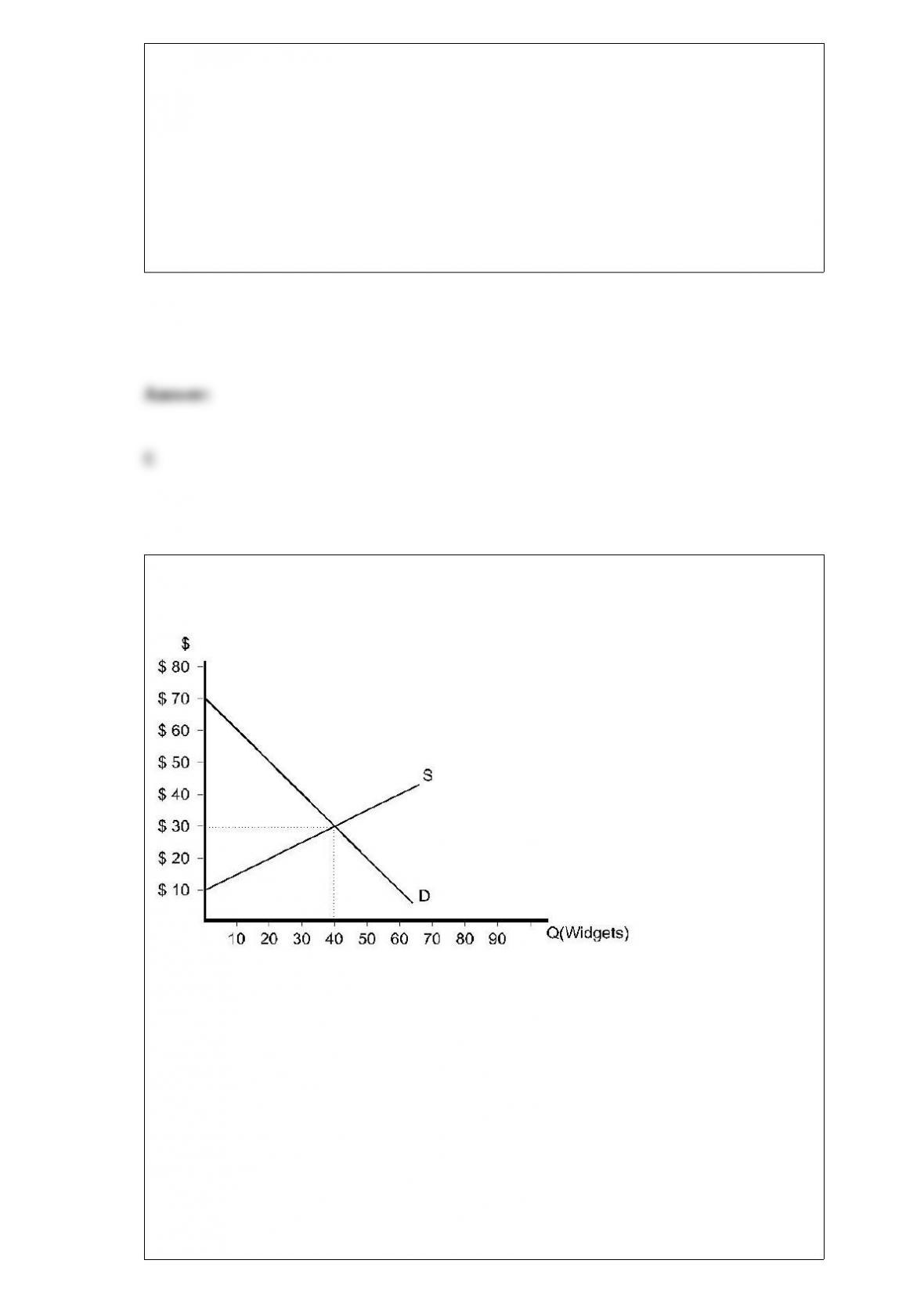
Figure 9.4
Suppose the market in Figure 9.4 is currently in equilibrium. If the government
establishes a price floor of $50, how many widgets will be sold?
A) 20
B) 30
C) 40
D) 50

E) 60
Which of the following pairs of goods are substitutes?
A) Baseball bats and baseballs
B) Hot dogs and mustard
C) Computer hardware and software
D) Gasoline and motor oil
E) Owner-occupied housing and rental housing
Which would not increase the productivity of labor?
A) An increase in the size of the labor force
B) An increase in the quality of capital
C) An increase in the quantity of capital
D) An increase in technology
E) An increase in the efficiency of energy