1) the demand in the united states for yen will increase if, other things remaining equal:
a.labor costs rise in japan
b.income rises in japan
c.prices rise in japan
d.interest rates rise in japan
2) suppose that japan maintains a pegged exchange rate that overvalues the yen. this
would likely result in:
a.japanese exports becoming cheaper in world markets
b.imports becoming expensive in the japanese market
c.unemployment for japanese workers
d.full employment for japanese workers
3) a trade policy designed to alleviate some domestic economic problem by exporting it
to foreign countries is known as a (an):
a.international dumping policy
b.trade adjustment assistance policy
c.most-favored-nation policy
d.beggar-thy-neighbor policy
4) given an open economy with high capital mobility, fiscal policy is strengthened
under fixed exchange rates.
a.true
b.false
5) as workers migrate from low-wage mexico to high-wage united states, wages tend to
rise in mexico and fall in the united states.
a.true
b.false
6) macdougall’s empirical study of comparative advantage was based on the notion that
a product’s labor cost is underlaid by labor productivity and the wage rate.
a.true
b.false
7) regarding the applicability of free trade to cigarettes, it is correct to say:
a.the rules of free trade apply to cigarettes
b.the rules of free trade should not apply to cigarettes
c.a and b are the topic of current debate
d.there are special rules applying to cigarettes world-wide
8) which exchange-rate mechanism calls for frequent redefining of the par value by
small amounts to remove a payments disequilibrium?
a.dual exchange rates
b.adjustable pegged exchange rates
c.managed floating exchange rates
d.crawling pegged exchange rates
9) figure 11.1 illustrates the supply and demand schedules for the swiss franc. assume
that exchange rates are flexible.
figure 11.1. supply and demand schedules of francs
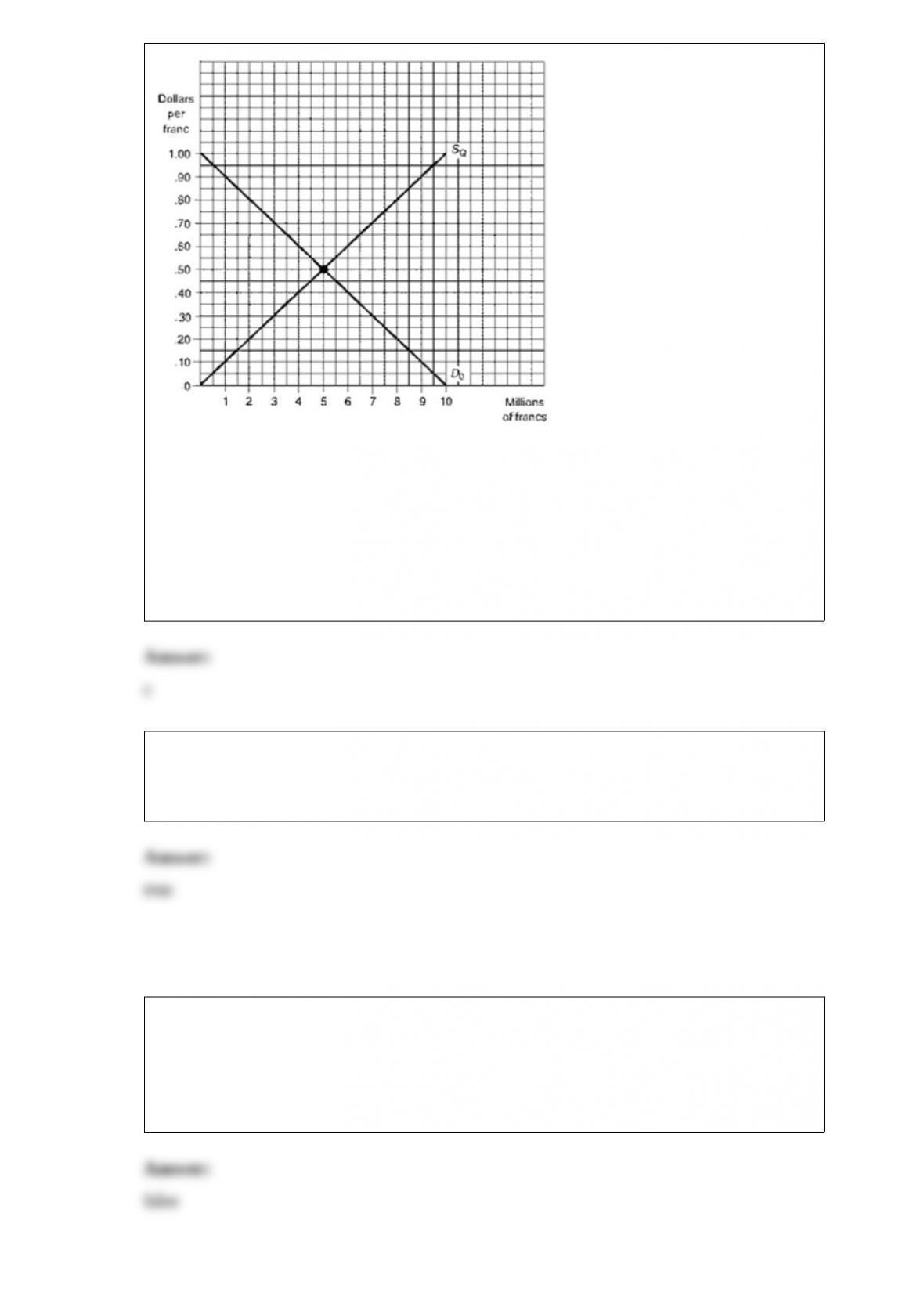
refer to figure 11.1. suppose the exchange rate is $.70 per franc. at this exchange rate
there is an ____ of francs which leads to a ____ in the dollar price of the franc, a (an)
____ in the quantity of francs supplied, and a (an) ____ in the quantity of francs
demanded.
a.excess demand, rise, increase, decrease
b.excess demand, rise, decrease, increase
c.excess supply, fall, decrease, increase
d.excess supply, fall, increase, decrease
10) most of china’s manufactured exports have constituted labor-intensive goods.
a.true
b.false
11) a free-trade area is an association of trading countries whose members agree to
remove all trade restrictions among themselves, while each member country imposes
identical trade restrictions against nonmember countries.
a.true
b.false
12) most of the world’s population now lives in countries that are:
a.integrated into world markets
b.becoming integrated into world markets
c.near poverty
d.a and b
13) the longer the currency pass-through period, the ____ required for currency
depreciation to have the intended effect on the trade balance.
a.shorter the time period
b.longer the time period
c.larger the spending cut
d.smaller the spending cut
14) the u.s. trade-remedy laws attempt to redress hardships for u.s. firms resulting from
actions and policies of foreign firms and governments.
a.true
b.false
15) which of the following tends to cause the u.s. dollar to appreciate in value?
a.an increase in u.s. prices above foreign prices
b.rapid economic growth in foreign countries
c.a fall in u.s. interest rates below foreign levels
d.an increase in the level of u.s. income
16) if a joint venture among competing firms is able to cut costs by extracting wage
concessions from domestic workers, national welfare increases.
a.true
b.false
17) according to ricardo, a country will have a comparative advantage in the product in
which its:
a.labor productivity is relatively low
b.labor productivity is relatively high
c.labor mobility is relatively low
d.labor mobility is relatively high
18) the purpose of international dumping is to decrease a firm’s costs and increase its
profits, compared to what would be realized in the absence of dumping.
a.true
b.false