To compete in the automobile market, Tesla must make many strategic decisions such
as whether to introduce a new car model, how to sell and service its cars, and where to
advertise. At Tesla’s Fremont, California plant, managers must decide on the monthly
production quantities of their S and X models. In making this decision, the managers
A) face no trade-off because the Fremont plant only produces these two models of the
many Tesla models produced worldwide.
B) face a trade-off, because producing more of one model means producing less of the
others.
C) will choose to only produce the quantity of S and X models where marginal cost
equals zero.
D) will always decide on production quantities in which revenues are maximized.
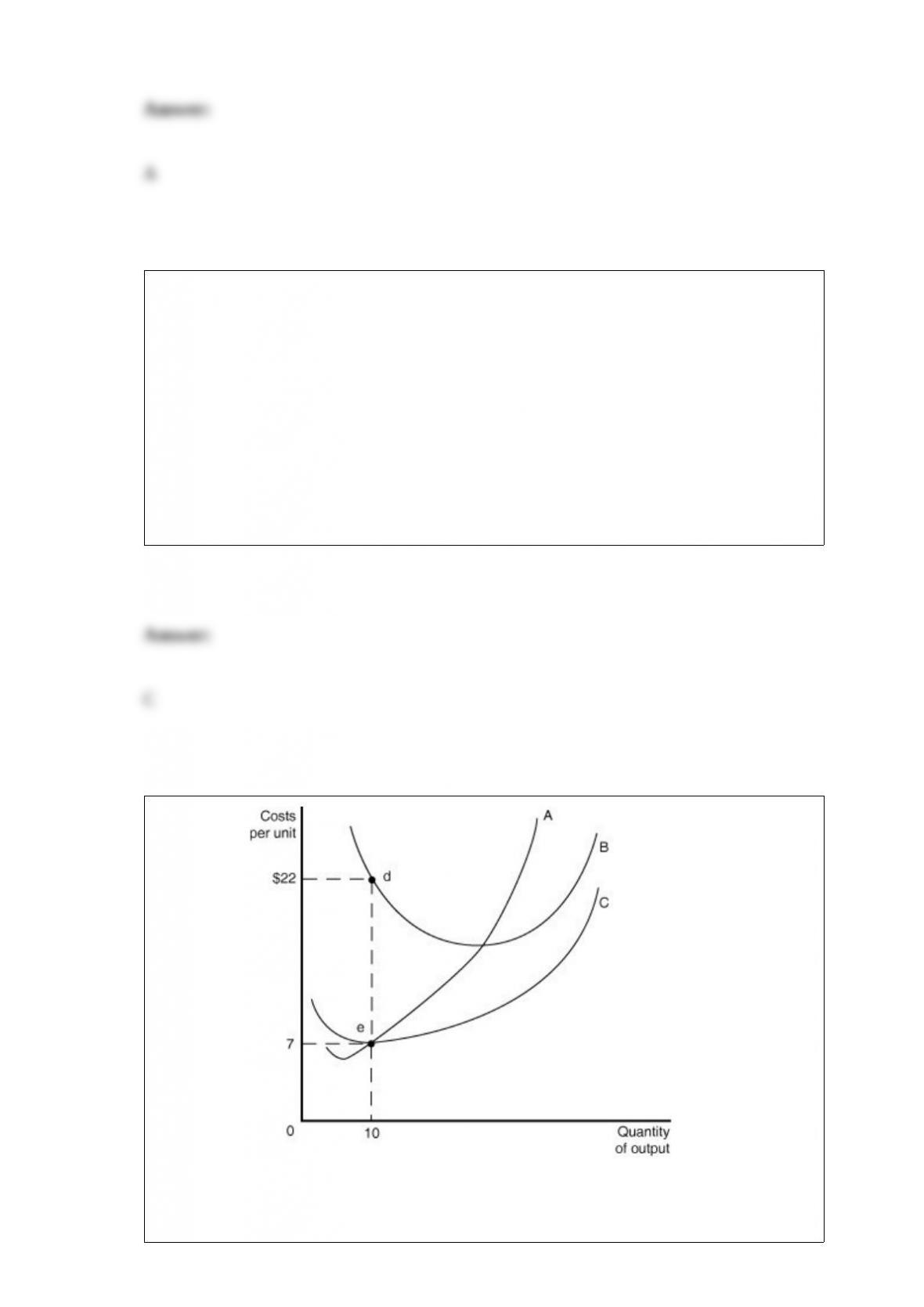
Table 6-1
Suppose you own a bookstore. You believe that you can sell 40 copies per day of the
latest John Grisham novel when the price is $35. You consider lowering the price to $25
and believe this will increase the quantity sold to 50 books per day. Compute the price
elasticity of demand using the mid-point formula and these data. Select the correct
implication from your work.
A) The demand for the John Grisham book is inelastic. Revenue will fall if the price is
lowered.
B) The demand for the John Grisham book is elastic. Revenue will rise if the price is
lowered.
C) The demand for the John Grisham book is inelastic. Revenue will rise if the price is
lowered.
D) The demand for the John Grisham book is elastic. Revenue will fall if the price is
lowered.
Most economists agree that an automatic mechanism brings the economy back to
potential GDP in the long run. In mid-2011, two years after the recession of 2007-2009
had ended, real GDP in the United States
A) had returned to potential GDP.
B) had exceeded potential GDP by 1.5 percent.
C) remained more than 7 percent below potential GDP.
D) was predicted to never return to potential GDP.
Figure 11-8
Answer the following questions.
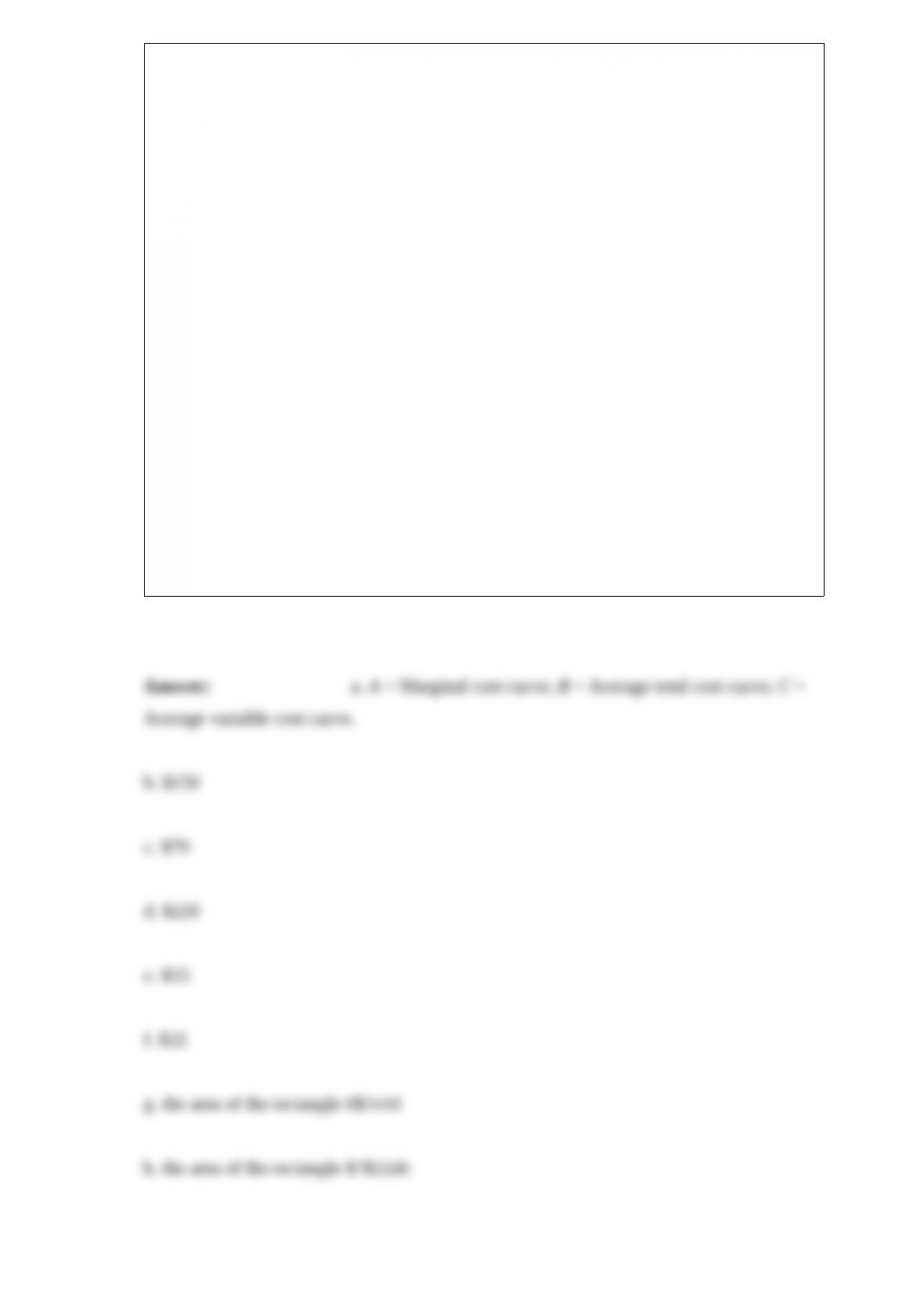
a. Identify the curves in the diagram.
A ________________________________________
B ________________________________________
C ________________________________________
b. What is the numerical value of fixed cost when the quantity of output = 10?
c. What is the numerical value of variable cost when the quantity of output = 10?
d. What is the numerical value of total cost when the quantity of output = 10?
e. What is the numerical value of average fixed cost when the quantity of output = 10?
f. What is the numerical value of average total cost when the quantity of output = 10?
g. On the graph identify the area that represents the total variable cost of production
when the quantity of output = 10.
h. On the graph identify the area that represents the fixed cost of production when the
quantity of output = 10.

Between 1981 and 2011, the overall mortality rate in the United States
A) decreased by more than 25 percent.
B) slowly but steadily increased.
C) remained fairly constant.
D) was similar to the average rate in most low-income countries.
Lower personal income taxes
A) increase aggregate demand.
B) decrease disposable income.
C) decrease aggregate demand.
D) increase transfer payments.
The long-run supply curve for a perfectly competitive, constant-cost industry
A) is upward-sloping.
B) is horizontal.
C) is downward-sloping.
D) is found by adding up the marginal cost curves for all firms in the industry.

If the U.S. government removes tariffs it had placed on imports from countries that
have been accused of deliberately undervaluing their currencies, the price of these
imports will ________ and the demand for the undervalued currency will ________.
A) rise; rise
B) rise; fall
C) fall; rise
D) fall; fall
If China decides to enact laws to clean up the environment, what would be the effect on
GDP?
A) GDP would increase reflecting the fact that the environment would be cleaner.
B) GDP would decrease if the pollution controls reduce productivity by more than the
cost of the controls.
C) GDP would increase as the citizens of China were made happier as the environment
was cleaned up.
D) GDP would increase as the environmental costs of pollution were not included in the
calculation of GDP.

What is meant by the “law of one price”?
A) Identical products should sell for the same price everywhere.
B) A law was passed in 1913 that made it illegal to sell the same good or service to
different people for different prices.
C) This is a section of the Sherman Act that forced trusts (for example, the Standard Oil
Company) to charge the same price for the same good or service in different states.
D) Foreign companies should not be allowed to sell a product in the United States for
prices different from prices these companies charge in other countries.