
1) University researchers create a positive externality because what they discover in
their research labs can easily be learned by others who haven’t contributed to the
research costs. What could the federal government do to equate the equilibrium quantity
of university research and the socially optimal quantity of university research
produced?
a.tax university researchers
b.offer grants to university researchers
c.eliminate subsidized student loans
d.nothing
2) Suppose the government imposes a tax of 20 percent on the first $50,000 of income
and 30 percent on all income above $50,000. What is the marginal tax rate when
income is $60,000?
a.10 percent
b.20 percent
c.30 percent
d.50 percent
3) Table 17-13
Two home-improvement stores (Lopes and HomeMax) in a growing urban area are
interested in expanding their market share. Both are interested in expanding the size of
their store and parking lot to accommodate potential growth in their customer base. The
following game depicts the strategic outcomes that result from the game. Increases in
annual profits of the two home-improvement stores are shown in the table below.
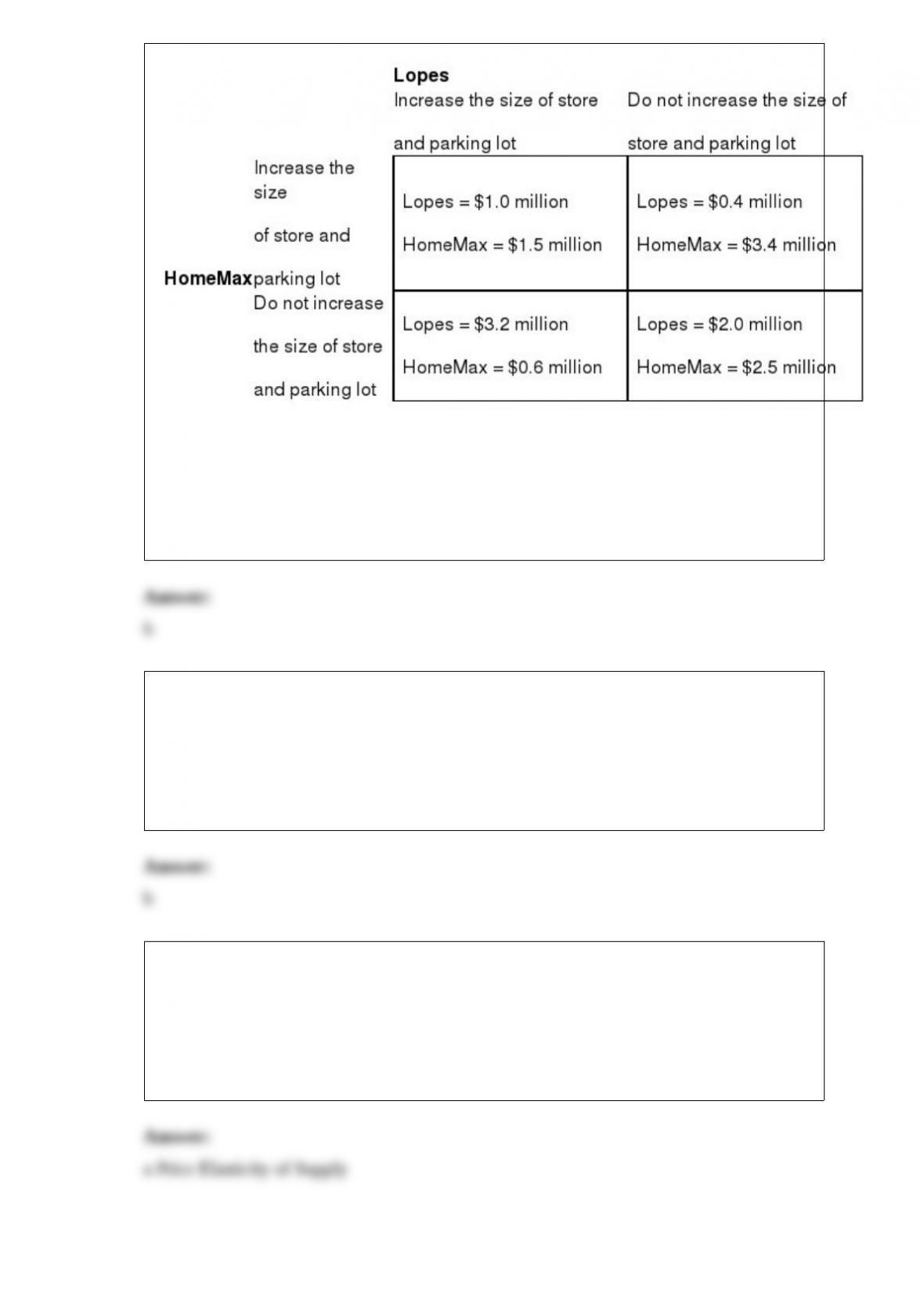
Refer to Table 17-13. If both stores follow a dominant strategy, HomeMax’s annual
profit will grow by
a.$0.6 million.
b.$1.5 million.
c.$2.5 million.
d.$3.4 million.
4) The study of how society manages its scarce resources is most closely associated
with which field of study?
a.environmental studies
b.economics
c.management
d.accounting
5) Which of the following statements is valid when supply is perfectly elastic at a price
of $4?
a.The elasticity of supply approaches infinity.
b.The supply curve is vertical.
c.At a price below $4, quantity supplied is infinite.
d.At a price above $4, quantity supplied is zero.
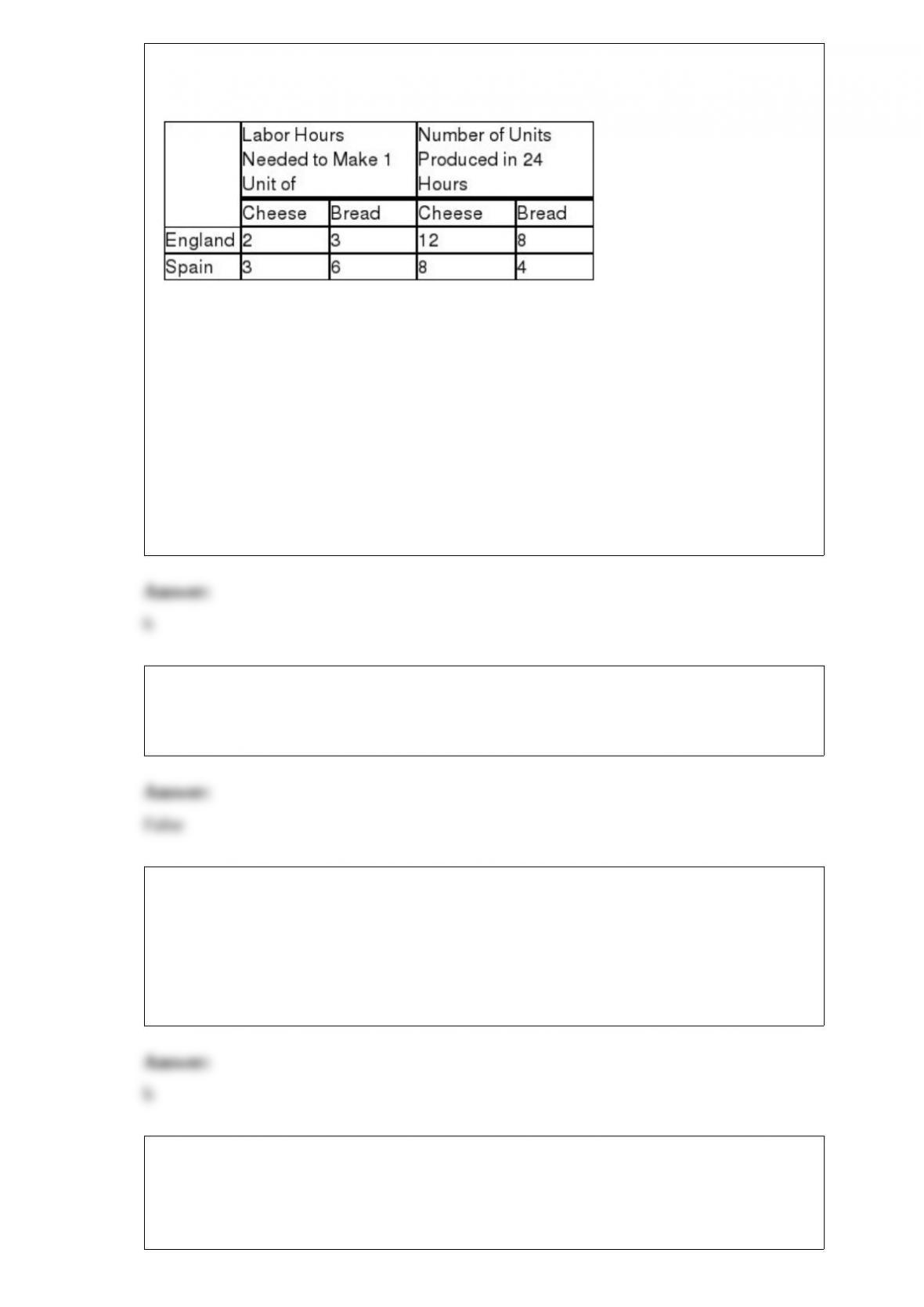
6) Assume that England and Spain can switch between producing cheese and producing
bread at a constant rate.
We could use the information in the table to draw a production possibilities frontier for
England and a second production possibilities frontier for Spain. If we were to do this,
measuring bread along the horizontal axis, then
a.the slope of England’s production possibilities frontier would be 0.67 and the slope of
Spain’s production possibilities frontier would be -0.5.
b.the slope of England’s production possibilities frontier would be 1.5 and the slope of
Spain’s production possibilities frontier would be -2.
c.the slope of England’s production possibilities frontier would be .75 and the slope of
Spain’s production possibilities frontier would be -1.
d.the slope of England’s production possibilities frontier would be 2 and the slope of
Spain’s production possibilities frontier would be -.5.
7) In the United States, all families pay the same proportion of their income in taxes.
a.True
b.False
8) With which of the Ten Principles of Economics is the study of international trade
most closely connected?
a.People face tradeoffs.
b.Trade can make everyone better off.
c.Governments can sometimes improve market outcomes.
d.Prices rise when the government prints too much money.
9) When a tax is levied on buyers, the
a.supply curves shifts upward by the amount of the tax.
b.tax creates a wedge between the price buyers effectively pay and the price sellers
receive.

c.tax has no effect on the well-being of sellers.
d.All of the above are correct.
10) The unique point at which the supply and demand curves intersect is called
a.market harmony.
b.coincidence.
c.equivalence.
d.equilibrium.
11) Holding all other forces constant, if decreasing the price of a good leads to a
decrease in total revenue, then the demand for the good must be
a.unit elastic.
b.inelastic.
c.elastic.
d.None of the above is correct because a price decrease never leads to an decrease in
total revenue.
12) In a market with a fixed number of firms, as long as price is above average
a.variable cost, each firm‘s marginalcost curve is its supply curve.
b.variable cost, each firm‘s averagetotalcost curve is its supply curve.
c.total cost, each firm‘s marginalcost curve is its supply curve.
d.total cost, each firm‘s averagetotalcost curve is its supply curve.