If a country has an absolute advantage in producing a product, it may not have a
comparative advantage in producing that product.
The Federal Home Loan Mortgage Corporation and the Federal National Mortgage
Association were established by Congress in order to regulate banks that buy and sell
mortgage-backed securities.
Consider the following T-account for a bank:
If the required reserve ratio is 20 percent and the bank is holding no excess reserves, the
bank at this point can make no more loans.
Today, the United States charges an average tariff rate of less than 1.5 percent.
If bankers become more uncertain regarding future deposits and withdrawals and
choose to hold more excess reserves against deposits, the money multiplier will
increase.
If the marginal propensity to save is 0.35, the multiplier is 2.86.
An increase in the tax wedge associated with a given economic activity will decrease
the level of that activity.
The situation in which one party to a transaction takes advantage of knowing more than
the other party to the transaction is known as adverse selection.
If the demand for a product decreases and the supply of the same product increases, the
equilibrium quantity will increase.
Managed float exchange systems were abandoned with the implementation of the gold
standard.
The International Monetary Fund was created to facilitate the borrowing and lending of
dollar reserves to central banks of the countries participating in the Bretton Wood
System.
Both countries involved in a pegging of currency must agree to the terms of the
pegging.
Ceteris paribus, an increase in the government’s budget deficit will decrease the
financial account surplus.
If an increase in crime causes households to spend money on police and security
systems, GDP will rise.
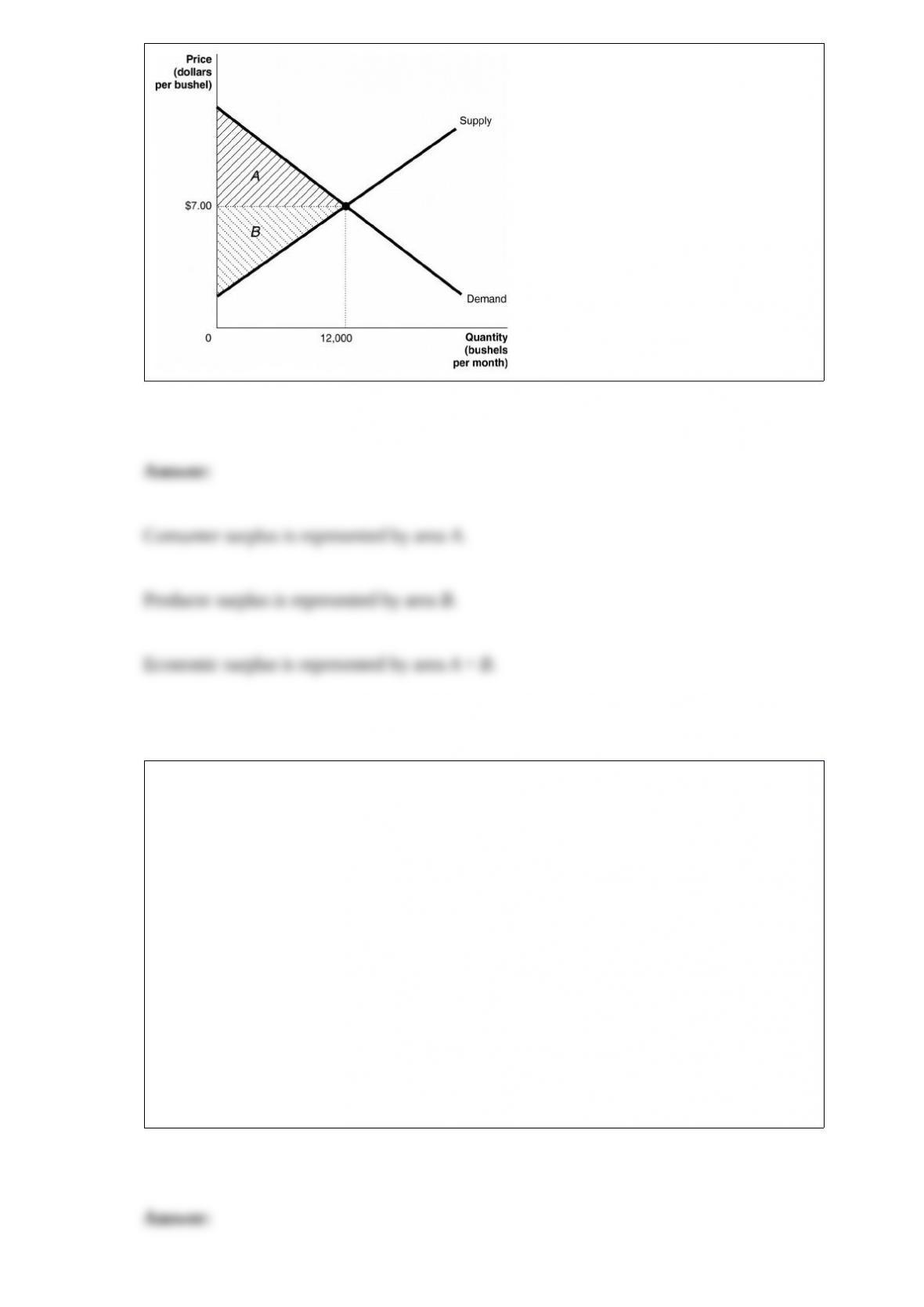
The graph below represents the market for alfalfa. The market price is $7.00 per bushel.
Identify the areas representing consumer surplus, producer surplus, and economic
surplus.
The Philippines and Vietnam have roughly the same size population. Suppose the GDP
of the Philippines is $1,000 billion and the GDP of Vietnam is $10,000 billion. You
should conclude
A) a typical person in Vietnam is 10 times as well off as the typical person in the
Philippines.
B) a typical person in Vietnam is more than 10 times as well off as the typical person in
the Philippines.
C) a typical person in Vietnam is less than 10 times as well off as the typical person in
the Philippines.
D) it is not possible to make a good comparison of the economic well being of a typical
individual in the 2 countries without additional information.

Increases in real GDP wouldoverstatethe increase in the well-being of a country over
time if, over that time period, the
A) average hours worked per week increased.
B) amount of pollution decreased.
C) price level increased.
D) crime rate decreased.
Monthly expenditures for a family of 4 in 2012 averaged $1,400. In 2013, the cost of
the same purchases was $1,500. If 2012 is the base year, what was the CPI in 2013?
A) 110
B) 107
C) 100
D) 93
The average price of goods and services in the economy is also known as
A) the price level.
B) the inflation rate.
C) a market basket.
D) the cost of living.
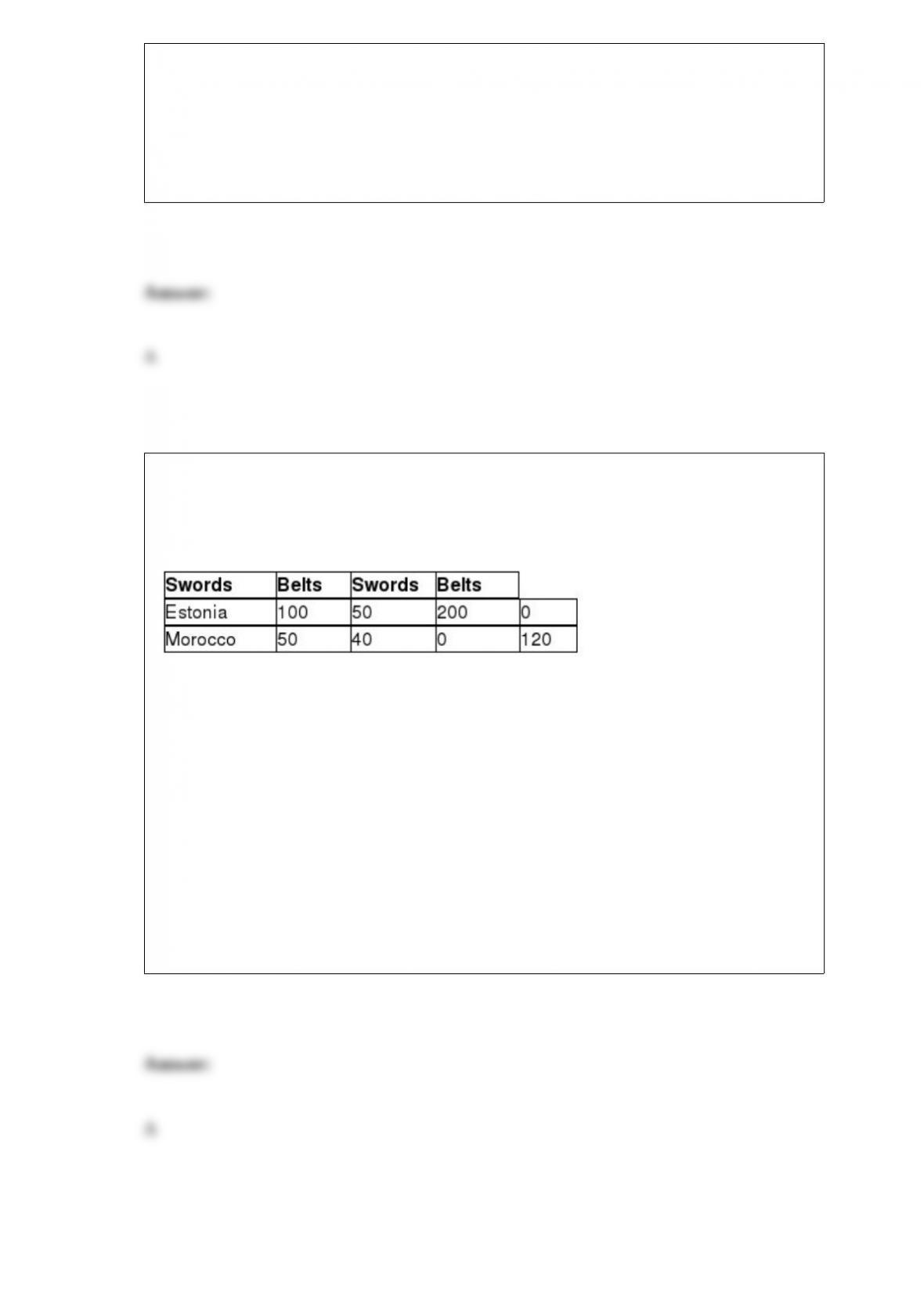
Table 7-6
Production and
Consumption Production
Without Trade With Trade
Estonia and Morocco can produce both swords and belts. Table 7-6 shows the
production and consumption quantities without trade, and the production numbers with
trade.
Refer to Table 7-6. With trade, what is the total gain in sword production?
A) 50
B) 100
C) 200
D) 350

John Maynard Keynes argued that if many households decide at the same time to
increase saving and reduce spending,
A) this will increase investment spending in the short run and expand the economy in
the long run.
B) the economy will benefit in the short run but the effect will not last into the long run.
C) this will have a major negative impact on the economy in both the short run and in
the long run.
D) they may make themselves worse off by causing aggregate expenditure to fall,
thereby pushing the economy into a recession.
Which of the following is not counted in M1?
A) checking account balances
B) credit card balances
C) coins in circulation
D) currency in circulation
E) traveler’s check balances
Table 4-6
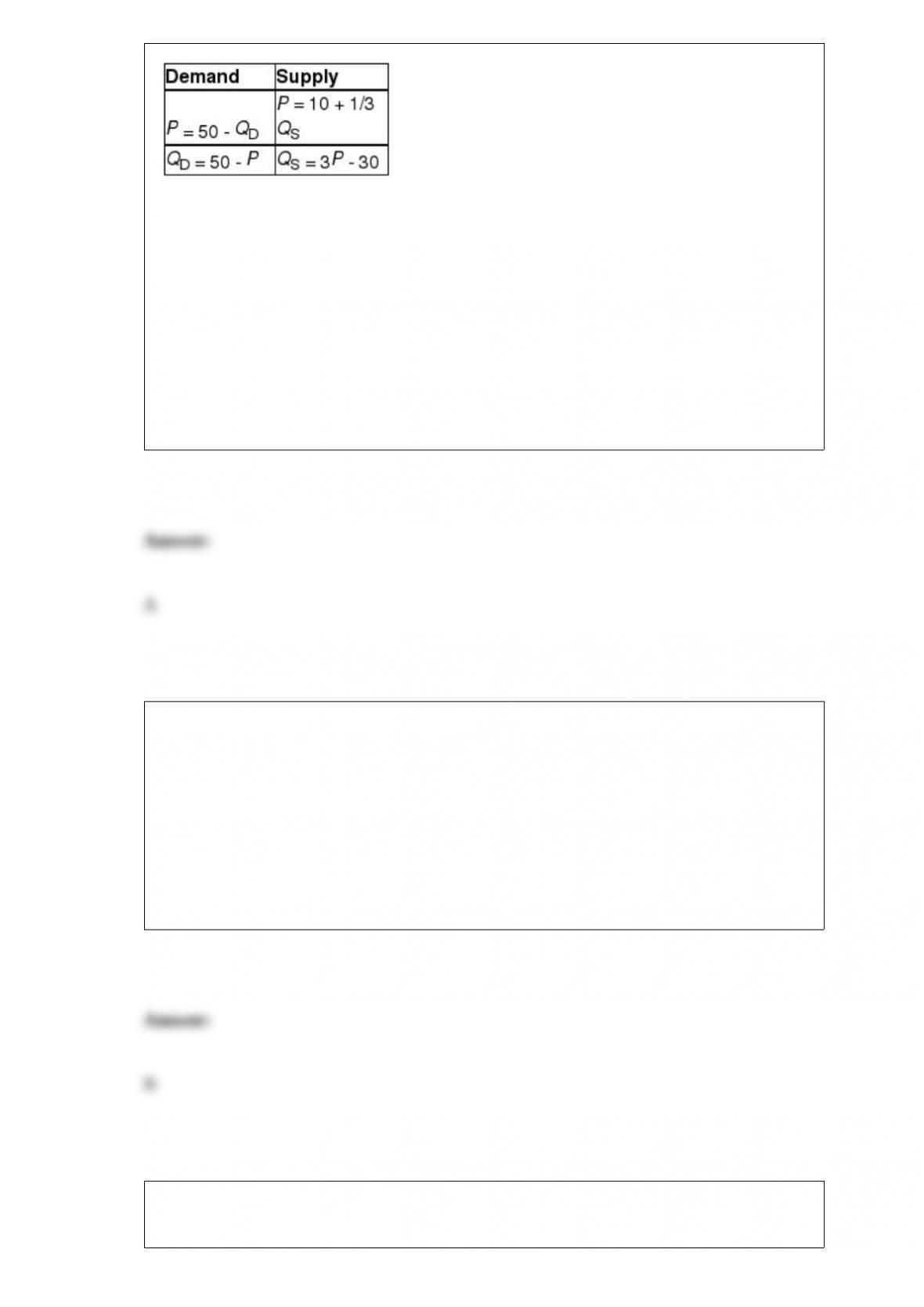
Refer to Table 4-6. The equations above describe the demand and supply for Aunt
Maud’s Premium Hand Lotion. What are the equilibrium price and quantity (in
thousands) for Aunt Maud’s Lotion?
A) $20 and 30 thousand
B) $30 and 20 thousand
C) $60 and 30 thousand
D) $20 and 60 thousand
If expected inflation rises, the long-run Phillips curve will
A) shift to the right.
B) not be affected.
C) shift to the left.
D) become negatively sloped.
In 2003, Congress passed a tax cut that included a reduction in the marginal tax rate on
stock dividends. This essentially increased the after-tax rate of return on stocks that
offer dividends. Using the loanable funds market, describe what will happen to saving,
investment, economic growth, the real interest rate, and the quantity of loanable funds
exchanged.
Why might a country raise interest rates in the face of an exchange rate crisis?
In 1991, Argentina decided to peg its currency (the Argentinean peso) to the U.S. dollar.
Most of Argentina’s trading, however, was with Brazil and Europe, not the United
States. What result would pegging the Argentinean peso to the U.S. dollar have on the
cost of imports from and exports to Brazil and Europe?
How can tax simplification be beneficial to the economy?
What are two reasons why employees would prefer for their employer pay for their
health insurance rather than receiving increased wages and paying for their own health
insurance?