
Which of the following is a factor of production?
A) a necklace produced by a jewelry manufacturer
B) 50 shares of Google stock
C) the security guard at the local bank
D) $1,000 in casino chips
Figure 5-10
Chicken pox vaccinations for toddlers benefit society by protecting young children and
by preventing an epidemic of the disease. Thus, the social benefits of chicken pox
vaccinations exceed the private benefit for any quantity of vaccinations as illustrated in
Figure 5-10.
One way to obtain the economically efficient amount of chicken pox vaccinations is for
governments to subsidize these vaccinations. What is the size of the per-vaccination
Pigovian subsidy that the government must provide to internalize the external benefits?
A) PE
B) (PE– PG)
C) (PE– PF)
D) (PF– PG)

Shares of stock and long-term debt, including corporate and government bonds and
bank loans, are bought and sold on
A) the stock market.
B) capital markets.
C) foreign exchange markets.
D) commodity markets.
When the labor market is at full employment
A) there is only cyclical unemployment in the economy.
B) there is only structural unemployment in the economy.
C) the unemployment rate is 0%.
D) there is no cyclical unemployment in the economy.
What is the most common type of business?
A) corporation
B) partnership
C) sole proprietorship
D) They are equally represented because of federal laws.
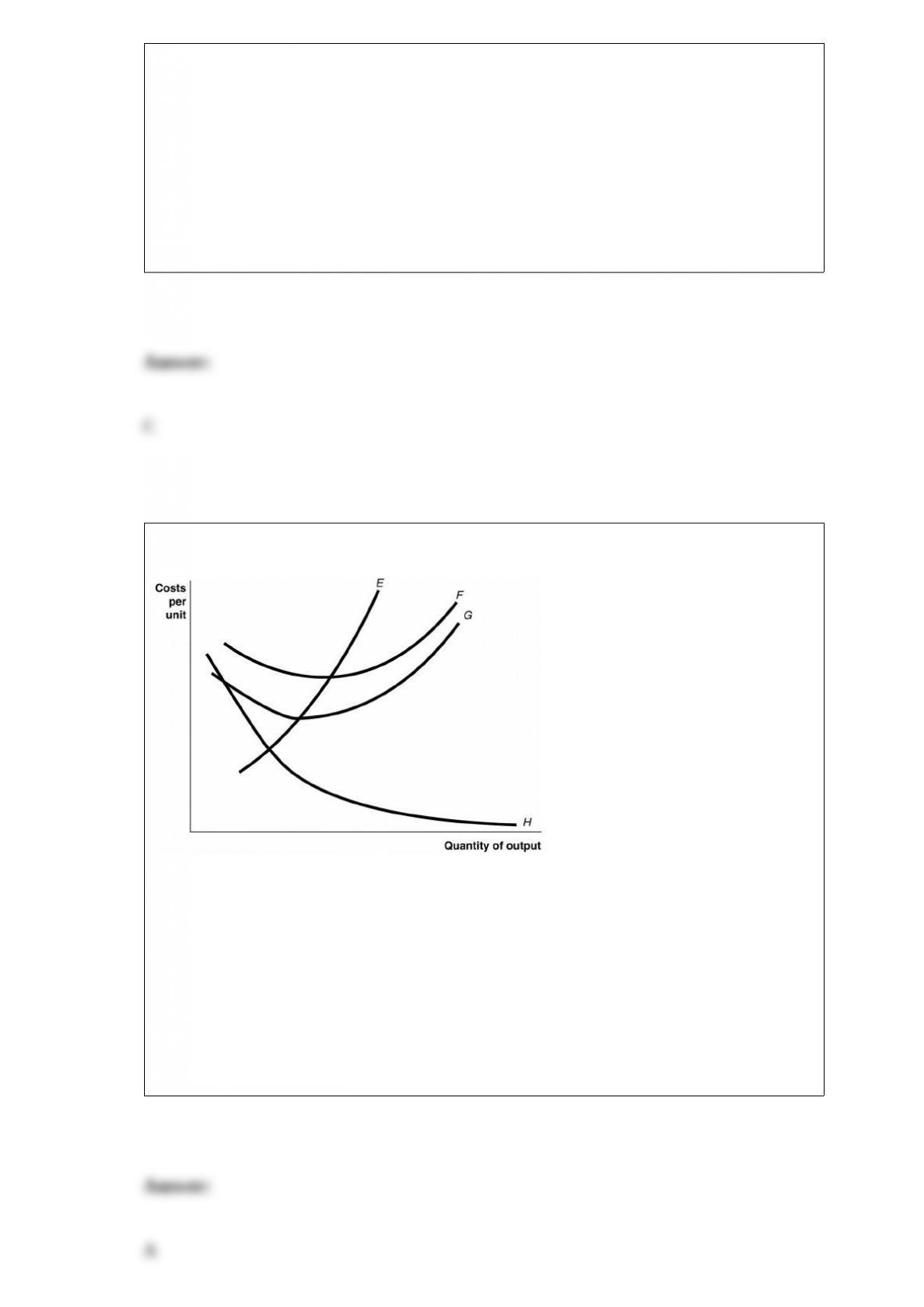
Figure 11-5
The vertical difference between curves F and G measures
A) average fixed costs.
B) marginal costs.
C) fixed costs.
D) sunk costs.

Which of the following are implicit costs for a typical firm?
A) opportunity costs of capital owned and used by the firm
B) the cost of labor hired by the firm
C) utilities cost
D) a business licensing fee
According to the National Bureau of Economic Research, the recession that began in
December 2007
A) lasted 12 months.
B) lasted 18 months.
C) lasted 27 months.
D) had not ended by December 2011.
What factors are not important in determining exchange rate fluctuations in the long
run?
A) relative price levels across countries
B) relative rates of productivity growth across countries

C) preferences for domestic and foreign goods across countries
D) speculating in currency markets
If one U.S. dollar could be exchanged for one Australian dollar in 1970, and one U.S.
dollar can now be exchanged for 0.98 Australian dollars, which of the following is true?
A) The U.S. dollar gained value against the Australian dollar.
B) The Australian dollar lost value against the U.S. dollar.
C) The Australian dollar gained value against the U.S. dollar.
D) Both A and C are true.
In the United States, the bulk of health care spending is paid by health insurance
companies. Such a system is also called ________ where consumers of health care pay
a nominal fee and the rest are paid by the health insurance provider.
A) universal health care system
B) third-party payer system
C) socialized medicine system
D) single-payer system

Suppose the Fed increases the money supply. Which of the following is true?
A) At the original interest rate, the quantity of money demanded is equal to the quantity
of money supplied.
B) At the original interest rate, the quantity of money demanded is less than the quantity
of money supplied.
C) At the original interest rate, the quantity of money demanded is greater than the
quantity of money supplied.
D) The interest rate must rise for the money market to clear.
Vaccinating people against a communicable disease such as influenza not only reduces
the chances that the person vaccinated will catch the disease but also reduces the
probability that an epidemic of the disease will occur. Which of the following
statements is true?
A) Reducing the chances that the person vaccinated will catch the disease is a private
cost while reducing the probability of an influenza epidemic is a social benefit.
B) Vaccinating people against communicable diseases yields private benefits in excess
of social benefits.
C) Reducing the chances that the person vaccinated will catch the disease is a private
benefit while reducing the probability of an influenza epidemic is a social benefit.
D) The benefits of the influenza vaccination outweigh the costs.

Currency traders expect the value of the dollar to fall. What effect will this have on the
demand for dollars and the supply of dollars in the foreign exchange market?
A) Demand for dollars will increase, and supply of dollars will decrease.
B) Demand for dollars will increase, and supply of dollars will increase.
C) Demand for dollars will decrease, and supply of dollars will increase.
D) Demand for dollars will decrease, and supply of dollars will decrease.
You lend $5,000 to a friend for one year at a nominal interest rate of 10%. The CPI over
that year rises from 180 to 190. What is the real rate of interest you will earn?
A) 0%
B) 4.4%
C) 5.5%
D) 5.8%

The demand by all the consumers of a given good or service is the ________ for the
good or service.
A) market demand
B) quantity demanded
C) law of demand
D) scheduled demand
A period of expansion in the business cycle ends when
A) real GDP is equal to potential GDP.
B) the business cycle reaches its peak.
C) the business cycle reaches its trough.
D) real GDP is less than potential GDP.
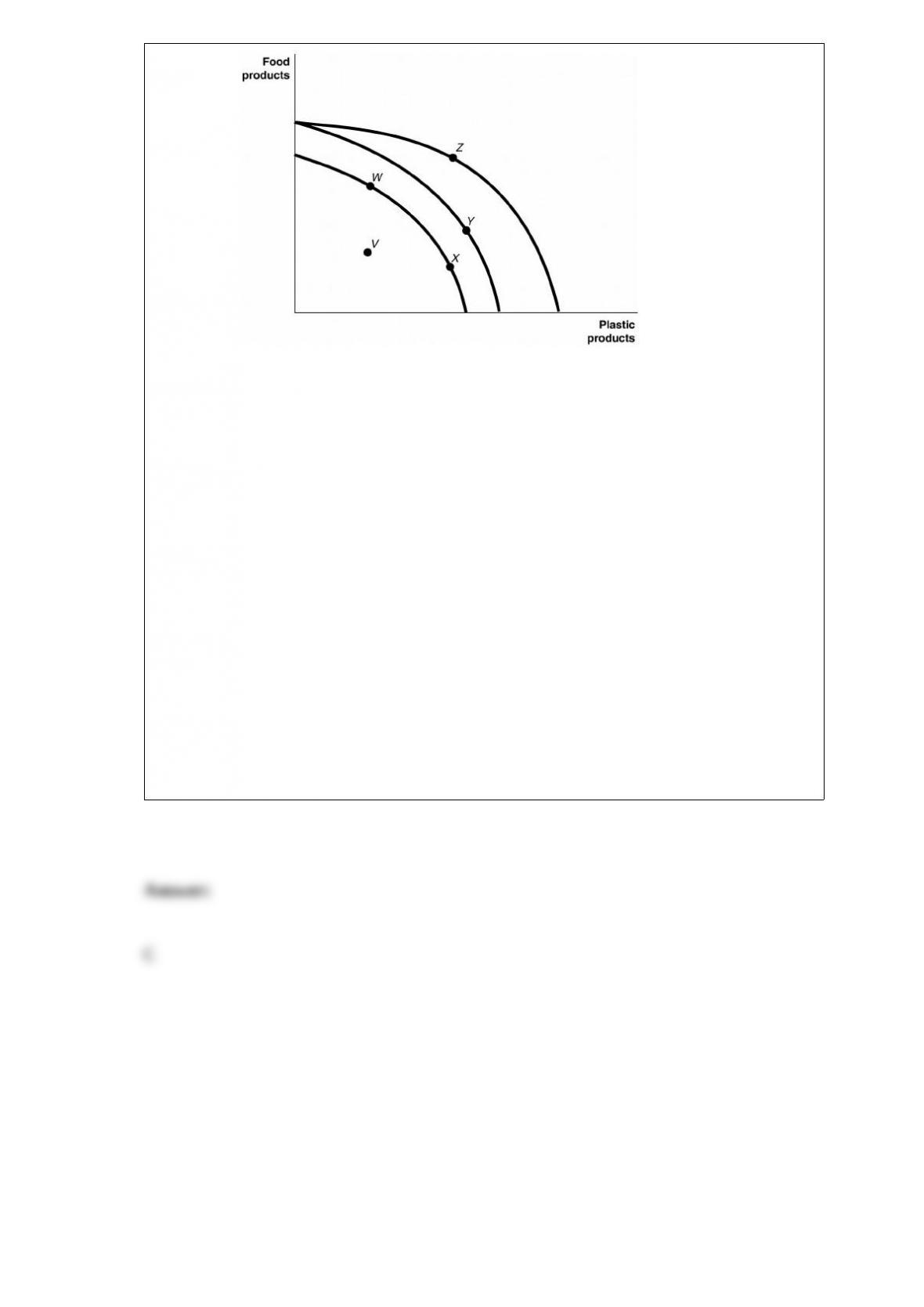
Figure 2-4 Figure 2-4 shows
various points on three different production possibilities frontiers for a nation. Consider
the following events:
a. an increase in the patent protection period to 75 years
b. a hurricane that destroys a substantial portion of a nation’s capital stock
c. the implementation of a secure and enforceable property rights system Which of the
events listed above could cause a movement from W to Z?
A) a only
B) a and b only
C) a and c only
D) b and c only
E) a, b, and c