
Total revenue is equal to
A) the amount of funds earned by a firm minus its costs of production.
B) the total quantity sold of a product over a given period of time.
C) the price of a product multiplied by the number of units of the product sold.
D) the monetary value of the capital (for example, plant and equipment) a firm owns.
A ‘stockout” occurs when
A) brokers run out of shares of stock to sell of a particular company.
B) a disruption due to a power outage, etc., causes a temporary production shutdown.
C) a company holds too many goods in inventories.
D) a firm loses sales because goods consumers want are not available.
To be a natural monopoly a firm must
A) control a key resource input.
B) have economies of scale that are so large that it can supply the entire market at a
lower cost than two or more firms.

C) have significant network externalities.
D) be very large relative to the total market.
A monopoly is a firm that is the only seller of a good or service that does not have
A) a patent.
B) a close complement.
C) a barrier to entry.
D) a close substitute.
Which of the following products allows the seller to identify different groups of
consumers (segment the market) and practice price discrimination?
A) clothing items sold through Macy’s Department Store
B) a hamburger sold at Burger King
C) a cafe latte sold at Starbucks
D) tickets to matinee shows at a movie theatre
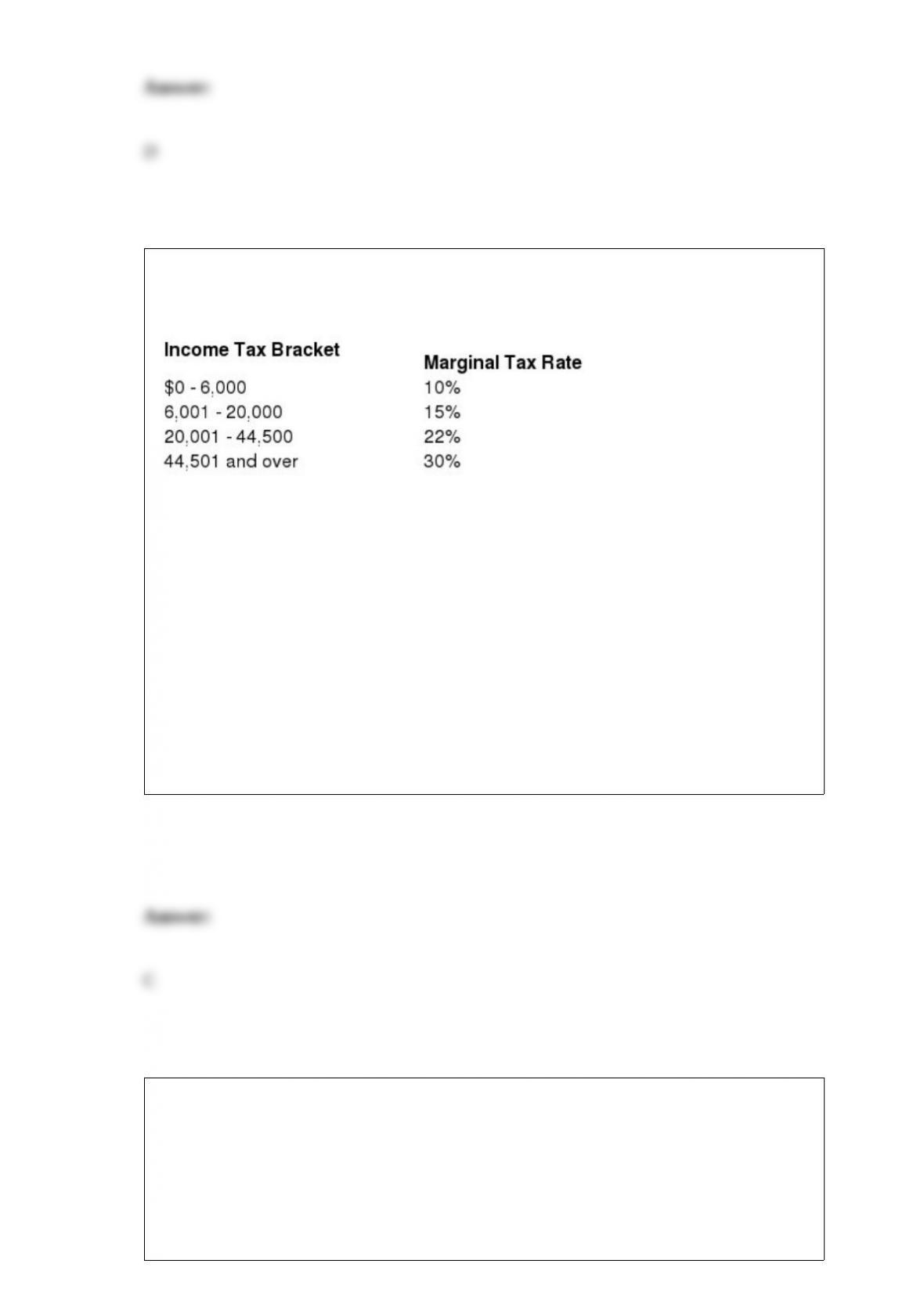
Table 18-9
Table 18-9 shows the income tax brackets and tax rates for single taxpayers in
Monrovia.
Refer to Table 18-9. Sylvia is a single taxpayer with an income of $70,000. What is her
marginal tax rate and what is her average tax rate?
A) marginal tax rate = 30%; average tax rate = 30%
B) marginal tax rate = 8%; average tax rate = 19.3%
C) marginal tax rate = 30%; average tax rate = 22.5%
D) marginal tax rate = 20%; average tax rate = 30%
If an increase in income leads to a decrease in the demand for popcorn, then popcorn is
A) an inferior good.
B) a neutral good.
C) a necessity.

D) a normal good.
Consider the following pricing strategies:
a. perfect price discrimination
b. charging different prices to different groups of customers
c. optimal two-part tariff
d. single-price monopoly pricing
Which of the pricing strategies allows a producer to capture the entire consumer surplus
that would have gone to consumers under perfect competitive pricing?
A) a, b, c, and d
B) a, b, and c only
C) a and b only
D) a and c only
If Mort’s House of Flowers sells one dozen roses to different customers at different
prices, economists would consider this an example of

A) price gouging.
B) rational ignorance.
C) arbitrage.
D) price discrimination.
If the labor supply is unchanged, an increase in the demand for labor will
A) increase the equilibrium wage and decrease the number of workers employed.
B) increase the equilibrium wage and increase the quantity of jobs demanded.
C) decrease the equilibrium wage and increase the number of workers employed.
D) increase the equilibrium wage and increase the number of workers employed.
Which of the following statements about two-part tariffs is false?
A) Because each individual has a different individual demand curve, if there is just one
entrance fee some consumers will be able to reap some consumer surplus.
B) The producer cannot capture the entire consumer surplus because the entrance fee
might discourage some potential consumers even though they would have been willing
to pay a lesser entrance fee.
C) Two-part tariff pricing allows a producer to capture the entire consumer surplus.
D) For two-part tariff pricing to be successful, the producer must be able to identify two
distinct customer groups.
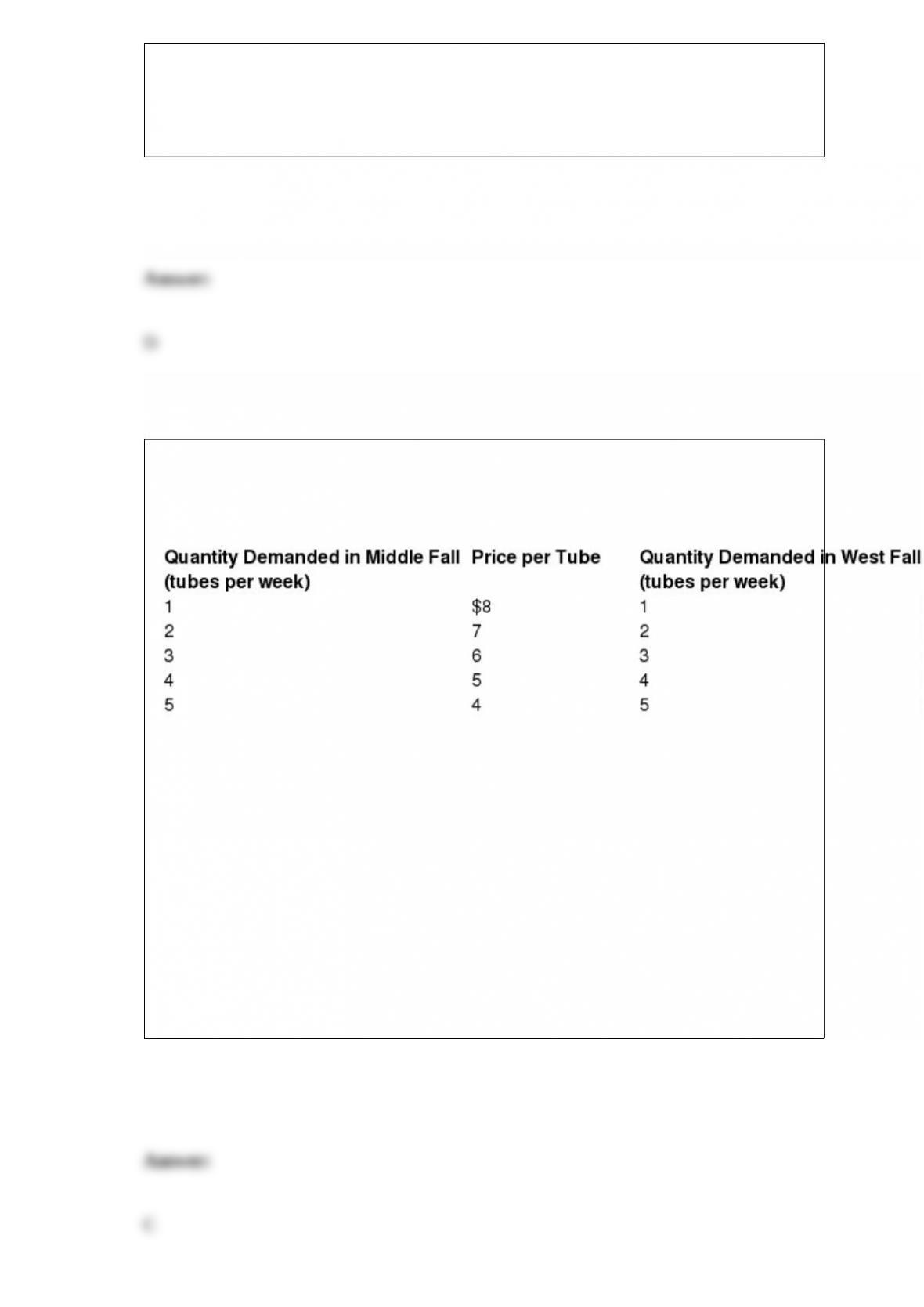
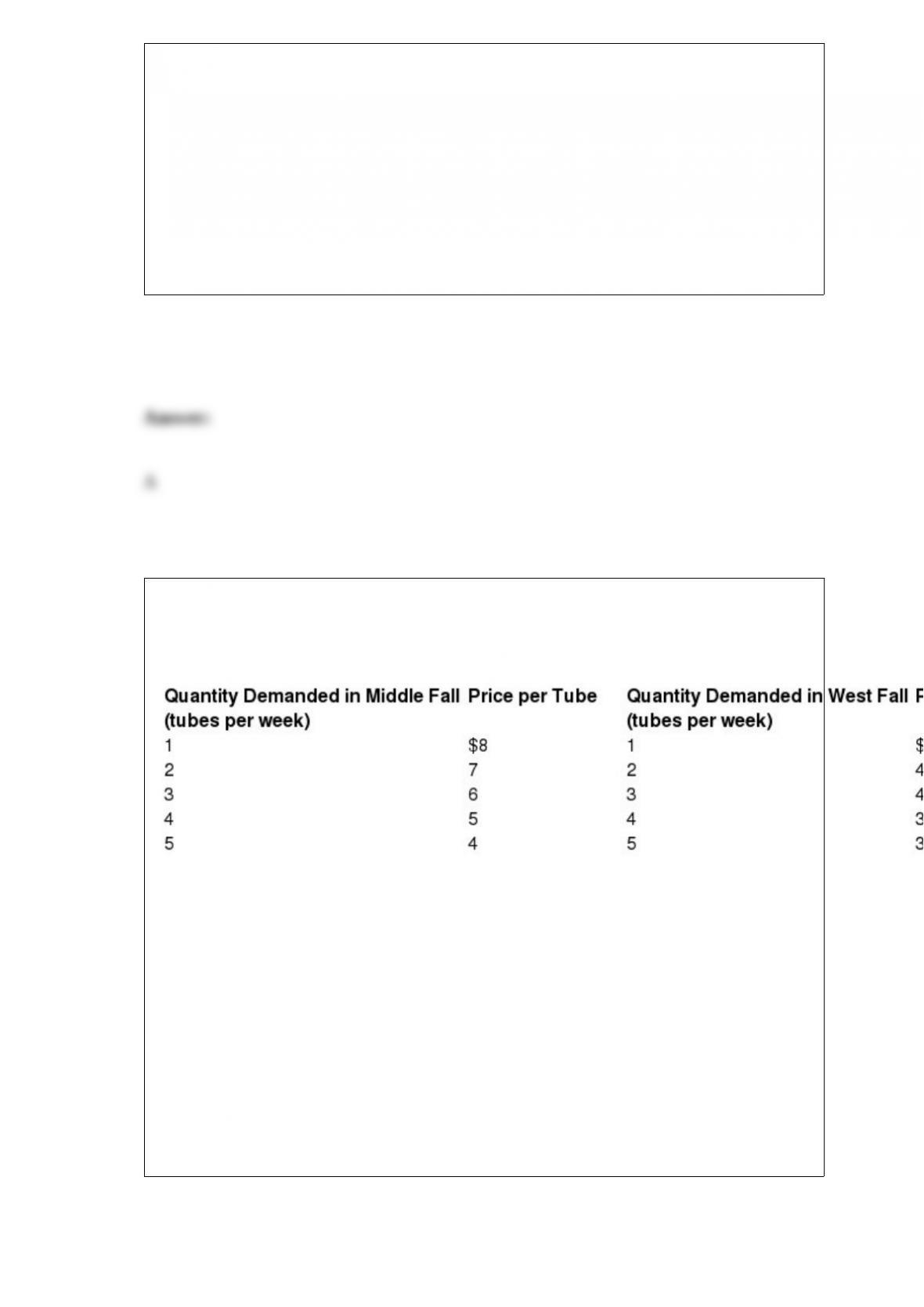
Table 16-2
Neem Products sells its Ayurvedic Neem toothpaste in two completely isolated markets
with demand schedules as shown in Table 16-2. The average cost of production is
constant at $2 per tube.
Refer to Table 16-2. What are the total profits from both markets combined?
A) $50
B) $48
C) $18
D) $15
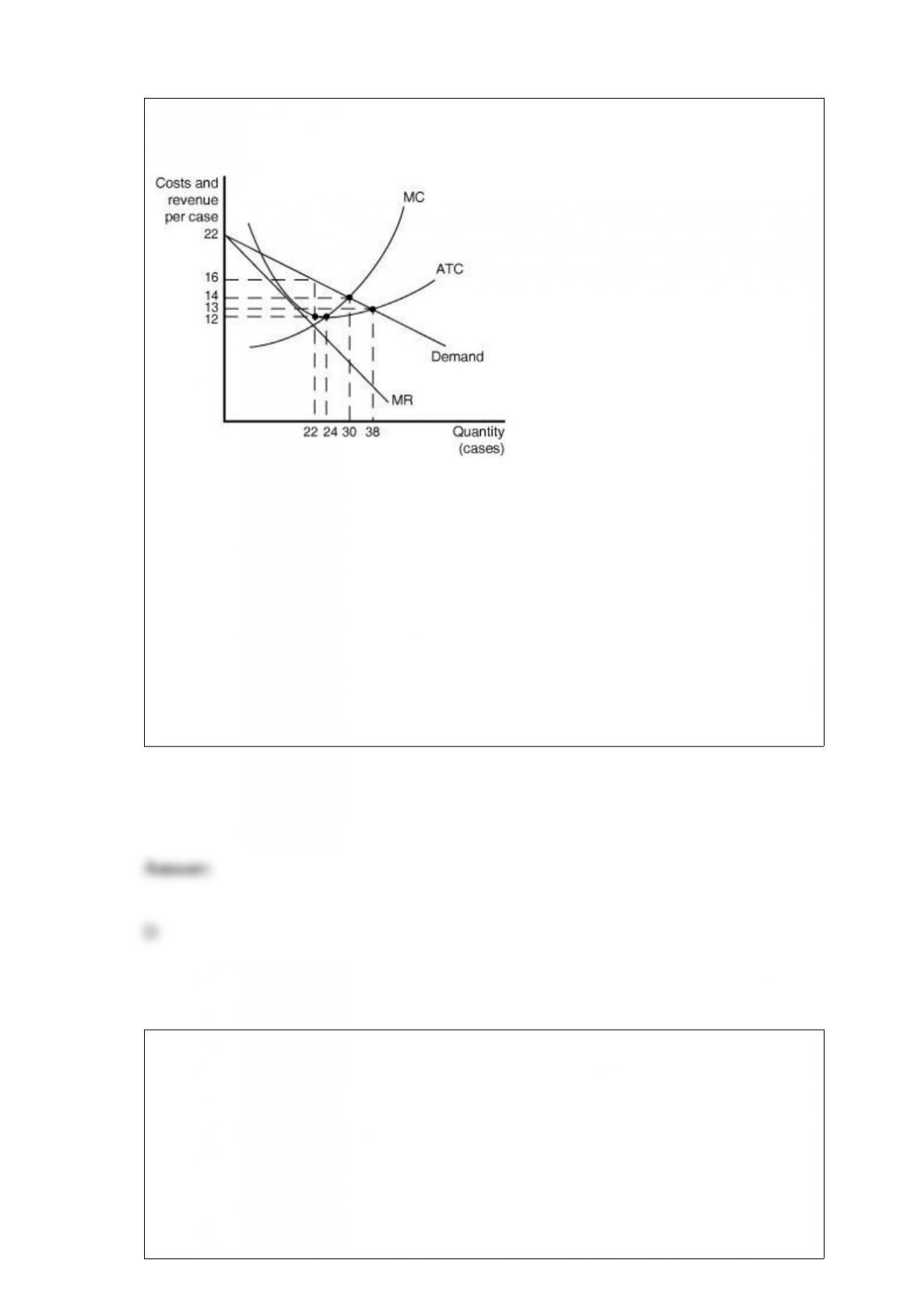
Figure 13-8
Figure 13-8 shows cost and demand curves for a monopolistically competitive producer
of iced tea.
Refer to Figure 13-8. What is the firm’s profit-maximizing price?
A) $12
B) $13
C) $14
D) $16
Experience with patents in the pharmaceutical industry shows that when patents on
drugs expire
A) most patients will continue to buy the drugs from the same firms because their
doctors recommend they buy brand-name drugs.
B) prices remain high without patent protection because of a lack of competition. Firms
that are not granted patents cannot compete with firms that are granted patents.

C) other firms are free to produce chemically identical drugs. Competition reduces the
profits that had been earned by the firms that received patents.
D) firms will find ways to obtain additional patent protection – often by making
cosmetic changes in drugs that were patented – so that they can continue charging high
prices.
What is a prisoner’s dilemma?
A) a game that involves no dominant strategies
B) a game in which prisoners are stumped because they cannot communicate with each
other
C) a game in which players act in rational, self-interested ways that leave everyone
worse off
D) a game in which players collude to outfox authorities
Suppose $1 billion is available in the budget and Congress is considering allocating the
funds to one of the following three alternatives:
a. subsidies for education
b. research on Alzheimer’s
c. increased border security
If voters prefer a to b and b to c, then if preferences are transitive,
A) they should prefer a to c.
B) they should prefer c to a.
C) they should be indifferent between a and c.
D) it is not always possible to rank voters’ preferences between a and c.
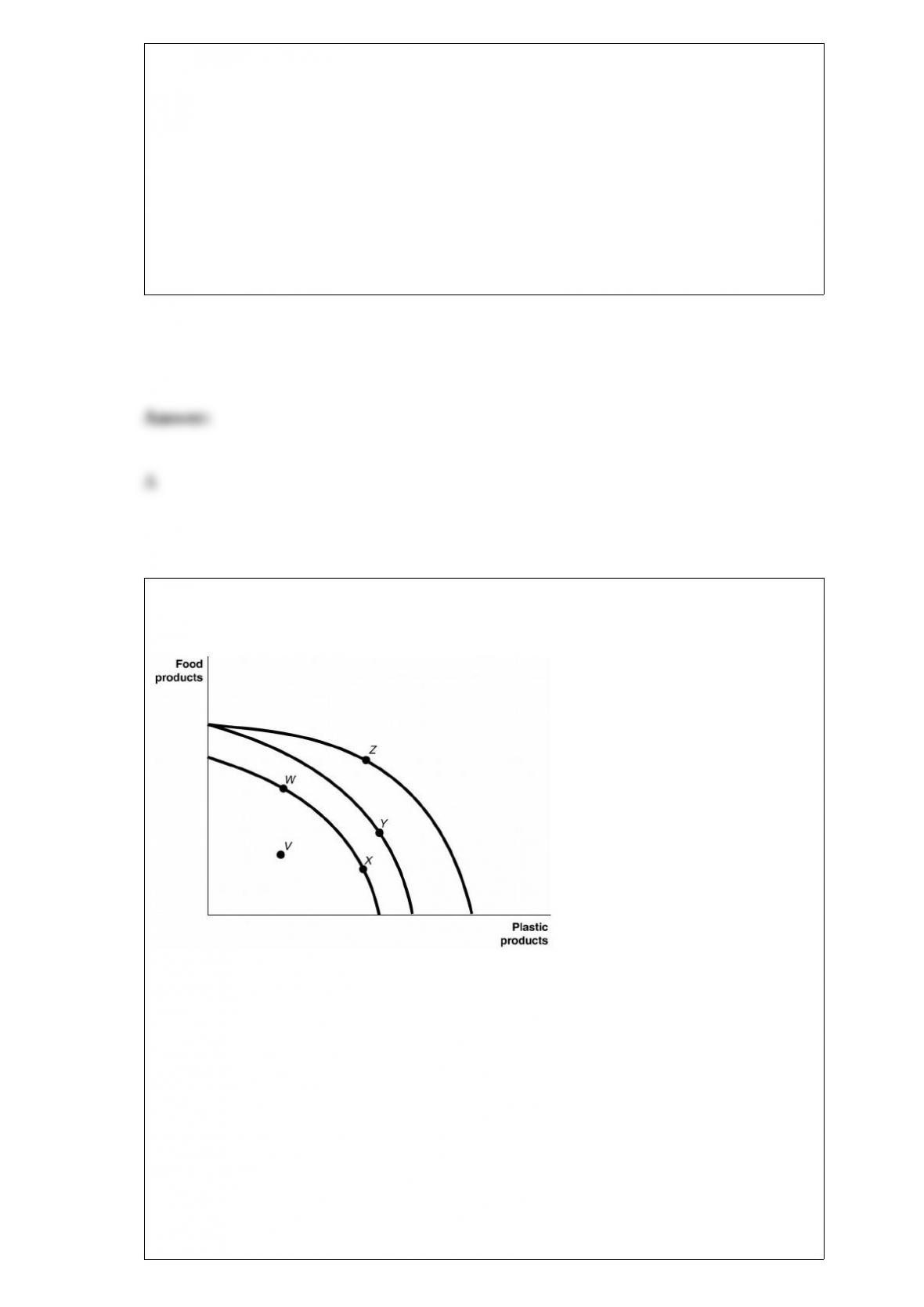
Figure 2-4
Figure 2-4 shows various points on three different production possibilities frontiers for
a nation.
Refer to Figure 2-4. A movement from X to Y
A) could be due to a change in consumers’ tastes and preferences.
B) could occur because of an influx of immigrant labor.
C) is the result of advancements in food production technology only, with no change in
the technology for plastic production.
D) is the result of advancements in plastic production technology only, with no change

in food production technology.
The cross-price elasticity of demand between Coca-Cola and Pepsi-Cola is calculated
by dividing
A) the percentage change in quantity demanded of Coca-Cola by the percentage change
in the quantity demanded of Pepsi-Cola.
B) the percentage change in the price of Pepsi-Cola by the percentage change in
quantity demanded of Coca-Cola.
C) the percentage change in the price of Coca-Cola by the percentage change in the
price of Pepsi-Cola.
D) the percentage change in the quantity demanded of Coca-Cola by the percentage
change in the price of Pepsi-Cola.
The principle of opportunity cost is that
A) in a market economy, taking advantage of profitable opportunities involves some
money cost.
B) the economic cost of using a factor of production is the alternative use of that factor
that is given up.
C) taking advantage of investment opportunities involves costs.

D) the cost of production varies depending on the opportunity for technological
application.
Which of the following is not a characteristic of monopolistic competition?
A) Firms are price takers.
B) There are many buyers and sellers.
C) Barriers to entry are low.
D) Firms sell similar, but not identical, products.
According to a Wall Street Journal article, hhgregg has differentiated itself from its
competition, particularly from large chain stores such as Best Buy
A) by charging lower prices.
B) by providing better customer service.
C) by selling inferior products.
D) by offering discounts for cash sales.

For which of the following firms is patent protection of vital importance?
A) furniture producers
B) software firms
C) pharmaceutical firms
D) auto makers
Based on projections from the U.S. Census Bureau and the Congressional Budget
Office
A) there will be a significant increase in the demand for health care by the year 2020.
B) there will be a significant decrease in the demand for health care by the year 2020.
C) there will be no significant change in the demand for health care by the year 2020.
D) the change in the supply of health care will more than make up for the change in
demand for health care by the year 2020.
Which of the following refers to the use of computer networks to purchase, sell, or
exchange products; service customers; and collaborate with partners?
A) e-commerce
B) telecommuting
C) data virtualization
D) virtual hosting
Table 16-2
Neem Products sells its Ayurvedic Neem toothpaste in two completely isolated markets
with demand schedules as shown in Table 16-2. The average cost of production is
constant at $2 per tube.
Refer to Table 16-2. Which of the following statements is trueabout the two markets?
A) The demand in Middle Fall is more price elastic than the demand in West Fall.
B) The demand in Middle Fall is less price elastic than the demand in West Fall.
C) The demand in Middle Fall is more income elastic than the demand in West Fall.
D) The demand in Middle Fall is less income elastic than the demand in West Fall.

Though large firms have the knowledge and resources to utilize a better pricing
strategy, many choose to use cost-plus pricing. One reason for this is that
A) large firms do not have to maximize their profits because they face little competition
from other firms.
B) there is less risk of violating antitrust laws if a cost-plus pricing strategy is used
rather than a profit-maximizing pricing strategy.
C) the additional revenue that would result from a profit-maximizing pricing strategy is
an insignificant fraction of the firms’ revenues.
D) firms often adjust the markup they charge to reflect current demand.
Assume that a comparable worth law is passed that determines that kindergarten
teachers and bricklayers have comparable jobs; therefore, workers in both of these
occupations should be paid the same wages. Assume that prior to the law, bricklayers
were paid a higher wage than kindergarten teachers. Which of the following is the most
likely result of the comparable worth law?
A) The equilibrium wage will be the same for kindergarten teachers and bricklayers.
B) Some former bricklayers will become kindergarten teachers and some former
kindergarten teachers will become bricklayers.
C) There will be a shortage in the market for bricklayers and a surplus in the market for
kindergarten teachers.
D) There will be surplus in the market for bricklayers and a shortage in the market for
kindergarten teachers.

A firm using a two-part tariff can produce the economically efficient outcome by
A) making the fixed-fee portion of the price as low as possible.
B) setting the per-unit portion of the price equal to the marginal cost of production.
C) setting the per-unit portion of the price equal to the average cost of production.
D) setting the fixed-fee portion of the price at some proportion to the fixed cost of
production.
Goods can be classified on the basis of whether their consumption is
A) internal and excludable.
B) rival and competitive.
C) includable and cooperative.
D) rival and excludable.
How has organizing a successful firm in a market economy changed over the last
century?
A) It has become easier as more and more firms discover how to do it.
B) As government intervention has decreased, firms now have more freedom.
C) There has been no change one way or the other over the last century.
D) It has become more difficult to organize an efficient and successful firm.
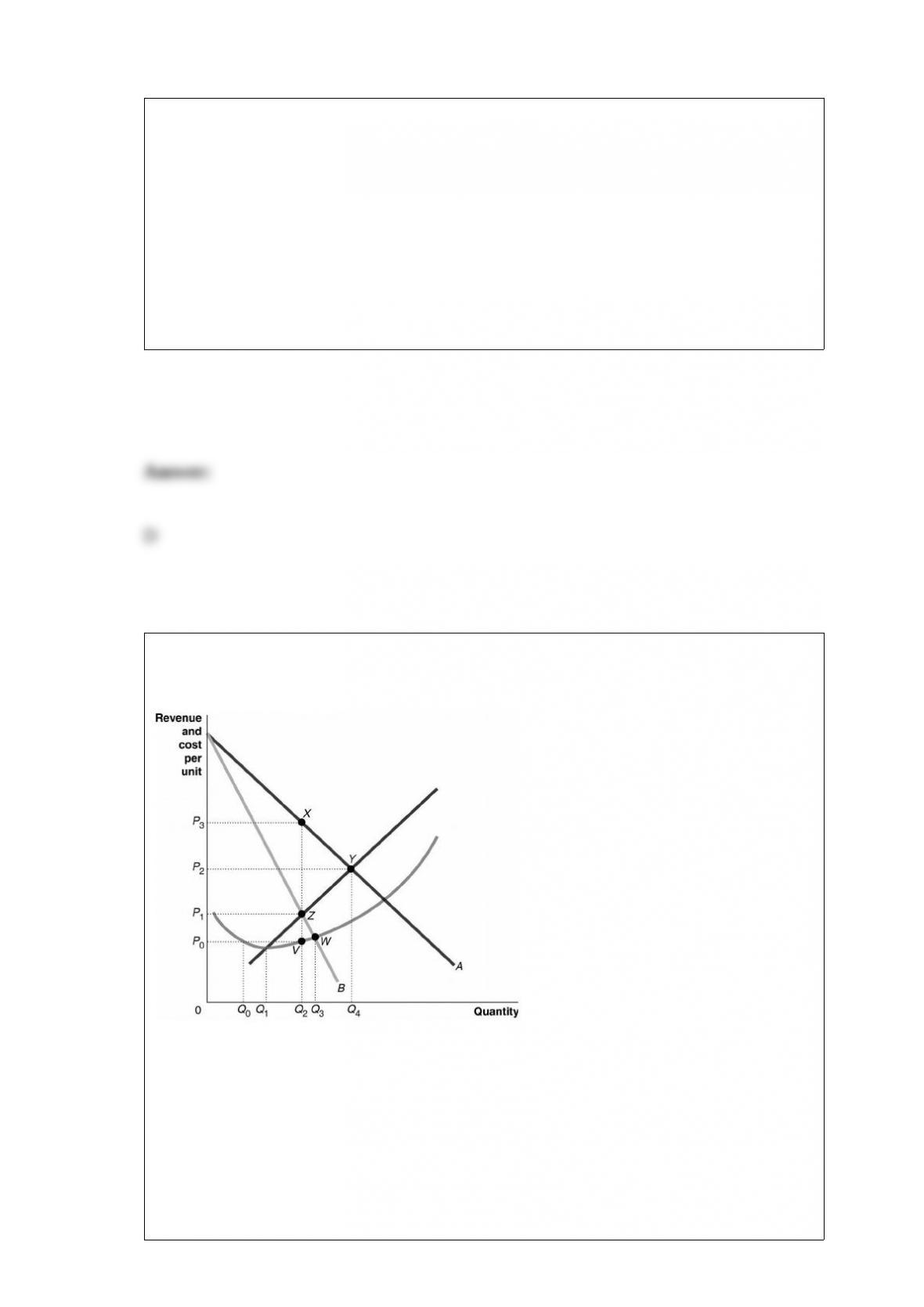
Figure 15-8
Figure 15-8 reflects the cost and revenue structure for a monopoly that has been in
business for a very long time.
Refer to Figure 15-8. Use the figure above to answer the following questions.
a. Identify the curves labeled A and B. Identify the curve which contains both point Y
and point Z. Identify the curve which contains both point V and point W.
b. What is the profit-maximizing quantity and what price will the monopolist charge?
c. What area represents total revenue at the profit-maximizing output level?
d. What area represents total cost at the profit-maximizing output level?
e. What area represents profit?
f. What is the profit per unit (average profit) at the profit-maximizing output level?
g. If this industry was organized as a perfectly competitive industry, what would be the
profit-maximizing price and quantity?
h. What area represents the deadweight loss as a result of a monopoly?
Suppose the demand curve for a product is represented by a typical downward-sloping
curve. Now suppose the demand for this product increases. Which of the following
statements accurately predicts the resulting increase in price?
A) The more elastic the supply curve, the greater the price increase.
B) The more elastic the supply curve, the smaller the price increase.
C) The increase in price is not affected by the elasticity of the supply curve.
D) There will be no increase in price if the supply curve is perfectly inelastic.
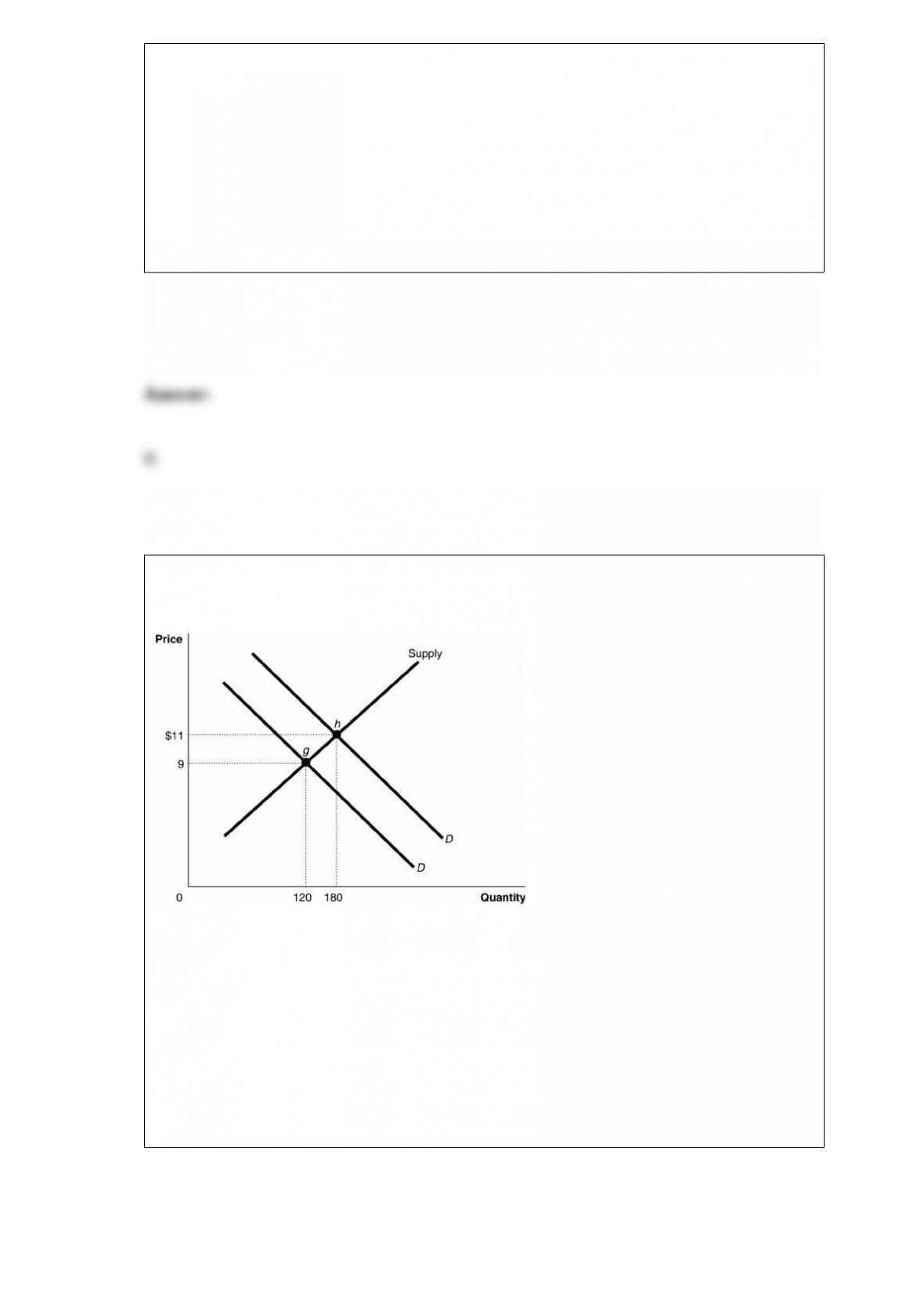
Figure 6-11
Refer to Figure 6-11. What is the value of the price elasticity of supply between g and
h?
A) 20 percent
B) 0.5
C) 2
D) 0.02

Common resources differ from public goods in that
A) common resources are non-excludable while public goods are excludable to those
who do not pay for the good.
B) unlike public goods, common resources are rivalrous in consumption.
C) common resources are collectively owned by a group of people while public goods
are government owned.
D) common resources are resources that cannot be renewed but the production of public
goods can be increased any time.