Even if the population declines, scarcity will still exist.
The minimum wage is an example of a price ceiling.
Ceteris paribus, an increase in the money supply will lower short-term interest rates.
The U.S. economy would gain from the elimination of tariffs and quotas even if other
countries do not reduce their tariffs and quotas.
The term “market” refers only to trading arrangements that have been approved by the
government.
“A decrease in the price of tablet computers will decrease the demand for desktop
computers.” This statement is an example of a normative economic statement.
Consumer surplus is the Difference between the highest price someone is willing to pay
for a product and the price he actually pays for the product.
If the demand for a product increases and the supply of the same product increases, the
equilibrium price will increase.
In an oligopoly, minimum efficient scale is likely to occur at a level of output that is a
large fraction of industry sales.
The Coase Theorem asserts that government intervention is a prerequisite for
addressing externality problems.
A public franchise gives the exclusive right to produce a product for 20 years from the
date the product is invented.
It is possible to have a comparative advantage in producing a good or service without
having an absolute advantage.

A monopoly is defined as a firm that has the largest market share in an industry.
A monopoly differs from monopolistic competition in that
A) a monopoly has market power while a firm in monopolistic competition does not
have any market power.
B) a monopoly can never make a loss but a firm in monopolistic competition can.
C) in a monopoly there are significant entry barriers but there are low barriers to entry
in a monopolistically competitive market structure.
D) a monopoly faces a perfectly inelastic demand curve while a monopolistic
competitor faces an elastic demand curve.
The supply curve for umbrellas
A) shows the supply of umbrellas consumers are willing and able to buy at any given
price.
B) is downward sloping.
C) shows the relationship between the quantity of umbrellas firms are willing and able
to supply and the quantity of umbrellas consumers are willing and able to purchase.

D) shows the relationship between the price of umbrellas and the quantity of umbrellas
supplied.
Article Summary. Based on resale prices for tickets for the 2013 Super Bowl in New
Orleans, face-value prices for the most expensive tickets to the 2014 game are
expected to more than double, with significant price increases for lesser-valued
tickets as well. Evidence indicates that sports teams are more interested in
maximizing attendance instead of ticket revenue, since greater attendance means
more spending on items such as parking and concessions. Higher ticket prices in
secondary markets seem to verify that teams are charging less than they could be
if their goal was to maximize ticket revenue. Source: Patrick Rishe, “Super Bowl
XLVIII Pricing: A Lesson In Demand Elasticity,” Forbes, September 19, 2013.
How would sports teams know if they were operating on the elastic portion of the
demand curve for tickets?
A) If they increased ticket prices and the total revenue from ticket sales increased.
B) If they increased ticket prices and the total revenue from ticket sales did not change.
C) If they increased ticket prices and the total revenue from ticket sales decreased.
D) If they decreased ticket prices and the total revenue from ticket sales did not change.
When net capital flows are negative,
A) capital inflows are less than capital outflows.
B) net foreign investment is negative.
C) capital outflows are less than capital inflows.
D) A and B are both correct.
Collusion makes firms better off because if they act as a single entity (a cartel) they can
reduce output and increase their prices and profits. But some cartels have failed and
others are unstable. Which of the following is a reason why cartels often break down?
A) Most cartels do not have a dominant strategy.
B) When a cartel is profitable the amount of competition it faces increases.
C) Members of a cartel may resent having to share their profits equally.
D) Each member of a cartel has an incentive to “cheat” on the collusive agreement by
producing more than its share when everyone else sticks with the collusive agreement.
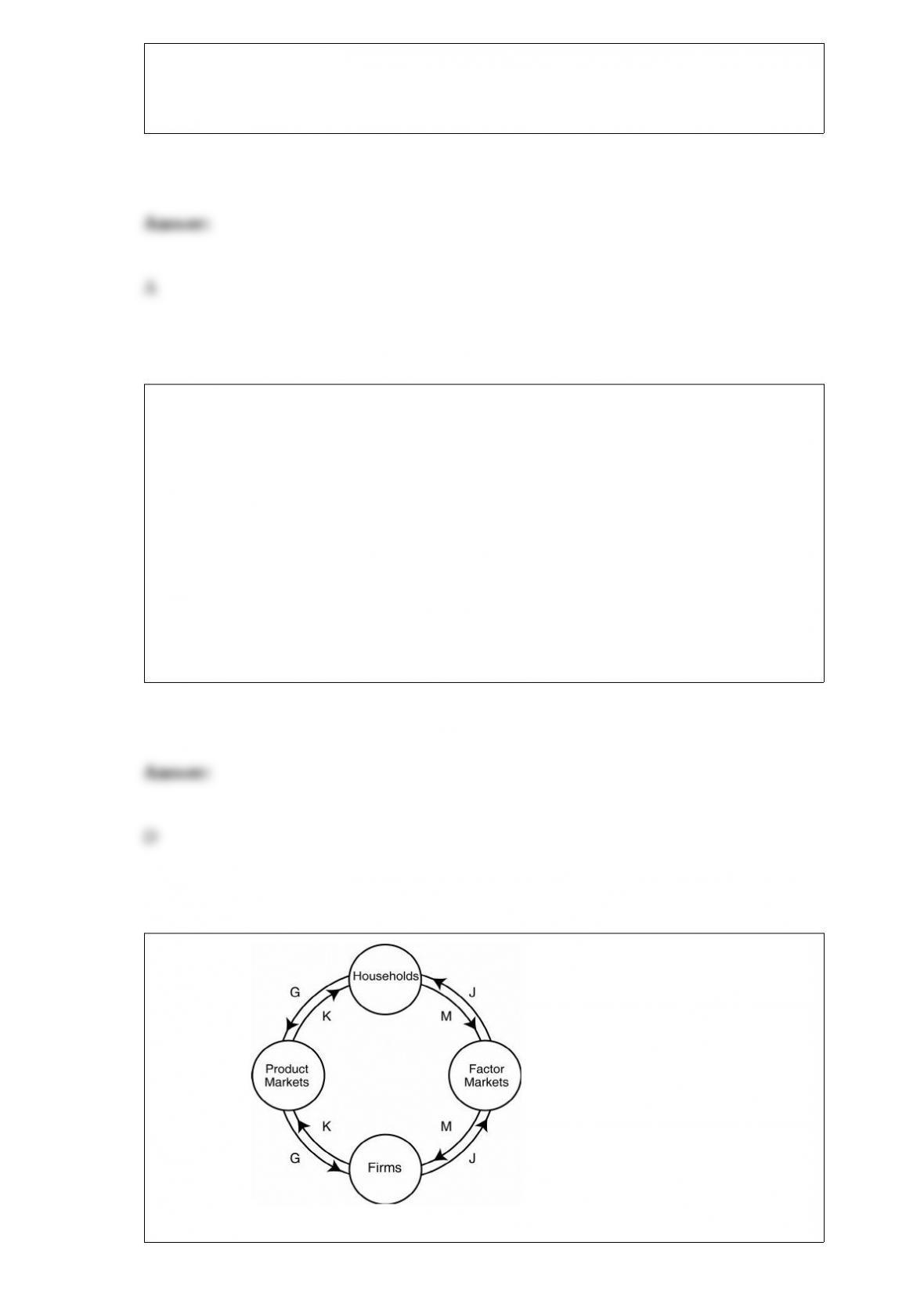
Figure 2-19

Which two arrows in the diagram depict the following transaction: LaDonna sells 20
pairs of sunglasses at the Oakley store.
A) J and M
B) J and G
C) K and M
D) K and G
An efficient tax is
A) a tax that imposes an equal tax burden on buyers and sellers.
B) a tax that raises a maximum amount of revenue.
C) a tax that imposes a small excess burden relative to the tax revenue that it raises.
D) a tax that is used to fund research and development of new technology.
If opportunity costs are ________, the production possibilities frontier would be
graphed as a negatively sloped straight line.
A) decreasing
B) increasing
C) negative

D) constant
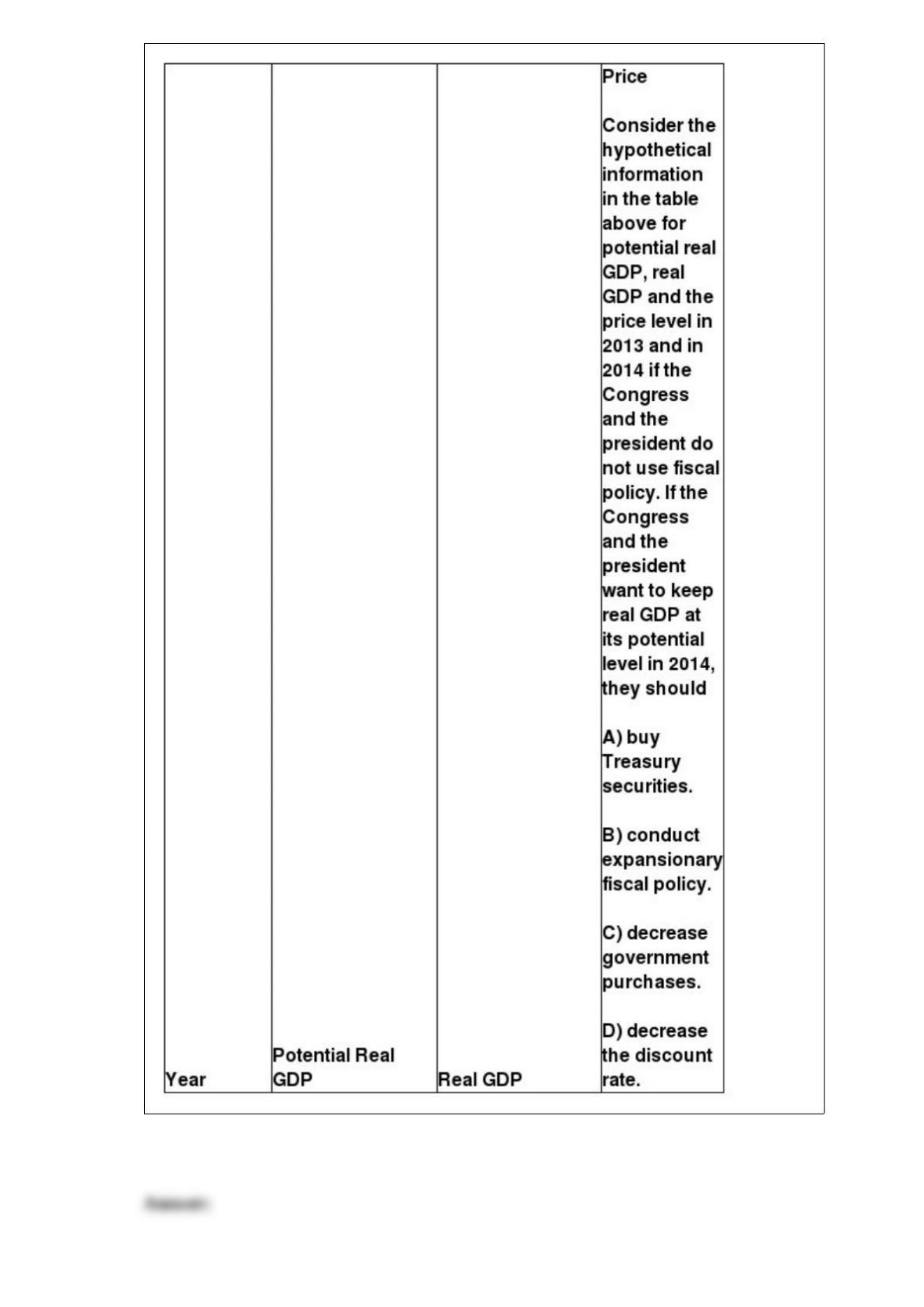
Table 27-2

Yield management is the practice of
A) determining production functions to minimize production costs.
B) forecasting competitors’ responses to price changes.
C) using buyer data to rapidly adjust prices.
D) using information technology to find the best interest rate.
Congress passed the Freedom to Farm Act in 1996. What was the purpose of this Act?
A) to encourage more people to become farmers
B) to grant free land to farmers in order to produce crops that were particularly scarce
C) to phase out the use of price ceilings in agricultural markets
D) to phase out price floors and return to a free market in agriculture
An advantage of the household survey over the establishment survey of the labor
market is that the household survey
A) is based on actual payrolls, rather than on unverified answers.

B) includes the number of self-employed persons.
C) includes the number of discouraged workers.
D) omits persons employed at newly opened firms.
If the Fed decided to reverse its policy actions implemented during the heart of the
recession, the Fed would be acting to try to prevent
A) a decrease in unemployment.
B) an increase in unemployment.
C) an increase in deflation.
D) an increase in inflation.
The law of one price
A) states that consumers can only buy one good or service at a time.
B) is a law passed by Congress that prohibits firms from selling a product at two
different prices in the same market at the same time.
C) states that consumers will pay any price for a product that has a perfectly inelastic
demand curve.
D) states that identical products should sell for the same price everywhere.
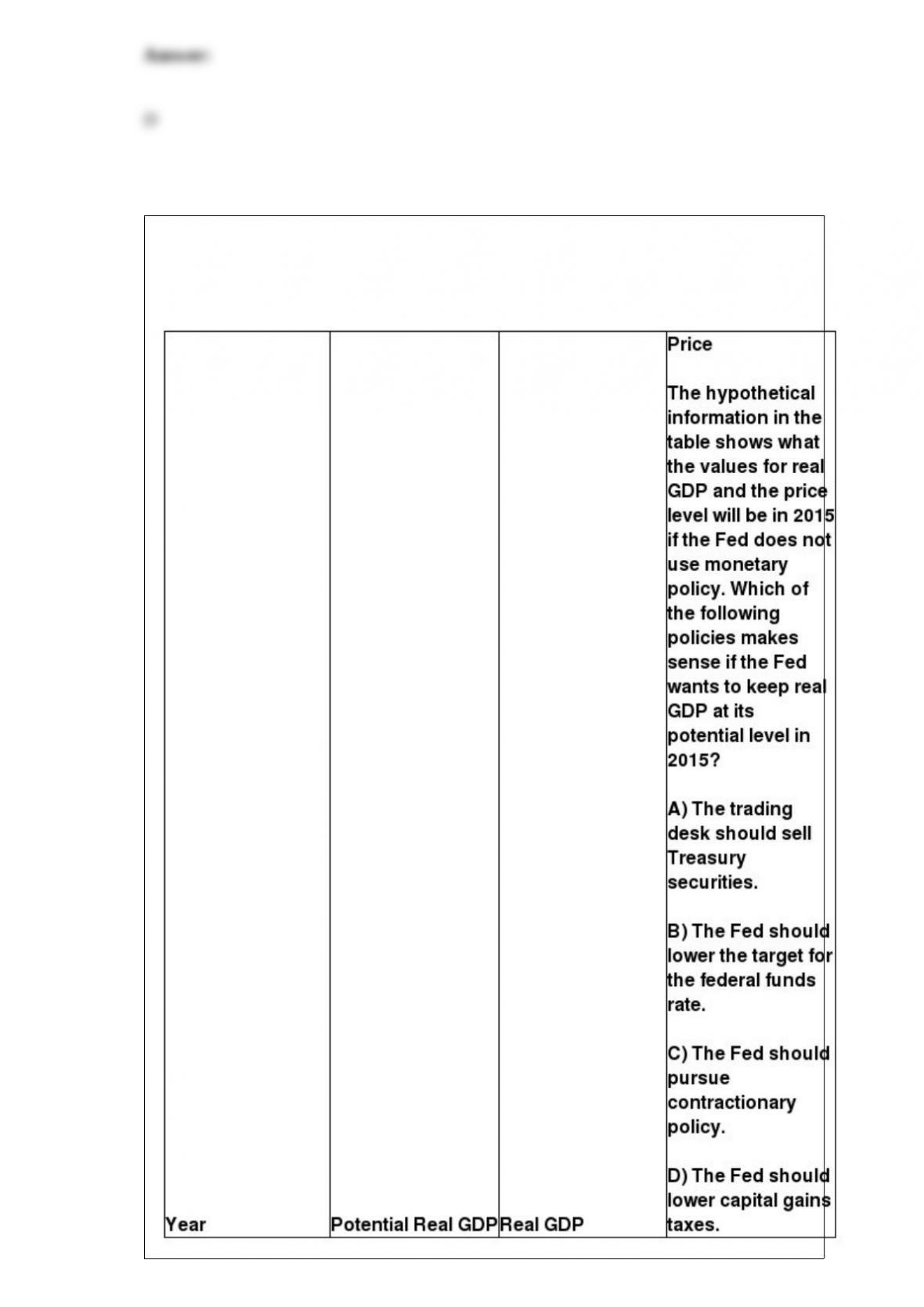
Table 15-1
Which of the following is a microeconomics question?
A) Why do economies experience periods of high inflation?
B) Will Federal Reserve intervention lower the inflation rate?
C) Why has growth in the economy increased since the end of the recession?
D) Will the merger of American Airlines and US Airways increase or decrease airfares?
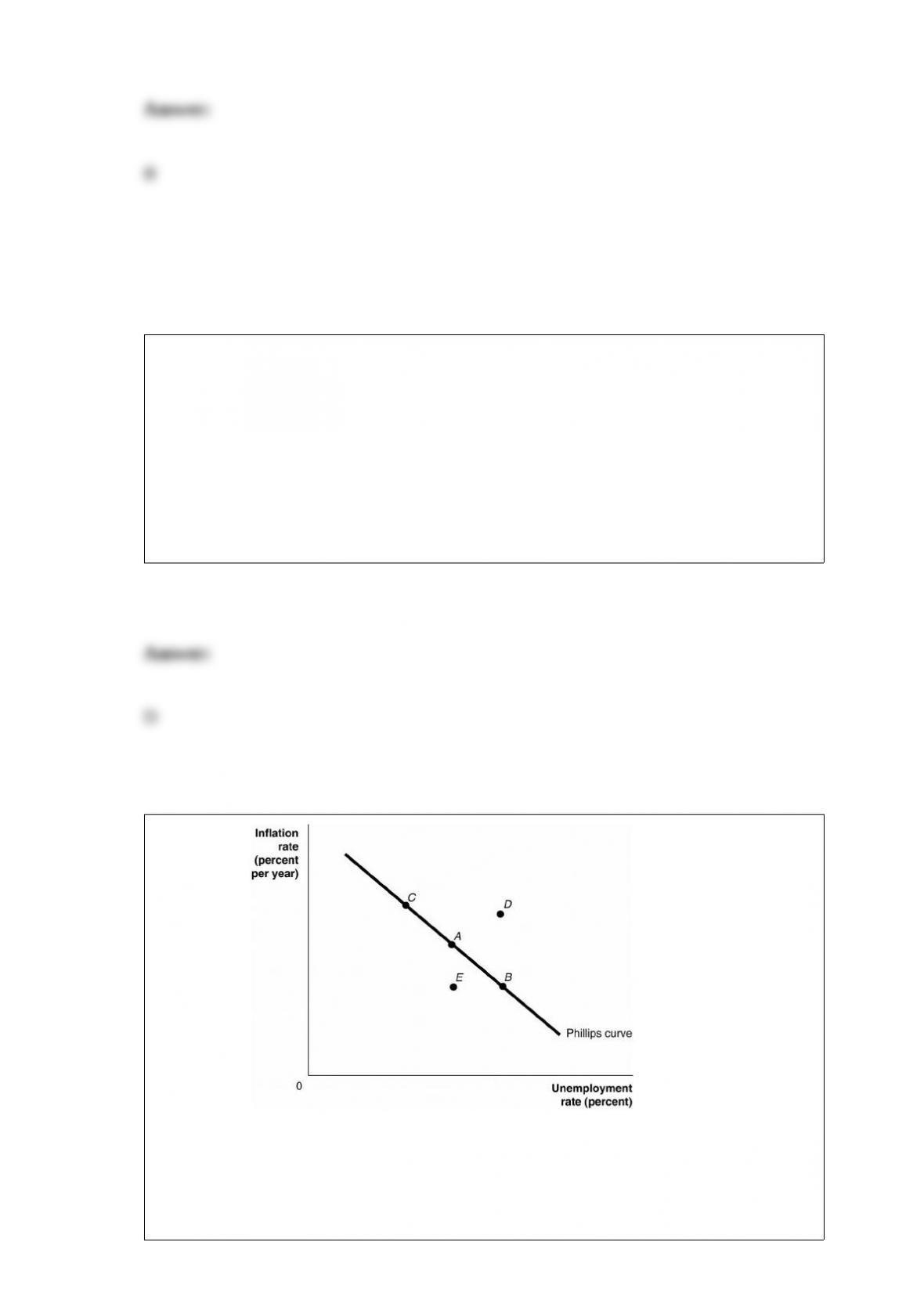
Figure 28-1
Suppose that the economy is currently at point A, and the unemployment rate at A is the
natural rate. What policy would the Federal Reserve pursue if it wanted the economy to
move to point B in the long run?

A) Buy treasury bills.
B) Sell treasury bills.
C) Raise the discount rate.
D) Decrease the money supply.
E) No policy will move the economy to point B in the long run.
According to the law of one price
A) if transaction costs are zero, identical goods should sell for the same price
everywhere.
B) if transactions costs are zero, firms must sell a product at a price equal to its
marginal cost.
C) if transactions costs are zero, all firms must earn the same profit margin.
D) there must be no differences in the cost of producing identical goods by different
producers.
The process of countries becoming more open to foreign trade and investment is known
as
A) autarky.
B) foreign exchange.

C) globalization.
D) protectionism.
If the economy is falling below potential real GDP, which of the following would be an
appropriate fiscal policy to bring the economy back to long-run aggregate supply? An
increase in
A) the money supply and a decrease in interest rates.
B) government purchases.
C) oil prices.
D) taxes.
Discuss the correct and incorrect economic analysis in the following statement.
“The United Auto Workers Union has successfully negotiated a 9 percent increase in
wages for its workers. This increase in the wage rate causes an increase in demand for
automobiles, since many consumers now have greater incomes, and also a decrease in
the supply of automobiles because the cost of production has increased. These effects
cancel each other out resulting in no change in equilibrium price and quantity in the
automobile market.”
Over the last 50 years, has the ratio of household production to gross domestic product
in the United States increased or decreased? Consider the effect of the increased
number of women working outside the home, and the effect of advances in technology
in household production such as microwaves, coffee makers, power tools, etc.
What are the three main sets of factors that cause the supply and demand curves in the
foreign exchange market to shift?
Explain the concepts of cross-price elasticity of demand and income elasticity of
demand. What do positive and negative values indicate for each of these demand
elasticities?
What is the difference between net exports and the current account balance?
Describe the difference between technology and positive technological change.
Describe how Wal-Mart has used positive technological change to manage its inventory.
What is a circular flow diagram and what does it demonstrate?
What happens to a monopoly’s revenue when it sells more units of its product?