
A currency depreciation is a(n):
A. increase in the value of a currency relative to other currencies.
B. decrease in the value of a currency relative to other currencies.
C. reduction in the official value of a currency in a fixed-exchange-rate system.
D. increase in the official value of a currency in a fixed-exchange-rate system.
Matt is offered a job driving the campus shuttle bus from 4 p.m. to 6 p.m. each Monday.
His reservation wage for this job is $7 per hour. If the campus transportation director
offers Matt $50 per hour, how much economic surplus will Matt enjoy as a result of
accepting the job?
A. $36 per hour
B. $43 per hour
C. $50 per hour
D. $86 per hour
Pat used to work as an aerobics instructor at the local gym earning $35,000 a year. Pat
quit that job and started working as a personal trainer. Pat makes $50,000 in total annual
revenue. Pat’s only out-of-pocket costs are $12,000 per year for rent and utilities,
$1,000 per year for advertising and $3,000 per year for equipment.
Pat’s explicit costs are ______, and Pat’s implicit costs are ______.
A. $16,000; $51,000
B. $15,000; $36,000
C. $16,000; $35,000
D. $35,000; $16,000
The profit maximizing rule MR = MC applies to:
A. all firms.
B. monopolists only.
C. perfectly competitive firms only.
D. imperfectly competitive firms only.

Which of the following is NOT a determinant of demand for gasoline?
A. Consumers’ incomes.
B. The price of diesel.
C. The price of automobiles.
D. The quantity of gasoline supplied.
The Scarcity Principle states that:
A. people don’t have enough money to buy what they want.
B. society will eventually run out of resources.
C. with limited resources, having more of one thing means having less of another.
D. some countries have fewer resources than others.
The United States generally has a comparative advantage in the development of
technology because it has:
A. large amounts of natural resources.
B. a disproportionate share of the world’s best research universities.
C. the greatest need for new technology.
D. patent laws, which no other country has.
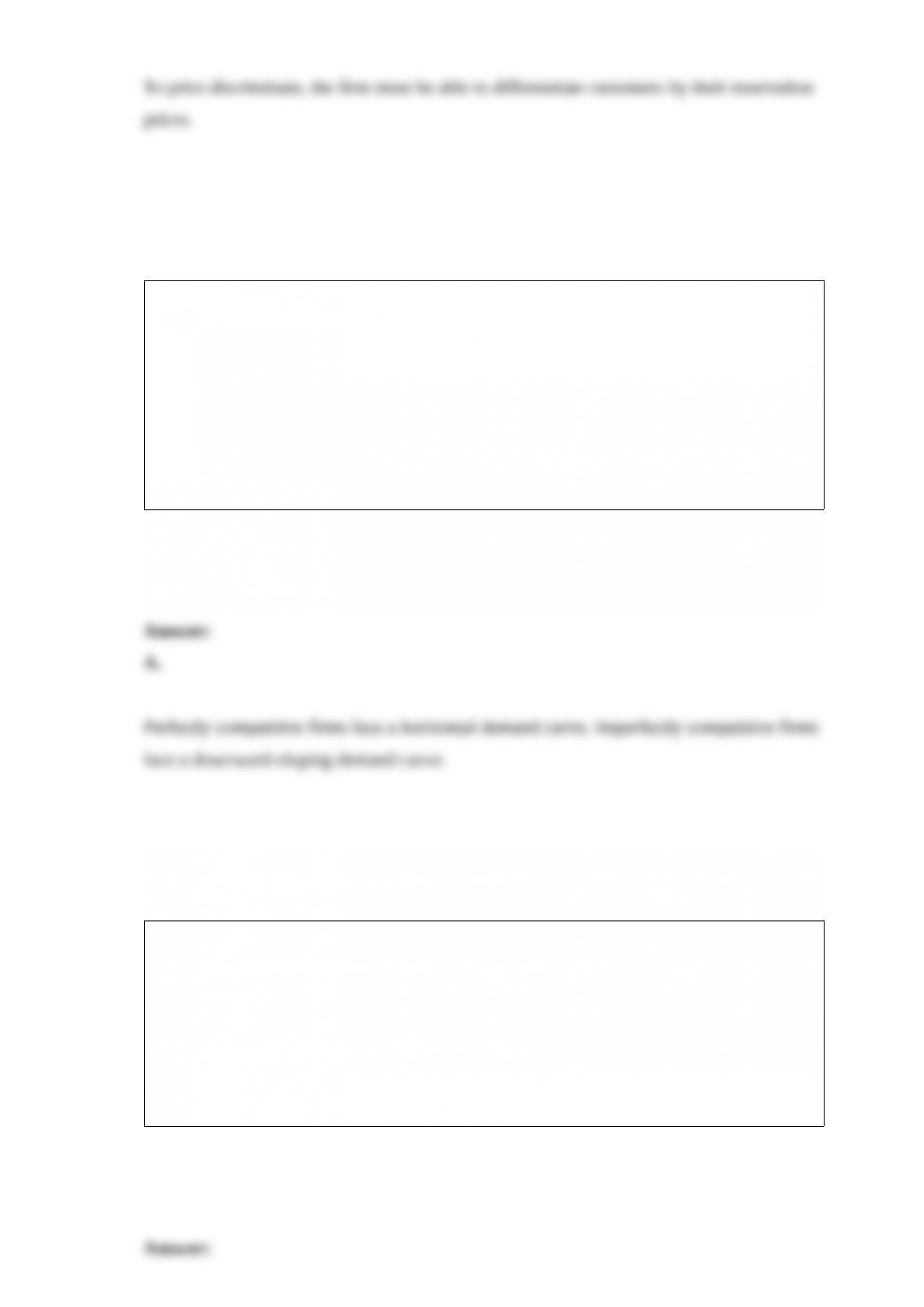
Based on the information in the table, what is the unemployment rate?
A. 7.2%
B. 8.0%
C. 10.0%
D. 28.0%

Suppose workers and employers agree to a three-year wage contract under the
expectation of 3% inflation, but inflation turns out to be 1%. In this case, ______ lost
purchasing power, and ______ gained purchasing power.
A. employers; workers
B. no one; employers
C. workers; employers
D. employers; no one
Consider an industry with two firms producing similar products. Each firm’s total cost
(in dollars) is given below.
Acme Manufacturing: TC = 100 + 3Q.
Generic Industries: TC = 500 + 3Q.
When each firm is producing the same quantity, Acme’s average total cost is:
A. lower than Generic’s average total cost.
B. equal to Generic’s average total cost.
C. higher than Generic’s average total cost.
D. lower than Generic’s average total cost at some levels of output, and higher than
Generic’s average total cost at other levels of output.

If a good is nonrival, then:
A. it has no substitutes.
B. consumers can enjoy it without paying for it.
C. consumption of the good by one person does not diminish its availability to others.
D. consumption of the good by one person diminishes its availability to others.
In order to effectively price discriminate, one requirement is that a seller must be able
to:
A. resell the product.
B. identify customers with different reservation prices.
C. avoid detection because price discrimination is illegal.
D. reduce costs when producing the discounted item.
To sell an extra unit of output, a perfectly competitive firm ______, and an imperfectly
competitive firm ______.
A. need not alter its price; must lower its price
B. must hope the market price falls; must lower its price
C. need not alter its price; need not alter its price
D. must lower its price; must lower its price
Conspicuous consumption is a more effective signal of ability for people who:
A. live in large cities instead of small towns.
B. already have well-established reputations.
C. live in small towns instead of large cities.
D. don’t understand moral hazard.

The discovery and utilization of vast, previously unknown oil and mineral deposits in a
country will increase:
A. average labor productivity.
B. the share of the population employed.
C. the unemployment rate.
D. the quantity of human capital.
The town of Pleasantville has two local TV stations. If one of them invests in the
newest weather forecasting technology, one can predict that:
A. the other station will continue to use its current weather forecasting technology.
B. the other station will upgrade its weather forecasting technology.
C. both stations eventually will switch back to the old weather forecasting technology.
D. the quality of weather forecasts will remain unchanged.
The government subsidizes education because:
A. it is a pure public good.
B. private firms will not provide education.
C. the government can provide a better education than can private firms.
D. education is thought to have positive externalities.
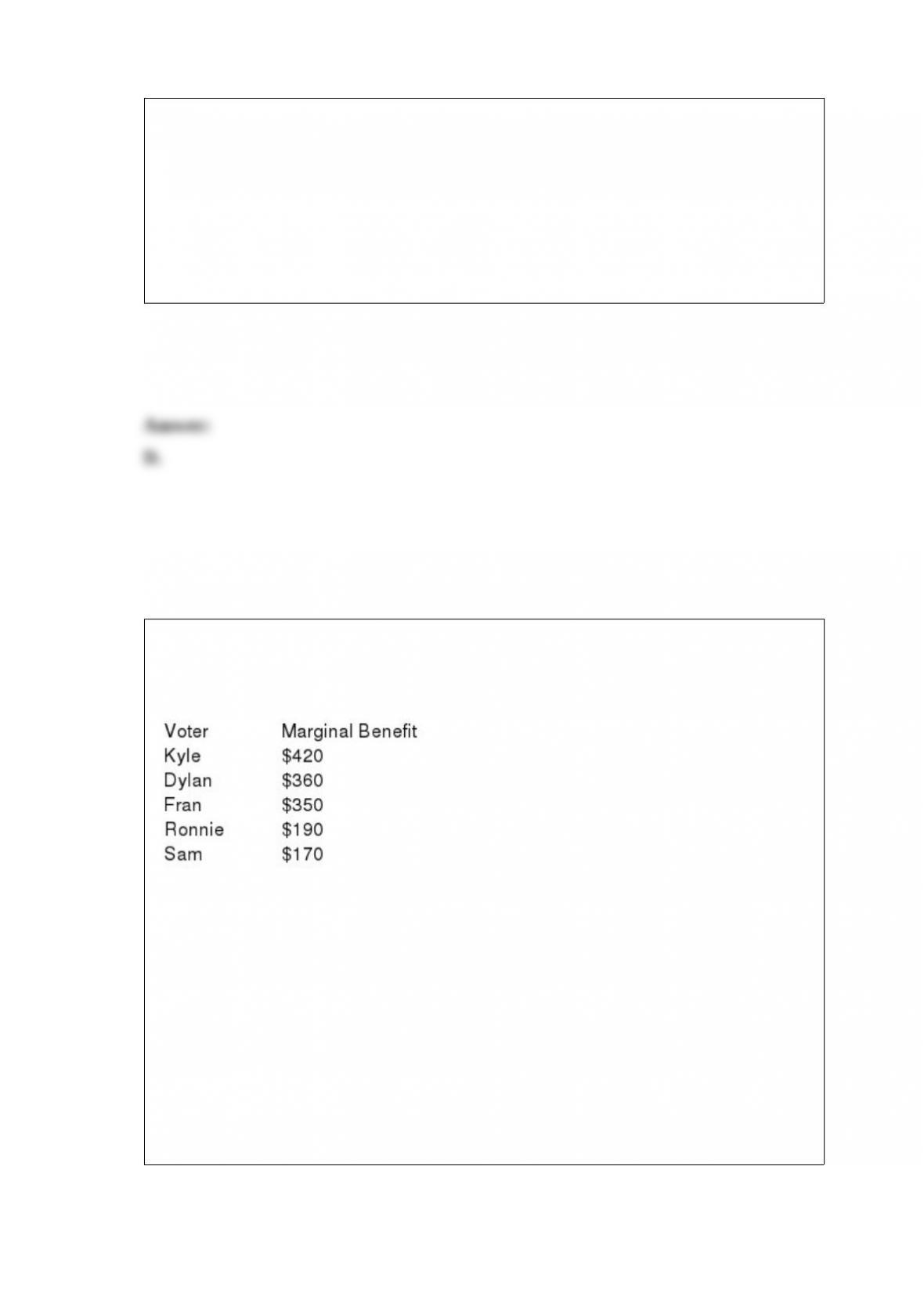
The small city of Pleasantville is considering building a public swimming pool that
costs $1,000. Each resident’s marginal benefit of the swimming pool is shown below. It
takes a 4/5 majority to pass any tax measure, and all residents must vote.
Dylan proposes that the city let a private company build the pool and charge residents a
one-time fee to use the pool as much as they like. Only residents who pay the fee would
be allowed to use the pool. If the private company were allowed to set a single fee,
then:
A. no private company would offer to build the pool.
B. a private company would offer to build the pool and would set the fee equal to $200.
C. a private company would offer to build the pool and would set the fee equal to $250.
D. a private company would offer to build the pool and would set the fee equal to $298.

One shortcoming of real GDP as an indicator of society’s social well-being is that it
fails to take into account the:
A. growth in productivity.
B. increase in the quantity of goods.
C. non-market production.
D. change in the price level.
A rational person:
A. makes choices based on total benefits and total costs.
B. makes choices based on added benefits and added costs.
C. undertakes activities until the net benefits become less than zero.
D. considers the financial benefits and financial costs of making a choice.

Investment is a(n) ______ that changes the ______ of capital.
A. flow; stock
B. stock; flow
C. asset; liability
D. liability; asset
Refer to the figure above. What might cause Supply to shift from the Original Supply to
the New Supply?
A. A storm in South America wipes out the entire coffee crop.
B. New technology reduces the amount of coffee beans necessary to make a
good-tasting pot of coffee.
C. A news report that coffee consumption greatly increases productivity.
D. An increase in the price of tea.
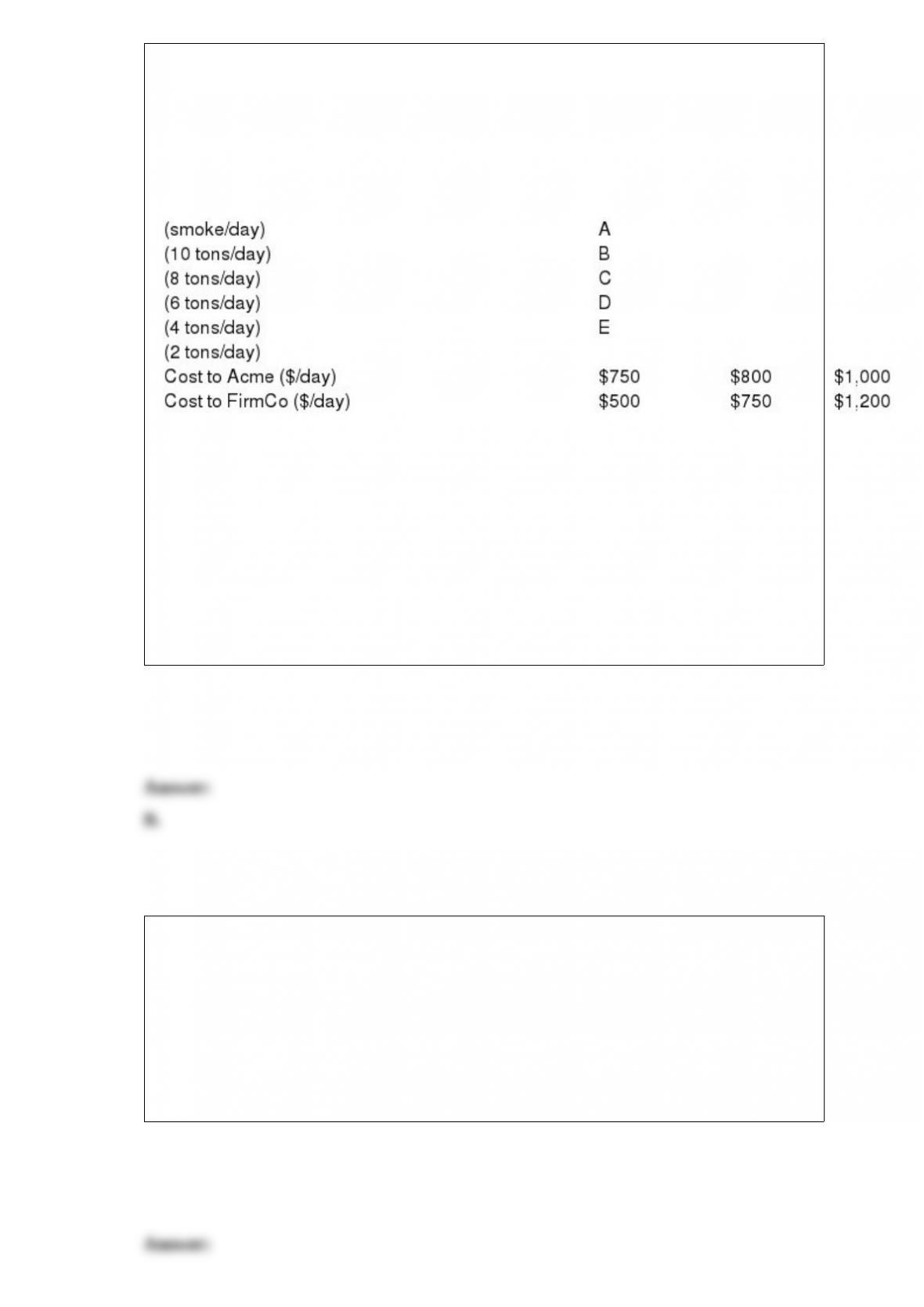
Two firms, Acme and FirmCo, have access to five production processes, each of which
has a different cost and gives off a different amount of pollution. The daily costs of the
processes and the corresponding number of tons of smoke emitted are shown in the
table below.
process
Suppose the firms are both currently using process A. If the government requires each
firm to reduce pollution by 20%, then the firms will adopt process ______, and a total
of ______ tons of smoke will be emitted each day.
A. A; 18
B. B; 16
C. C; 12
D. D; 8
OPEC is an example of a:
A. monopsony.
B. cartel.
C. monopoly.
D. duopoly.
Suppose a retail store was offering 10% off list prices on all goods. The benefit of the
10% savings is:
A. unrelated to the list price of the good.
B. negatively related to the list price of the good.
C. positively related to the list price of the good.
D. zero since costs and benefits shouldn’t be measured proportionally.
Refer to the figure below.
If Column Cruises offers reduced rates, and Row Resorts keeps its rates high, then Row
Resorts will earn ______, and Column Cruises will earn ______.
A. 300; 300
B. 50; 50
C. 500; 10
D. 10; 500
Refer to the figure below. If this firm is a price taker, then when the price of each unit of
output is $30, how much profit does this firm earn at its profit-maximizing level of
output?
A. $500
B. $800
C. $1,200
D. $1,600
European firms wishing to purchase American goods and services are ______ the
foreign exchange market.
A. suppliers of U.S. dollars in
B. demanders of Euros in
C. supplied dollars by the European Central Bank for use in
D. demanders of U.S. dollars in

Suppose there are two small island countries: Avarice, which is populated by people
who are completely self-interested, and Altruism, which is populated by people who
have adopted social norms of generosity and cooperation. Commitment problems will
be:
A. largely avoided in Avarice, but prevalent in Altruism.
B. largely avoided in Altruism, but prevalent in Avarice.
C. prevalent on both islands.
D. largely avoided on both islands.
Consider an industry with two firms producing similar products. Each firm’s total cost
(in dollars) is given below.
Mega Corp: TC = 5,000 + 100Q.
Big Inc: TC = 4,000 + 200Q.
If each firm is producing 15 units, you would expect:
A. both firms to continue to produce 15 units.
B. Big Inc to be able charge a lower price than Mega Corp.
C. Mega Corp to be able charge a lower price than Big Inc.
D. Both Mega Corp and Big Inc to reduce output and charge higher prices.
Changes in autonomous consumption could be the result of:
A. changes in disposable income.
B. changes in inflation.
C. changes in the mpc.
D. changes in housing prices.