1) If monies added to, or subtracted from, the Social Security trust fund were excluded
from Federal budget calculations, the current Federal budget:
A.deficit would nearly disappear.
B.deficit would be substantially larger.
C.surplus would nearly disappear.
D.surplus would be substantially smaller.
2)
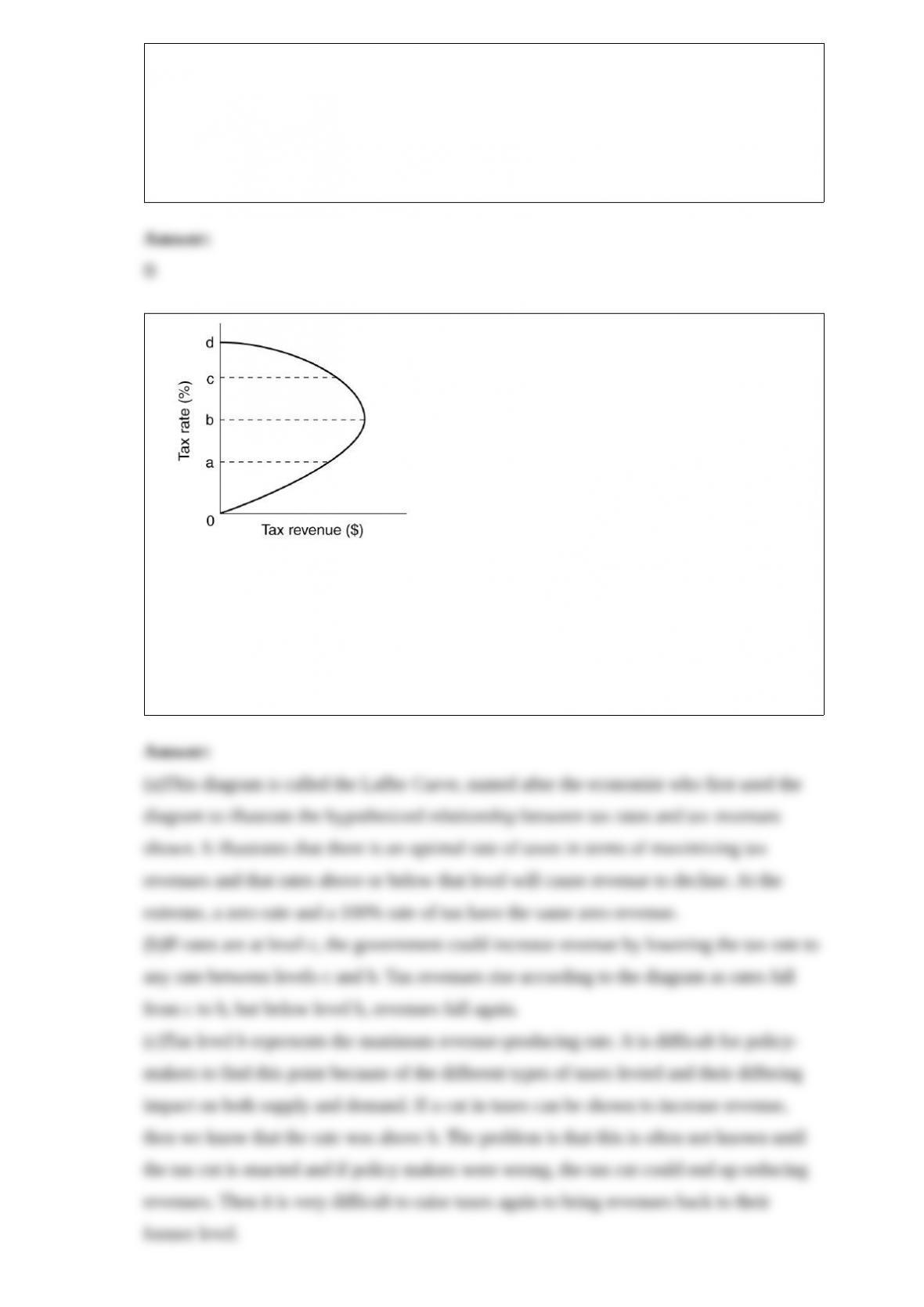
Use the following diagram to answer the next three questions.
(a)What is this diagram called and what does it say about the relationship between tax
rates and tax revenues?
(b)If tax rates are at level c, should the government raise or lower tax rates to increase
revenues? Explain.
(c)What does tax level b represent? Could policy makers find the actual rate that b
represents? Discuss this point.

3) According to the Taylor rule, if real GDP rises 1 percent above potential GDP, the
Fed should raise the Federal funds rate, relative to the current rate of inflation, by:
A.0.5 percentage points.
B.1 percentage points.
C.1.5 percentage points.
D.2 percentage points.
4) An employer is prejudiced, prefers to hire white rather than African-American
workers, and is willing to pay higher wages to obtain white workers. This illustrates:
A.reverse discrimination.
B.the crowding model.
C.the taste-for-discrimination model.
D.statistical discrimination.
5) in an economy experiencing a persistently falling price level:
a.potential gdp will necessarily exceed actual gdp.
b.changes in nominal gdp may either overstate or understate changes in real gdp.
c.changes in nominal gdp understate changes in real gdp.
d.changes in nominal gdp overstate changes in real gdp.
6) in 2005, the median age for u.s. immigrants who had lived in the united states for
less than a year was:
a.18.
b.25.
c.32.
d.45.
7) Menu costs:
A.increase during recession.
B.decrease during recession.
C.are the costs to firms of changing prices and communicating them to customers.
D.are sunk costs and therefore should be disregarded.
8) When current tax revenues exceed current government expenditures and the
economy is achieving full employment:
A.the standardized budget has neither a deficit nor a surplus.
B.the standardized budget may have either a deficit or a surplus.
C.the standardized budget has a surplus.
D.nominal GDP and real GDP are equal.
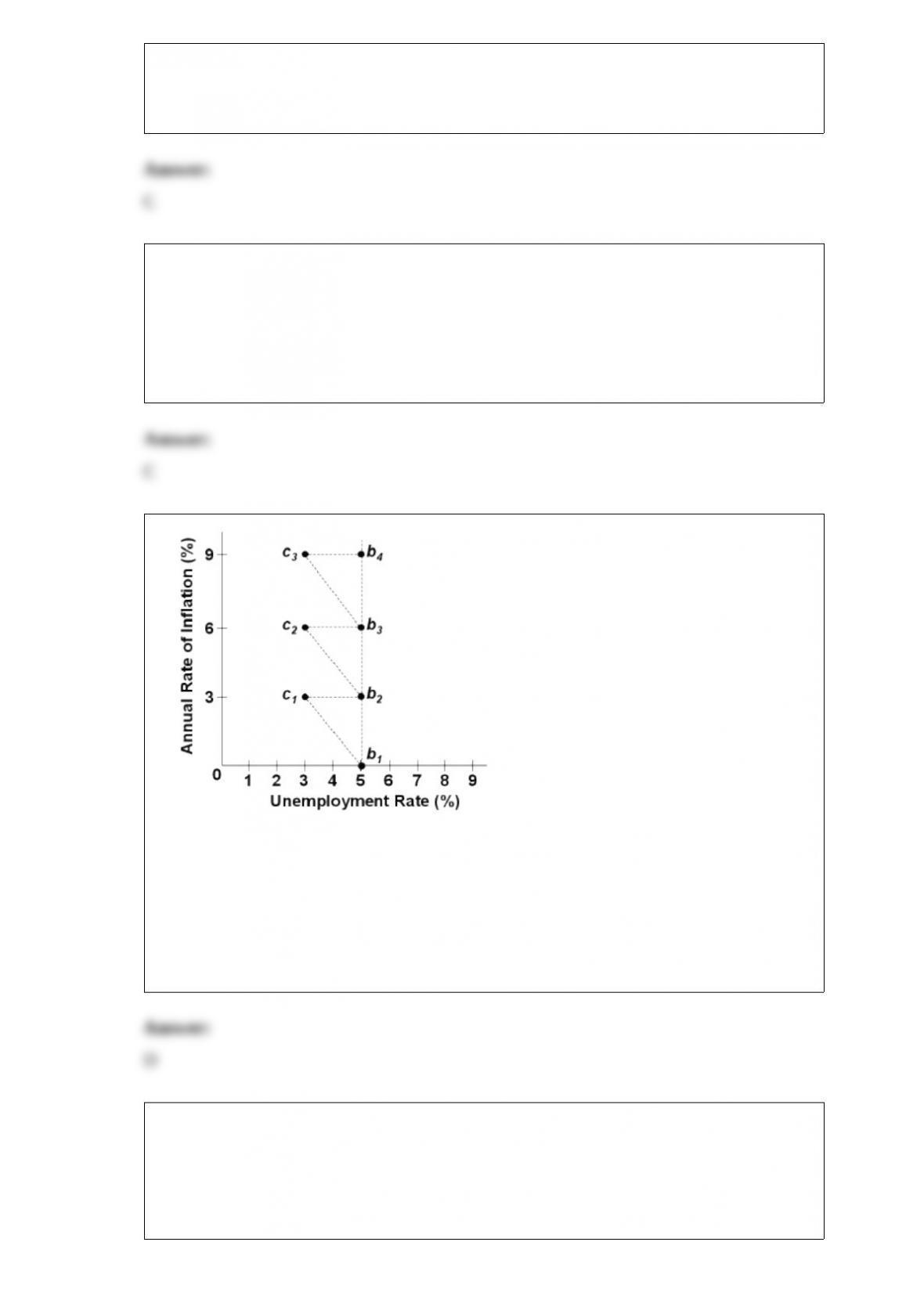
9)
Refer to the above diagram and assume the economy is initially at point b1. Point c1
represents:
A.a stable position because reality and expectations are consistent.
B.a stable position because full employment and a constant annual inflation rate are
represented.
C.an unstable situation because government will undertake contractionary policies.
D.an unstable situation because nominal wage rates will increase.
10) In 2006, the United States’ current account deficit reached a new high of:
A.$811 billion.
B.$917 billion.
C.$1.2 trillion.
D.$2.3 trillion.

11) The long-run aggregate supply curve is vertical:
A.because the rate of inflation is steady in the long run.
B.because resource prices eventually rise and fall with product prices.
C.because product prices always increase at a faster rate than resource prices.
D.only when the money supply increases at the same rate as real GDP.
12) Stock options as a form of payment are designed to:
A.evade the equal-pay-for-equal work provisions of the Federal antidiscrimination law.
B.boost the overall earnings of minimum wage workers.
C.offset monopsony.
D.address the principal-agent problem.
13) If government increases its tax revenues by $15 billion and the MPC is 2/3, then we
can expect the equilibrium GDP to:
A.decrease by $30 billion.
B.decrease by $45 billion.
C.decrease by $35 billion.
D.decrease by $55 billion.
14) In comparing monetarism and rational expectations theory we find that:
A.both favor policy rules and for the same reasons.
B.both favor policy rules, but for different reasons.
C.both favor discretionary policies.
D.the former favors discretionary policy, while the latter favors policy rules.
15) refer to the above data. the average product (ap) when two units of labor are hired
is:
a.8
b.9

c.10
d.18
16) Which one of the following would increase income inequality as measured by
official Census data and the quintile distribution?
A.a doubling of social security retirement benefits
B.the elimination of the food stamp program
C.the elimination of the TANF program
D.reduced divorce rates
17) government’s economic role is complicated by the fact that:
a.public goods entail no opportunity costs.
b.the public sector cannot base decisions on marginal costs and marginal benefits.
c.economic decisions are made in a political context.
d.the marginal utility of public goods rises rather than falls.
18) economic immigrants:
a.are defined as any international migrants that have an impact on the economy.
b.are defined as international migrants motivated by economic gain.
c.only impact the economy if they enter the country legally.
d.include not only people, but also any capital that migrates from another country.
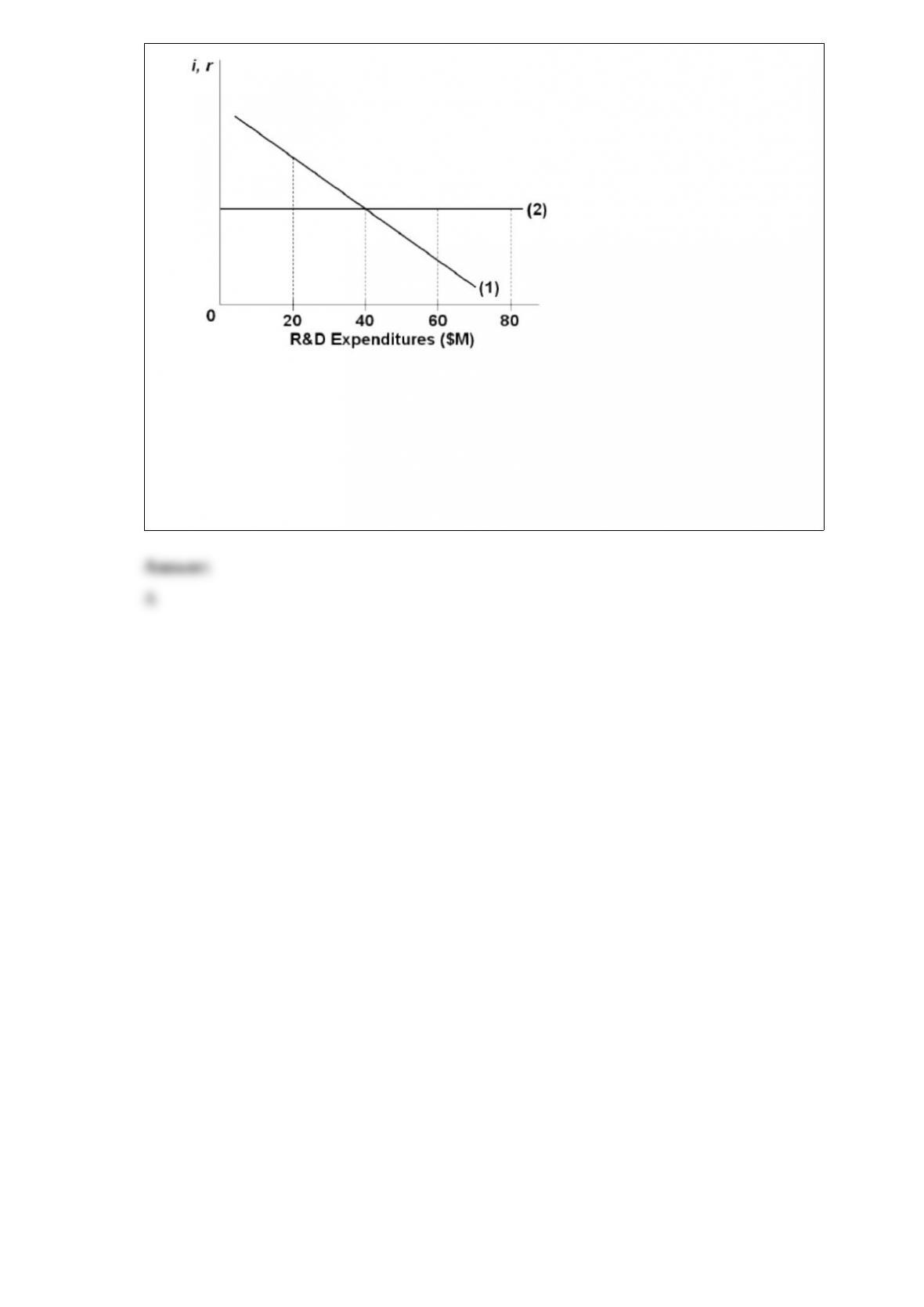
19)
Assume that a firm’s interest-rate-cost of funds curve for R&D is perfectly elastic.
Which of the following would increase a firm’s optimal R&D expenditures and, in
equilibrium, leave the expected rate of return on the last dollar of R&D unchanged?
A.a rightward shift of the expected-rate-of-return curve
B.an upward shift of the interest-rate-cost of funds curve
C.a leftward shift of the expected-rate-of-return curve
D.a downward shift of the interest-rate-cost of funds curve