
Suppose the supply curve for digital cameras shifts to the right. This will cause a
relatively large decrease in the price of digital cameras if both demand and supply are
inelastic.
Answer:
The U.S. government would never approve a proposed merger between two firms that
could significantly increase the newly merged firm’s market power even if the
efficiency gains from the newly merged firm could make consumers better off.
Answer:
If marginal cost is above the average variable cost, then average variable cost is
decreasing.
Answer:
If the marginal product of labor is decreasing, then marginal cost of production must be
rising.
Answer:

Shortage means the same thing as scarcity.
Answer:
The total value of production from Ford’s manufacturing plant in Cologne, Germany
would be included in Germany’s gross national product.
Answer:
Examining the conditions that could lead to unemployment in an economy is an
example of microeconomics topic.
Answer:
To increase gas mileage, automobile manufacturers make cars small and light. Large
cars absorb more of the impact of an accident than small cars but yield lower gas
mileage. These facts suggest that a positive relationship exists between safety and gas
mileage.

Answer:
A welding machine is an example of a factor of production if it is being used to produce
automobiles.
Answer:
Which of the following would cause the short-run aggregate supply curve to shift to the
right?
A) an increase in the price level
B) a decrease in inflation expectations
C) a technological advance
D) an increase in interest rates
Answer:
Compared to a competitive market, a firm that has a monopsony in a labor market
would
A) hire fewer workers and pay higher wages.
B) hire more workers and pay lower wages.
C) hire fewer workers and pay lower wages.
D) hire more workers and pay higher wages.
Answer:
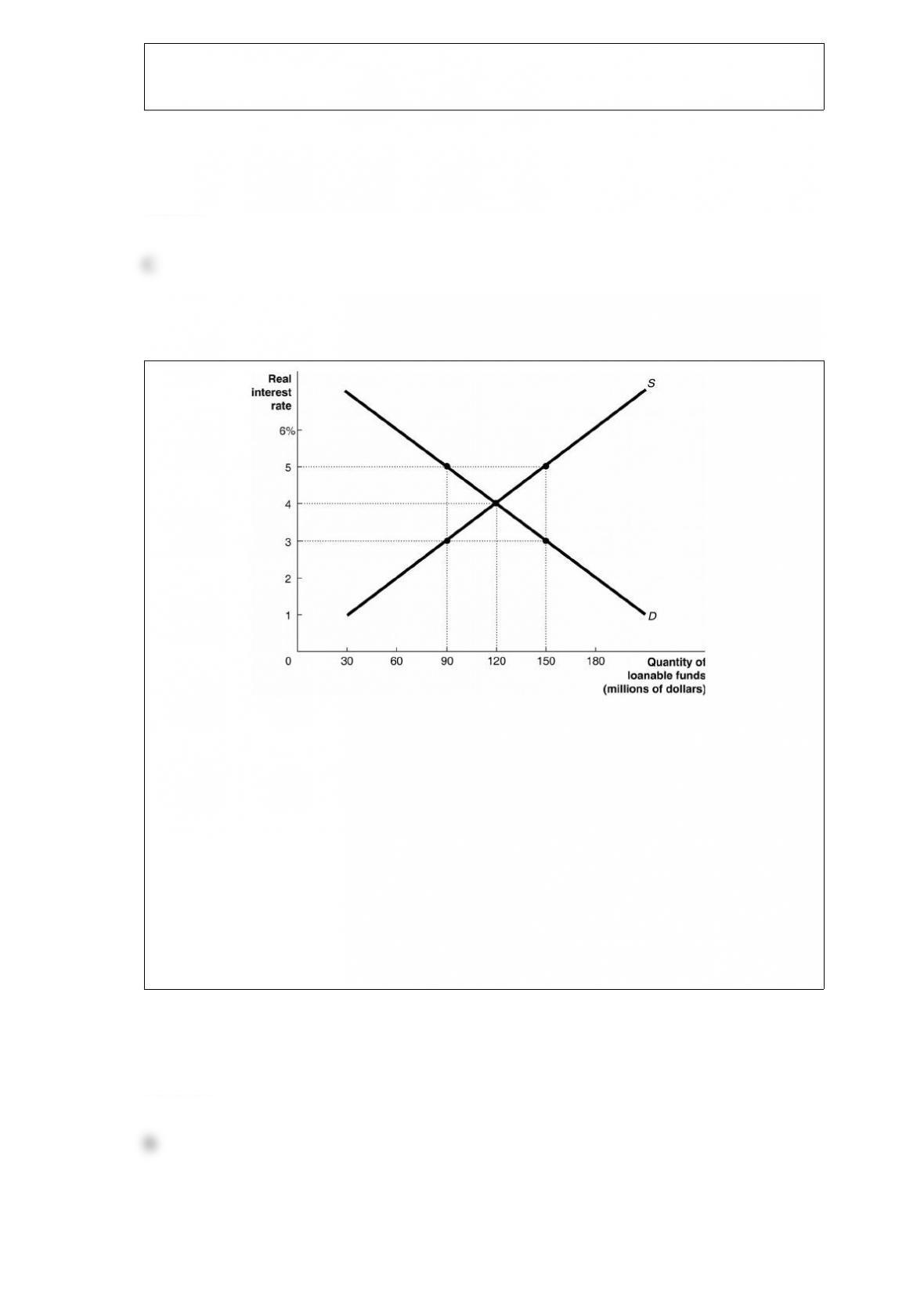
Figure 21-6
The market is in equilibrium. If the government budget deficit rises, which of the
following would you expect to see?
A) The quantity of loanable funds demanded by firms will rise above $120 million.
B) The quantity of loanable funds demanded by firms will fall below $120 million.
C) The budget deficit will have no impact on the quantity of loanable funds demanded
by firms.
D) The interest rate will fall below 4 percent.
Answer:

Your roommate Serafina, a psychology major, said, “The problem with economics is
that it assumes that consumers and firms always make the correct decision. But we
know that everyone’s human, and we all make mistakes.” Do you agree with her
comment?
A) Yes, I agree with her. One cannot make predictions about economic behavior
because in reality people make incorrect choices in many situations.
B) I disagree with her. Economics does not study correct or incorrect behaviors but
rather it assumes that economic agents behave rationally, meaning they make the best
decisions given their knowledge of the costs and benefits.
C) Yes, I agree with her. Economic theory should allow for irrational behavior so that
we can have more reliable predictions.
D) I disagree with her. If we cannot assume that decisions are correct, then we will not
be able to examine the moral implications of these decisions.
Answer:
When housing prices ________, as they did beginning in 2006 following the housing
market bubble, consumption spending on furniture, appliances, and home
improvements declined as many households found it ________ to borrow against the
value of their homes.
A) rise; easier
B) rise; harder
C) fall; easier
D) fall; harder
Answer:
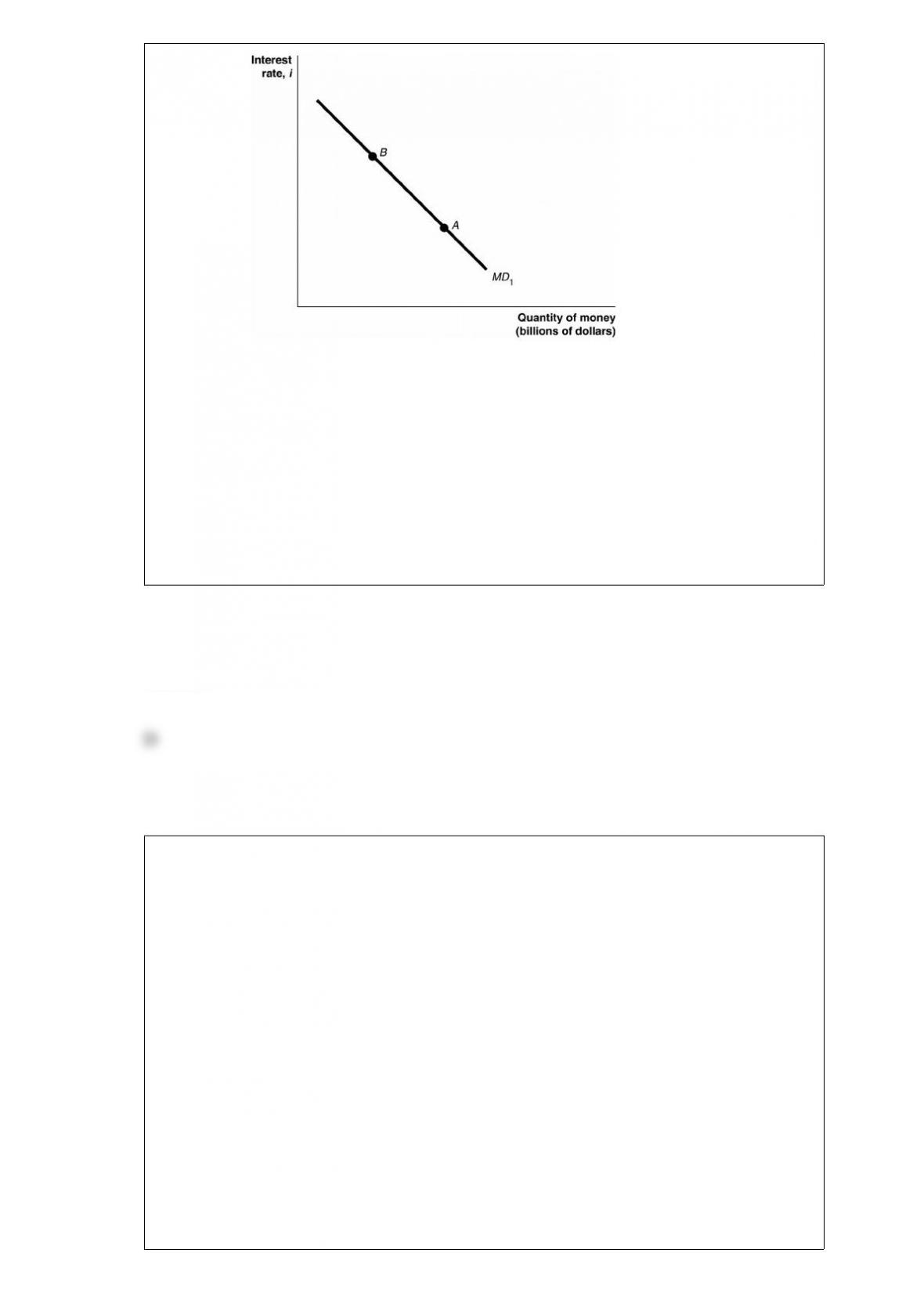
Figure 15-4
In the figure above, a movement from point A to point B would be caused by
A) a decrease in real GDP.
B) an increase in the price level.
C) a decrease in the price level.
D) an increase in the interest rate.
Answer:
Consider the following characteristics:
a. low transaction costs
b. small levels of pollution
c. high levels of pollution
d. clear assignment of property rights. Which of the above are assumptions behind the
Coase Theorem?
A) a, b, and d
B) a, c, and d
C) a and d

D) a only
Answer:
According to two economists, George Ackerlof and William Dickens, how can
cognitive dissonance affect workers’ perceptions of their jobs?
A) Cognitive dissonance makes workers believe that measures to improve their health
and safety in the workplace are ineffective.
B) Cognitive dissonance causes workers to perceive they are victims of discrimination
when, in fact, they are not.
C) Cognitive dissonance might cause workers to underestimate the true risks of their
jobs.
D) Cognitive dissonance causes a worker to believe his marginal revenue product is
greater than it really is.
Answer:
The largest source of tax revenue for state and local governments in the United States in
2012 was
A) sales taxes.
B) the corporate income tax.
C) the property tax.
D) the individual income tax.
Answer:
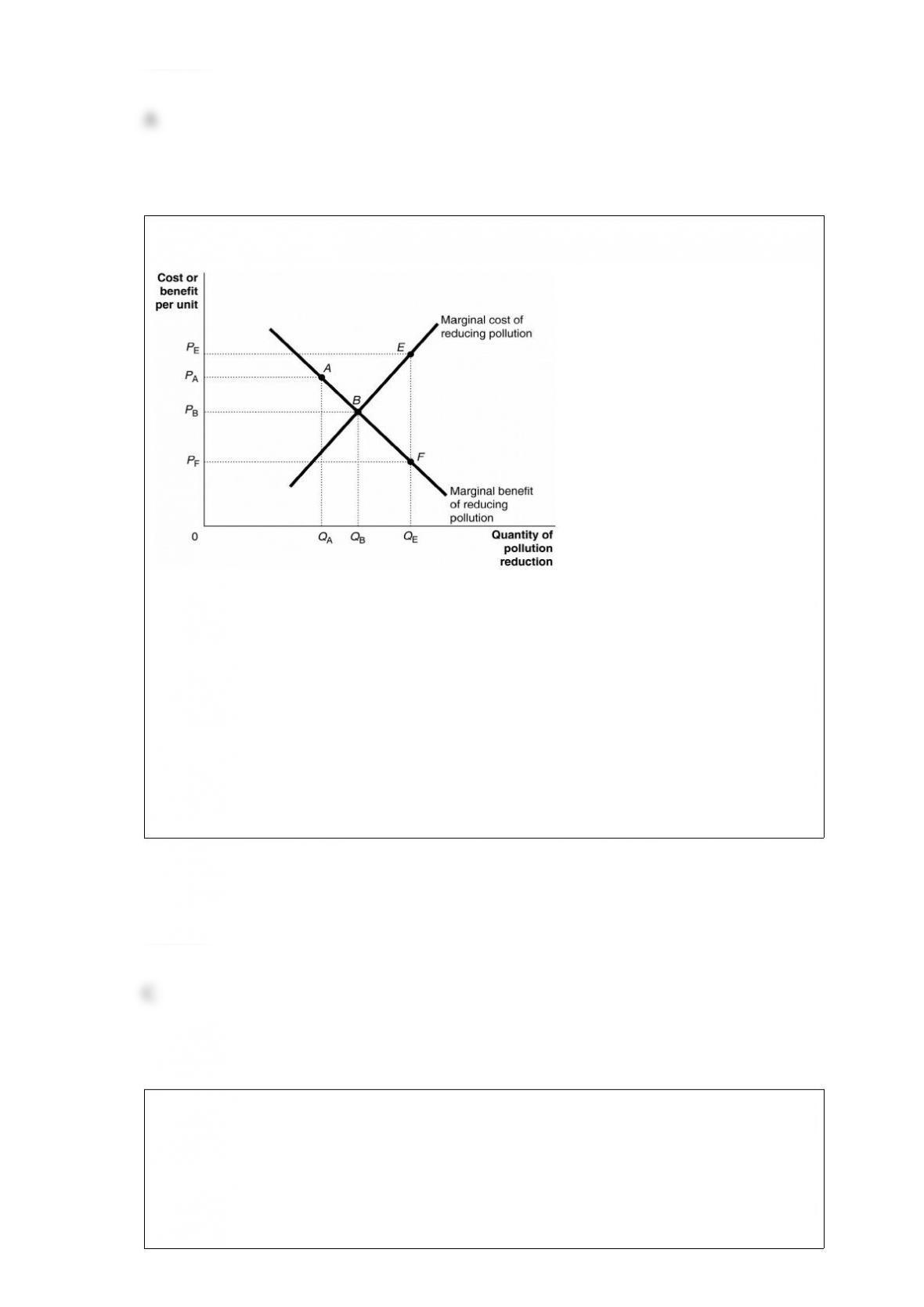
Figure 5-7
Which of the following statements is true?
A) At QE the benefits of reducing pollution outweighs the cost of pollution reduction.
B) At QB society is under allocating resources to pollution reduction.
C) The optimal quantity of pollution reduction is QB.
D) The optimal quantity of pollution reduction is QE.
Answer:
In the United States in 2012, the percentage of people without some form of private
health insurance was about
A) 17%.
B) 29%.

C) 36%.
D) 83%.
Answer:
An article in the Wall Street Journal in early 2001 noted two developments in the
market for laser eye surgery. The first development concerned side effects from the
surgery, including blurred vision. The second development was that the companies
renting eye-surgery machinery to doctors had reduced their charges. In the market for
laser eye surgeries, these two developments
A) decreased demand and decreased supply, resulting in a decrease in the equilibrium
quantity and an increase in the equilibrium price of laser eye surgeries.
B) decreased demand and increased supply resulting in an increase in both the
equilibrium quantity and the equilibrium price of laser eye surgeries.
C) decreased demand and increased supply, resulting in a decrease in the equilibrium
price and an uncertain effect on the equilibrium quantity of laser eye surgeries.
D) decreased demand and increased supply, resulting in a decrease in both the
equilibrium price and the equilibrium quantity of laser eye surgeries.
Answer:
Figure 5-15

Figure 5-15 shows the market for
Atlantic salmon, a common resource. The current market equilibrium output of Q1 is
not the economically efficient output. The economically efficient output is Q2.
The current market equilibrium output is partly the result of overfishing. In that case,
what does S2 represent?
A) the private marginal benefit of harvesting salmon
B) the social marginal benefit of harvesting salmon
C) the private marginal cost of harvesting salmon
D) the social marginal cost of harvesting salmon
Answer:
If the price of lattes, a normal good you enjoy, falls,
A) the income and substitution effects offset each other but the price effect leads you to
buy more lattes.
B) both the income and substitution effects lead you to buy more lattes.
C) the income effect which causes you to increase your latte consumption outweighs
the substitution effect which causes you to reduce your latte consumption, resulting in
more latte purchased.
D) the substitution effect which causes you to increase your latte consumption
outweighs the income effect which causes you to reduce your latte consumption,
resulting in more latte purchased.
Answer:
If technological change occurs in the economy,
A) the long-run aggregate supply curve will shift to the right.
B) the long-run aggregate supply curve will shift to the left.
C) we will move up along the long-run aggregate supply curve.
D) we will move down along the long-run aggregate supply curve.
Answer:
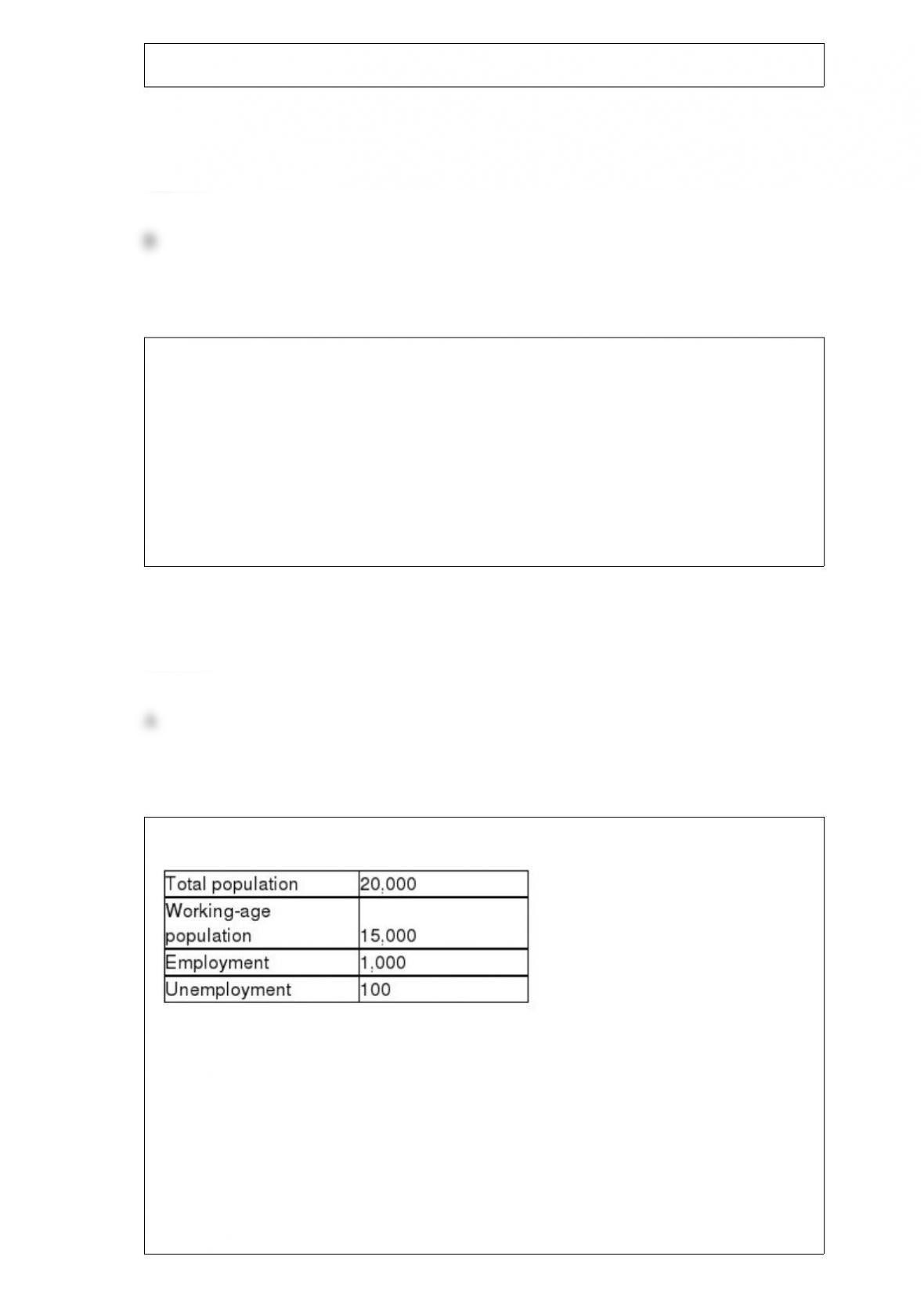
Table 20-1
Consider the data above for a simple economy.
The labor force participation rate for this simple economy equals
A) (1,000/1,100) 100.
B) (1,000/15,000) 100.
C) (1,100/15,000) 100.

D) (1,100/20,000) 100.
Answer:
Which of the following is an example of a quasi-public good?
A) cable television
B) organic apples
C) stock of knowledge in the public domain
D) crime prevention
Answer:
If the required reserve ratio is 100 percent, could the Federal Reserve still change the
money supply with open market operations? Explain whether they could or could not.
Answer:
Why do we subtract import spending from total expenditures?
Answer:
Many book publishers use cost-plus pricing to establish prices for some of their books.
Would you expect a publishing company to use a strict cost-plus pricing system for all
its books? How might you determine if a publishing company actually does use
cost-plus pricing for all its books?
Answer:
Explain two different ways to determine the profit-maximizing level of output for a
firm in a perfectly competitive market.

Answer:
Serafina was earning $75 per hour and working 50 hours per week. Serafina’s wage rose
to $90 per hour, and as a result, she now works 60 hours per week. What can you
conclude from this information about the income effect and the substitution effect of a
wage change for Serafina?
Answer:
Based on the following information, calculate public saving, net foreign investment,
and national income. Assume that the capital account is zero and net transfers are zero.
private saving = $145 billion
exports = $285 billion
imports = $240 billion
consumption = $600 billion
private investment = $125 billion
government purchases = $75 billion
Answer:

The owner of a firm wants some advice on how to increase productivity. Suggest three
ways the entrepreneur could increase labor productivity through improving technology.
Answer:
In 2012, which type of tax raised the most revenue for the U.S. federal government?
Which type of tax raised the most revenue for state and local governments?
Answer:
How can a sole proprietorship raise funds needed for firm expansion?
Answer: