1) Suppose a commercial bank has checkable deposits of $100,000 and the legal reserve
ratio is 10 percent. If the bank’s required and excess reserves are equal, then its actual
reserves:
A.are $30,000.
B.are $10,000.
C.are $20,000.
D.cannot be determined from the given information.
2) the market system’s answer to the fundamental question “how will the system
promote progress?” is essentially:
a.”through government funded research programs.”
b.”through the redistribution of income to promote greater equality.”
c.”through training and retraining programs.”
d.”through the profit potential that encourages development of new technology.”
3) To say that land rent performs no incentive function means that:
A.higher rental payments will not bring forth a larger quantity of land.
B.rent is not a cost to specific firms but it is a cost from the standpoint of the economy
as a whole.
C.rent does not allocate land in terms of productive efficiency.
D.rent tends to allocate land into the most productive uses.
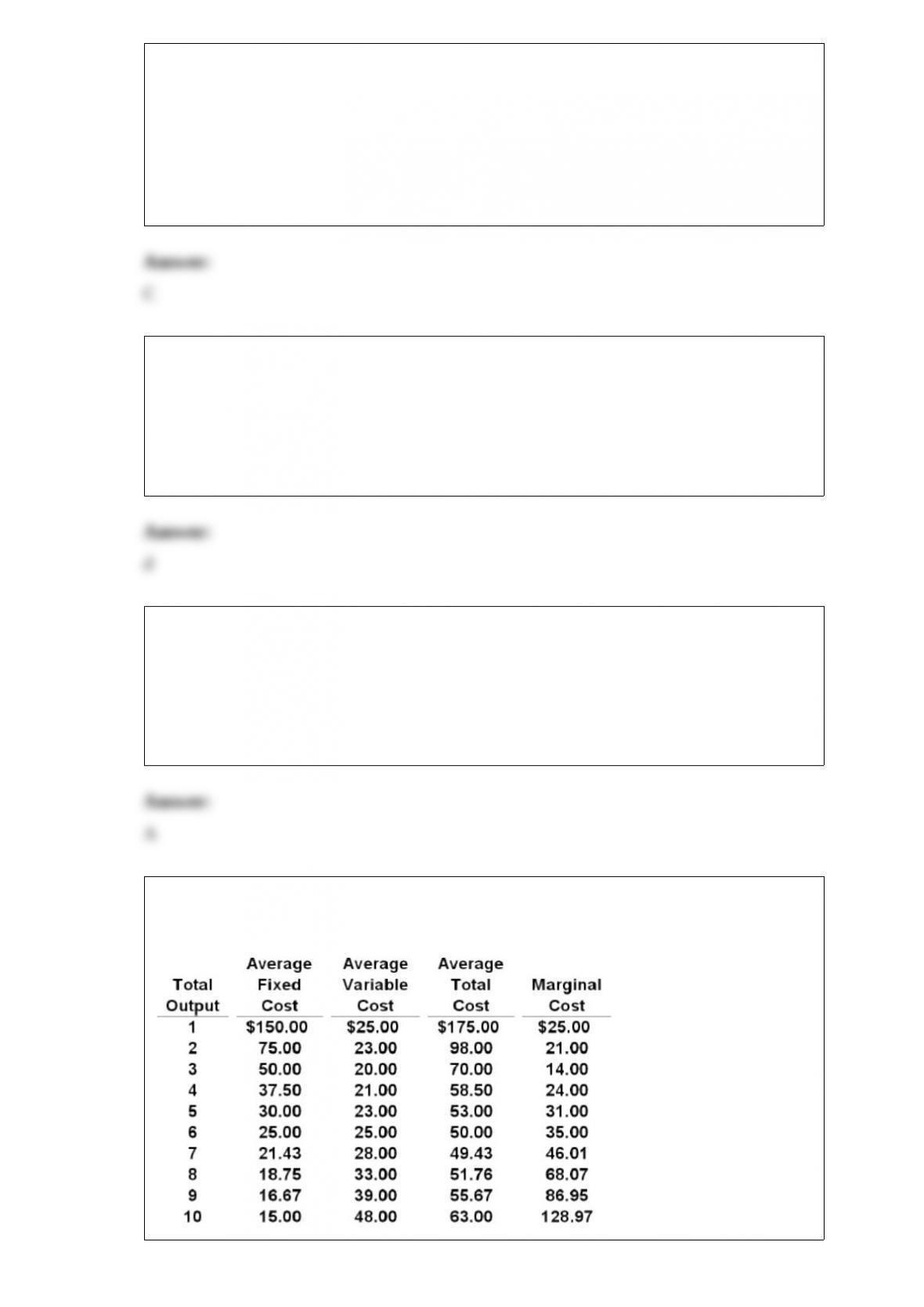
4) the following cost data for a firm that is selling in a purely competitive market.

refer to the above data. at 3 units of output, total variable cost is ____ and total cost is
____
a.$20; $70.
b.$60; $210.
c.$20; $210.
d.$60; $350.
5) if a pure monopolist is operating in a range of output where demand is elastic:
a.it cannot possibly be maximizing profits.
b.marginal revenue will be positive but declining.
c.marginal revenue will be positive and rising.
d.total revenue will be declining.
6) The primary purpose of the legal reserve requirement is to:
A.prevent banks from hoarding too much vault cash.
B.provide a means by which the monetary authorities can influence the lending ability
of commercial banks.
C.prevent commercial banks from earning excess profits.
D.provide a dependable source of interest income for commercial banks.
7) health care costs have greatly increased in recent years in the united states. this fact
alone does not establish an overallocation of resources to health care because:
a.the benefits of health care have also greatly increased in recent years.
b.rising medical care prices have inflated health care costs.
c.the marginal cost of health care exceeds the average total cost of health care.
d.negative externalities sometime result from additional health care spending.
8) A tax that takes a larger proportion of income from low-income groups than from
high-income groups is a:
A.stabilizing tax.
B.regressive tax.
C.progressive tax.
D.proportional tax.
9) Suppose there are only two planets in the universe, Zenope and Zuranda. On each
planet, its inhabitants consume two productscoffee and fried chicken. Each planet has
an equal population. Producing solely coffee, Zenope can produce 50 units of coffee,
while Zuranda can produce 80 units of coffee. Producing solely fried chicken, Zenope
can produce 25 units, while Zuranda can produce 30 units.
(a)Which planet has the absolute advantage in coffee? In fried chicken?
(b)Which planet has the comparative advantage in coffee? In fried chicken?
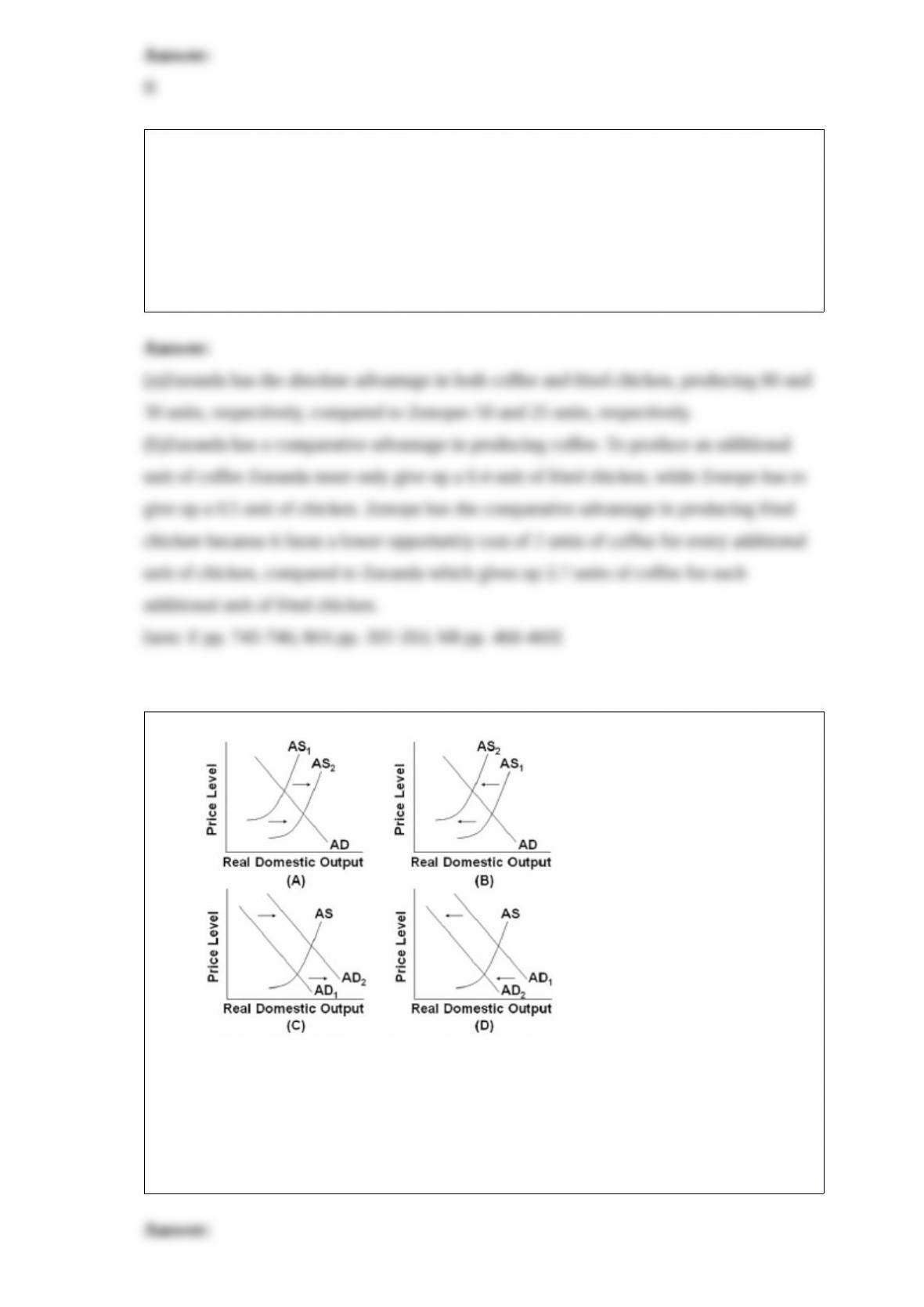
10)
Which of the above diagrams best portrays the effects of an increase in resource
productivity?
A.A
B.B
C.C
D.D

11) The Federal funds rate is:
A.higher than the prime interest rate.
B.lower than the prime interest rate.
C.always equal to the Fed’s discount rate.
D.equal to the prime interest rate minus the Fed’s discount rate.