
Frieda is at her local florist to buy a dozen roses. She is willing to pay $75 for the roses,
and buys them for $75. Frieda’s consumer surplus from the purchase is
A) $150.
B) $75.
C) $37.50.
D) $0.
Some corporate governance experts believe that serving on a company’s board of
directors for an extended length of time diminishes that member’s independence from
the company’s CEO. If this is true, it would tend to
A) reduce the principal-agent problem.
B) increase the principal-agent problem.
C) be in the best interest of shareholders.
D) have no impact on the company’s performance, since the CEO is only one member
of top management.
Suppose in the Germany, the opportunity cost of producing a gallon of beer is 5 gallons
of wine. In Italy, the opportunity cost of producing a gallon of beer is 3 gallons of wine.
a. What is the opportunity cost of producing a gallon of wine for Germany?
b. What is the opportunity cost of producing a gallon of wine for Italy?
c. Which country has a comparative advantage in the production of beer?
d. Which country has a comparative advantage in the production of wine?
Why did the United States abandon the gold standard in the 1930s?
A) The government wanted to rapidly expand the money supply in response to the
Great Depression.
B) The government wanted to move away from a floating exchange rate system to a
fixed exchange rate system.
C) The Treasury Department in the United States found it was cheaper to print paper
money instead of gold coins.
D) New sources of gold were discovered, so the price of gold plummeted, dramatically
reducing the value of the dollar.
If, in a perfectly competitive industry, the market price facing a firm is below its
average total cost but above average variable cost at the output where marginal cost
equals marginal revenue,

A) the industry supply will not change.
B) new firms are attracted to the industry.
C) some existing firms will exit the industry.
D) firms are breaking even.
Historically, the largest U.S. federal budget deficits as a percentage of GDP in the 20th
century occurred during
A) World War I and World War II.
B) the Great Depression.
C) 1970-1997.
D) the Vietnam war.
E) 1998-1999.
Growth in labor productivity in the economy as a whole has been ________ labor
productivity in health care.
A) approximately equal to
B) slightly faster than

C) almost twice as slow as
D) more than twice as fast as
Monopolistically competitive firms can differentiate their products
A) by producing at minimum efficient scale.
B) by producing where marginal revenue equals marginal cost.
C) by equating price and average total cost.
D) through marketing.
Before 1980, most U.S. corporations raised funds
A) in U.S. and foreign banks.
B) in U.S. stock and bond markets or in U.S. banks.
C) in U.S. stock and bond markets or in foreign capital markets.
D) in U.S. banks or in foreign capital markets.
The Farm Factory, a booth at the local Farmer’s Market, sells fresh eggs for $1.50 per
dozen and fresh milk for $2.50 per gallon. What is the opportunity cost of buying a
dozen eggs?
A) 1 2/3 gallons of milk
B) 3/5 of a gallon of milk
C) $2.50
D) $1.50
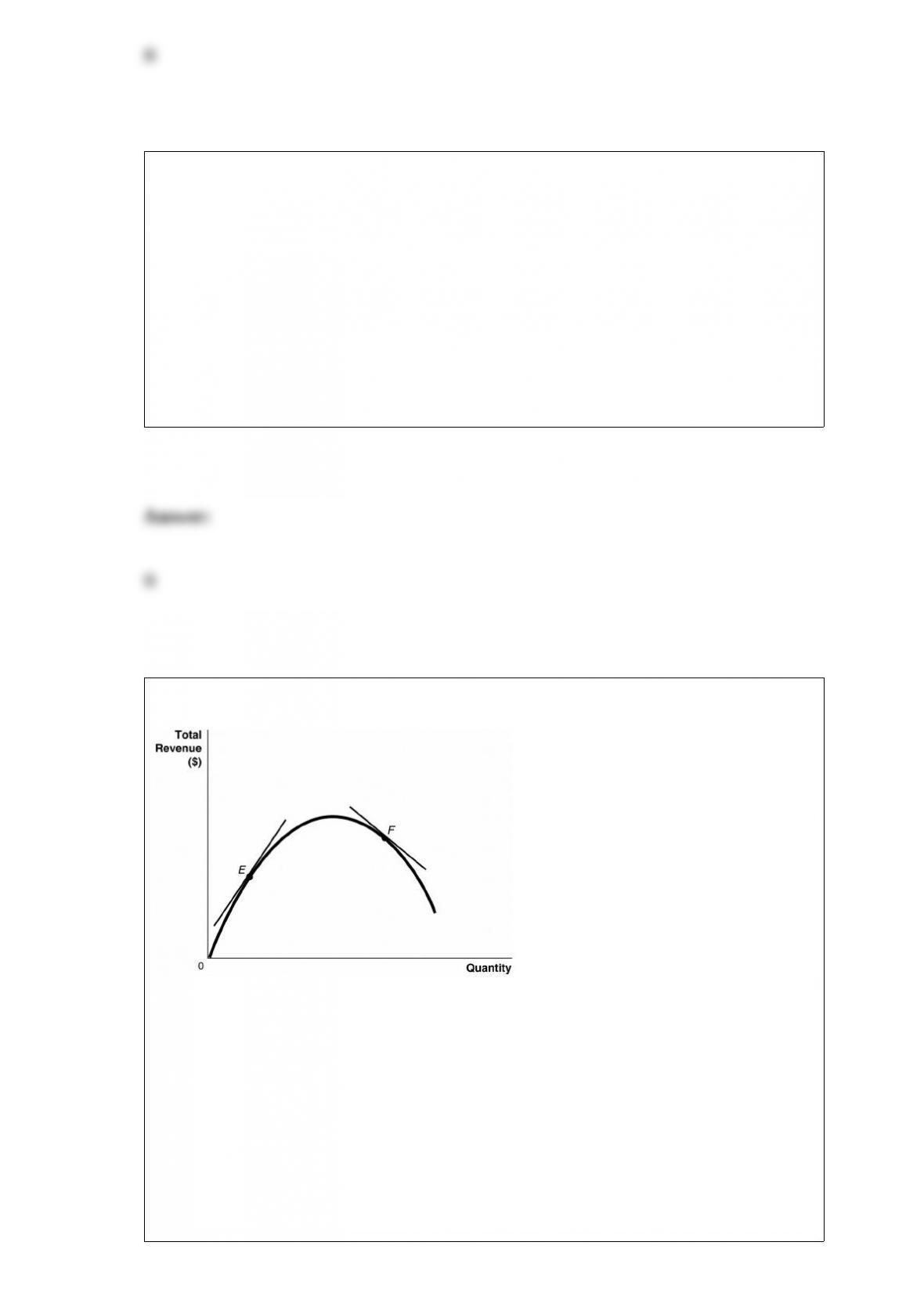
Figure 1-4
Which of the following statements is false?
A) The slope of the tangent at E is positive.
B) The slope of the tangent at F is negative.
C) The slope of the tangent at E and the slope of the tangent at F are equal.
D) Neither the slope of the tangent at E nor the slope of the tangent at F are equal to
zero.

Economists first began studying the relationship between changes in aggregate
expenditures and changes in GDP
A) in the 1950s.
B) during the Great Depression.
C) at the end of the Civil War.
D) during the Industrial Revolution.
The first economist to systematically analyze market failure was
A) Adam Smith.
B) Ronald Coase.
C) A. C. Pigou.
D) J. E. Meade.
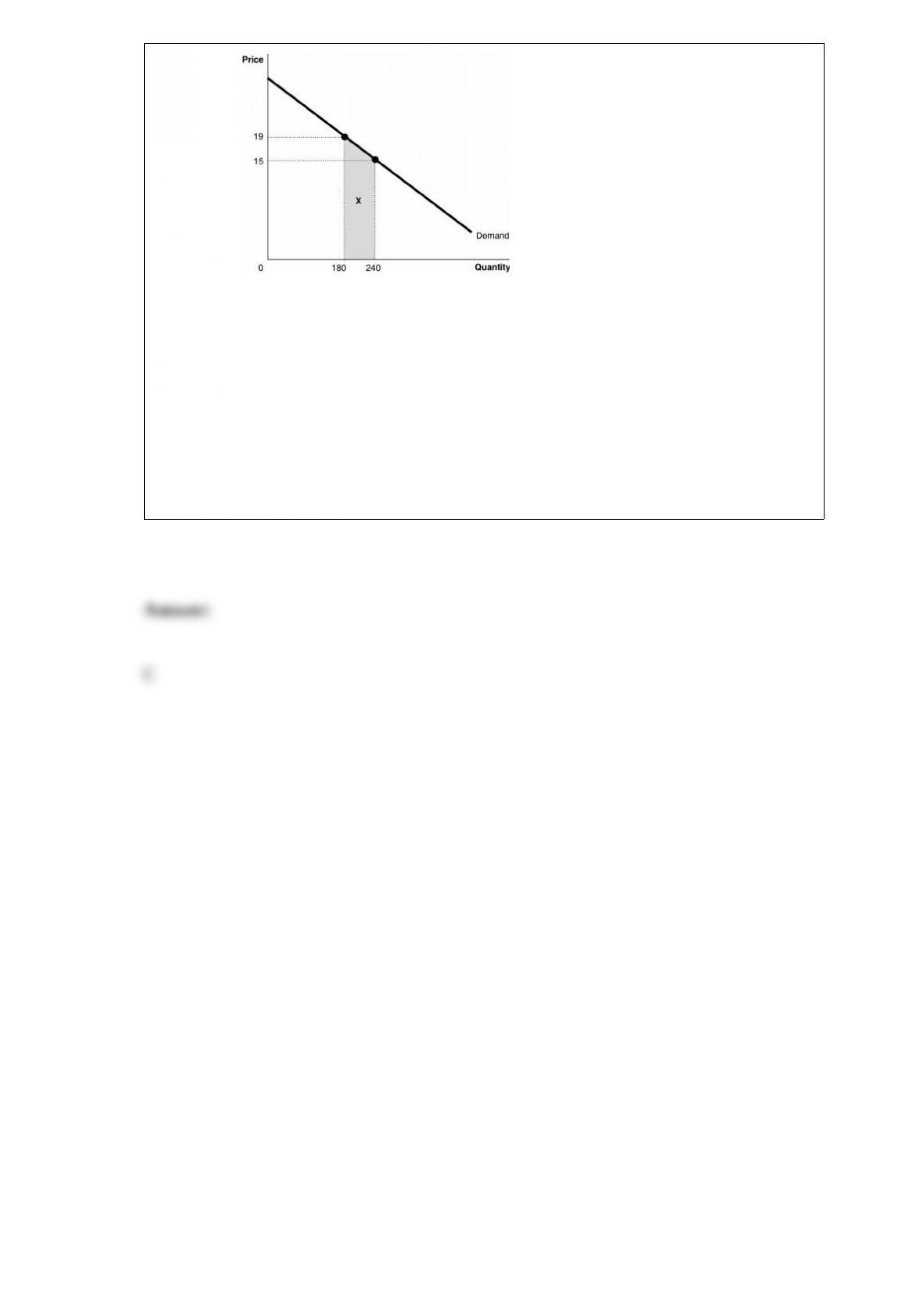
Figure 1-6
Calculate the area of the trapezoid X.
A) $361
B) $450
C) $1,020
D) $1,140