
1) Collective bargaining agreements usually cover:
A.wages and hours.
B.union status.
C.seniority and job opportunities.
D.all of these.
2) The legal cartel theory best describes the structure and economic outcomes of the:
A.automobile industry.
B.deregulated airline industry.
C.airline industry before deregulation.
D.local telephone communications industry.
3) the free-rider problem is that:
a.free public transportation is overcrowded.
b.people will not voluntarily pay for something that they can obtain without paying.
c.government supplies goods at no charge to people who can afford to pay for them.
d.public goods often create large external costs.
4) If a $10 billion decrease in lump-sum taxes increases equilibrium GDP by $40 billion
then:
A.the multiplier is 4.
B.the MPC for this economy is .8.
C.the MPC for this economy is .6.
D.the multiplier is 3.
5) offshoring often results from:
a.diminished human capital of american workers.
b.overly restrictive trade policies.
c.a change in comparative advantage.
d.a desire to help out workers in low income economies.
6) The demographic transition view alleges that:
A.the DVCs must first accept the use of birth control techniques to increase their
standards of living.
B.population growth will only decline if mortality rates exceed birth rates.
C.if incomes first rise, population growth will then decline.
D.population growth has no bearing on a nation’s per capita income.
7)
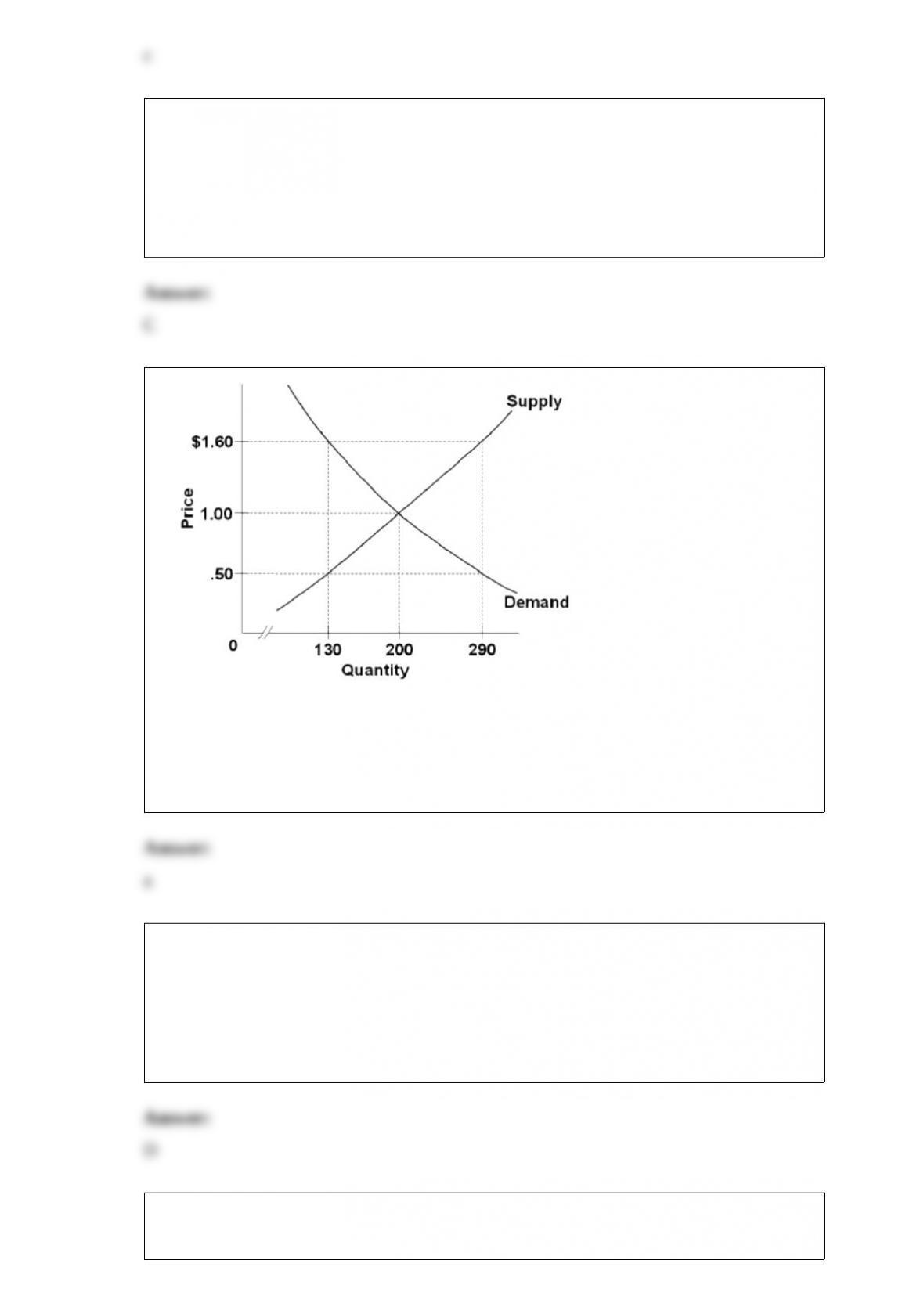
refer to the above diagram. the equilibrium price and quantity in this market will be:
a.$1.00 and 200.
b.$1.60 and 130.
c.$.50 and 130.
d.$1.60 and 290.
8) Suppose the reserve requirement is 10 percent. If a bank has $5 million of checkable
deposits and actual reserves of $500,000, the bank:
A.can safely lend out $500,000.
B.can safely lend out $5 million.
C.can safely lend out $50,000.
D.cannot safely lend out more money.
9) A monopsonist’s wage cost in hiring an additional worker is the:
A.worker’s wage rate.
B.worker’s wage rate plus the wage increases paid to all workers already employed.
C.worker’s wage rate adjusted for the lower price that must be charged for the extra
output.
D.marginal wage cost less the wage rate.
10) The ABC Commercial Bank has $5,000 in excess reserves and the reserve ratio is
30 percent. The bank must have:
A.$90,000 in outstanding loans and $35,000 in reserves.
B.$90,000 in checkable deposit liabilities and $32,000 in reserves.
C.$20,000 in checkable deposit liabilities and $10,000 in reserves.
D.$90,000 in checkable deposit liabilities and $35,000 in reserves.
11) the following information:
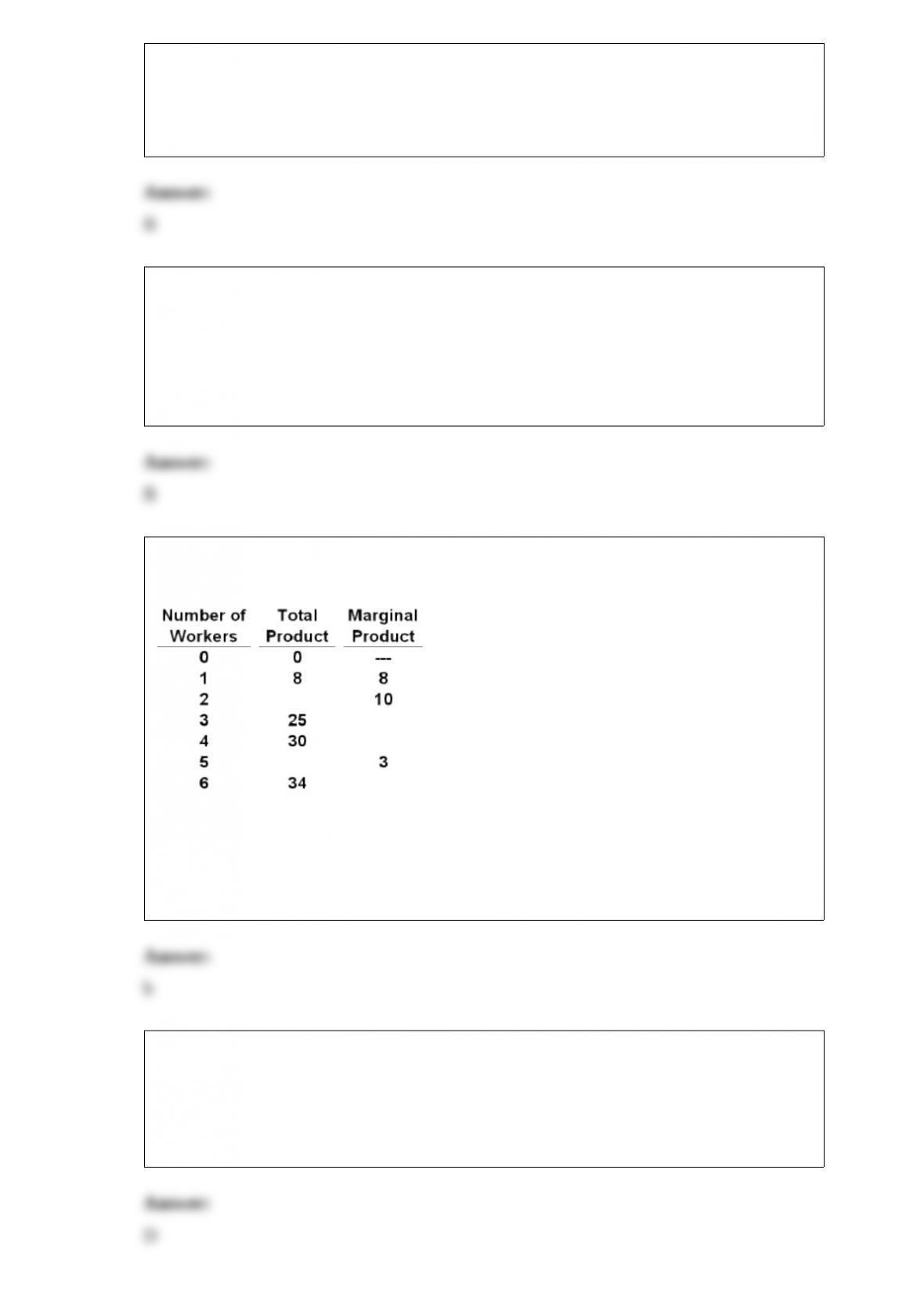
refer to the above data. when two workers are employed:
a.total product is 20
b.total product is 18
c.average product is 10
d.total product cannot be determined from the information given.
12) The M2 money supply includes:
A.stock certificates.
B.currency in bank vaults.
C.the cash value of life insurance policies.
D.individual shares in money market mutual funds.
13) black markets are associated with:
a.price floors and the resulting product surpluses.
b.price floors and the resulting product shortages.
c.ceiling prices and the resulting product shortages.
d.ceiling prices and the resulting product surpluses.
14)
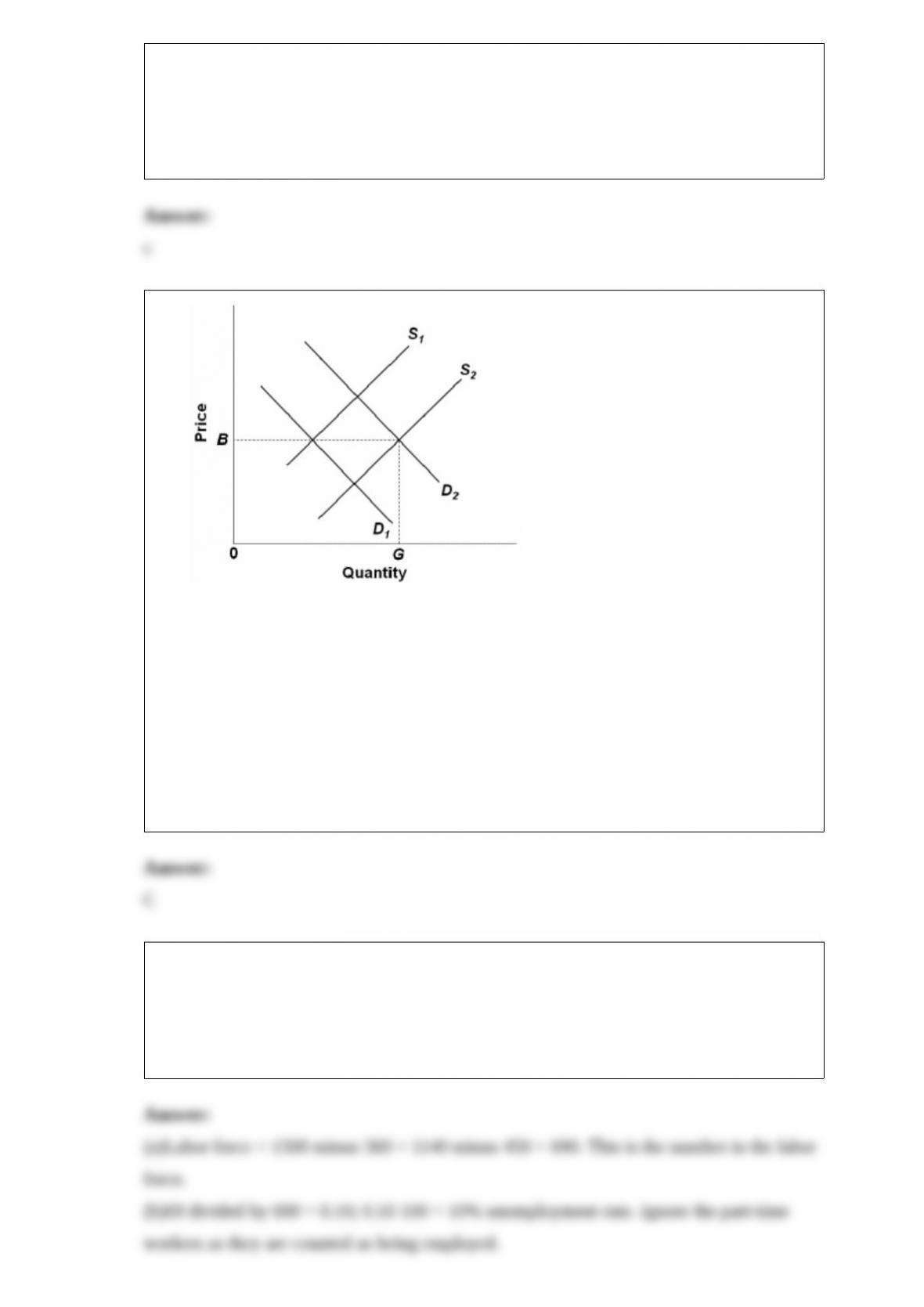
Refer to the above competitive market diagram for product Z. Assume that the current
market demand and supply curves for Z are D2 and S2. If there are substantial external
costs associated with the production of Z, then:
A.a price lower than B and an output greater than G would improve resource allocation.
B.government should levy a per unit excise tax on Z to shift the demand curve to the
right.
C.government should levy a per unit excise tax on Z to shift the supply curve toward
S1.
D.government should subsidize the production of Z to lower equilibrium price and
increase equilibrium output.
15) Use the following data to calculate: (a) the size of the labor force and (b) the official
unemployment rate.
Total population 1500; population under age 16 and institutionalized, 360; not in labor
force, 450; unemployed, 69; workers with part-time jobs who are looking for full-time
jobs, 30.

16) the pure monopolist’s demand curve is relatively elastic:
a.in the price range where total revenue is declining.
b.at all points where the demand curve lies above the horizontal axis.
c.in the price range where marginal revenue is negative.
d.in the price range where marginal revenue is positive.