
Suppose your neighbor likes to repair motorcycles in his front yard during evenings and
on weekends, and he earns $400 per week from this work. However, the sight of piles
of greasy motorcycle parts and the additional noise and traffic caused by his customers
reduces your value of living in this neighborhood by $300 per week. If you have a right
to live in peace and quiet, how can you achieve the efficient outcome?
A) He cannot afford to pay you enough money to allow him to work on motorcycles.
B) He pays you some value between $0 and $100 to allow his home business.
C) He pays you some value between $300 and $400 to allow his home business.
D) He pays you at least $400 to allow his home business.
Marginal product crosses the horizontal axis (is equal to zero) at the point where
A) average product is maximized.
B) total product is maximized.
C) diminishing returns set in.
D) output per worker reaches a maximum.
E) All of the above are true.
Consider the Matching Pennies game:
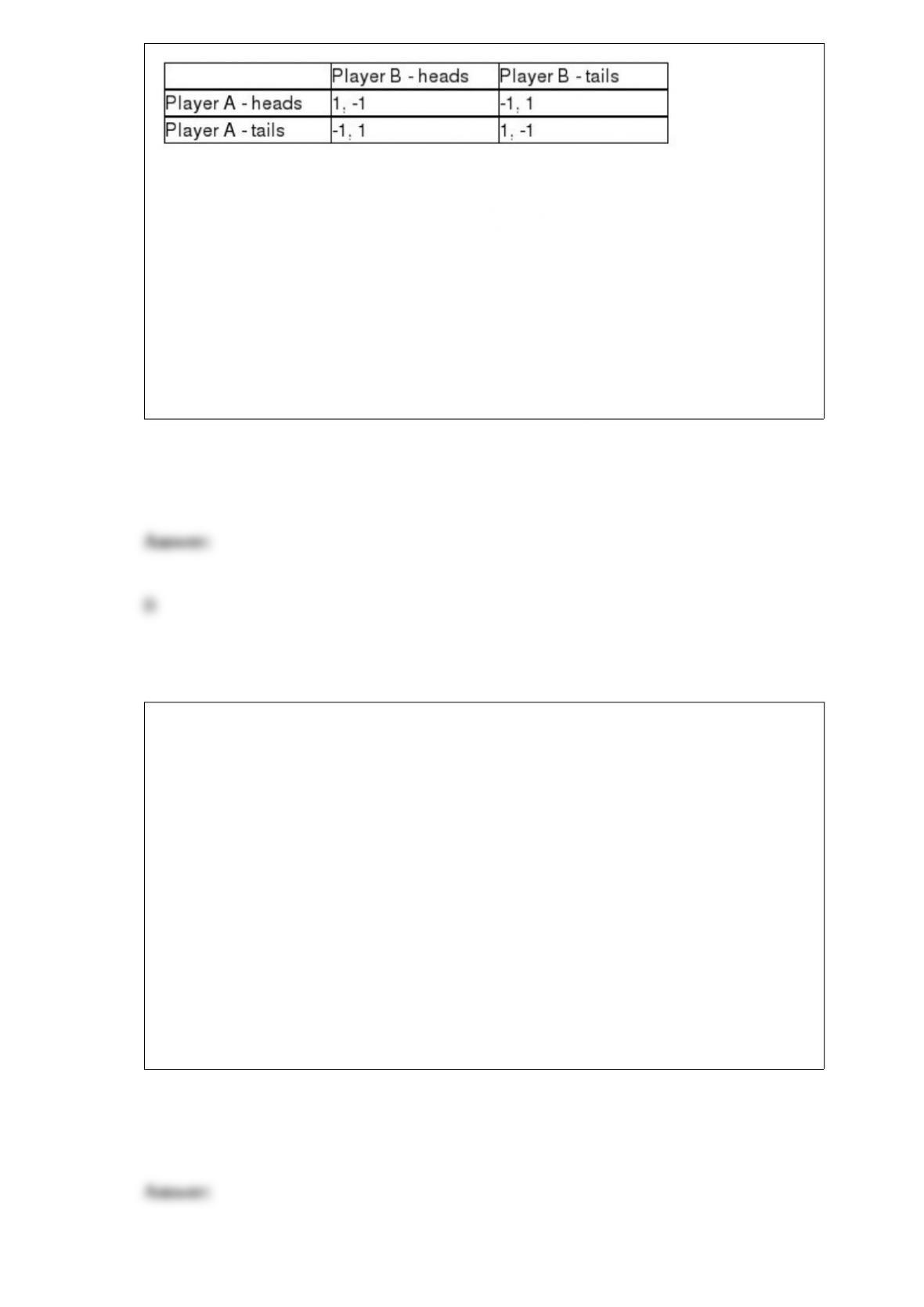
Suppose Player A always uses a pure strategy that selects heads, and Player B always
uses a pure strategy that selects tails. Is this outcome a Nash equilibrium?
A) Yes, both players have no incentive to change their actions.
B) No, Player A would want to switch to tails.
C) No, Player B would want to switch to heads.
D) No, Player B would want to switch to tails.
Consider the following statements when answering this question.
I. If no consumer has a kinked demand curve for CDs, then the market demand curve
for CDs cannot be kinked either.
II. If at a price of $10, every consumer has inelastic demand, then at that price the
market demand for CDs will be inelastic too.
A) I and II are true.
B) I is true, and II is false.
C) I is false, and II is true.
D) I and II are false.

Suppose the price of crude oil is $95 per barrel in New York and $85 per barrel in
Texas, and the transaction costs for trading between the two markets are $15 per barrel.
What actions should you take to arbitrage this price difference?
A) Buy oil in Texas and sell oil in NY
B) Sell oil in Texas and buy oil in NY
C) Buy oil in both markets and wait for higher prices
D) Do not buy or sell oil in either market
Envision a graph with meat on the horizontal axis and vegetables on the vertical axis. A
strict vegetarian would have indifference curves that are:
A) vertical lines.
B) horizontal lines.
C) diagonal straight lines.
D) right angles.
E) upward sloping.

Consider the information below:
For Group A the cost of attaining an educational level y is
CA(y) = $6,000y
and for Group B the cost of attaining that level is
CB (y) = $10,000y.
Employees will be offered $50,000 if they have y < y*, where y* is an education
threshold determined by the employer. They will be offered $130,000 if they have y >
y*.
If the threshold educational level y* is set at 20,
A) only individuals in Group K will attain it.
B) only individuals in Group M will attain it.
C) individuals in both groups will attain it.
D) no individuals will attain it.
E) some fraction of individuals in each group will attain it.
Suppose your neighbor likes to repair motorcycles in his front yard during evenings and
on weekends, and he earns $400 per week from this work. However, the sight of piles
of greasy motorcycle parts and the additional noise and traffic caused by his customers
reduces your value of living in this neighborhood by $300 per week. If your neighbor
has a right to operate this business, what is the efficient outcome?
A) He continues to operate the business.
B) You can pay him to move the business to another location.
C) He pays you to let him continue working on motorcycles at his home.
D) There is no efficient outcome from this situation.

When a good has a unitary price elasticity, consumer expenditures for the good
A) change in the same direction as a price change.
B) change in the opposite direction to a price change, but not necessarily by the same
percentage as the price change.
C) do not change when the price of the good decreases.
D) change in the opposite direction and by the same percentage as any price change.
Suppose a consumer only purchases food and clothing, and food is plotted along the
horizontal axis of the consumer’s indifference map. If the price of food and clothing
increase and income does not change, then the budget line changes by rotating:
A) counter-clockwise about the fixed vertical axis intercept.
B) clockwise about the fixed vertical axis intercept.
C) counter-clockwise about the fixed horizontal axis intercept.
D) clockwise about the fixed horizontal axis intercept.
E) none of the above

Which of the following markets has the most restrictive geographic boundary?
A) The market for retail gasoline
B) The market for housing
C) The market for gold
D) The market for beef
By 2011, how much had U.S. housing prices declined from their peak in 2006?
A) 2 percent
B) 33 percent
C) 40 percent
D) 50 percent

Higher input prices result in
A) upward shifts of MC and reductions in output.
B) upward shifts of MC and increases in output.
C) downward shifts of MC and reductions in output.
D) downward shifts of MC and increases in output.
E) increased demand for the good the input is used for.
Which price index published by the US federal government represents retail price
changes?
A) Consumer Price Index
B) Producer Price Index
C) GDP deflator
D) Dow-Jones Industrial Average
Relative to the Nash equilibrium in the Cournot model, the Nash equilibrium in the
Bertrand model with homogeneous products
A) results in the same output but a higher price.
B) results in the same output but a lower price.
C) results in a larger output at a lower price.
D) results in a smaller output at a higher price.
E) any of the above may result.
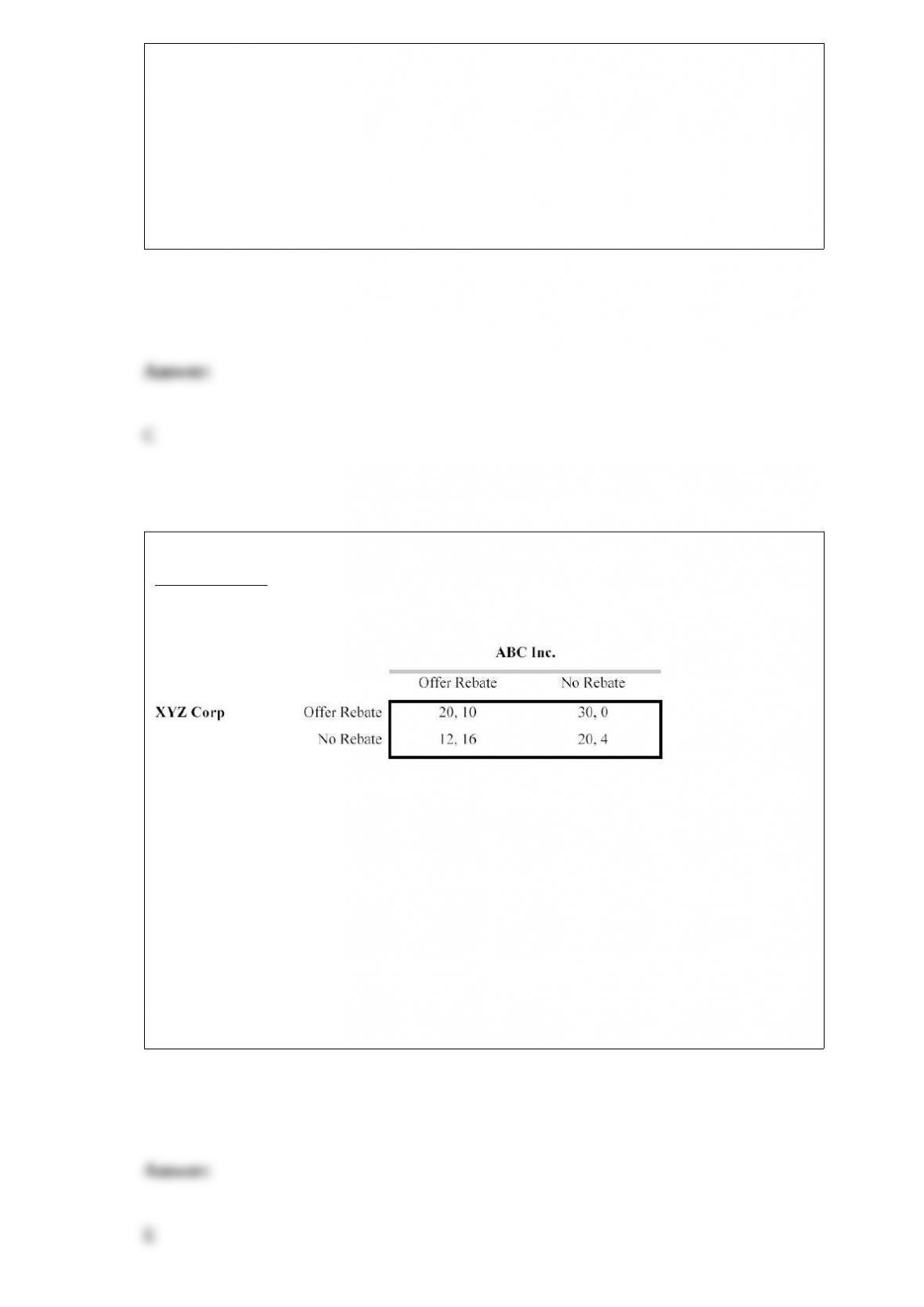
Scenario 13.2:
Consider the following game:
Which of the following is true about the game in Scenario 13.2?
A) ABC’s dominant strategy is to offer a rebate.
B) ABC’s dominant strategy is not offer a rebate.
C) XYZ’s dominant strategy is to offer a rebate.
D) XYZ’s dominant strategy is not offer a rebate.
E) Both ABC and XYZ offer a rebate as a dominant strategy.
Shooting Star Books is a small publishing company that specializes in science fiction
books. Like most publishers, Shooting Star releases new books in hardcover form and
later releases paperback versions of the books. The marginal cost of printing both types
of books is $2 per book, and Shooting Star maximizes profits by practicing
intertemporal price discrimination. The annual demand for recently released
(hardcover) books is Q1 = 400 – 10P1 where quantity demanded is measured in
thousands of books and price is measured in dollars per book. The annual demand for
the paperback version of previously released books is Q2 = 800 – 40P2.
a. What are the marginal revenue curves associated with the two demand curves for
books?
b. What are the profit maximizing prices for hardcover and paperback books? What are
the quantities of books demanded at these prices for hardcover and paperback books?
c. Suppose the market demand for paperback books shifts to Q2 = 150 – 100P2. How
does this change affect the profit maximizing price and quantity in the paperback book
market? Does this change affect the profit maximizing outcome in the hardcover book
market?
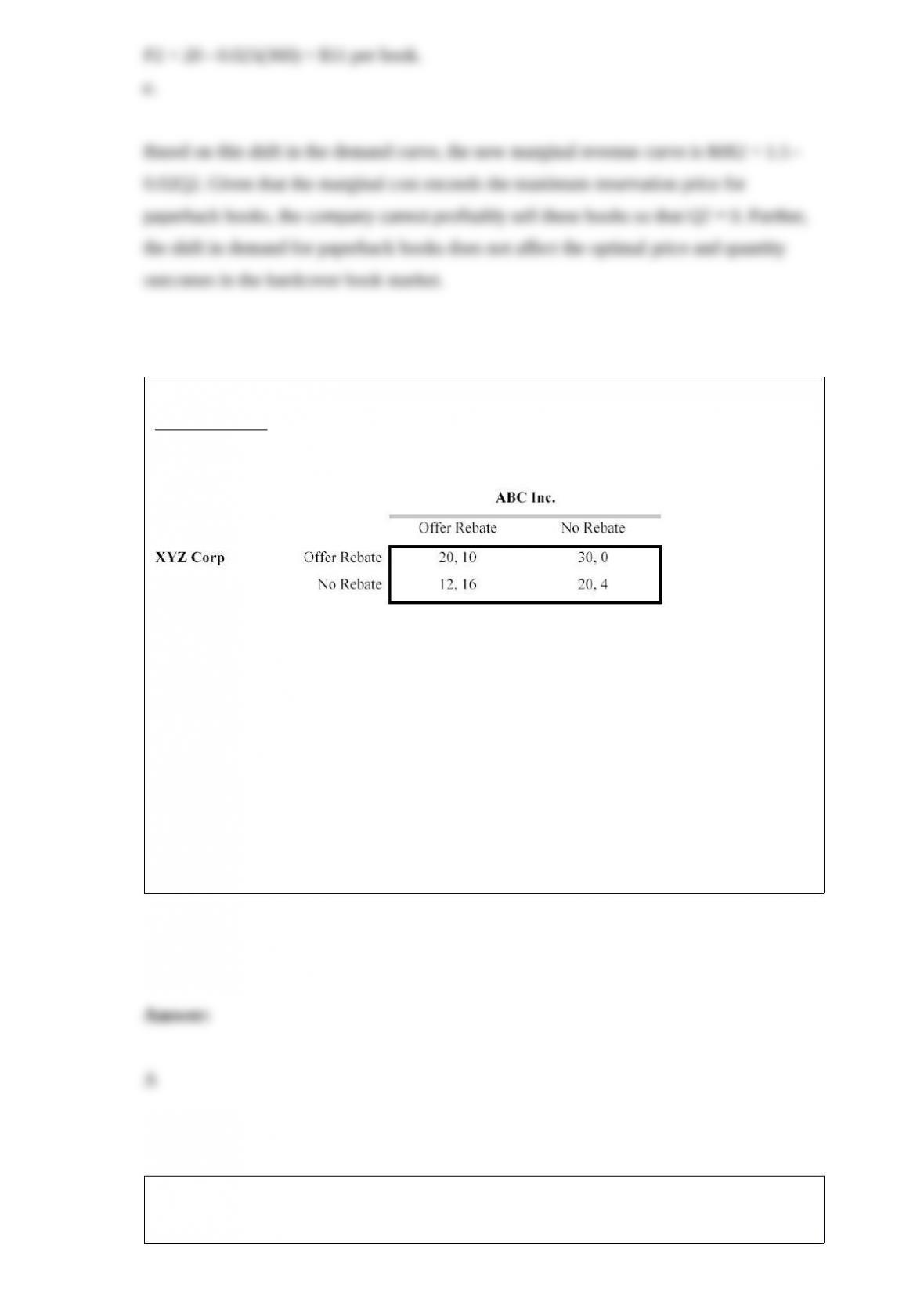
Scenario 13.2:
Consider the following game:
In the game in Scenario 13.2, the equilibrium strategies
A) are for both firms to offer rebates.
B) is for ABC to offer a rebate, and XYZ not to offer a rebate.
C) is for XYZ to offer a rebate, and ABC not to offer a rebate.
D) are for both firms to offer no rebate.
E) does not exist in pure strategies.
Suppose an investor equally allocates their wealth between a risk-free asset and a risky
asset. If the MRS of the current allocation is less than the slope of the budget line, then

the investor should:
A) shift more of their wealth to the risky asset.
B) shift more of their wealth to the risk-free asset.
C) keep the same asset allocation.
D) We do not have enough information to answer this question.
The purpose of a chain-weighted price index is to account for:
A) the costs of purchasing wholesale products like chains and industrial goods.
B) the changes in the quantities of goods and services purchased over time.
C) linkages in price changes among industrialized countries.
D) none of the above
Which of the following assertions, if proven true in a court of law, would help
Archer-Daniels-Midland, a maker of corn syrup, in its attempt to acquire another corn
syrup producer, the Clinton Corn Processing Company?
A) Archer-Daniels-Midland is a dominant producer of corn syrup.
B) There are no good substitutes for corn syrup for any of its major uses.

C) Archer-Daniels-Midland and the Clinton Corn Processing Company together hold
only a small share of the market for sweeteners including corn syrup and sugar.
D) Archer-Daniels-Midland produces many other different agricultural products, in
addition to corn syrup.
To evaluate the potential impact of introducing the hybrid Prius auto into the U.S.
market, Toyota Motor Corporation would use:
A) positive economic analysis.
B) normative economic analysis.
C) negative economic analysis.
D) forensic analysis.
Why does perfect competition guarantee a Pareto optimal distribution of goods between
two people? Under perfect competition,
A) everyone has the same preferences.
B) everyone faces the same prices.
C) everyone consumes the same quantity of both goods.

D) goods are homogeneous.
A monopolist has set her level of output to maximize profit. The firm’s marginal
revenue is $20, and the price elasticity of demand is -2.0. The firm’s profit maximizing
price is approximately:
A) $0
B) $20
C) $40
D) $10
E) This problem cannot be answered without knowing the marginal cost.
During the most recent recession, many people temporarily lost substantial value in
their retirement investment portfolios because most of the assets (including stocks,
bonds, and real estate) all declined in value at the same time. In hindsight, what was the
problem with these portfolios?
A) The portfolios were not adequately diversified because the assets were negatively
correlated, so all of the assets had negative returns at the same time.
B) The portfolios were not adequately diversified because the assets were more
positively correlated than expected, so all of the assets had negative returns at the same
time.
C) The portfolios were adequately diversified, but the assets should have been more
positively correlated to protect against recession risk.
D) The investors should not have diversified their investments to protect against
recession risk.
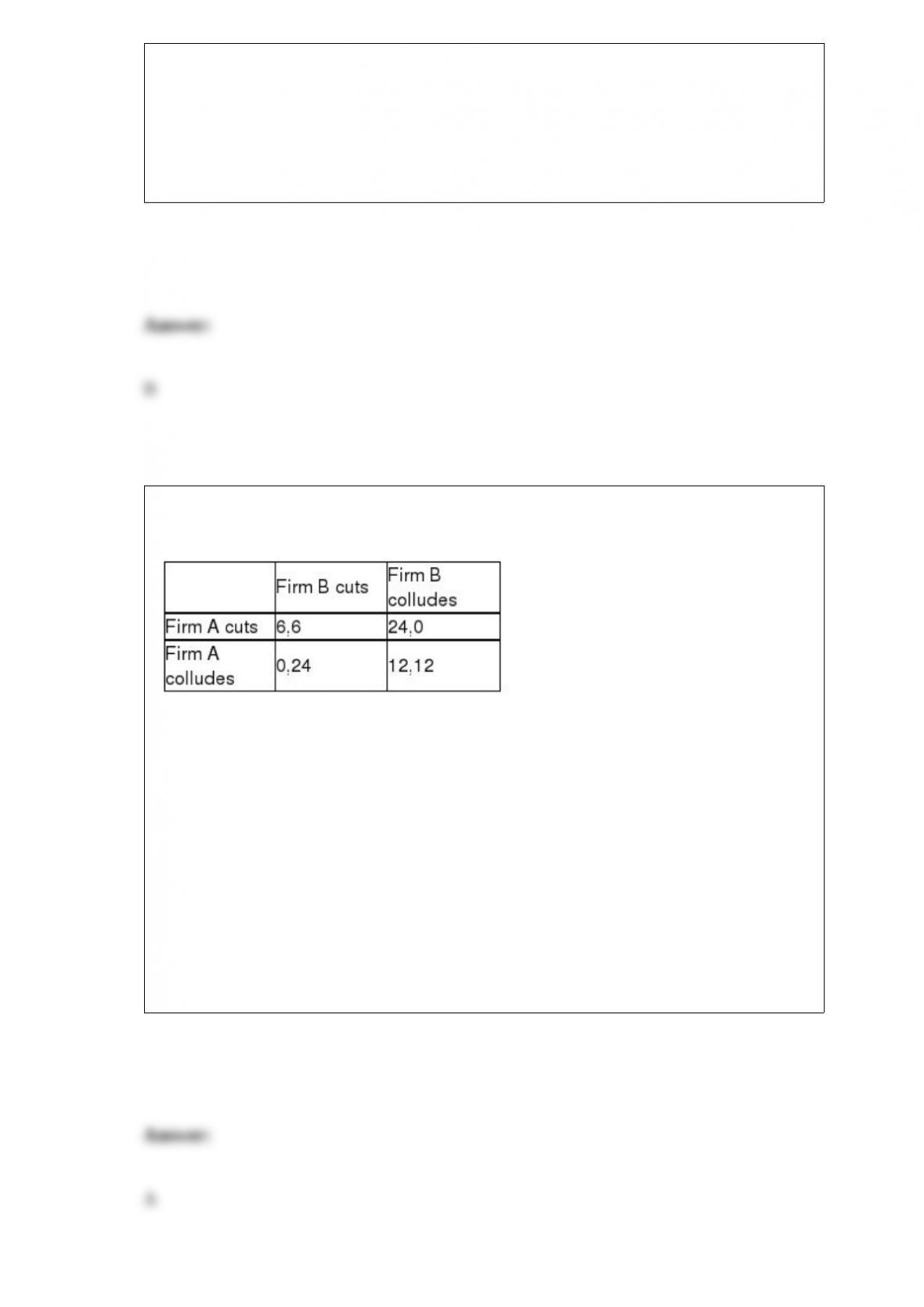
Consider the following payoff matrix for a game in which two firms attempt to collude
under the Bertrand model:
Here, the possible options are to retain the collusive price (collude) or to lower the price
in attempt to increase the firm’s market share (cut). The payoffs are stated in terms of
millions of dollars of profits earned per year. What is the Nash equilibrium for this
game?
A) Both firms cut prices.
B) A cuts and B colludes.
C) B cuts and A colludes.
D) Both firms collude.

The monopoly supply curve is the
A) same as the competitive market supply curve.
B) portion of marginal costs curve where marginal costs exceed the minimum value of
average variable costs.
C) result of market power and production costs.
D) none of the above
To determine whether an increase in the price of gasoline results in a consumer
spending a larger share of their expenditure on gasoline we need to know
A) only how much money the consumer spends on gasoline before the price change
B) only the change in the price of gasoline
C) only the change in the price of gasoline as a percentage of the original price
D) only the own price elasticity of demand for gasoline
E) none of the above
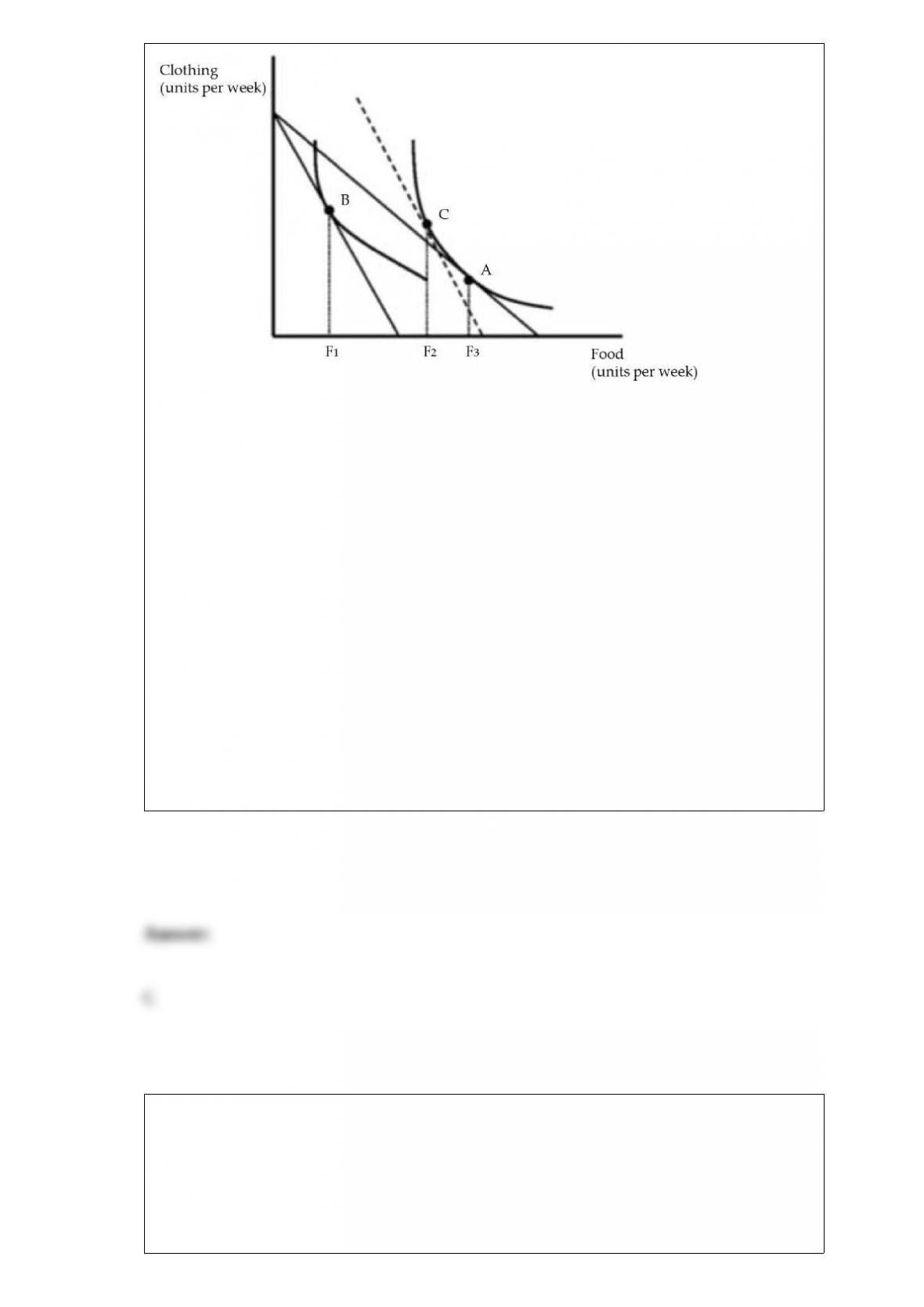
Figure 4.1
A consumer’s original utility maximizing market basket of goods is shown in Figure 4.1
as point A. Following a price change, the consumer’s utility maximizing market basket
changes is at point B.
Refer to Figure 4.1. The income effect of the price change in food on the quantity of
food purchased is:
A) the change from F3 to F1.
B) the change from F3 to F2.
C) the change from F2 to F1.
D) the change from F1 to F2.
E) none of the above
An individual consumes only two goods, X and Y. Which of the following expressions
represents the utility maximizing market basket?
A) MRSxy is at a maximum.
B) Px/Py = money income.
C) MRSxy = money income.
D) MRSxy = Px/Py.
E) all of the above
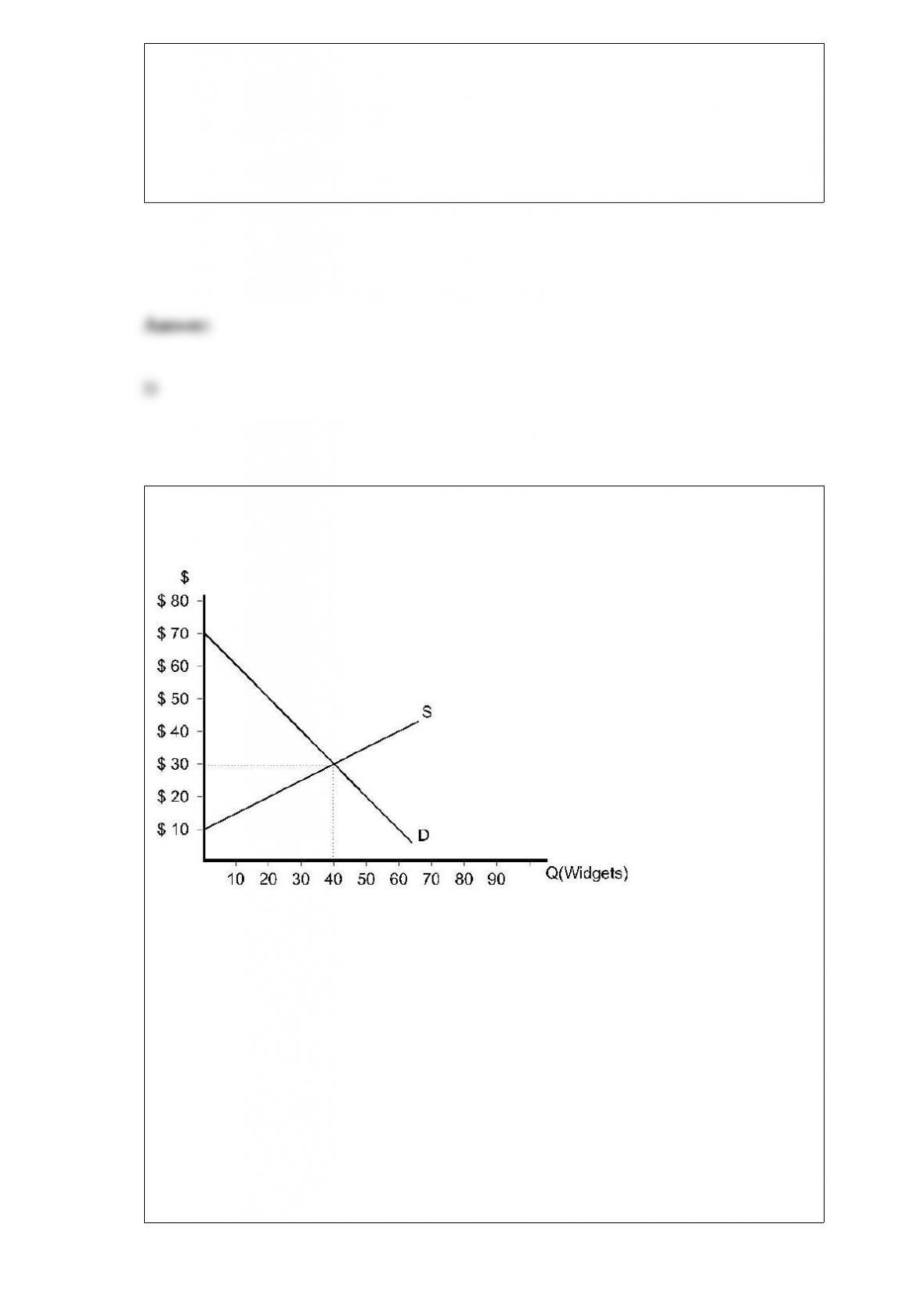
Figure 9.1
Refer to Figure 9.1. Suppose the market is currently in equilibrium. If the government
establishes a price ceiling of $20, producer surplus will
A) fall by $200.
B) fall by $300.
C) remain the same.
D) rise by $200.
E) rise by $300.

If the market price for a competitive firm’s output doubles then
A) the profit maximizing output will double
B) the marginal revenue doubles
C) at the new profit maximizing output, price has increased more than marginal cost
D) at the new profit maximizing output, price has risen more than marginal revenue
E) competitive firms will earn an economic profit in the long-run.
One form of economic stimulus that state governments can use is to exempt certain
types of purchases from state sales tax. For example, a law that permanently exempts
business equipment from state sales tax may stimulate purchases of these goods
because the law effectively reduces the price of the equipment. Business equipment
such as computers or vehicles are durable goods, so should we expect the tax exemption
program to have more impact on equipment demand in the short run or long run?
A) More impact in the long run because business equipment demand becomes more
income elastic in the long run
B) More impact in the long run because business equipment demand becomes more
price elastic in the long run
C) More impact in the short run because business equipment demand becomes more
income elastic in the long run

D) More impact in the short run because business equipment demand becomes more
price inelastic in the long run
Scenario 4.3:
The demand for erasers (Q) is given as follows:
Q = 240 – 4Pe + 2I + Pb + A
where Pe is the price of erasers
I is the level of income
Pb is the price of another good
A is the level of advertising
Suppose that Q = 240, Pe = 10, Pb = 10, and A = 2.Given the information in Scenario
4.3, erasers and good b, are:
A) substitutes.
B) complements.
C) completely unrelated.
D) normal.
E) inferior.
A consumer or producer who does not pay for use of a nonexclusive good but expects
others to pay is known as a:
A) free rider.
B) price setter.
C) fringe element.
D) none of the above