
If the price of peaches, a substitute for plums, decreases the demand for plums will
increase.
Trade only occurs if there are only winners, and no losers, as a result of the trade.
Economic profit is the difference between a firm’s revenue and its opportunity costs.
A consumer’s indifference curves can never cross.

Consider a manufacturing operation that uses specialized machinery and labor to
produce its output. In this case, the input that is not fixed in the short run is labor.
There are a limited number of original Picasso paintings. This means that the supply of
original Picasso paintings is perfectly inelastic.
Early adopters are consumers who will pay a high price to be among the first to own
new products.
A snack shop inside a hotel in a busy city has a monopoly on food sales if it is the only

food vendor in the hotel that is open 24 hours a day.
Both first-degree price discrimination and optimal two-part tariff pricing maximize
economic surplus.
Market power in the United States causes a huge loss of economic efficiency.
During recessions, economics majors earn about 35 percent more than the typical
college graduate.

A monopsony is a term used to refer to a firm that is the sole seller of a good or service.
If additional units of a good could be produced at a constant opportunity cost, the
production
possibilities frontier would be bowed outward (concave).
Advertising is the action of a firm that is intended to maintain the differentiation of its
product over time.

Economists assume people’s tastes are identical.
A monopolistically competitive firm that earns economic profits in the short run will be
able to expand its market share even if the market size remains constant.
The additional cost to a producer of hiring an additional unit of labor is called the
marginal cost.
The Sarbanes-Oxley Act of 2002 requires that each member of the board of directors
personally certify the accuracy of financial reports.

Decision trees can only be used to analyze sequential games.
If a perfectly competitive firm maximizes short-run profits, its marginal revenue will be
positive and less than its price.
In response to a surplus the market price of a good will fall; as the price falls, the
quantity demanded will increase and quantity supplied will decrease until equilibrium is
reached.
In an oligopoly, minimum efficient scale is likely to occur at a level of output that is a
large fraction of industry sales.
A key insight of the public choice model is that public policymakers are likely to pursue
the public’s interest, even if their self-interests conflict with the public interest.
To maximize utility consumers should buy goods and services to the point where the
marginal utility of each item consumed is maximized.
In the short run, a profit-maximizing firm will shut down if its total revenue is greater
than its variable costs.

A tax is efficient if it imposes a small excess burden relative to the tax revenue it raises.
As output increases, average fixed cost gets smaller and smaller.
Today, few U.S.-based manufacturing firms make their products exclusively in the
United States out of entirely U.S.-made parts.
The process of countries becoming more open to foreign trade and investment is known
as outsourcing.
If a firm’s fixed cost exceeds its total revenue, the firm should stop production by
shutting down temporarily.
The demand for gasoline is perfectly inelastic because most people need gasoline to
drive their cars.
The law of one price states that identical products should sell for the same price
everywhere as long as transactions costs are zero.

When voluntary exchange takes place, both parties gain from the exchange.
When negative externalities exist, the competitive market supply curve does not include
all of the costs borne by members of society.
In a centrally planned economy, the households and firms decide how economic
resources will be allocated.

Seth’s grandmother gave him a $50 savings bond for his birthday. The bond pays $50 at
maturity, which is in five years. If the interest rate is 5%, the bond has a present value
of $43.19.
Last year, the Pottery Palace supplied 8,000 ceramic pots at $40 each. This year, the
company supplied the same quantity of ceramic pots at $55 each. Based on this
evidence, The Pottery Palace has experienced
A) a decrease in supply.
B) an increase in supply.
C) an increase in the quantity supplied.
D) a decrease in the quantity supplied.
A change in all of the following variables will change the market demand for a product
except
A) the price of the product.
B) population and demographics.
C) income.
D) tastes.

The three most widely followed stock indexes in the United States include all of the
following except
A) the Dow Jones Industrial Average.
B) the S&P 500.
C) the Fortune 500.
D) The NASDAQ.
Some firms practice odd pricing because
A) they believe that customers will buy a larger quantity with an odd price.
B) it is a way to price discriminate.
C) it is too difficult for sellers to reeducate buyers into accepting even prices.
D) it lowers transactions costs.
a. What is the World Trade Organization?
b. When was it established?
c. How many countries are members of the World Trade Organization?
For each surfboard that Australia produces, it gives up the opportunity to make 25
boomerangs. New Zealand can produce 1 surfboard for every 15 boomerangs it
produces. Which of the following is true about the comparative advantage between the
two countries?
A) Australia has the comparative advantage in producing surfboards.
B) Australia has the comparative advantage in producing boomerangs.
C) New Zealand has the comparative advantage in producing surfboards and
boomerangs.
D) New Zealand has the comparative advantage in producing boomerangs.
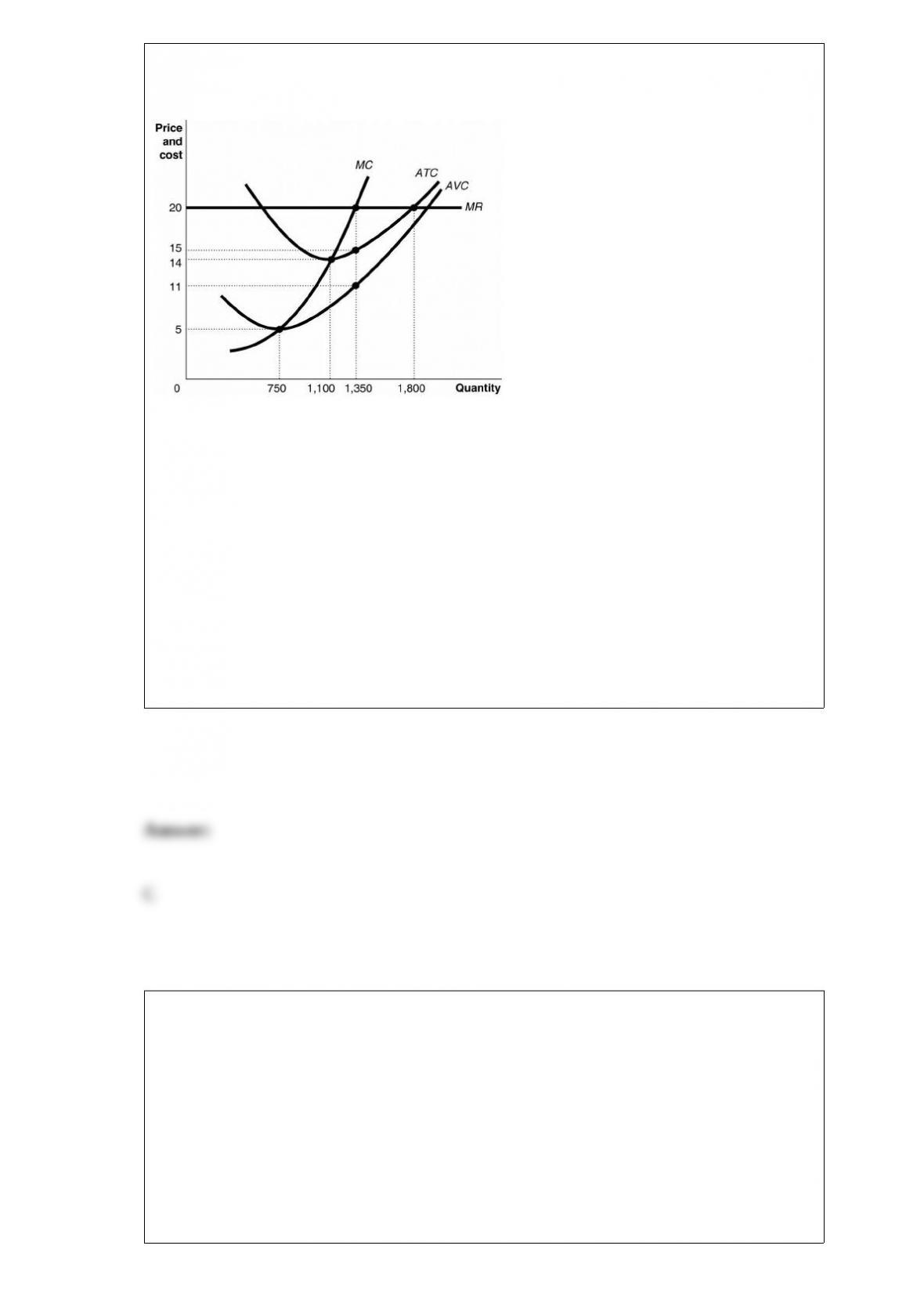
Figure 12-5
Figure 12-5 shows cost and demand curves facing a typical firm in a constant-cost,
perfectly competitive industry.
Refer to Figure 12-5. If the market price is $20, what is the firm’s profit-maximizing
output?
A) 750 units
B) 1,100 units
C) 1,350 units
D) 1,800 units
An oligopolist differs from a perfect competitor in that
A) there is cutthroat competition in perfect competition but little competition in
oligopoly because firms have significant market power.
B) firms in an oligopoly do not produce homogeneous products while firms in perfect
competition do.
C) the market demand curve for a perfectly competitive industry is perfectly elastic but
it is downward-sloping in an oligopolistic industry.

D) there are no entry barriers in perfect competition but there are entry barriers in
oligopoly.
In the United States, the federal income tax is an example of a
A) progressive tax.
B) regressive tax.
C) proportional tax.
D) flat tax.
Figure 15-17
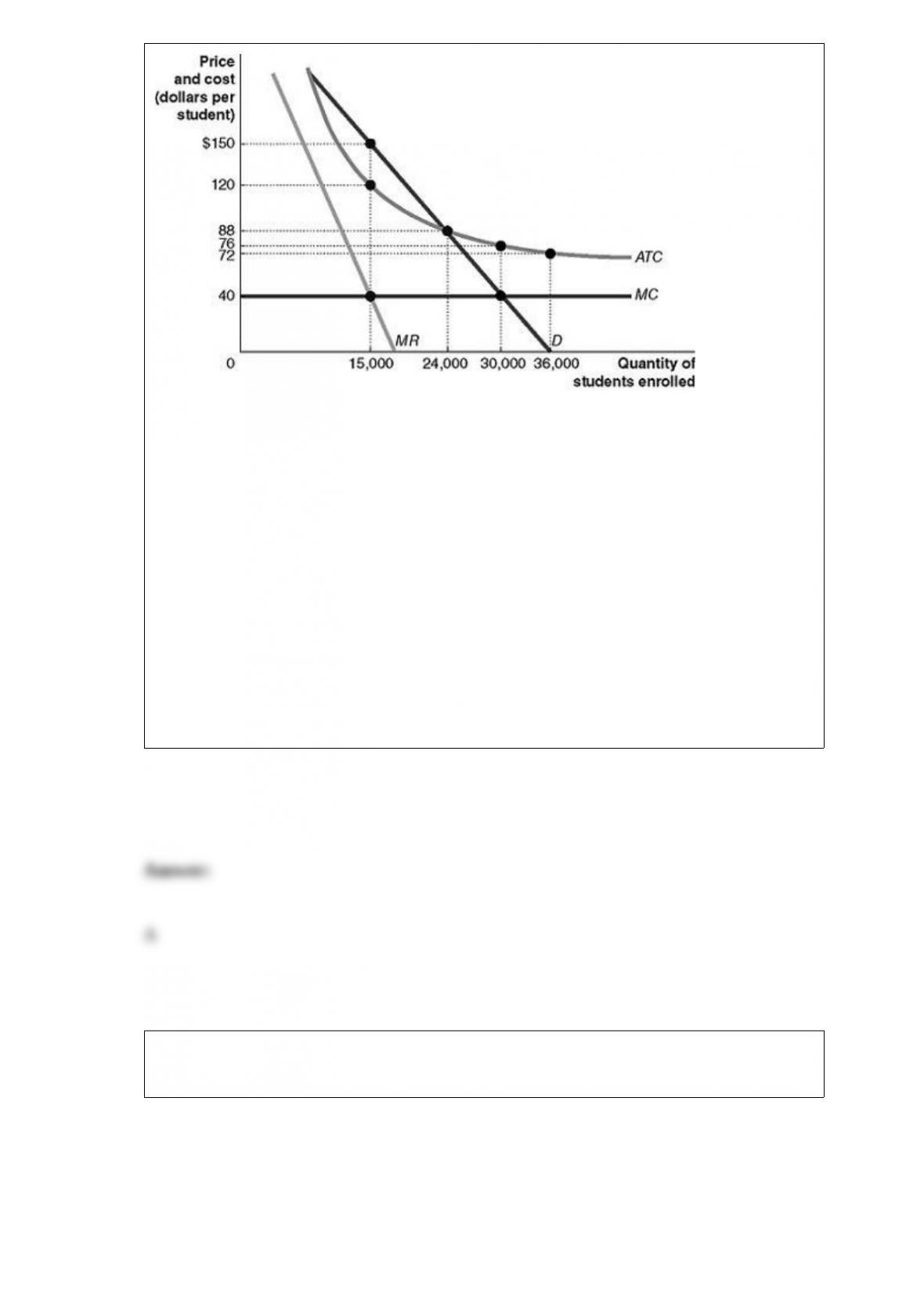
Your college decides to offer a psychology course as a MOOC that can be taken by
students anywhere in the world, whether they are actually enrolled in your college or
not. The demand and cost situation for the MOOC is shown in the figure.
Refer to Figure 15-17. The faculty member who designed the course argues: “I think
the course should be priced so that the maximum number of students enroll.” Which
price should this faculty member favor?
A) $0
B) $40
C) $88
D) $150
Figure 16-7
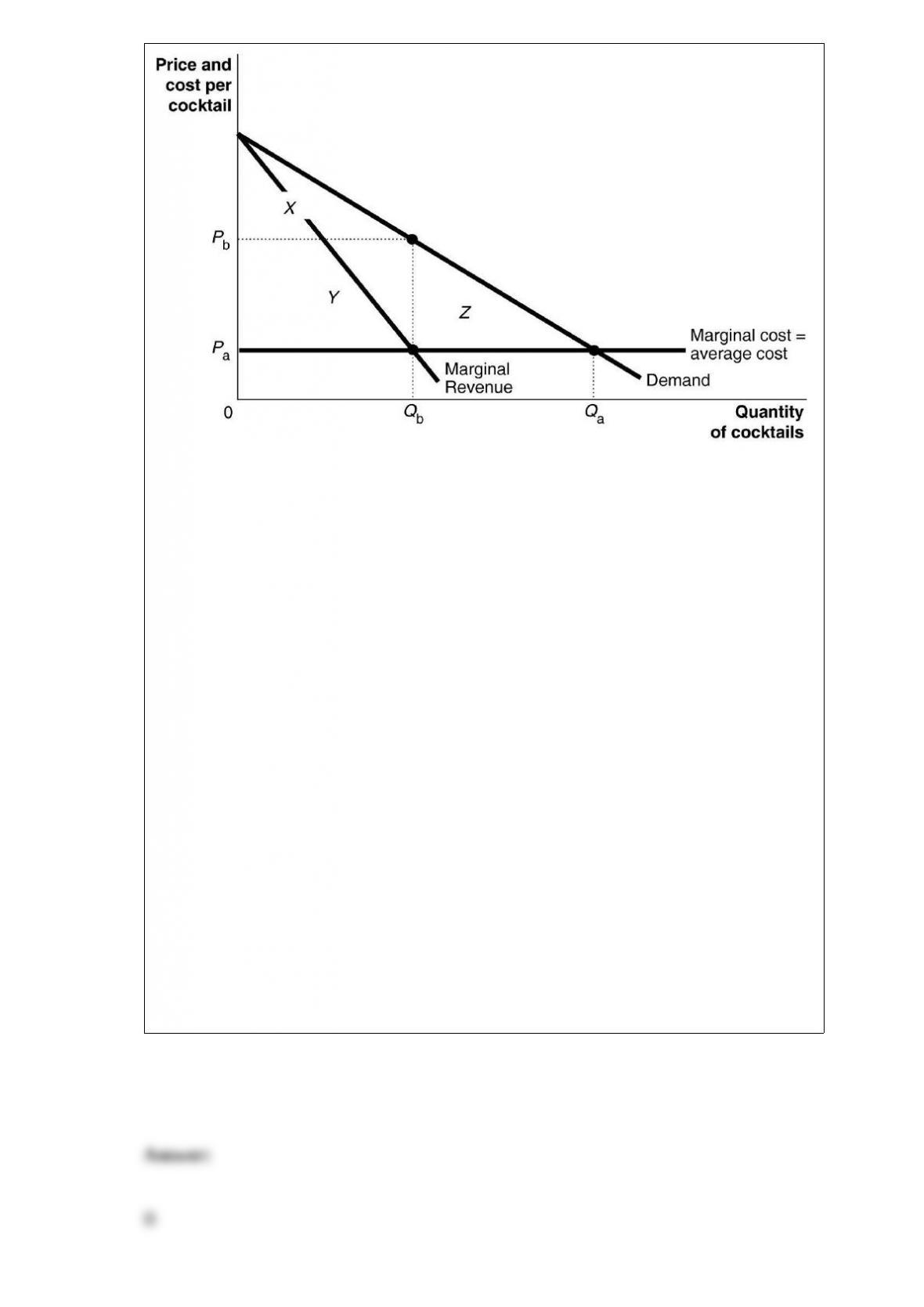
The Lizard Lounge is well known for its exotic cocktails. Figure 16-7 shows its
estimated demand curve for cocktails.
Refer to Figure 16-7. The owners of the Lizard Lounge are considering the following
four pricing options:
a. A single price scheme where the cocktail price equals the monopoly price.
b. A single price scheme where the cocktail price equals the competitive price.
c. A two-part tariff: a monopoly price for cocktails and a cover charge that will generate
total revenue equal to the area X.
d. A two-part tariff: a competitive price for cocktails and a cover charge that will
generate total revenue equal to the area X + Y + Z.
Under which scheme are the Lounge customers best off?
A) scheme a
B) scheme b
C) scheme c
D) scheme d

The De Beers Company blocked competition
A) in the diamond market by controlling the output of most of the world’s diamond
mines.
B) by controlling the supply of most of the world’s high-quality bauxite, the mineral
used to produce aluminum.
C) in the market for fresh and frozen cranberries because it controls about 80 percent of
the cranberry crop.
D) because it has lower production costs than other department stores due to economies
of scale.
Uber uses what is known as surge pricing to set prices based on the number of people
who request rides at a given time in a given area. Based on this pricing method, prices
will
A) fall when supply decreases.
B) rise when supply increases.
C) rise when demand increases.
D) rise when demand decreases.
How does the decreasing use of traditional cameras affect the market for traditional
camera film?
A) The demand curve for traditional camera film shifts to the right.
B) The quantity of traditional camera film demanded decreases.
C) The quantity of traditional camera film demanded increases.
D) The demand curve for traditional camera film shifts to the left.
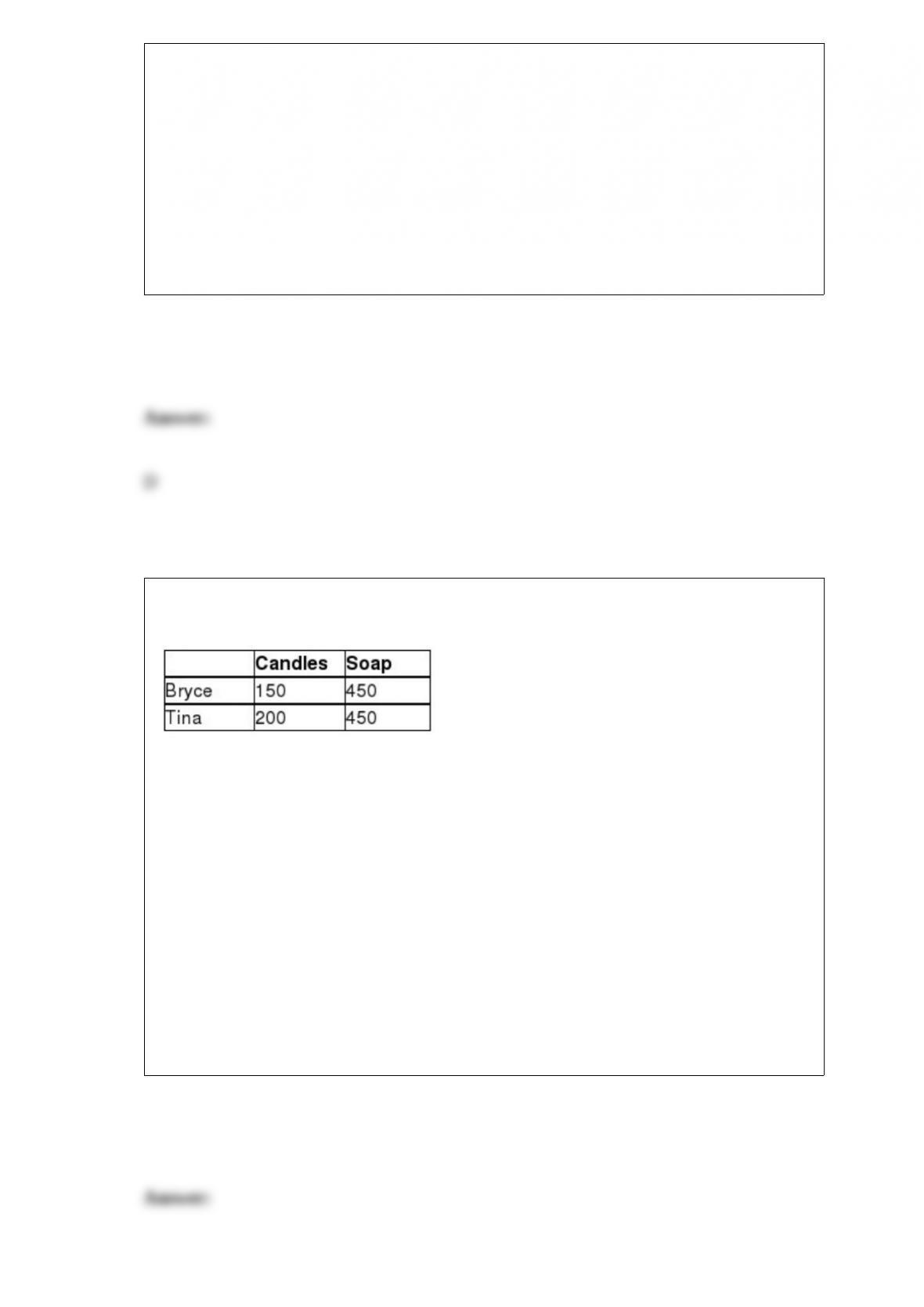
Table 9-3
Bryce and Tina are artisans who produce homemade candles and soap. Table 9-3 lists
the number of candles and bars of soap Bryce and Tina can each produce in one month.
Refer to Table 9-3. Select the statement that accurately interprets the data in the table.
A) Bryce has an absolute advantage in making candles and Tina has an absolute
advantage in making soap.
B) Bryce has an absolute advantage in making soap and Tina has an absolute advantage
in making candles.
C) Bryce has an absolute advantage in making soap.
D) Tina has an absolute advantage in making candles.

A firm that is first to the market with a new product frequently discovers that there are
design flaws or problems with the product that were not anticipated. How do these
problems affect the innovating firm?
A) The firm is protected by a first-mover advantage: initial design flaws tend not to
harm a firm significantly because consumers resist changing products for fear of
incurring high switching costs.
B) They reduce profits for the new innovations and open the door to competitors who
can enter the new market with a better product.
C) Because these design flaws were not anticipated, consumers tend to be more
forgiving and are likely to remain loyal to the company and its products.
D) The firm’s cost increases as it improves the product but it will not be able to raise its
price for fear of alienating customers. Consequently, its profits will erode although its
market share remains secure.
All of the following will shift the labor supply curve except
A) an increase in labor force participation rate among women.
B) an increase in the average age of retirement.
C) an increase in the wage rate.
D) a change in a country’s immigration policy.
Economists Cade Massey and Richard Thaler analyzed whether teams in the National
Football League distributed salaries efficiently. Massey and Thaler found that
A) the first few players selected in first round of the NFL draft are paid much higher
salaries relative to their marginal products than players drafted later in the first round.
B) rookies are paid salaries greater than their marginal products; veteran players are
paid salaries less than their marginal products.
C) veteran players who sign as free agents are paid more relative to their marginal
products than rookie players selected in the first round of the draft.
D) both rookie players and veteran players are paid less than the value of their marginal
products because of the lack of competition among teams.
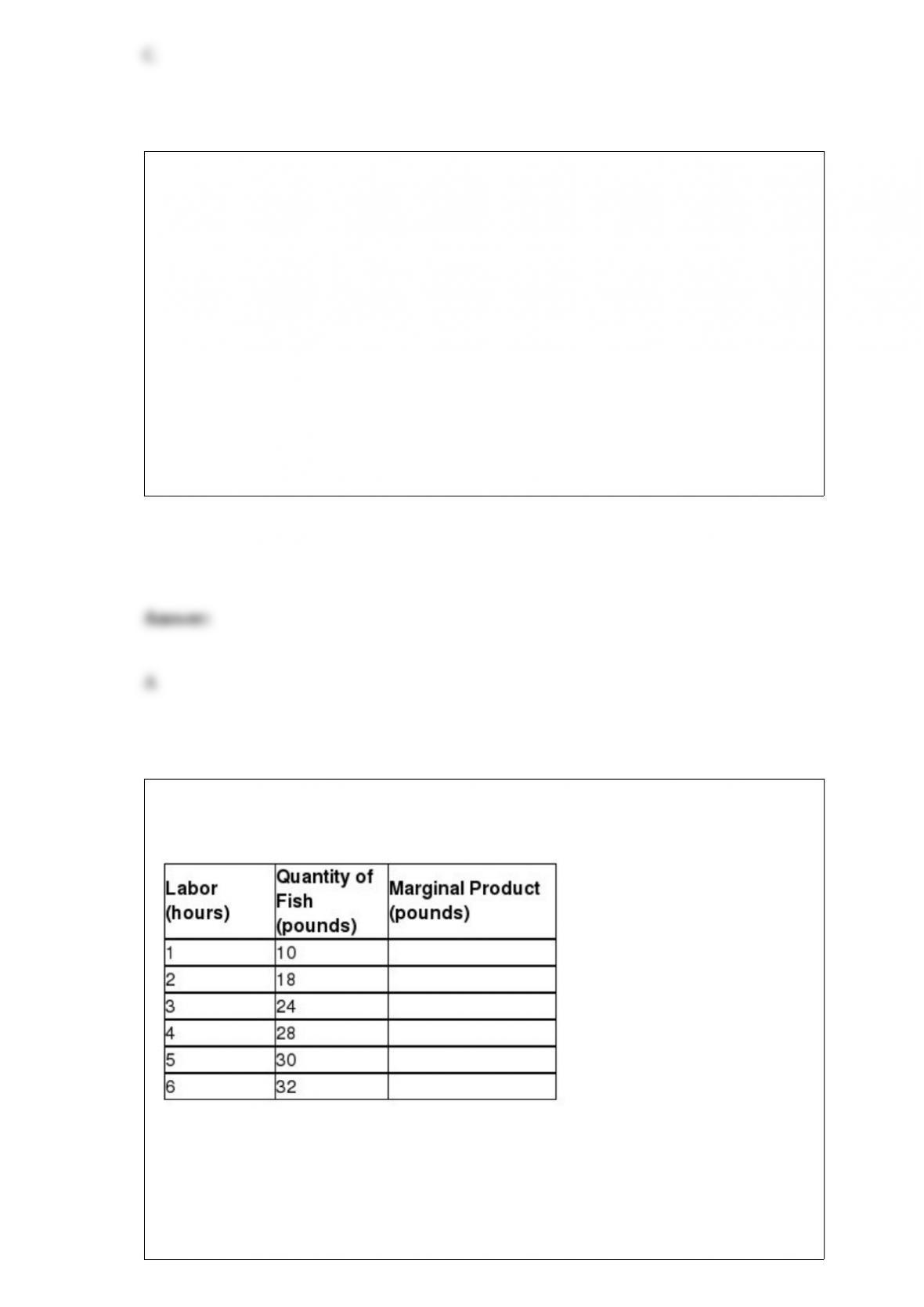
Table 11-4
Refer to Table 11-4. The table above shows the following relationship between hours
spent fishing and the quantity of fish caught for Juan, a commercial fisherman.
a. Complete the Marginal Product column in Table 11-4.
b. Characterize the production function, i.e. does the production function display
increasing marginal returns, diminishing marginal returns, etc.
c. Using the data above, graph Juan’s marginal product curve. Be sure to label the
horizontal and vertical axes. Is your graph consistent with your answer to part (b)?
Explain.
d. Juan uses the following inputs for fishing a small wooden boat (B), a fishing pole (P)
and of course, his labor (L). Treating the boat and the fishing pole as fixed inputs and
using the data above, graph Juan’s Total Product of Labor curve. Be sure to label the
horizontal and vertical axes.
e. The opportunity cost of Juan’s time is $8 per hour. If Juan receives $2 per pound for
his fish, what is the optimal number of hours he should spend fishing? Explain how you
arrived at your answer. Hint: Recall marginal benefit and marginal cost analysis.
Figure 4-8
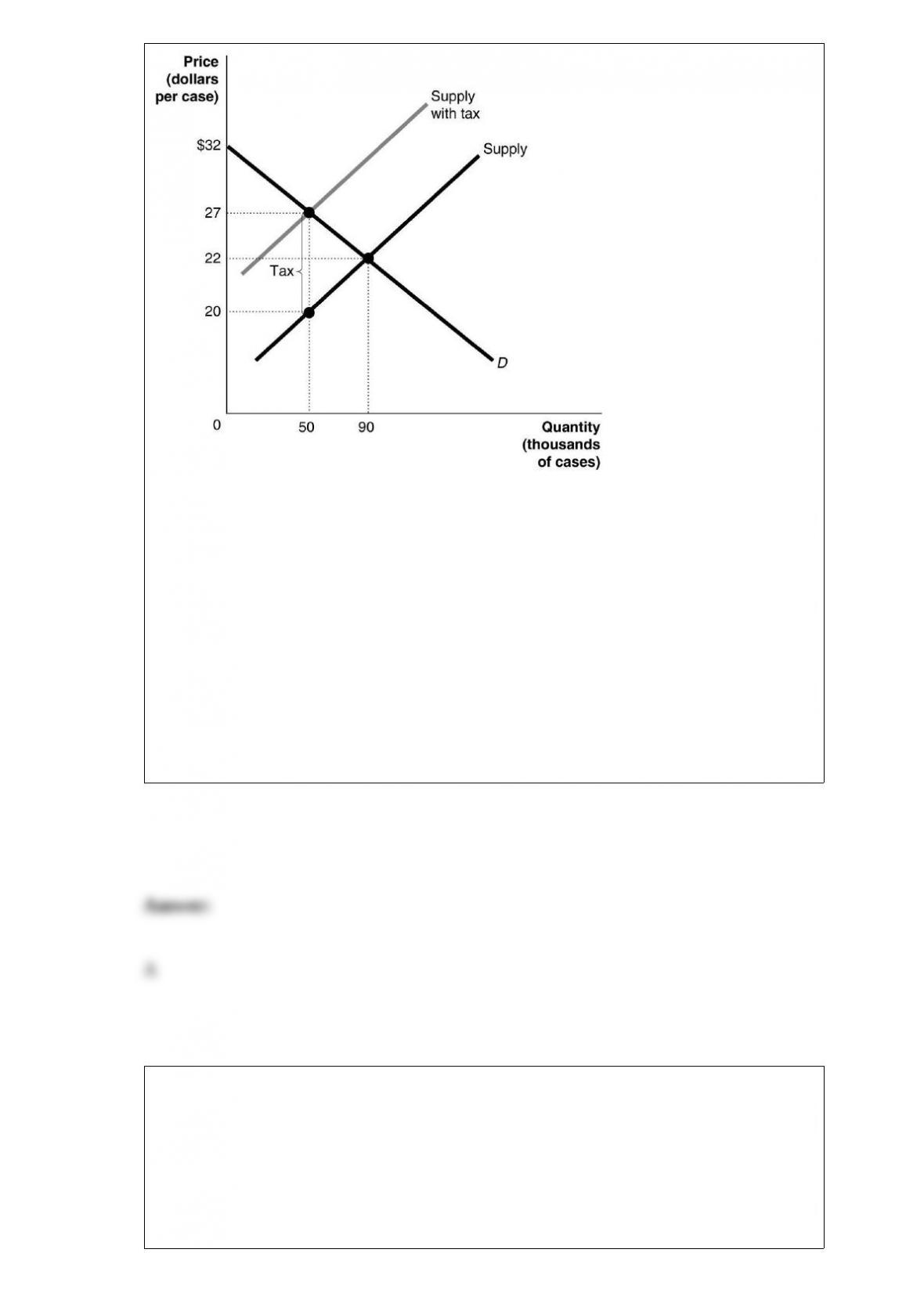
Figure 4-8 shows the market for beer. The government plans to impose a unit tax in this
market.
Refer to Figure 4-8. For each unit sold, the price sellers receive after the tax (net of tax)
is
A) $20.
B) $22.
C) $27.
D) $32.
To maximize their profits and defend those profits from competitors, monopolistically
competitive firms must
A) lobby government to erect barriers to entry in their industries.
B) limit foreign competition in their markets by encouraging the government to impose
tariffs and other trade restrictions.

C) differentiate their products.
D) achieve economies of scale.
Ted’s Pancake Kitchen suffers a short-run loss. When should Ted decide to shut down
rather than continue to produce?
A) if his Kitchen’s revenue is less than its variable costs
B) if his Kitchen’s revenue is less than its fixed costs
C) if his Kitchen’s revenue is less than its explicit costs
D) if his Kitchen’s revenue is less than its total costs
Which of the following is a microeconomics question?
A) Why do economies experience periods of high inflation?
B) Will Federal Reserve intervention lower the inflation rate?
C) Why has growth in the economy increased since the end of the recession?
D) Will the merger of American Airlines and US Airways increase or decrease airfares?

The excess burden of a tax
A) measures the efficiency loss to the economy that results from a tax, causing a
reduction in the quantity of goods and services produced.
B) is measured by the administrative costs required to implement a tax system.
C) is a measure of the hardship imposed on low-income individuals in a society.
D) is a measure of the foregone consumption as a result of having to pay taxes.
Congressman Flack votes for a program that will benefit the constituents of
Congressman Walpole. The public choice model suggests that Flack’s vote is best
explained by which of the following?
A) rational ignorance
B) party loyalty
C) logrolling
D) the voting paradox
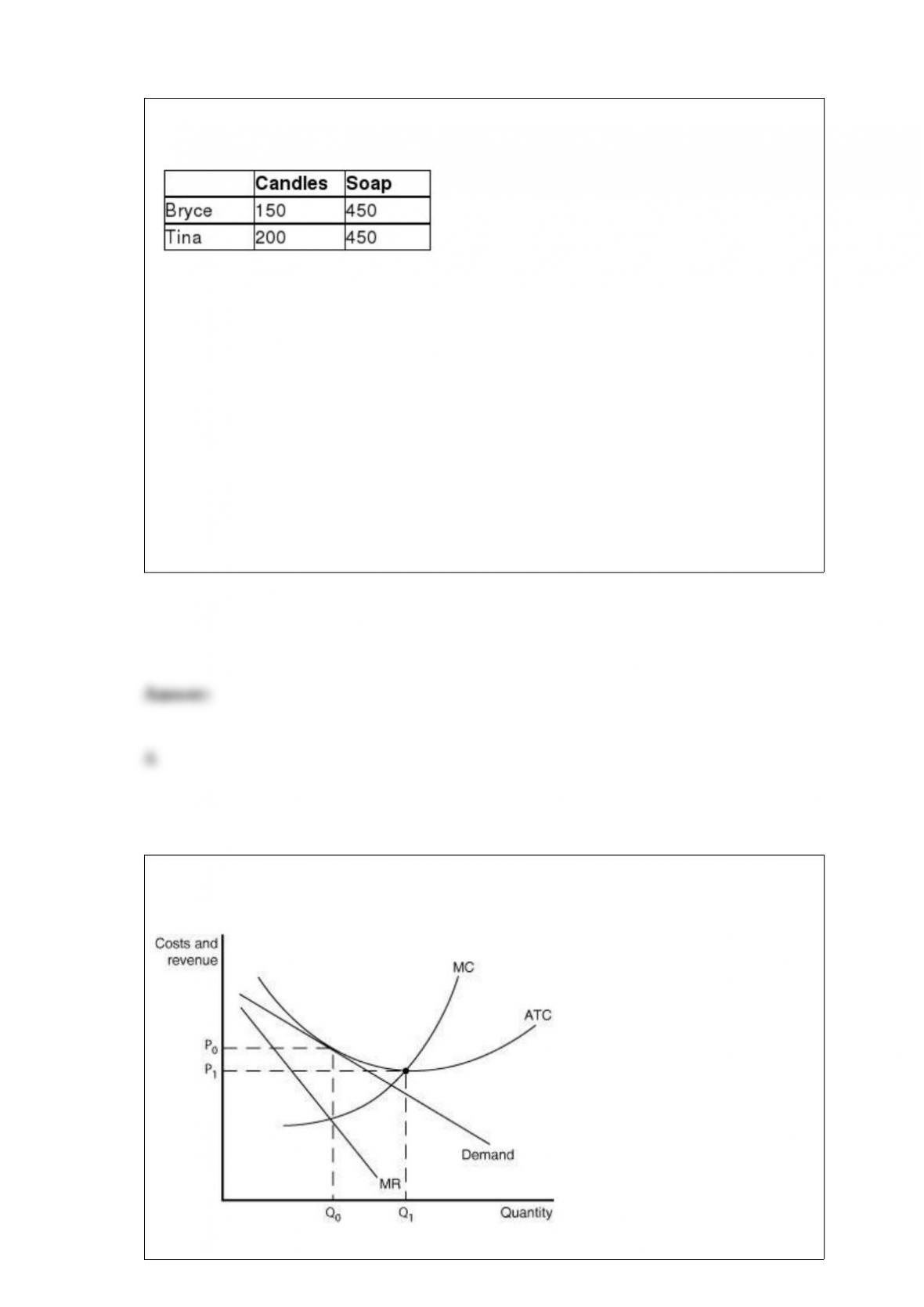
Table 9-3
Bryce and Tina are artisans who produce homemade candles and soap. Table 9-3 lists
the number of candles and bars of soap Bryce and Tina can each produce in one month.
Refer to Table 9-3. Select the statement that accurately interprets the data in the table.
A) Bryce has a greater opportunity cost than Tina for making candles.
B) Bryce’s opportunity cost for making candles is less than Tina’s.
C) Tina has a greater opportunity cost than Bryce for making candles.
D) Bryce’s opportunity cost for making candles and making soap are both greater than
Tina’s.
Figure 13-14
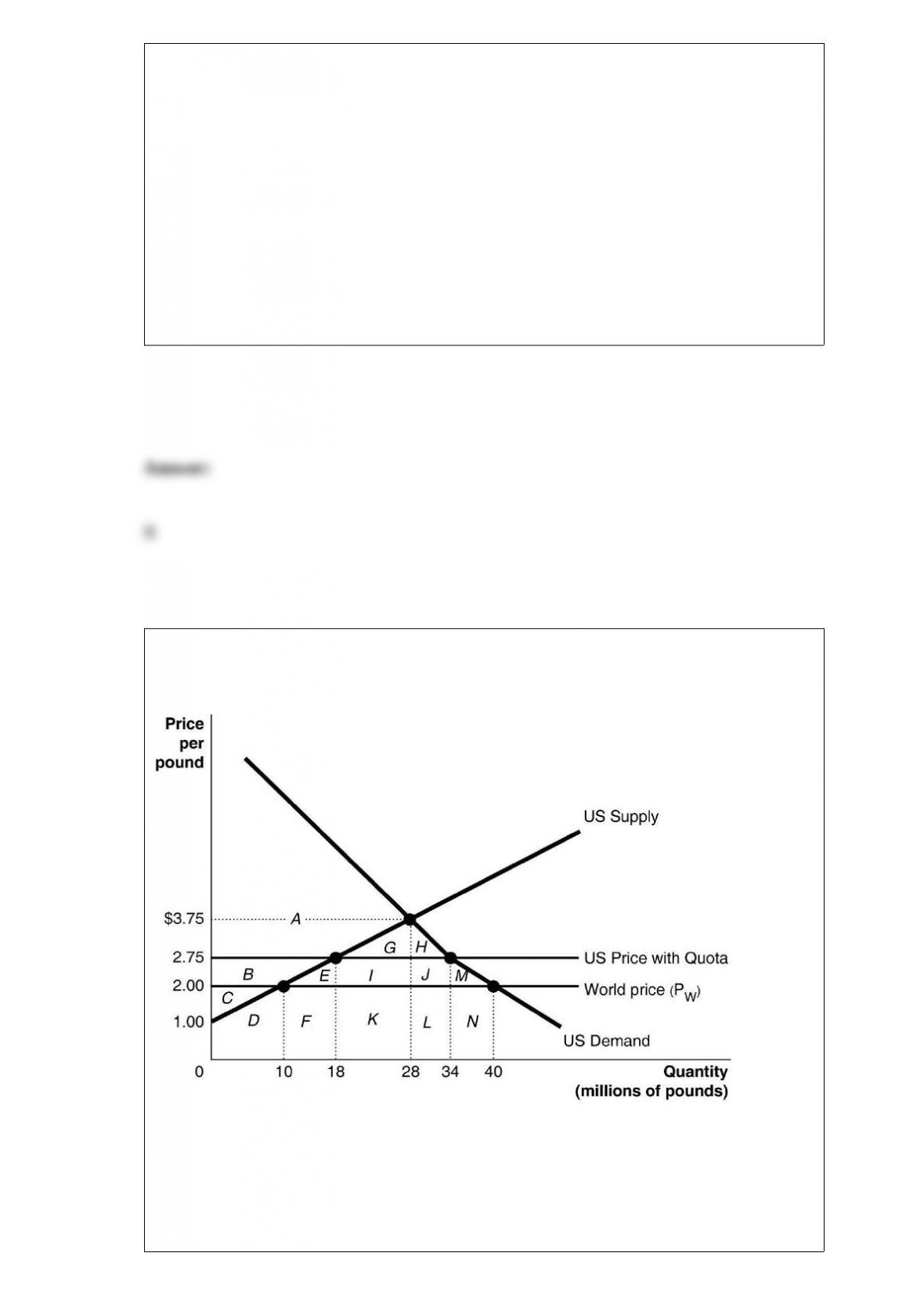
Figure 13-14 illustrates a monopolistically competitive firm.
Refer to Figure 13-14. It is possible to lower the average cost of production by
expanding output beyond Q0 to Q1. Why wouldn’t a firm expand its output to Q1?
A) The firm wants to maximize accounting profit rather than economic profit.
B) The firm would suffer an economic loss at Q1 while it would break even at Q0.
C) The firm’s marginal revenue would be negative at Q1.
D) Demand is not sufficient for consumers to buy Q1.
Figure 9-3
Since 1953 the United States has imposed a quota to limit the imports of peanuts.
Figure 9-3 illustrates the impact of the quota.
Refer to Figure 9-3. What is the area of domestic producer surplus without a quota?
A) C

B) C + B
C) A + B + C
D) A + B + C + D
Why is a typical person likely to gather more information when buying a new car than
when voting for a member of Congress?
A) because a person’s preferences are more likely to be met with little effort in the
political sphere but this is not the case when buying a car in the private marketplace
B) because it is less costly to acquire information about consumer items than it is about
political candidates
C) because buying a new car affects a person more immediately and personally
compared to voting for a member of Congress; in the latter, a person’s vote is only one
of many voters and therefore, not likely to have a large impact on the outcome
D) because the effects of buying a car are long term while a member of Congress has a
relatively short tenure
Tanesha sells homemade candles over the Internet. Her annual revenue is $64,000 per
year, the explicit costs of her business are $17,000, and the opportunity costs of her
business are $22,000. What are the implicit costs of her business?
A) $17,000
B) $22,000
C) $39,000
D) $47,000
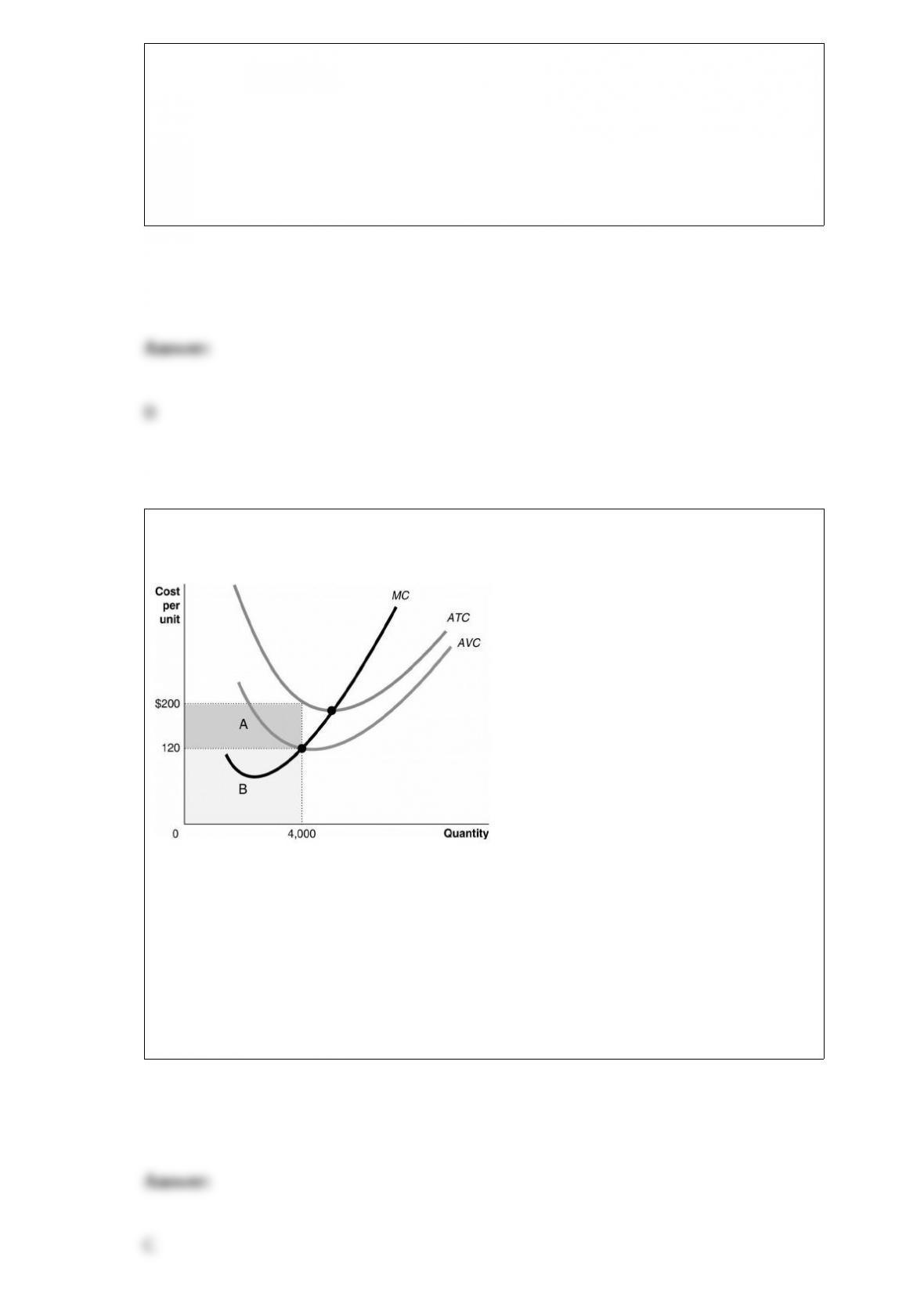
Figure 12-8
Refer to Figure 12-8. Suppose the market price is $120. Which of the following is true?
A) The firm earns a profit equal to the area A.
B) The firm earns a profit equal to the area A + B.
C) The firm suffers a loss equal to the area A.
D) The firm will break even.
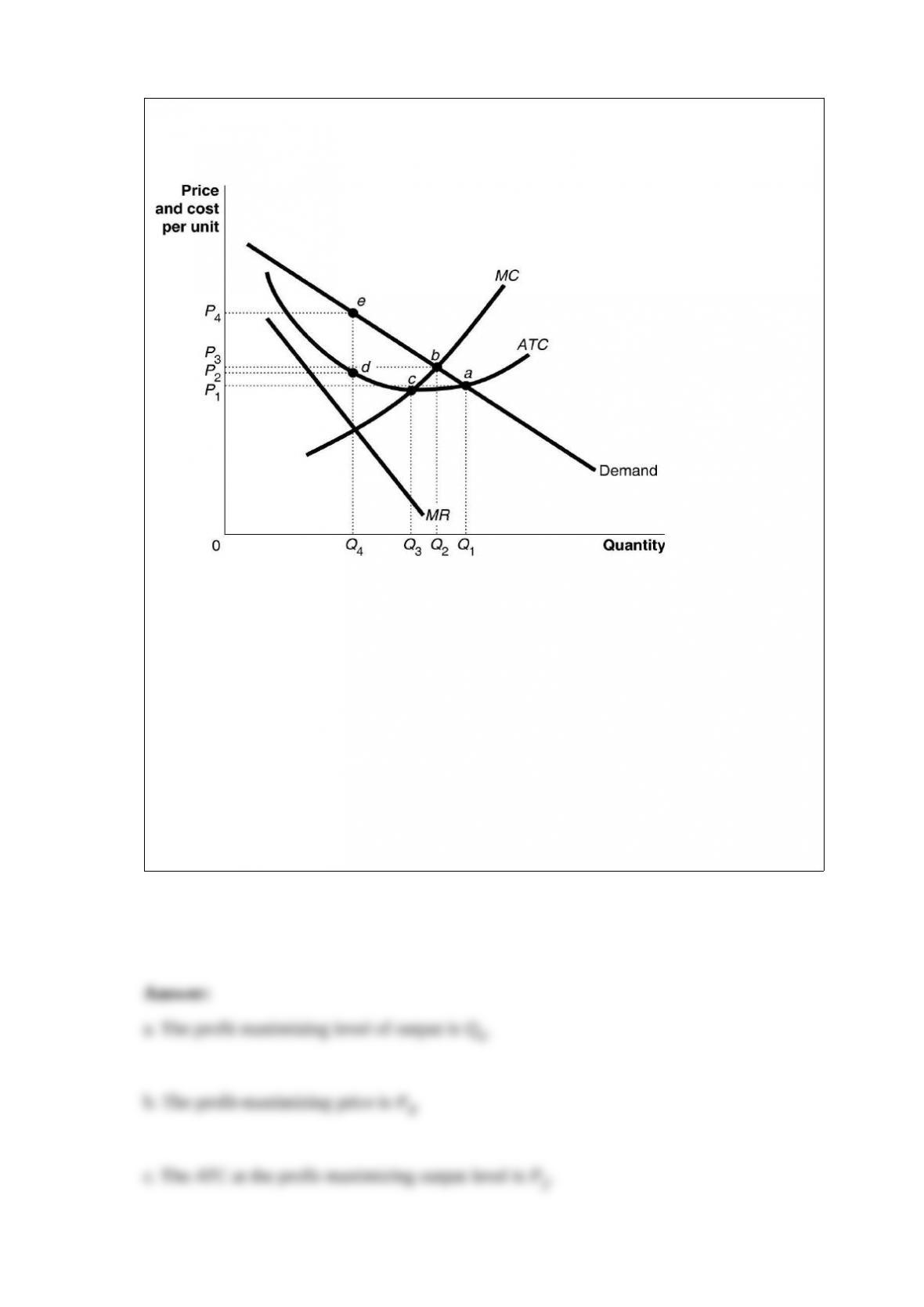
Figure 13-15
Refer to Figure 13-15 to answer the following questions.
a. What is the profit-maximizing output level?
b. What is the profit-maximizing price?
c. What is the average total cost at the profit-maximizing output level?
d. What area represents the firm’s profit?
e. At which output level are economies of scale exhausted?
f. Does this graph most likely represent the long run or the short run? Why?
Which of the following products allows the seller to identify different groups of
consumers (segment the market) and practice price discrimination?
A) clothing items sold through Macy’s Department Store
B) a hamburger sold at Burger King
C) a cafe latte sold at Starbucks
D) tickets to matinee shows at a movie theatre
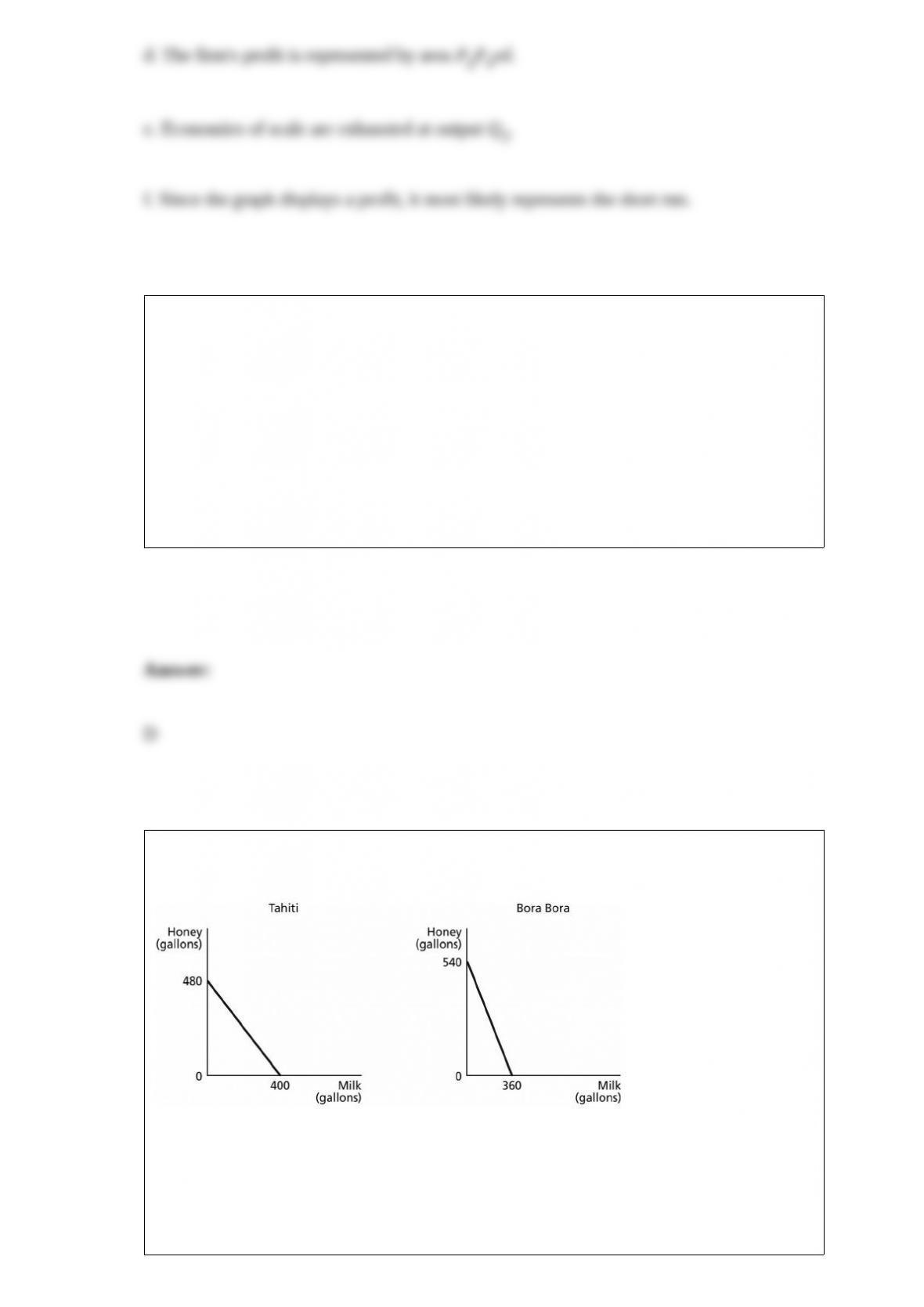
Figure 2-10
Figure 2-10 shows the production possibilities frontiers for Tahiti and Bora Bora. Each
country produces two goods, milk and honey.
Refer to Figure 2-10. What is the opportunity cost of producing one gallon of milk in
Bora Bora?

A) 2/3 of a gallon of honey
B) 8 gallons of honey
C) 125 gallons of honey
D) 5 gallons of honey
Until the early 1980s, The Walt Disney Company used a pricing strategy in which
visitors to its theme parks paid a low admission fee and also paid for rides. This pricing
strategy is an example of
A) perfect price discrimination.
B) cost-plus pricing.
C) a two-part tariff.
D) monopoly pricing.
Explain how the decision by parents to not immunize their children, hoping that their
children will not get sick because other parents have had their children immunized, is
an example of free riding. How is this behavior dangerous to the public?

Is it possible for a firm to have an absolute advantage in producing something without
having a comparative advantage? Why or why not?
Explain the concept of network externalities.
How does a positive externality in consumption reduce economic efficiency?
The total amount of copper in the earth is not increasing. Does this mean that in the
market for copper, the supply curve is perfectly inelastic? Explain.
What is equity, and how does it differ from efficiency?
The demand for labor is a derived demand. Explain what is meant by the term “derived
demand.”
Are the costs of utilities always fixed, always variable, or can they be both? Briefly
explain.
State the Coase theorem.
During 2007, many ‘subprime” and “Alt-A” borrowers began to default on their
mortgages. Describe ‘subprime” and “Alt-A” borrowers.
If you own a bond with a 3 percent coupon rate and new bonds are paying 8 percent,
what will happen to your bond’s market price?
Wally, Vijay, Sandra, and Consuela make up a software development team at Javasoft.
The firm is considering implementing one of two incentive compensation schemes. In
scheme A, each programmer receives an annual bonus if he or she meets all individual
programming deadlines. In scheme B, members of the team share equally in a joint
bonus if the team meets all of its product delivery deadlines. All four employees are
equally talented but Wally is a slacker who does as little work as he can get away with.
Which scheme might team members prefer? Which scheme will management prefer?

Explain the differences between a change in supply and a change in quantity supplied.
What is the difference between explicit and implicit costs?
What is a public franchise? Are all public franchises natural monopolies?
What is an entrepreneur?
Explain why the monopolist has no supply curve?
Suppose that at a price of $55, 100 units were sold while at a price of $33, 153 units
were sold. Without calculating the price elasticity value, can you determine whether
demand is elastic, unit elastic, or inelastic? Explain your answer.
If the government is most interested in minimizing excess burden of an excise tax,
should it impose the tax on goods that are elastic or on goods that are inelastic?