
The model of perfect competition is useful because
a. most firms in the real world are perfectly competitive.
b. perfectly competitive firms exert significant pricing power.
c. government regulation is designed to eliminate perfect competition.
d. it is a model of an ideal world that sheds much light on a market’s effect on resource
allocation.
e. advertising agencies depend heavily on the advertising dollars of perfectly
competitive firms.
The more sophisticated version of the quantity theory of money differs from the crude
quantity theory by assuming that
a. the circulation velocity of money is constant.
b. the economy does not always operate at a full-employment level of GDP.
c. fiscal policy is the primary means of stimulating the economy.
d. the money supply has no effect on the price level.
e. controlling inflation is more important than reducing unemployment.

The market supply curve of labor
a. shifts outward when output expands in the market.
b. relates the price of labor to the total amount of labor supplied in the market.
c. increases with product price.
d. is perfectly elastic under perfect competition.
e. generally slopes downward to the right.
In recent years, one characteristic of the growth process in the emerging market
economies has been the
a. volatility of and bumpiness experienced in the growth path.
b. inability of any of these countries to close the gap.
c. need to rely heavily on central planning and state-owned enterprises to make it work.
d. fact that it has been limited exclusively to economies in the Western Hemisphere.
e. absence of any currency crises.
In 2012, the top 5 percent of U.S. households received incomes in excess of

a. $5 million.
b. $1 million.
c. $500,000.
d. $250,000.
e. $200,000.
Evidence to date suggests that the North American Free Trade Agreement
a. produced enormous job losses in the United States as firms relocated production to
Mexico.
b. was responsible for the Mexican financial crises in 1995 and 1996.
c. caused U.S. exports to Mexico to fall to record lows.
d. had a bigger positive impact on the Mexican economy than on the U.S. economy.
e. made Mexico and Canada more susceptible to damage from the 1997 Asian crisis.
The predominant analytical framework for guiding economic policy during the 1940s,
1950s, and early 1960s was
a. the classical model.

b. the monetarist view.
c. the Keynesian view.
d. the equation of exchange.
e. Say’s law.
Our money supply, narrowly defined, consists of
a. currency, checking accounts, savings accounts, and money market mutual funds.
b. money created by the commercial banks.
c. coins, currency, demand deposits, and other checkable deposits.
d. cash, checks, and near money.
e. coins, paper money, all checkable deposits, and gold.
Approximately what share of the U.S. public debt is held by federal government
agencies and NOT held by the public?
a. 20 percent
b. 30 percent

c. 40 percent
d. 50 percent
e. 60 percent
An increase in autonomous investment spending initially produces an equal
a. increase in household consumption.
b. decrease in household saving.
c. increase in income for workers and suppliers.
d. decrease in induced investment spending.
e. increase in depreciation.
The existence of an inflationary gap implies that
a. the aggregate demand curve intersects the aggregate supply curve above potential
output.
b. fiscal policy should be used to push the aggregate demand curve to the right.
c. equilibrium GDP is below full-employment GDP.
d. the aggregate demand curve must be raised to promote a full-employment GDP.
e. government spending should be raised and taxes lowered to help the economy deal
with inflation.
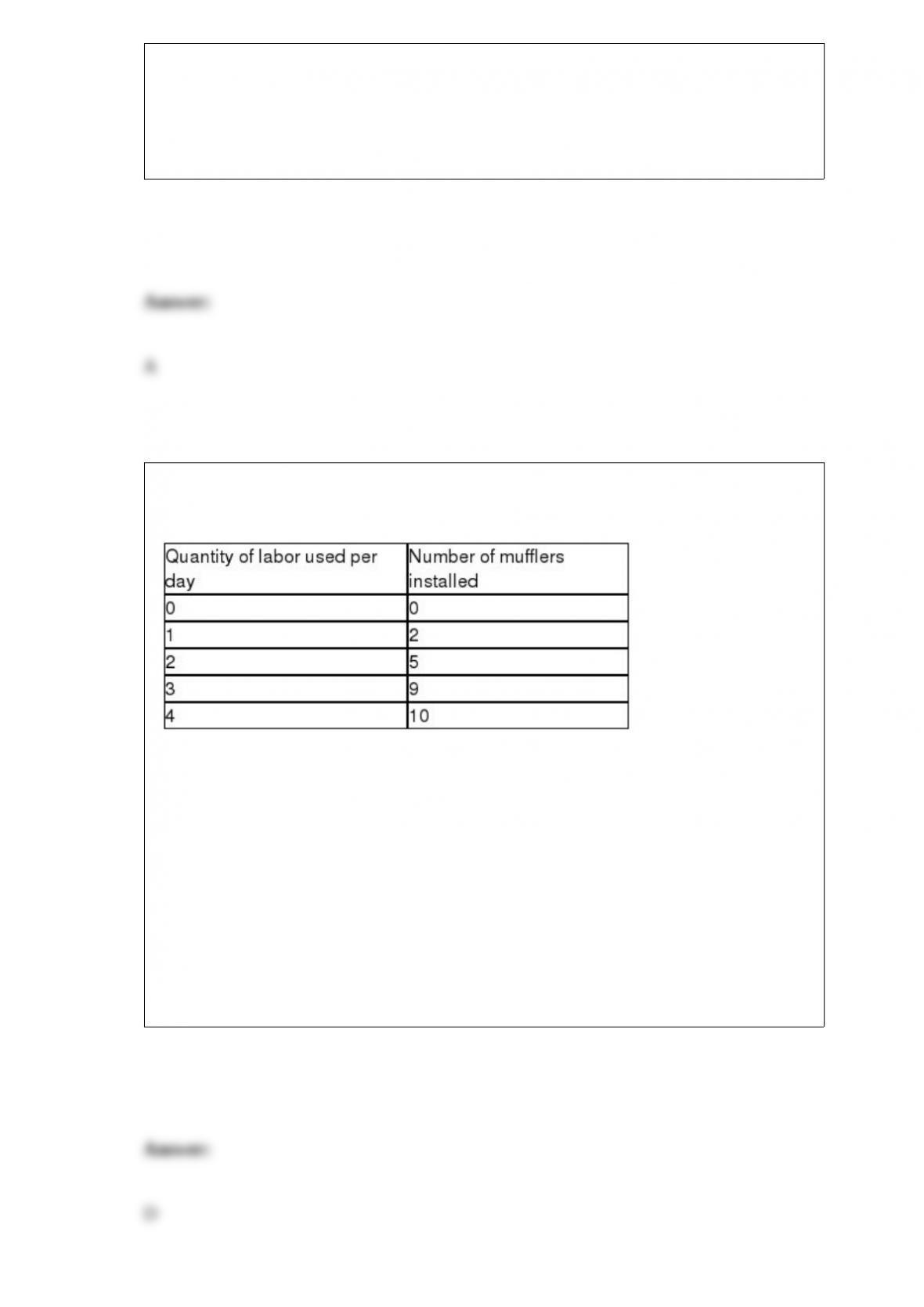
The following questions are based on the following information for an auto repair shop
specializing in muffler installation.
In this example, the variable input is the
a. muffler installation service.
b. muffler shop.
c. autos repaired.
d. labor.
e. price of the installed mufflers.

Why were Johnson’s 10 percent surtax and Nixon’s price-control program ineffective in
controlling the inflationary pressures they were designed to stop?
a. Both programs were based on the assumption that the aggregate supply was
horizontal.
b. Both presidents misread the economic signs of the times that clearly pointed to no
inflationary pressures.
c. Both were temporary in nature and so did little to deal with strong inflationary
expectations.
d. These measures never received the approval or support of the Council of Economic
Advisers.
e. The inflationary pressures had subsided by the time these programs were enacted.
If individuals adapt their expectations concerning the rate of inflation, the long-run
Phillips curve is
a. horizontal.
b. vertical.
c. downward sloping from left to right.
d. first upward, then downward sloping from left to right.
e. shifting upward and out from the origin.
An increase in the price level
a. decreases interest rates.
b. increases the transactions demand for money.
c. increases the prices of financial assets.
d. increases the value of existing money balances.
e. decreases imports.
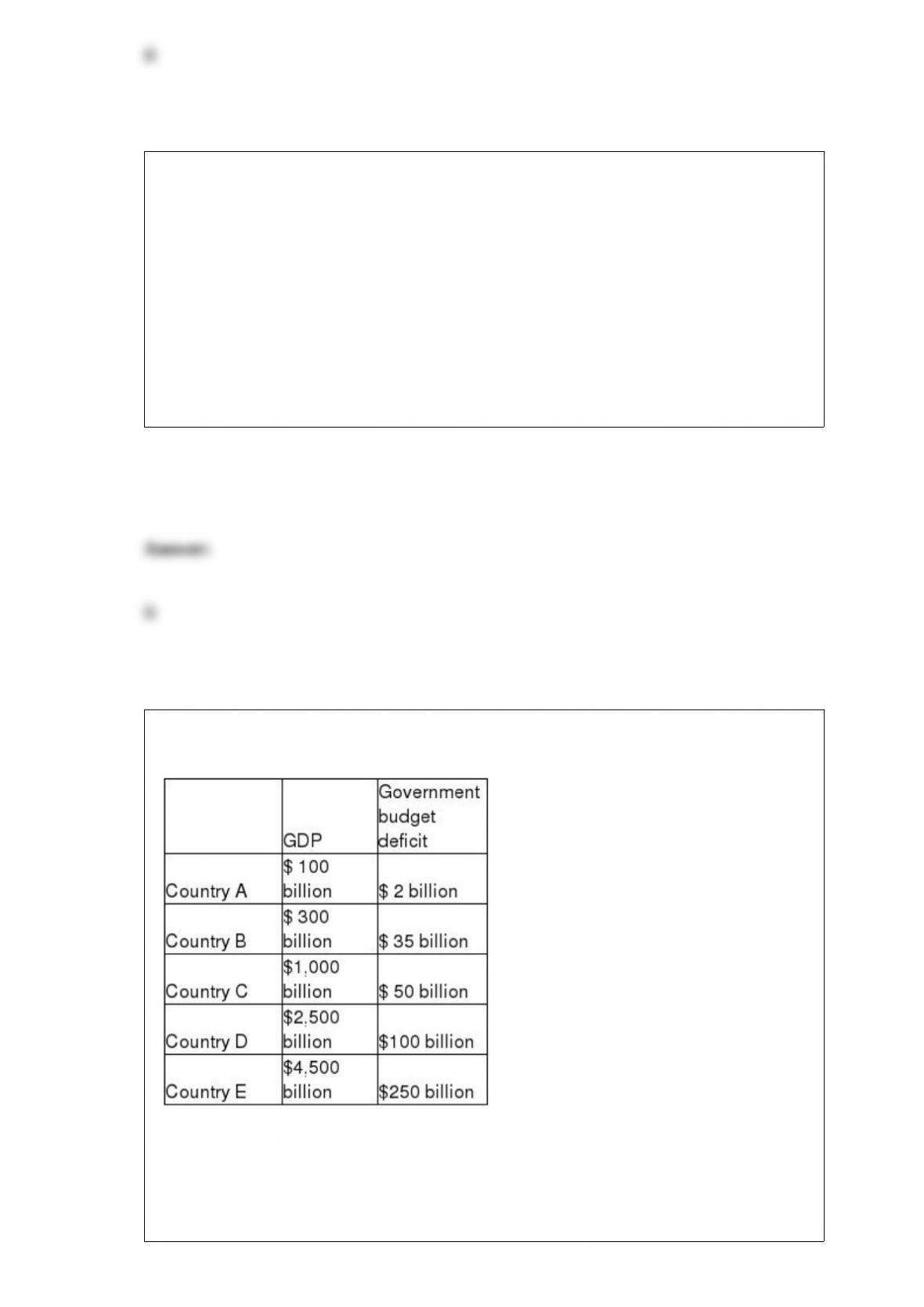
During the last 30 years, the federal government budget has
a. failed to record a surplus in any year.
b. recorded a surplus only in the year 1984.
c. had surpluses scattered over 10 of these years.
d. been in surplus annually since 1995.
e. recorded a surplus for the years 1999″2001.
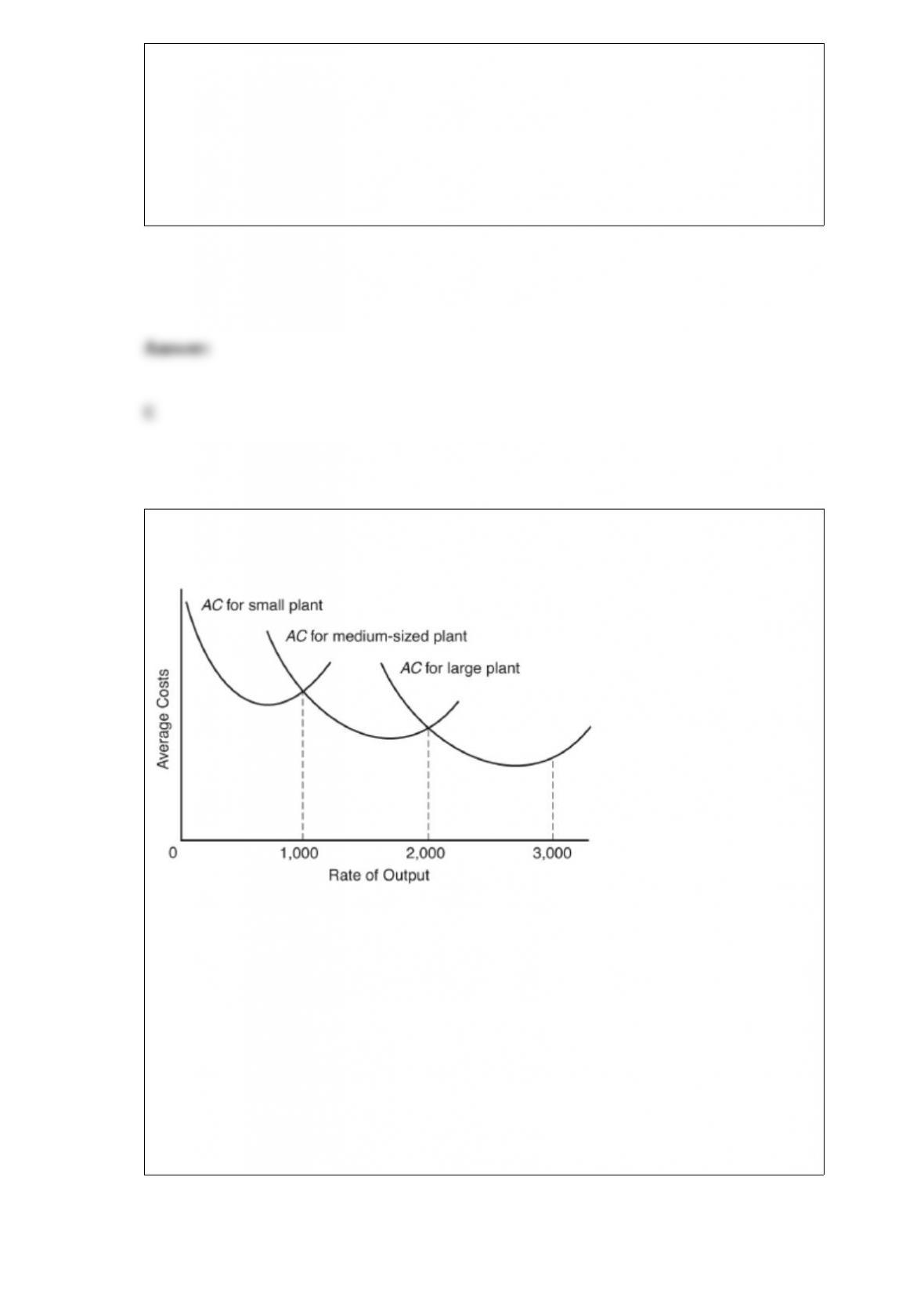
The following questions are based on the following diagram of the average cost curves
for three different-sized plants:
If the long-run average cost curve were shown, it would indicate
a. diminishing returns.
b. decreasing returns to scale.
c. constant returns to scale.
d. increasing returns to scale.
e. constant marginal cost.
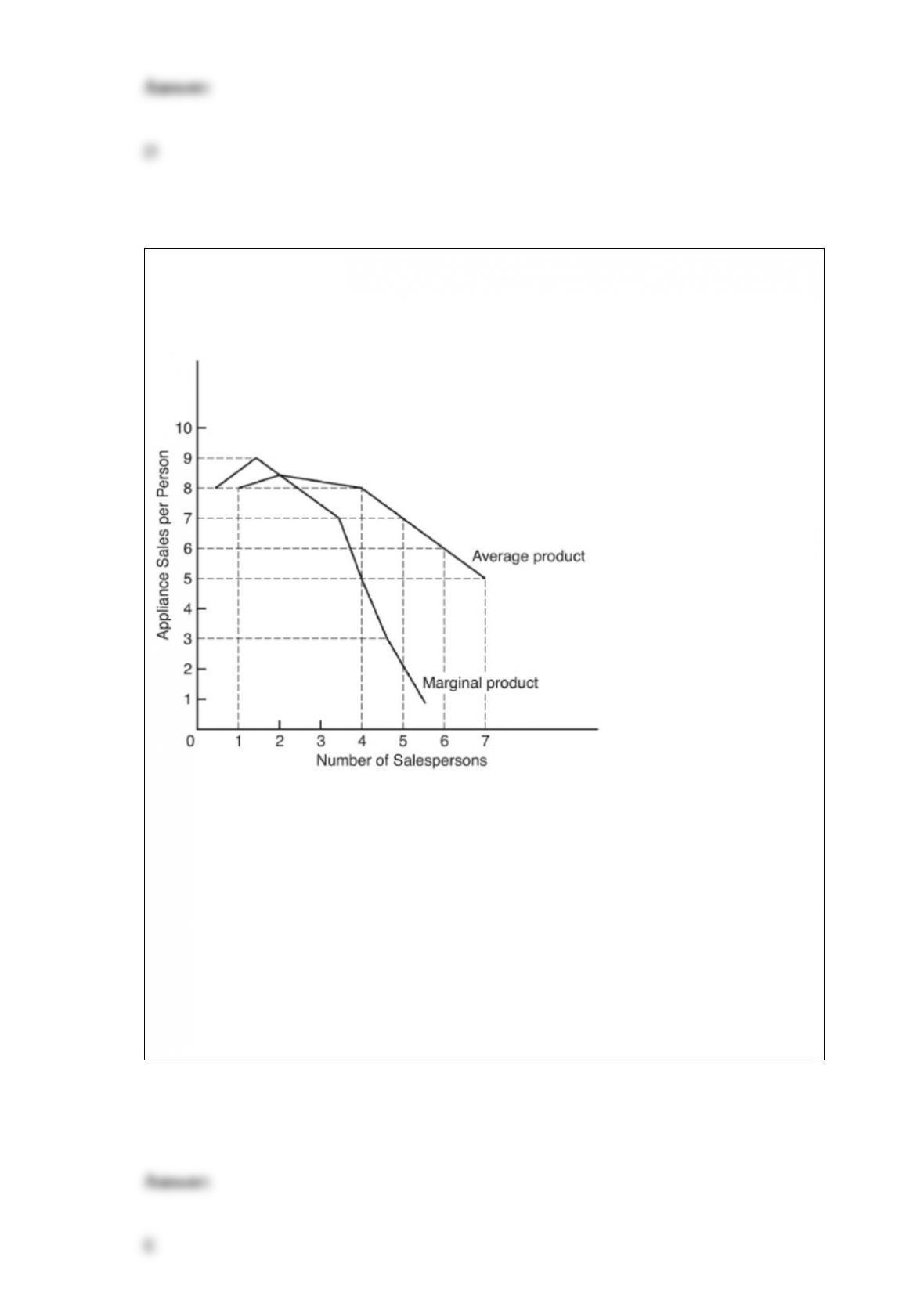
The following questions are based on the following diagram illustrating the weekly
average and marginal products for salespersons in the appliance department of a large
department store:
The number of appliances sold per week when four salespersons are employed is
a. 4.
b. 5.
c. 8.
d. 20.
e. 32.
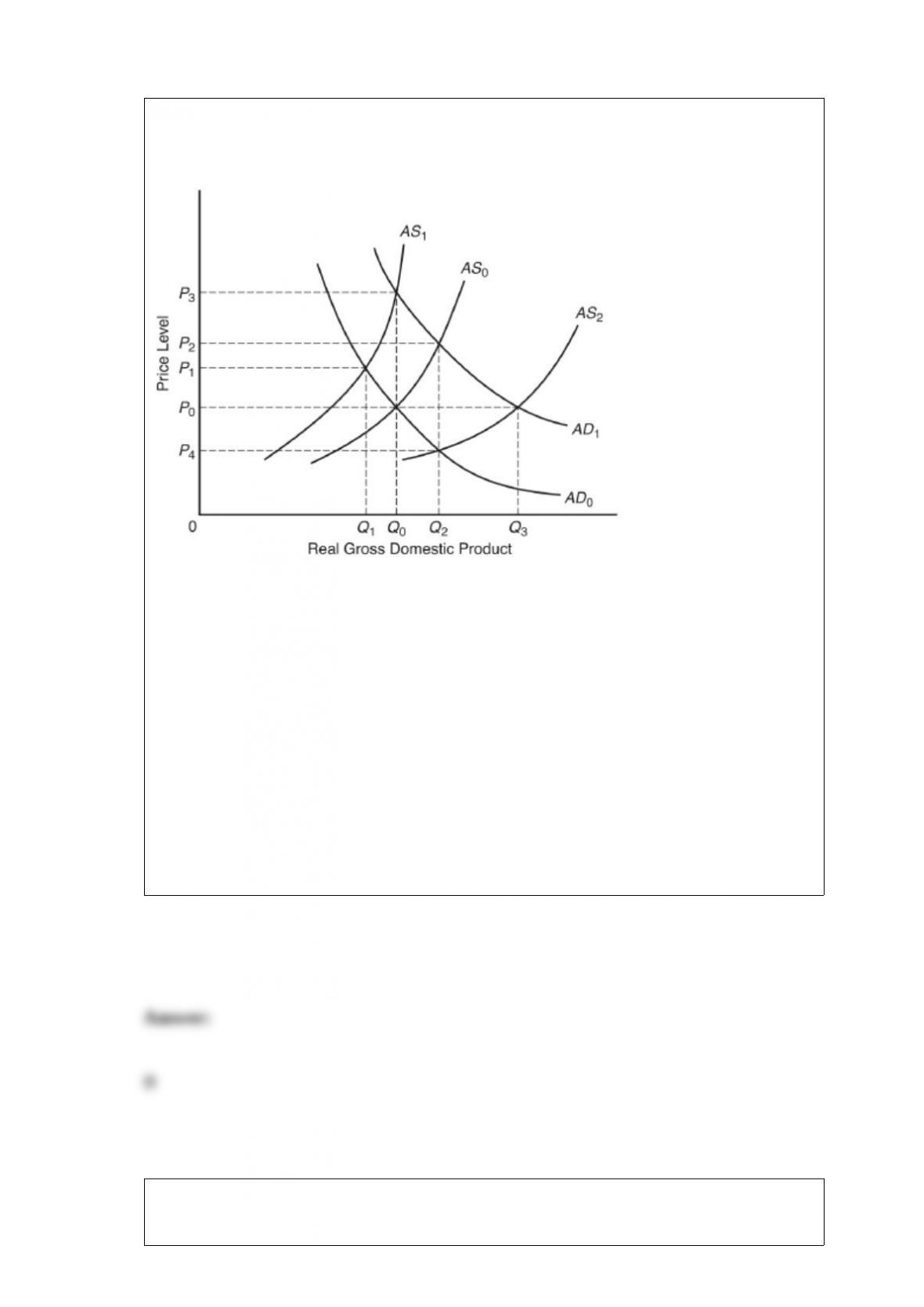
The following questions are based on the following diagram, in which existing
aggregate supply and demand curves are AS0 and AD0, respectively:
Monetary authorities might attempt to minimize the impact of the strategic input price
increases on unemployment by
a. doing nothing because unemployment is unchanged.
b. increasing the money supply to shift aggregate demand to AD1.
c. increasing the money supply to shift aggregate supply to AS2.
d. decreasing the money supply to shift aggregate supply to AS1.
e. decreasing the money supply to shift aggregate demand back to AD0.
Families below the poverty line are most likely to be

a. large (above seven persons), nonwhite, and headed by females.
b. small (two to three persons), nonwhite, and headed by males.
c. single male or female white persons.
d. three- to four-person households located in the suburbs.
e. uniformly distributed over all demographic groups.
The technical relationship between inputs and outputs is called the
a. balance sheet.
b. income statement.
c. production function.
d. technostructure.
e. net worth.
The 10 percent tax surcharge of 1968 was intended to help alleviate
a. a severe recession.
b. stagflation.

c. falling interest rates.
d. demand-side inflationary pressures.
e. structural unemployment.
A price index is computed by
a. calculating the ratio of the percentage change in price to the percentage change in
output.
b. multiplying average prices in the base year by 100.
c. subtracting GDP in the base year from the current GDP.
d. adding values expressed in base-year terms to current values.
e. dividing the current cost of a set of goods by the cost of the same goods in the base
year.
An incomes policy typically
a. requires that unions forgo wage increases.
b. gives particular firms and industries guidelines for decision making on wages and
prices.

c. establishes worker retraining programs.
d. legislates penalties for compliance.
e. redistributes incomes in favor of the poor.
A general criticism of the Kennedy-Johnson guidelines was that they
a. required price reductions equal to the rate of increase in overall productivity.
b. permitted no increases in wages or prices regardless of the rate of inflation.
c. resulted in inefficiency, waste, and a loss of economic freedom over time.
d. applied solely to the steel industry, rather than to the economy at large.
e. were long-run remedies and thus of no help during emergencies.
High rates of economic growth are clearly related to high rates of
a. unemployment.
b. consumption.
c. inflation.

d. technological change.
e. taxes on profits.
One crucial difference between the oligopolists and perfect competitors is that
a. perfect competitors are not concerned with maximizing profits.
b. nonprice competition plays a central role in oligopoly.
c. the price charged by oligopolists is less than that charged by perfect competitors.
d. perfect competitors advertise more heavily.
e. oligopolies are less prone to collusion.
Compared to a perfectly competitive industry in long-run equilibrium, an industry
under monopoly
a. may realize economic profits in the long run.
b. may sustain losses indefinitely and still remain in business.
c. actively encourages competitors and thereby increases profits.
d. continues to expand until profits are reduced to zero.

e. can sell at a price below average variable costand earn economic profits.
Which of the following is considered the most effective barrier to trade?
a. export subsidy
b. licensing requirements
c. tariff
d. quota
e. imposition of product quality standards
Oligopolistic nonprice competition focuses on
a. collusion and the formation of cartels.
b. vertical and horizontal mergers.
c. functional finance and target return rates.
d. output restrictions and resale maintenance agreements.
e. advertising and product development.

A consumer price index of 325 means that prices are ________ percent higher than
those in the base year.
a. 325
b. 225
c. 125
d. 25
e. 3.25
The unemployment of anthracite coal miners following the conversion of home heating
to oil and gas is an example of
a. underemployment.
b. cyclical unemployment.
c. structural unemployment.
d. frictional unemployment.
e. unemployment caused by the short-run tradeoff between inflation and
unemployment.
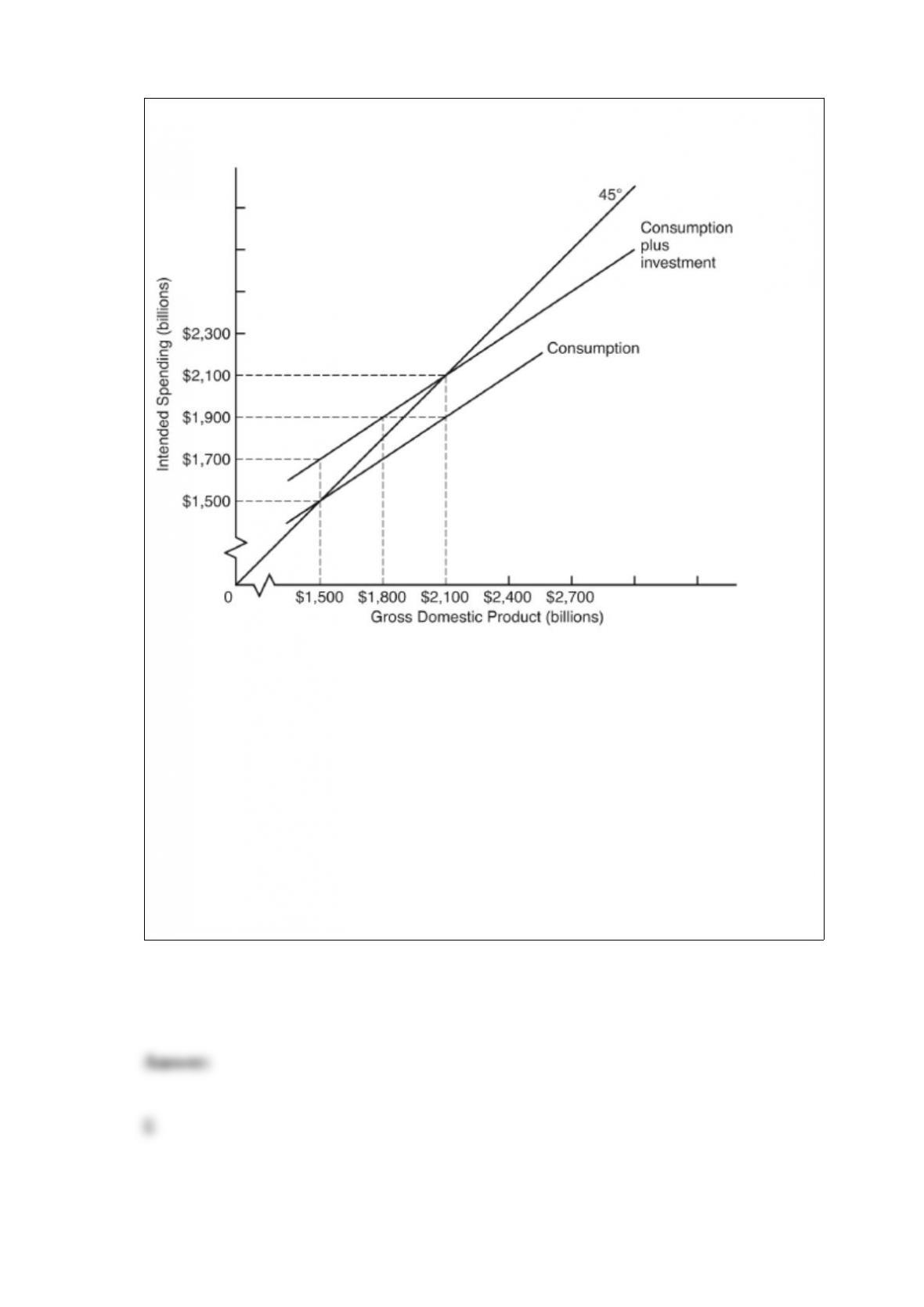
The following questions are based on the following diagram:
Given the consumption and investment spending shown on the graph, the equilibrium
GDP is ________ billion.
a. $1,500
b. $1,700
c. $1,800
d. $1,900
e. $2,100
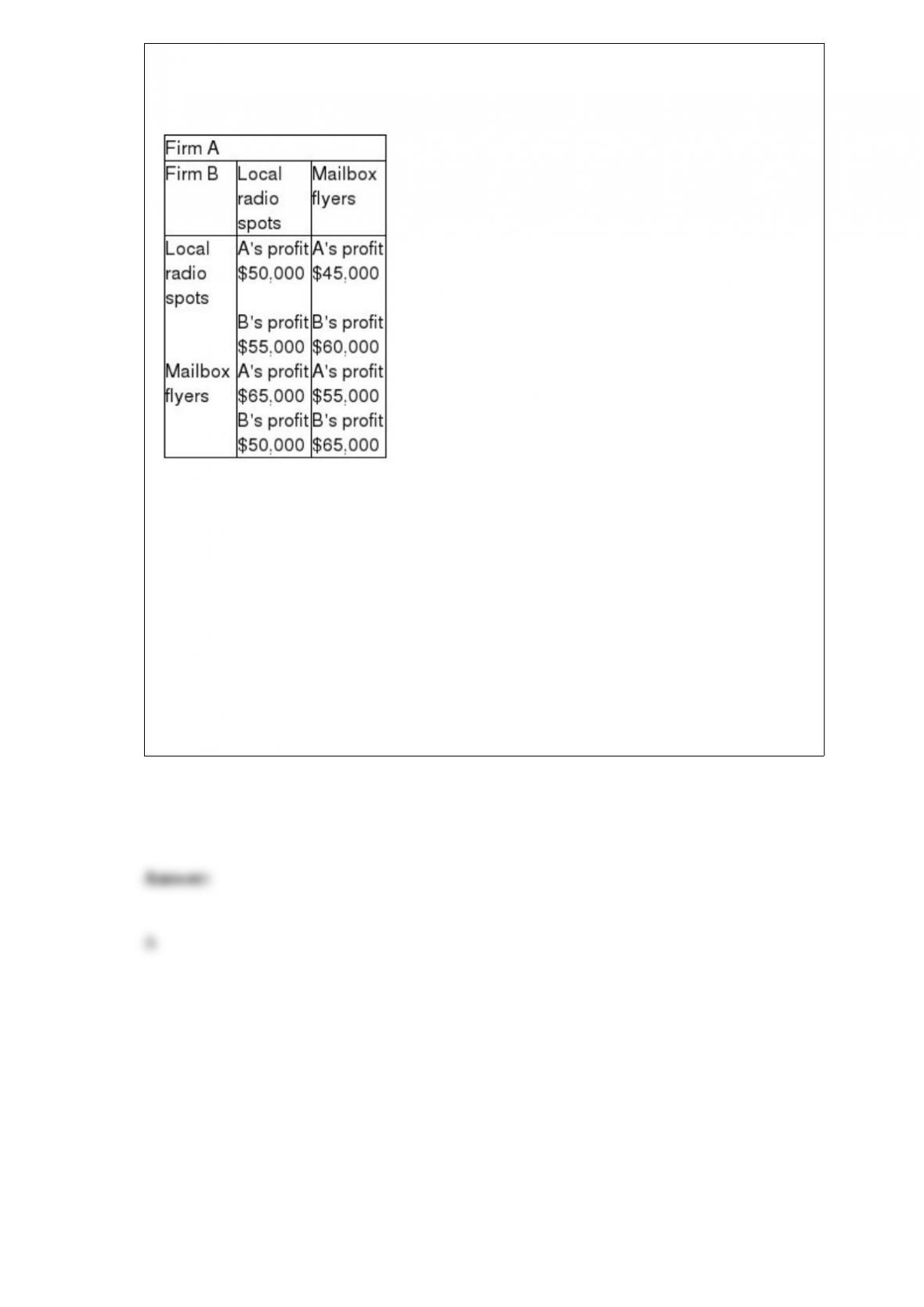
The possible outcomes of a two-firm nonrepeated promotional campaign are
summarized as follows:
According to the information given
a. firm A’s dominant strategy is local radio spots.
b. firm A’s dominant strategy is mailbox flyers.
c. firm B’s dominant strategy is local radio spots.
d. firm B’s dominant strategy is mailbox flyers.
e. neither firm has a dominant strategy.