
1) because of the recent productivity acceleration, the business cycle is dead.
2) Right-to-work laws prohibit the formation of labor unions.
3) choices entail marginal costs because resources are scarce.
4) a vertically integrated firm is a group of plants each operating at different stages of
production.
5) In electricity generation, it is most economically efficient to use a single energy
source.
6) The shape of the aggregate supply curve is determined by what happens to aggregate
demand as real output expands.
7) The pursuit through government of a transfer of wealth at society’s expense is called
“rent seeking.”
8) the purchase of wal-mart stock is a part of gross investment, but not of net

investment.
9) The Celler-Kefauver Act outlawed interlocking directorates.
10) Under freely flexible (floating) exchange rates a U.S. trade deficit with Japan will
eventually cause the dollar price of yen to rise.
11) entry into a monopolistically competitive industry is typically blocked.
12) in a competitive market, every consumer willing to pay the market price can buy a
product and every producer willing to sell the product at that price can sell it.
13) The principal-agent problem in labor markets arises because of the possibility of
shirking by workers.
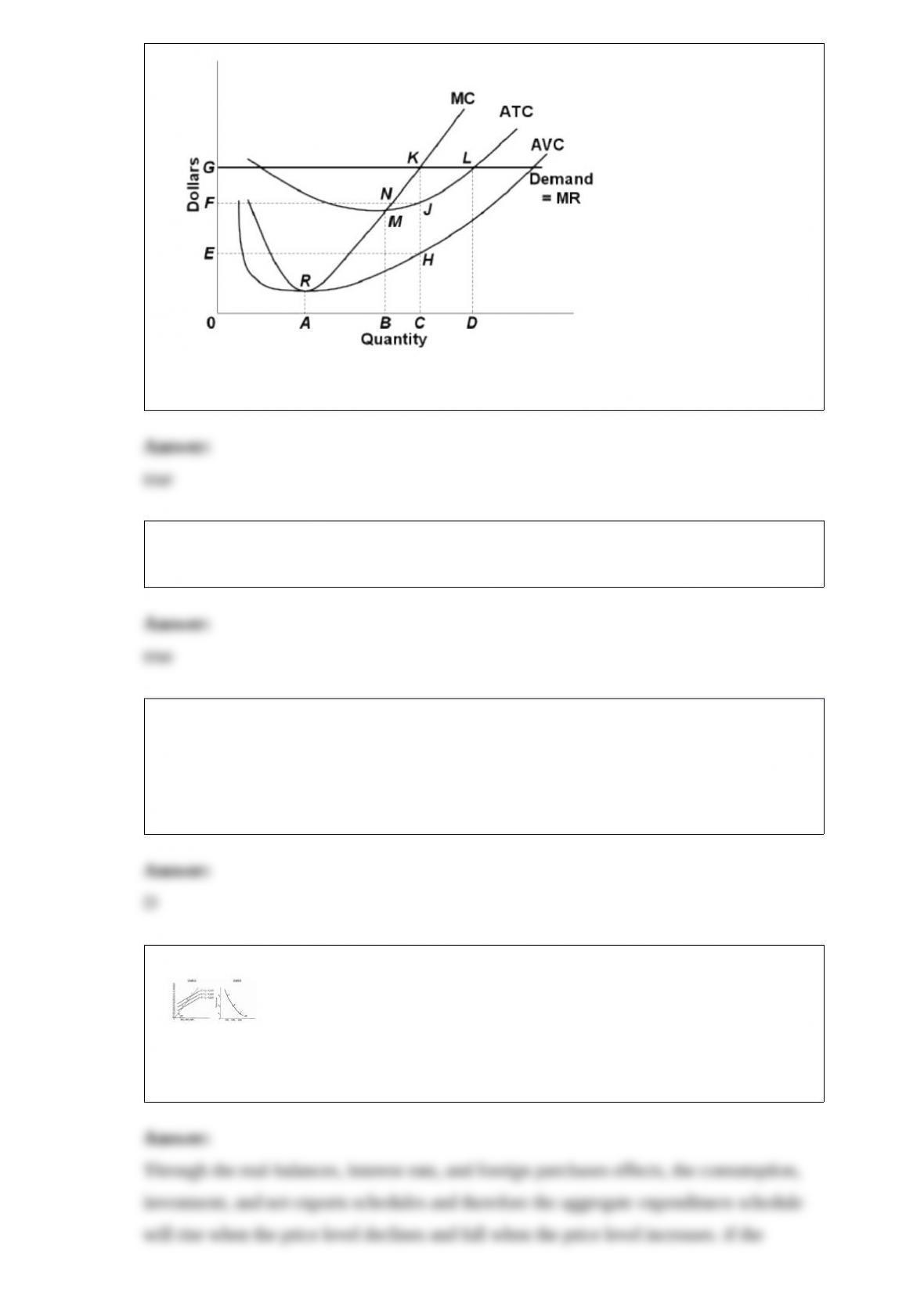
14)
refer to the above diagram. if the firm produced d units of output at price g, it would
earn a normal profit.
15) between 1953 and 2007, rising labor productivity contributed more to u.s. economic
growth than did increases in inputs.
16) The determinants of aggregate supply:
A.are consumption, investment, government, and net export spending.
B.explain why real domestic output and the price level are directly related.
C.explain the three distinct ranges of the aggregate supply curve.
D.include resource prices and resource productivity.
17)
Explain the relationship between the aggregate expenditures model in graph (A) below
and the aggregate demandaggregate supply model in graph (B) below. In other words,
explain how points 1, 2, and 3 are related to points 1, 2, and 3.

18) dvd players and dvds are:
a.complementary goods.
b.substitute goods.
c.independent goods.
d.inferior goods.
19) The aggregate supply curve (short-run) slopes upward and to the right because:
A.changes in wages and other resource prices completely offset changes in the price
level.
B.the price level is flexible upward but inflexible downward.
C.supply creates its own demand.
20) The “brain drain” problem in the DVCs refers to the fact that the best-educated
workers:
A.are concentrated in the public, rather than the private, sector.
B.are concentrated in the private, rather than the public, sector.
C.are concentrated in urban, rather than rural, areas.
D.have emigrated from the DVCs to the IACs.
21) Assume the Ajax Mining Company hires 80 percent of the nonunion labor force of
Mother Lode, New Mexico. Also, suppose that this labor force is highly immobile.
Economists would describe this employer as a:
A.monopolist.
B.oligopolist.
C.monopsonist.
D.monopolistic competitor.
22) which of the following transactions would be included in gdp?
a.mary buys a used book for $5 at a garage sale.
b.nick buys $5000 worth of stock in microsoft.
c.olivia receives a tax refund of $500.
d.peter buys a newly constructed house.
23) Smart cards sold by retailers, such as single-store gift cards and prepaid phone
cards, are known as:
A.credit cards.
B.debit cards.
C.stored-value cards.
D.E-cards.
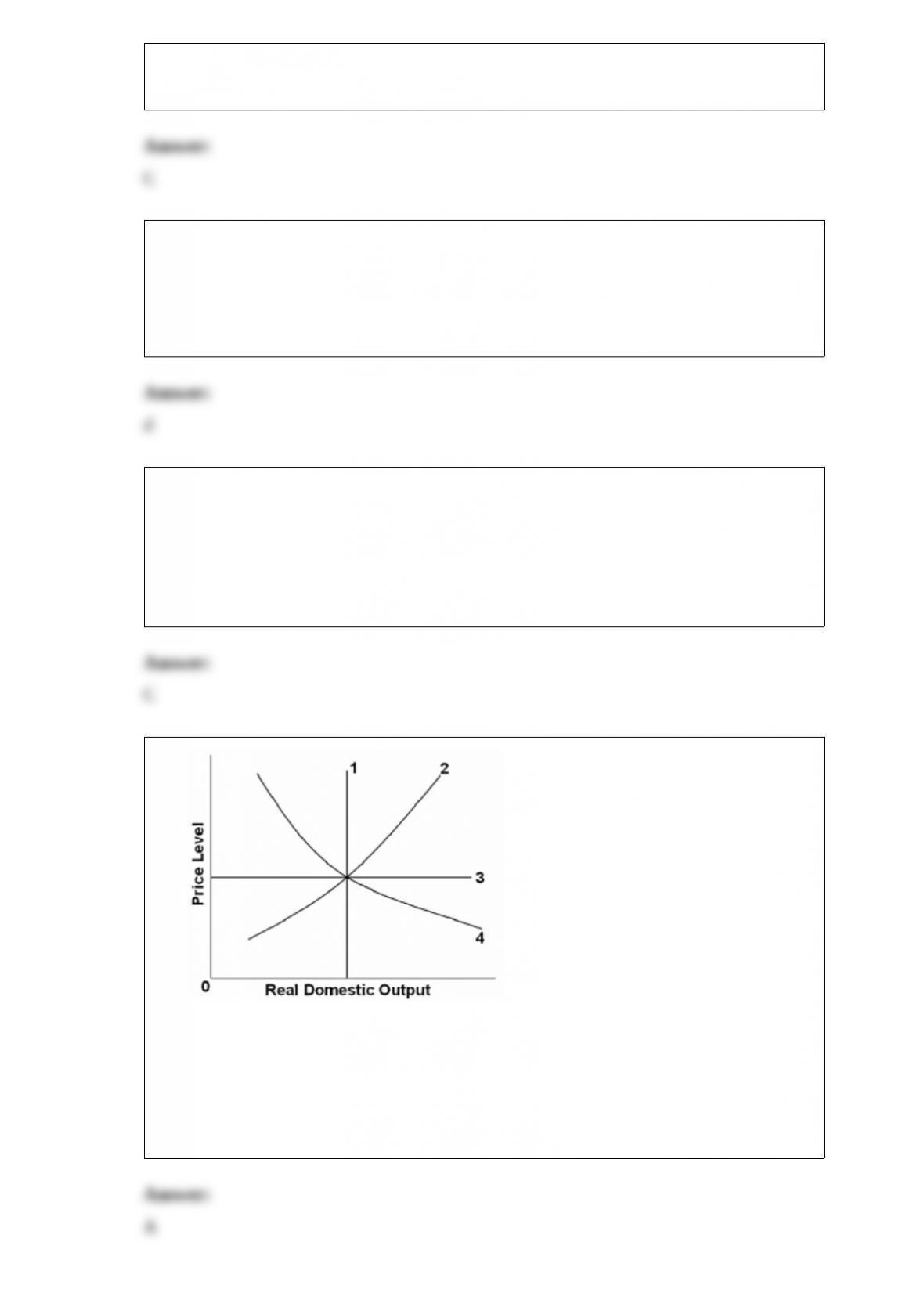
24)
In the above diagram, the economy’s relevant aggregate demand and
immediate-short-run aggregate supply curves, respectively, are lines:
A.4 and 3.
B.4 and 1.
C.2 and 4.
D.2 and 3.
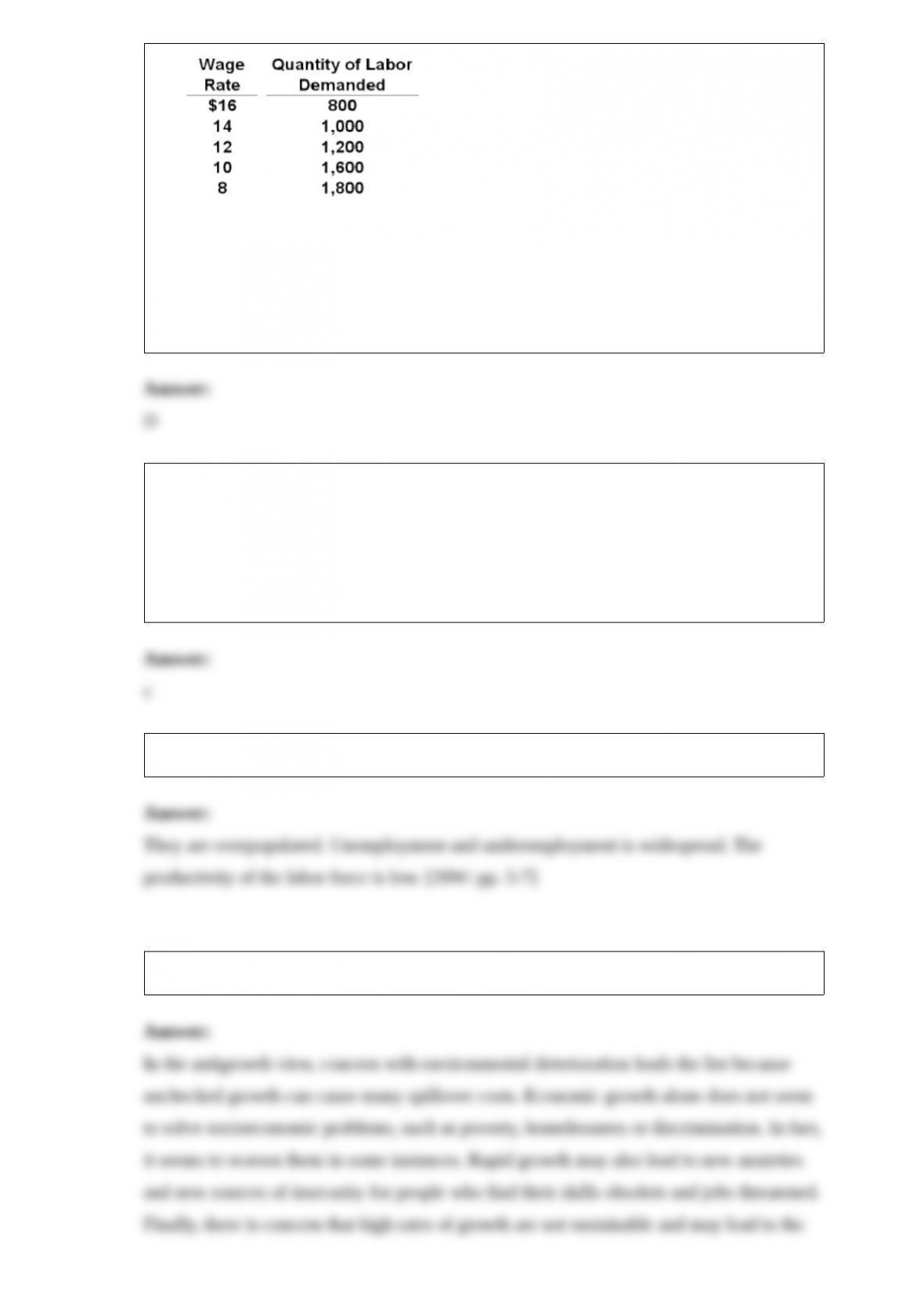
25)
Refer to the above data. Over the $10 to $8 range of wage rates, the demand for labor
is:
A.perfectly elastic.
B.elastic.
C.unit elastic.
D.inelastic.
26) the demand for a necessity whose cost is a small component of one’s total income
is:
a.perfectly inelastic.
b.perfectly elastic.
c.relatively inelastic.
d.relatively elastic.
27) What are three major human resource problems in developing nations?
28) Summarize the antigrowth view of economic growth.
29) Some economists argue that it is easier to resolve demand-pull inflation than it is
cost-push inflation. Use the aggregate demand and aggregate supply model to explain
this assertion.
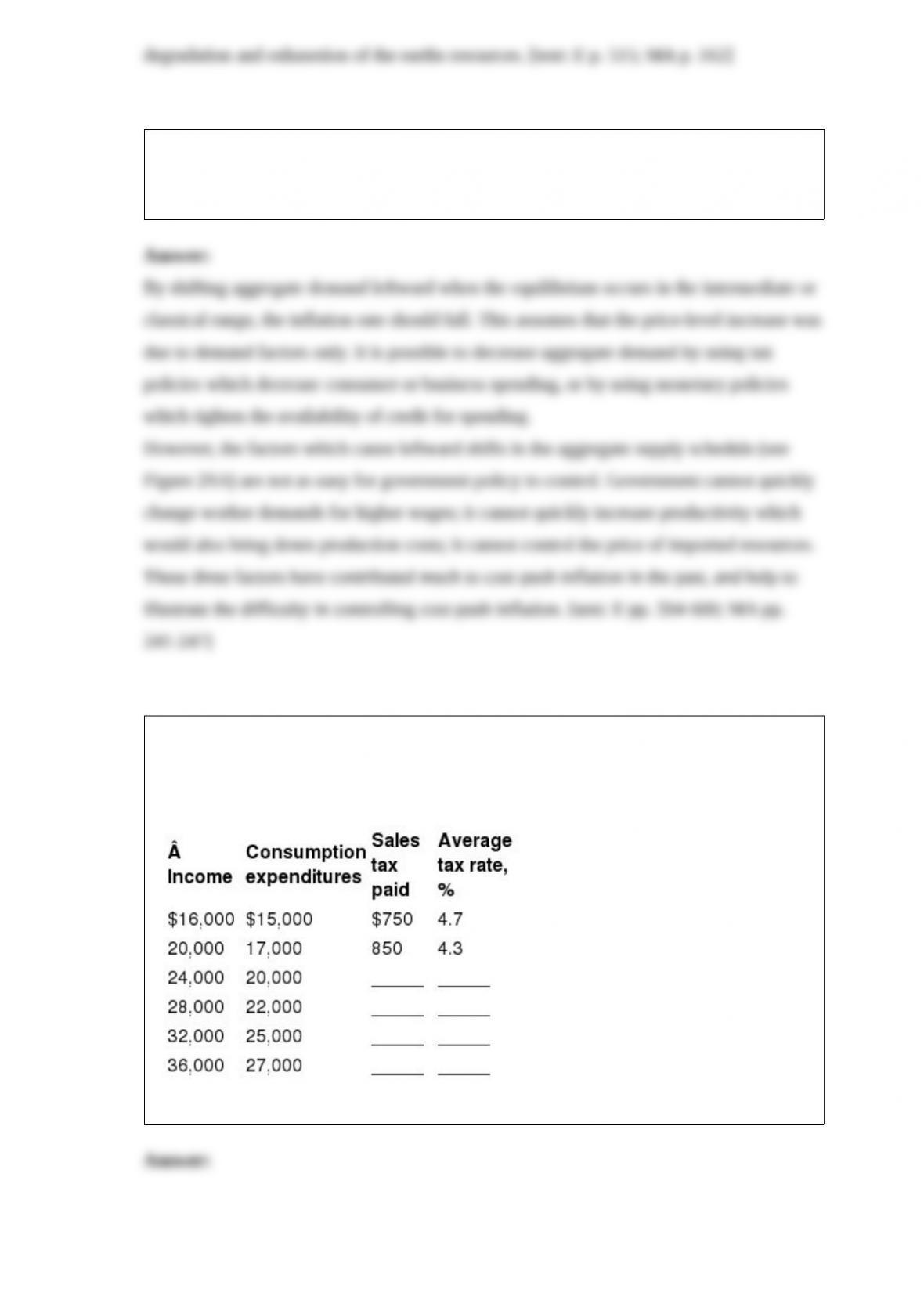
30) Assume a state government levies a 5% sales tax on all consumption expenditures.
Consumption expenditures at six income levels are shown in the table below. Compute
the sales tax paid and the average tax rate at these incomes in the table.
What type of tax is the sales tax in this case? Why?
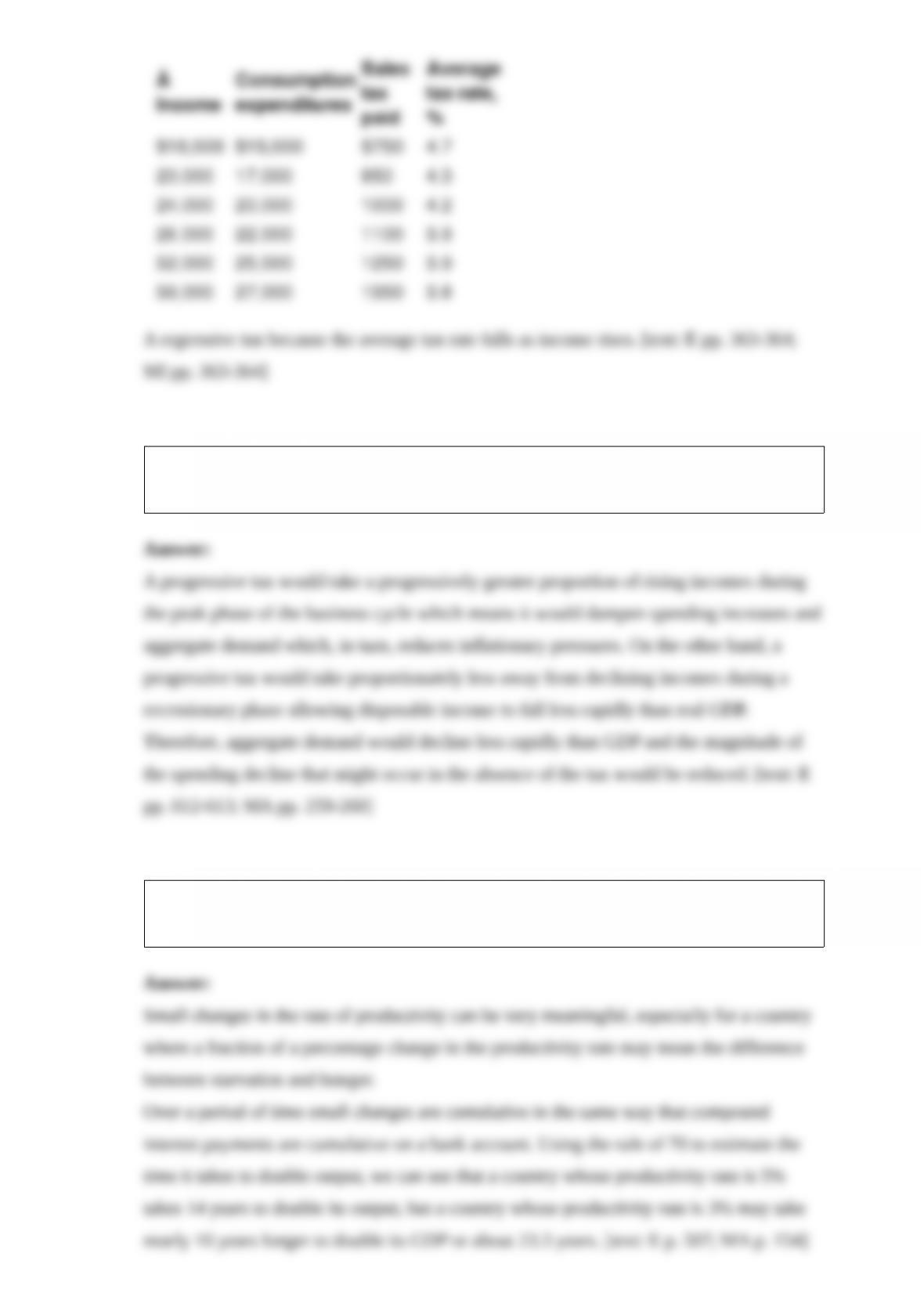
31) The more progressive a tax system, the greater is the economys built-in stability.
Explain this statement for both recessionary and peak phases of the business cycle.
32) Explain why even small changes in the rate of productivity are significant. Use the
rule of 70 to demonstrate the point.