
Private costs
A) are borne by producers of a good while social costs are borne by government.
B) are borne by consumers of a good while social costs are borne by government.
C) are borne by producers of a good while social costs are borne by society at large.
D) are borne by producers of a good while social costs are borne by those who cannot
afford to purchase the good.
When aggregate expenditure is less than GDP, which of the following is true?
A) There was an unplanned increase in inventories.
B) Firms spent more on capital goods than they anticipated.
C) Households bought more new homes than they anticipated.
D) All of the above must be true when aggregate expenditure is less than GDP.
Figure 15-6
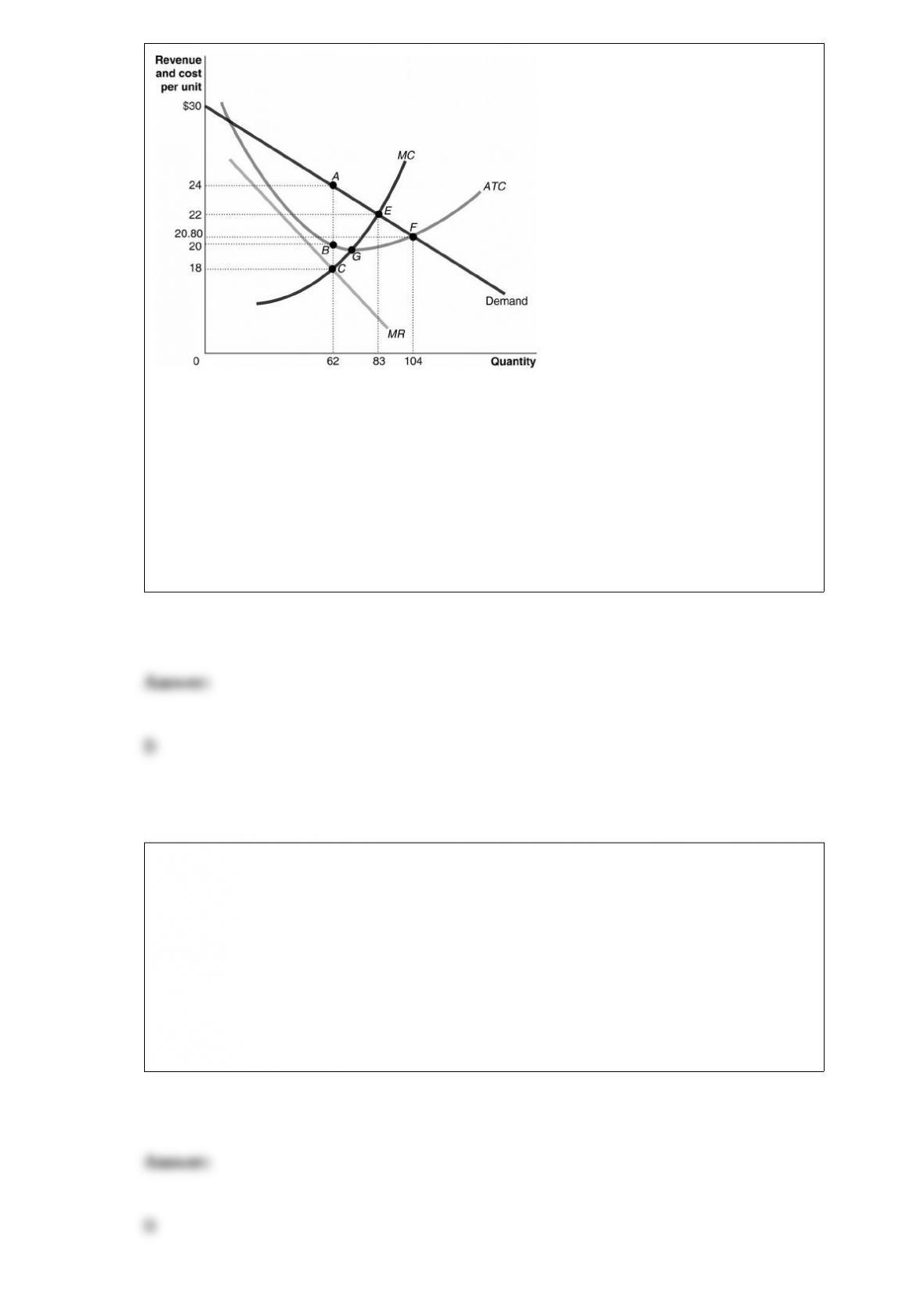
Figure 15-6 shows the cost and
demand curves for a monopolist. The monopolist’s total revenue is
A) $1,116.
B) $1,488.
C) $1,726.40
D) $1,826.
The tax multiplier equals the change in ________ divided by the change in ________.
A) taxes; equilibrium real GDP
B) equilibrium real GDP; taxes
C) taxes; consumption spending
D) consumption spending; taxes

If a firm expects that the price of its product will be higher in the future than it is today
A) the firm will go out of business.
B) the firm has an incentive to increase supply now and decrease supply in the future.
C) the firm has an incentive to decrease quantity supplied now and increase quantity
supplied in the future.
D) the firm has an incentive to decrease supply now and increase supply in the future.
When unemployment is below its natural rate, the inflation rate will eventually
A) increase.
B) decrease.
C) move to its natural rate.
D) become equal to the natural rate of unemployment.
Specializing in the production of a good or service in which one has a comparative
advantage enables a country to do which of the following?
A) never have to engage in trade with other nations
B) increase the variety of products that it can produce with a decrease in resources
C) consume a combination of goods that lies outside its own production possibilities
frontier
D) produce a combination of goods that lies outside its own production possibilities
frontier
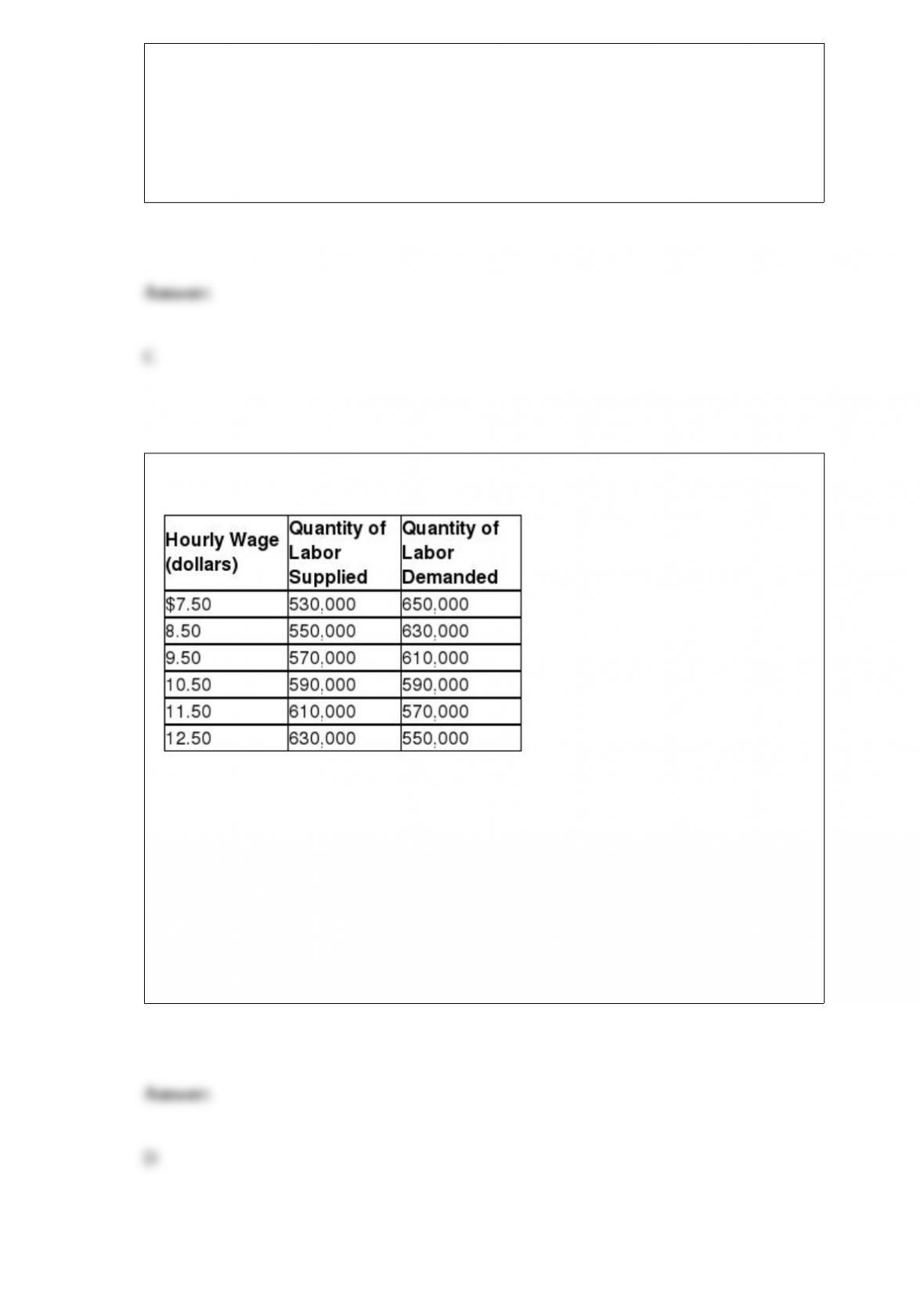
Table 4-4
Table 4-4 shows the demand and supply schedules for labor market in the city of Pixley.
If a minimum wage of $11.50 is mandated there will be a
A) shortage of 20,000 units of labor.
B) surplus of 20,000 units of labor.
C) shortage of 40,000 units of labor.
D) surplus of 40,000 units of labor.

The purchase of a new automobile is included in
A) consumption expenditures on services.
B) consumption expenditures on nondurable goods.
C) consumption expenditures on durable goods.
D) investment expenditures.
Consider a U-shaped long-run average cost curve that has a minimum efficient scale at
6,000 units of output. In this case, this industry would be
A) perfectly competitive if the market quantity demanded is 20,000 units.
B) monopolistically competitive if the market quantity demanded is 12,000 units.
C) an oligopoly if the market quantity demanded is 18,000 units.
D) an oligopoly if the four-firm concentration ratio is more than 10 percent.