
How are the fundamental economic decisions determined in Canada?
A) Individuals, firms, and the government interact in a market to make these economic
decisions.
B) These decisions are made by the country’s elders who have had much experience in
answering these questions.
C) The government decides because Canada is a centrally planned economy.
D) The United Nations decides because Canada is a developing economy.
If the nominal exchange rate between the American dollar and the Canadian dollar is
0.89 Canadian dollars per American dollar, how many American dollars are required to
buy a product that costs 2.5 Canadian dollars?
A) $1.32
B) $2.23
C) $2.75
D) $2.81
Which of the following would cause the equilibrium price of apple juice to decrease
and the equilibrium quantity of apple juice to increase?
A) a decrease in the price of apples
B) an increase in the price of apples

C) an increase in the price of orange juice, a substitute for apple juice
D) a decrease in the price of granola bars, a complement for apple juice
Which of the following policies would reduce structural unemployment?
A) an increase in the minimum wage
B) a job retraining program
C) implementing an unemployment insurance policy
D) building an online job database that helps workers find jobs
If aggregate demand just decreased, which of the following may have caused the
decrease?
A) a decrease in exports
B) a decrease in the interest rate
C) a decrease in the price level
D) a decrease in imports

If the exchange rate changes from $2.00 = £1 to $2.01 = £1 then
A) the dollar has depreciated.
B) the dollar has appreciated.
C) the British pound has depreciated.
D) the British pound has stayed constant in value.
An office supply store sells a ream of printer paper at a fixed price of $4.50. Which of
the following is a term used by economists to describe the money received from the sale
of an additional ream of paper?
A) marginal revenue
B) gross earnings
C) pure profit
D) marginal costs
E) net benefit

The production possibilities frontier shows
A) the various products that can be produced now and in the future.
B) the maximum attainable combinations of two products that may be produced in a
particular time period with available resources.
C) what an equitable distribution of products among citizens would be.
D) what people want firms to produce in a particular time period.
The nominal interest rate equals the real interest rate ________ the inflation rate.
A) times
B) divided by
C) plus
D) minus
A government budget surplus from reduced government spending (no change in net
taxes) will ________ the level of investment in the economy and ________ the level of
saving (private plus public) in the economy.
A) increase; decrease
B) increase; increase
C) decrease; increase

D) decrease; decrease
With a common currency such as the euro,
A) trade barriers between countries using the currency are increased.
B) individual countries using the currency are no longer able to run independent
monetary policies.
C) the prices of goods across countries using the currency must always be the same,
regardless of consumer preferences for goods across countries.
D) individual countries using the currency are no longer able to run independent fiscal
policies.
If the government purchases multiplier equals 2, and real GDP is $14 trillion with
potential real GDP $14.5 trillion, then government purchases would need to increase by
________ to restore the economy to potential real GDP.
A) $7.25 trillion
B) $1 trillion
C) $500 billion
D) $250 billion
Briefly describe changes in life expectancy, average height, and infant mortality in the
United States since 1850.
Is there a difference between the “true burden” of a tax and who is legally required to
pay a tax? Briefly explain.
Suppose 180,000 people are employed, 20,000 people are unemployed, and 50,000
people are out of the labor force, then calculate the labor force participation rate.
Explain how the static aggregate demand and aggregate supply model gives us
misleading results about the price level, particularly with respect to decreases in
aggregate demand. Describe how the aggregate demand curve is different in the
dynamic model as compared to the static model. Describe how potential GDP is
different in the dynamic model as compared to the static model.
How is the impact of contractionary monetary policy different in an open economy than
in a closed economy?
What was the source of the problems encountered by many financial firms during the
late 2000s?
What is consumer surplus? Why would policy makers be interested in consumer
surplus?
Since real GDP is adjusted for inflation and nominal GDP is not, nominal GDP must
always be higher than real GDP. Do you agree or disagree? Why?
Briefly describe the types of health care systems in Canada, Japan, and the United
Kingdom.
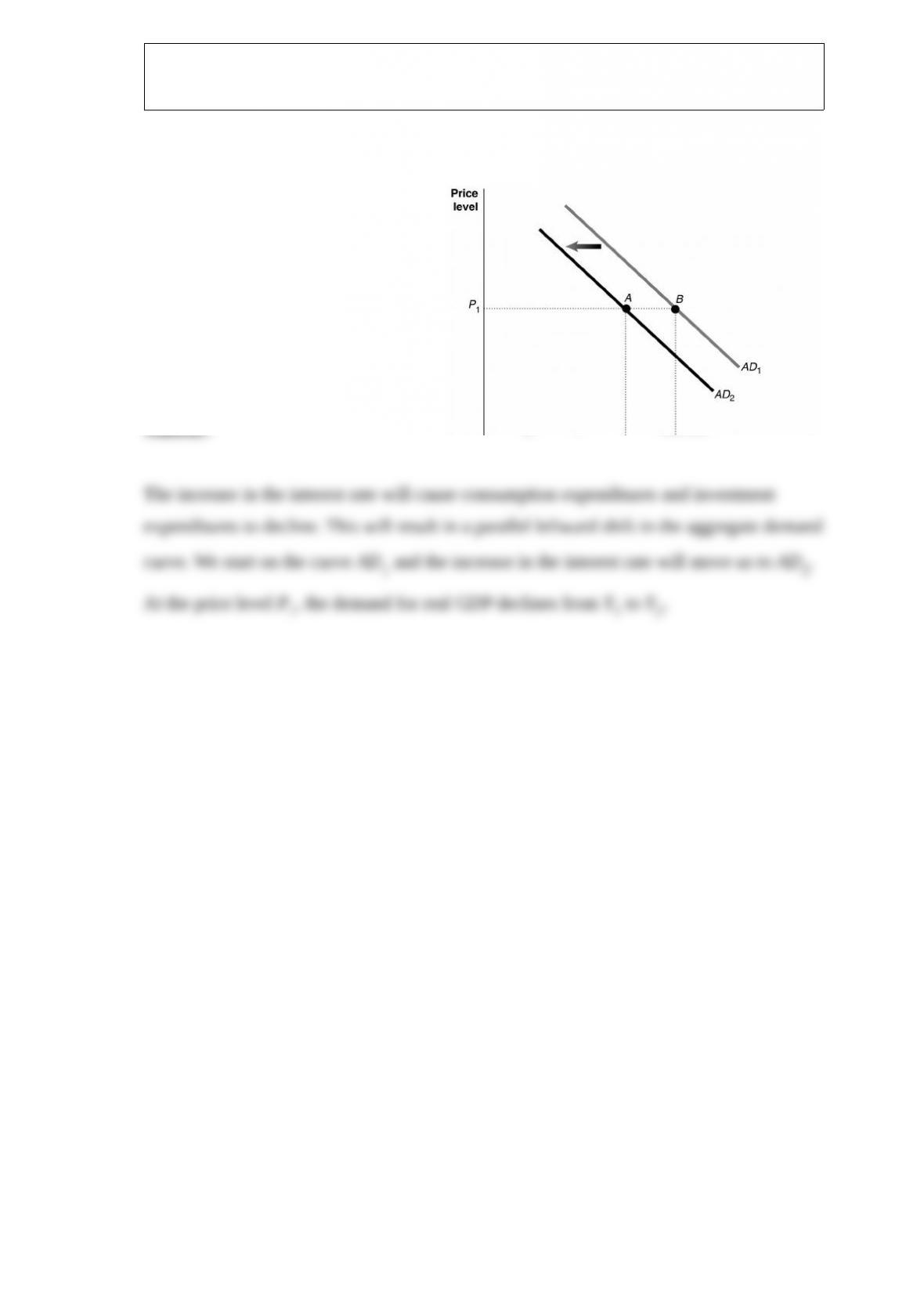
Using an aggregate demand graph, illustrate the impact of an increase in the interest
rate.