Expedia.com’s sale of discount airline tickets to those willing to travel any hour of a day
on any airline is an example of third degree price discrimination.
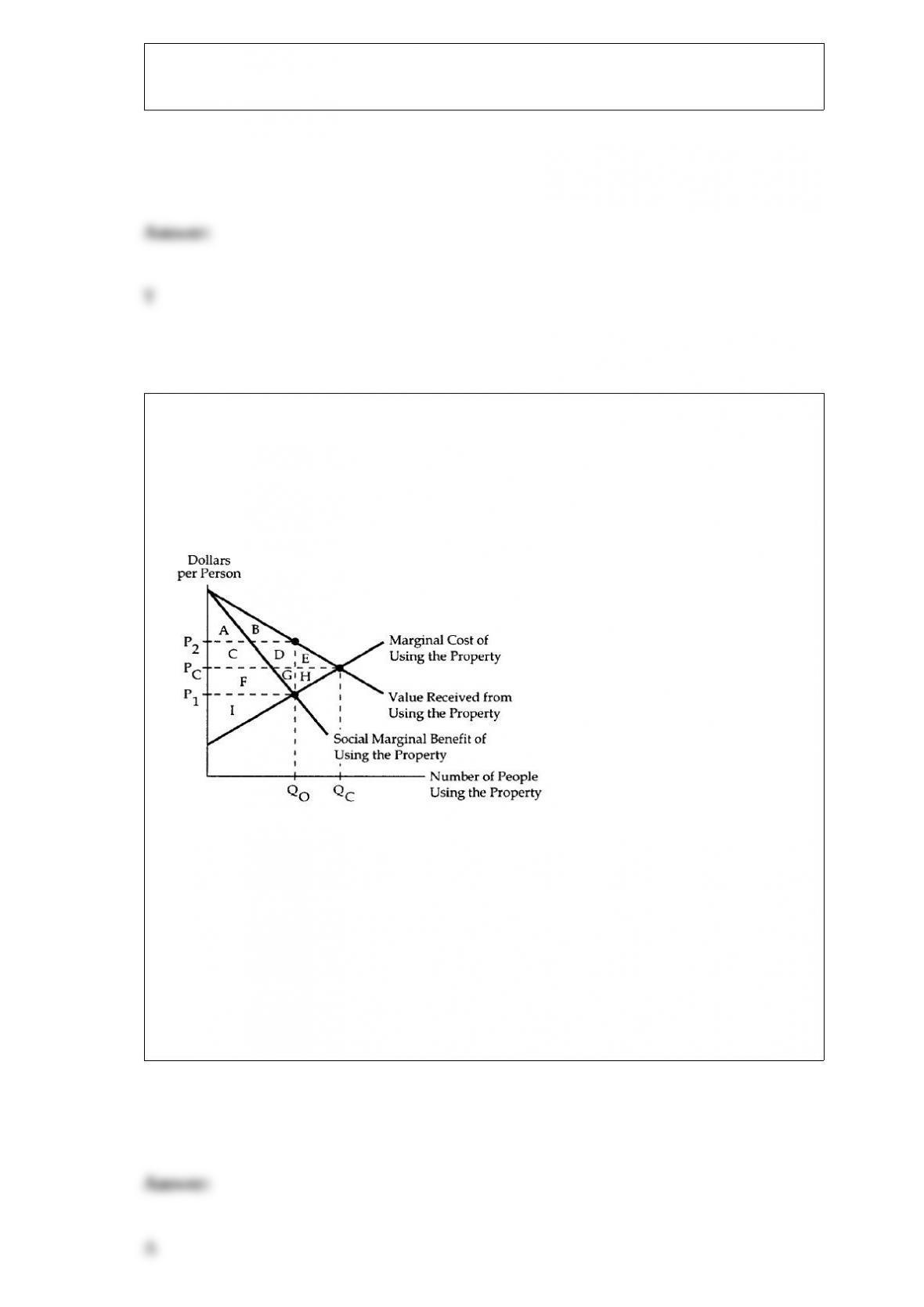
Common Property II
The following questions refer to the accompanying diagram, which shows the benefits
and costs associated with the use of a common property.
If the common property is privately owned, the surplus to the consumers is
a. Area I
b. Area I + F + G
c. Area I + F + G + H
d. zero.

When will the scale effect of a wage increase cause a fall in the amount of labor
employed?
a. Always.
b. When labor is not a regressive factor.
c. When labor and capital are substitutes in production.
d. When labor and capital are complements in production.
Why is a small country more likely to gain from international trade than a large
country?
a. Because autarkic relative prices in a small country are likely to be quite different
from the world relative prices.
b. Because a small country, unlike a large country, does not have the resources it needs
to be self-sufficient.
c. Because small countries tend to be specialized in their production, while large
countries tend to be diversified.
d. Because a small country is less likely to encounter decreasing returns to scale than is
a large country.

Which of the following would not increase the price of books?
a. A new literacy program that encourages reading.
b. A $10,000 permission fee paid for the right to reprint an author’s work.
c. An increase in the price of the ink used to print the books.
d. Higher costs for the glycerin used to make the glue with which the books are bound.
Which of the following is most likely beyond the scope of economic analysis?
a. Family structure.
b. Why some people contribute to charities.
c. Why some people choose to vote.
d. The actions of people who do what voices in their heads tell them to do.
A firm will shut down in the short run if its revenues fail to cover its
a. fixed costs.
b. variable costs.
c. total costs.

d. sunk costs.
Anna and Howard both own 100 shares of Photo-Hut. Anna buys stocks for income for
current consumption, Howard buys stocks for their future growth. This year the firm
has paid out all its profits to its stockholders. We can expect that
a. Anna and Howard will both spend the income.
b. Howard will spend the income, while Anna will use the money to buy more stock in
the firm.
c. Howard will sell the stock since it is not reinvesting its profits.
d. Anna will spend the income, while Howard will use the money to buy more stock in
the firm.
Suppose Afghanistan receives monthly gifts of food and other consumption goods from
the world’s nations. What effect will these gifts have on the Afghanistan’s labor market?
a. The demand for labor will rise.
b. The wage will rise and employment will fall.
c. Fewer jobs will be available and wages will be lower.
d. The gifts will have no effect on the labor market.

When a manufacturer produces 25 tables, the marginal and average costs are both equal
to $50 per table. A 26th table raises the marginal cost to $54 per table and the average
cost to $52 per table. What is the firm’s elasticity of supply when 25 table are produced?
a. 1/4.
b. 1/2.
c. 1.
d. 2.
Consider a bond with a $100,000 face value that matures in 1 year. If the bond pays a
nominal interest rate of 5%, what is the bond’s discount?
a. $952.
b. $2,000.
c. $4,762.
d. $5,000.

Kelly has received a $50 check from her Grandparents to help with her expenses at
college. She has narrowed her choices of how to spend the money to three: a new
backpack, a dinner out with a friend, a fleece vest. Of these she likes the vest best and
the backpack least. What is her cost of buying the fleece vest?
a. $50.
b. A new backpack.
c. A dinner out with a friend.
d. Nothing since the money was a gift to her.
Marginal cost can be expressed as the ration of the price of labor and the Marginal
Product of Labor
a. only when labor is held constant.
b. only when labor is the only variable input.
c. wether labor is held constant or not.
d. never.
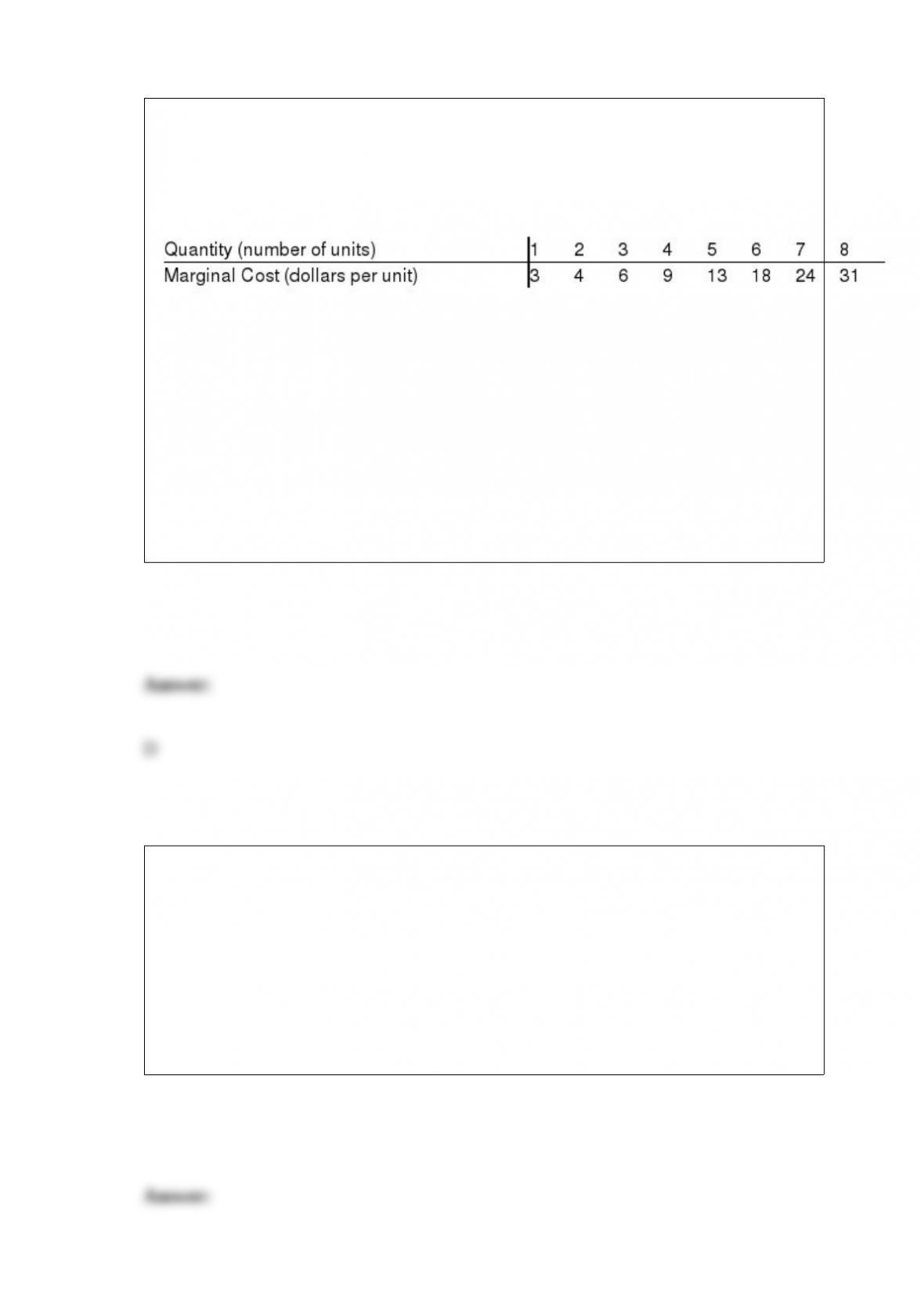
Marginal Cost of Production
The following questions refer to the following table which shows a firm’s marginal cost
of production.
Suppose the firm can sell as many units as it wants at a price of $20, then it should
produce
a. zero units
b. six units
c. seven units
d. the number of units is indeterminate without more information
The problem that economists consider is how an individual
a. actor’s preferences are formed.
b. actor decides to allocate scarce resources among competing ends.
c. firm decides on means for influencing its buyers preferences.
d. firm grows.

Consider each pair of strategies other than UP,RIGHT. Which of the following
statements is not true about those pairs?
a. They are all Pareto Optimal.
b. None of them are a Nash Equilibrium.
c. The players would not mutually agree to play any of them if such an agreement were
possible.
d. Each is requires that a player play a dominated strategy.
A 100 acre wood used by four people for collecting firewood is common property. The
socially efficient use of the wood could be achieved by assigning property rights
a. only if they go to whichever of the four most values the wood.
b. only if they are divided equally among all four users.
c. only if the are divided according to those who have been using it the longest.
d. period, to whom does not matter.
In the case before her, Judge Thomas has heard claims by orange growers that to order a
stop to orange growing in order to control a pest that thrives on oranges plants but does
not harm them would result in a loss of profits of $3 million a year. The pest however
causes $2 million of damages to trees owned by pulp manufacturers. The orange
growers have not mentioned that they could control the pest at a cost of $1 million per
year. High transactions costs have prevented the parties from reaching a private
agreement. If she gives the property right to the
a. orange growers, they will then voluntarily control the pest.
b. orange growers, they will not control the pest.
c. pulp manufacturers, they will pay the orange growers to control the pest.
d. pulp manufacturers, the orange growers would offer a side payment of at least $2
million to be able to grow oranges.
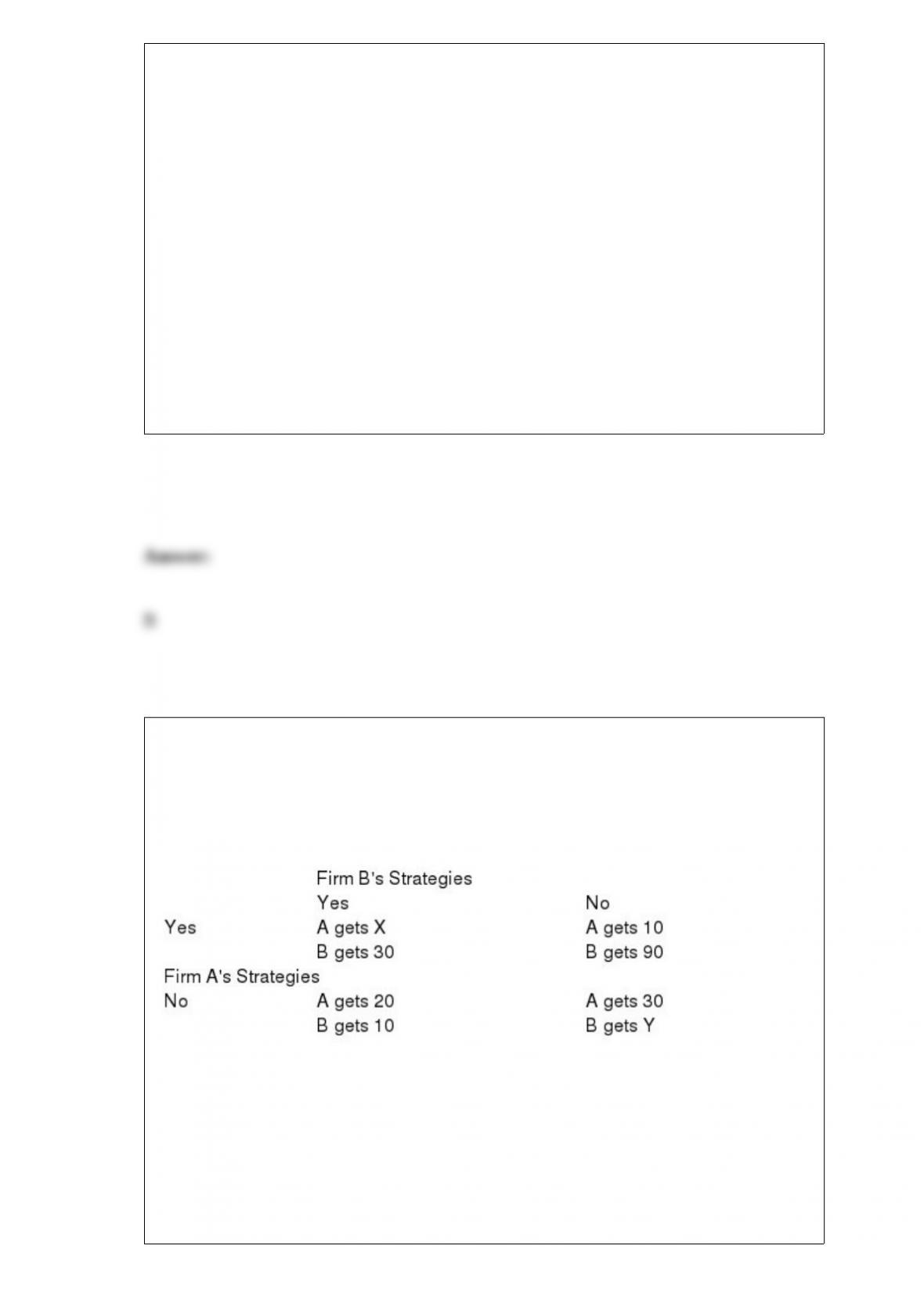
Game Matrix V
The following questions refer to the game matrix below. Each firm has a choice of
saying Yes or NO. The profits each gets depend upon which it chooses.
. Which of the following values of X and Y result in the only Nash Equilibrium being
(No, No) and there also being a Prisoners’ Dilemma?
a. X = 21, Y = 9.
b. X = 19, Y = 11.

c. X = 31, Y = 11.
d. It is not possible for (Yes, Yes) to be a Nash Equilibrium and for there to be a
Prisoners’ Dilemma.
Demand for a product is given by Q = 200 – P and supply is given by Q = 0.5P – 10. If
the quantity demanded rises by 10 units at every possible price, then the equilibrium
quantity will be
a. 40 units
c. 60 units
b. 50 units
d. 100 units
A worker who brings both labor and human capital to her job earns
a. both the wage rate for her labor and a share in the employer’s profits.
b. both the wage rate for her labor and a market rate of return on her skills.
c. the going wage rate for her labor, the benefits of her capital accrue to her employer’s
owners.
d. both the going wage rate for her labor and annual bonuses based on the level of

profits and her skills.
Goods X and Y
For the following questions, assume that good X is on the horizontal axis and good Y is
on the vertical axis in the consumer-choice diagram. PX denotes the price of good X, PY
is the price of good Y, and I is the consumer’s income. Unless otherwise stated, the
consumer’s preferences are assumed to satisfy the standard assumptions.
If the marginal rate of good X in terms of good Y is large, then the indifference curve
will be
a. convex.
b. concave.
c. steep.
d. flat.
To be as well off as possible, a nation should produce
a. only those goods that its populace desires.
b. the good within its productive capabilities that commands the highest price in the
world market.
c. the good that requires the fewest resources to produce.
d. whatever good it can produce at a cost lower than that incurred by other nations.
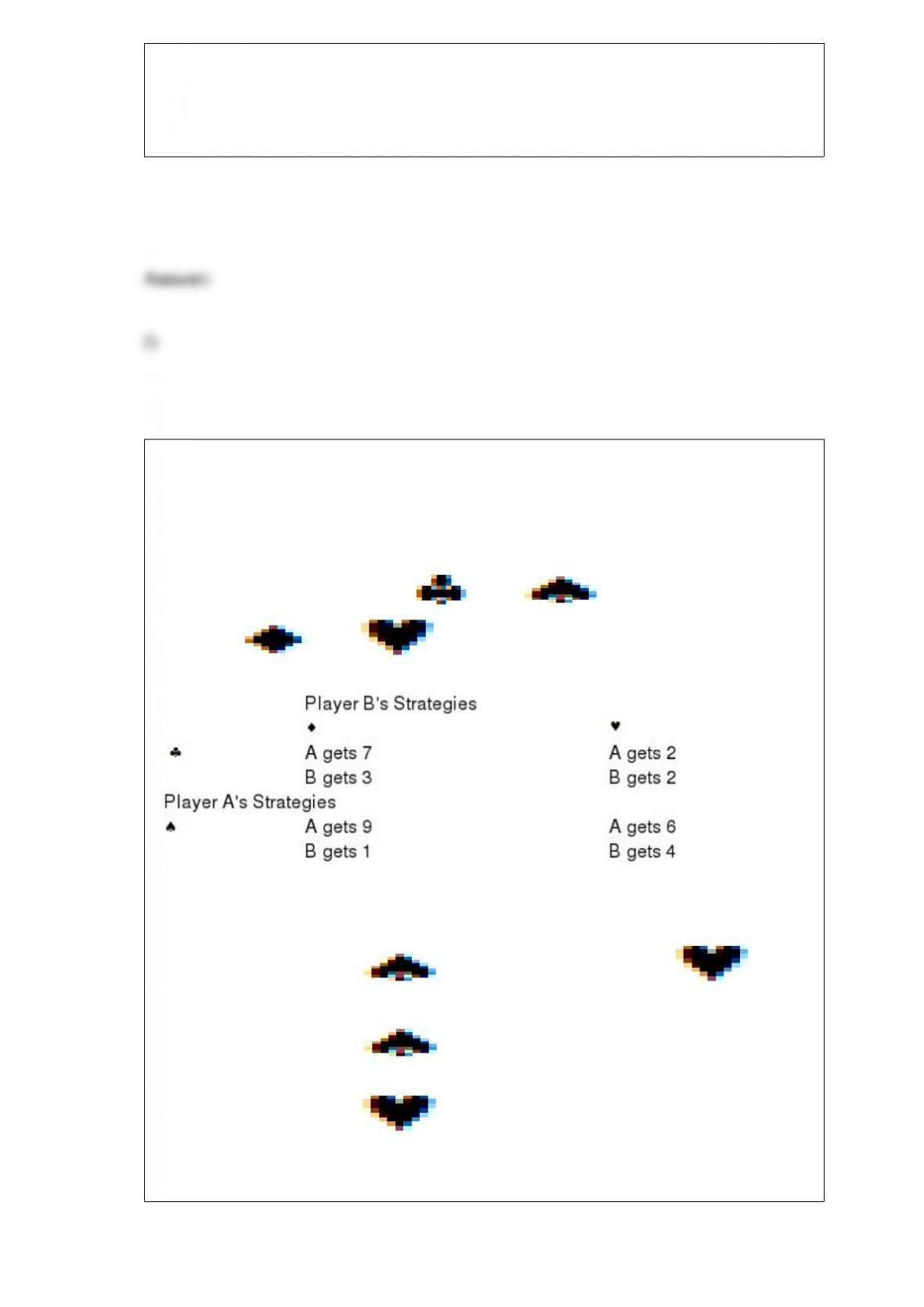
Game Matrix I
The following questions refer to the game matrix below.
Player A can play the strategies and , and Player B can play the
strategies and .
What are the dominant strategies in this game?
a. A’s dominant strategy is , and B’s dominant strategy is .
b. A’s dominant strategy is , but B does not have a dominant strategy.
c. B’s dominant strategy is , but A does not have a dominant strategy.
d. Neither player has a dominant strategy.

A die is rolled. The individual rolling the die will receive the number that lands in
dollars (i.e. if it lands 1, they receive $1, if it lands two, they receive $2, etc). The
expected value of the die roll is
a. $1.00
b. $2.25
c. $3.50
d. $6.00
To maximize its profits, a monopsonist will hire labor the quantity of labor at which
marginal revenue product of labor
a. is downward sloping and equal to the market wage rate.
b. is downward sloping and equal to its marginal labor cost.
c. minus marginal labor cost is maximized.
d. is maximized.

When there is an increase in the wage rate there will be
a. both a substitution effect and an income effect.
b. only a substitution effect.
c. only an income effect.
d. either a substitution effect or an income effect.
The representative agent chooses to consume
a. the endowment point.
b. equal amounts of current and future goods.
c. more future goods than current goods.
d. the basket of goods where the slope of the indifference curve equals -1.
Which of the following is not held constant when we use indifference-curve analysis to
derive the Engel curve for good X?
a. The price of good X.

b. The price of good Y.
c. The consumer’s income.
d. The consumer’s tastes.
Surveys show that a small increase in the price of organic potatoes will cause most
people to switch to other alternatives such as packaged mashed potatoes. This finding
suggests that the demand curve for organic potatoes is
a. relatively steep.
b. relatively flat.
c. upward sloping.
d. vertical.
Common Property I
The following questions refer to the accompanying diagram, which shows the benefits
and costs associated with the use of a common property.
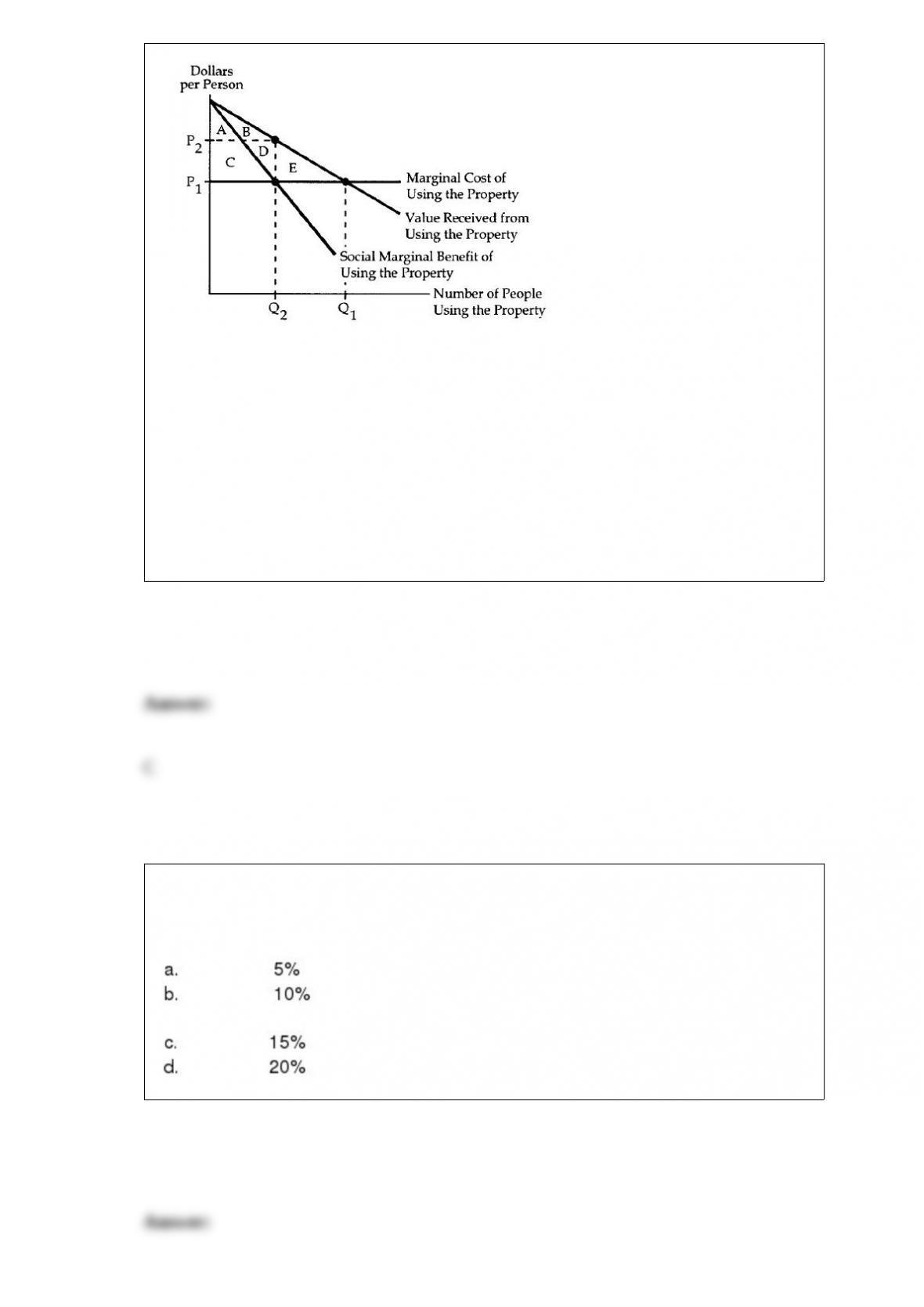
The efficient level of production and consumption on the common property is
a. zero.
b. Q1.
c. Q2
d. cannot be determined from the graph.
You have won a lottery prize that promises to pay you and your descendants $1000 a
year forever. If the lowest price you are willing to sell this perpetuity for is $20,000,
then you must be assuming that the relevant interest rate is

What is meant by a speculative bubble?
a. A pattern in past stock prices that, according to technical analysts, indicates higher
future prices.
b. A circumstance where everyone expects higher prices, which in turn causes higher
prices.
c. An occasional occurrence in program trading in which many investors
simultaneously receive instructions to sell.
d. A situation where poorly informed traders exacerbate any upturns or downturns in the
market.
A monopoly, like a competitive firm, will reduce its quantity supplied when an effective
price ceiling is imposed.
When a simple profit-maximizing monopoly begins to practice second-degree price
discrimination, both consumers and the monopoly will benefit.

In a two-good world, one good-but not both-can be inferior.
A competitive firm faces a downward-sloping demand for its product.
The relative price of bread in terms of wine is the amount of wine which can be traded
in exchange for a loaf of bread.

An efficient wage is the wage that maximizes the surplus of the worker.
When faced with a rent increase, the firm’s best policy is to use a small price increase to
compensate for some, but not all, of the loss.
Like a family, a firm faces a fixed level of expenditure and therefore must choose one
point along a particular isocost line.
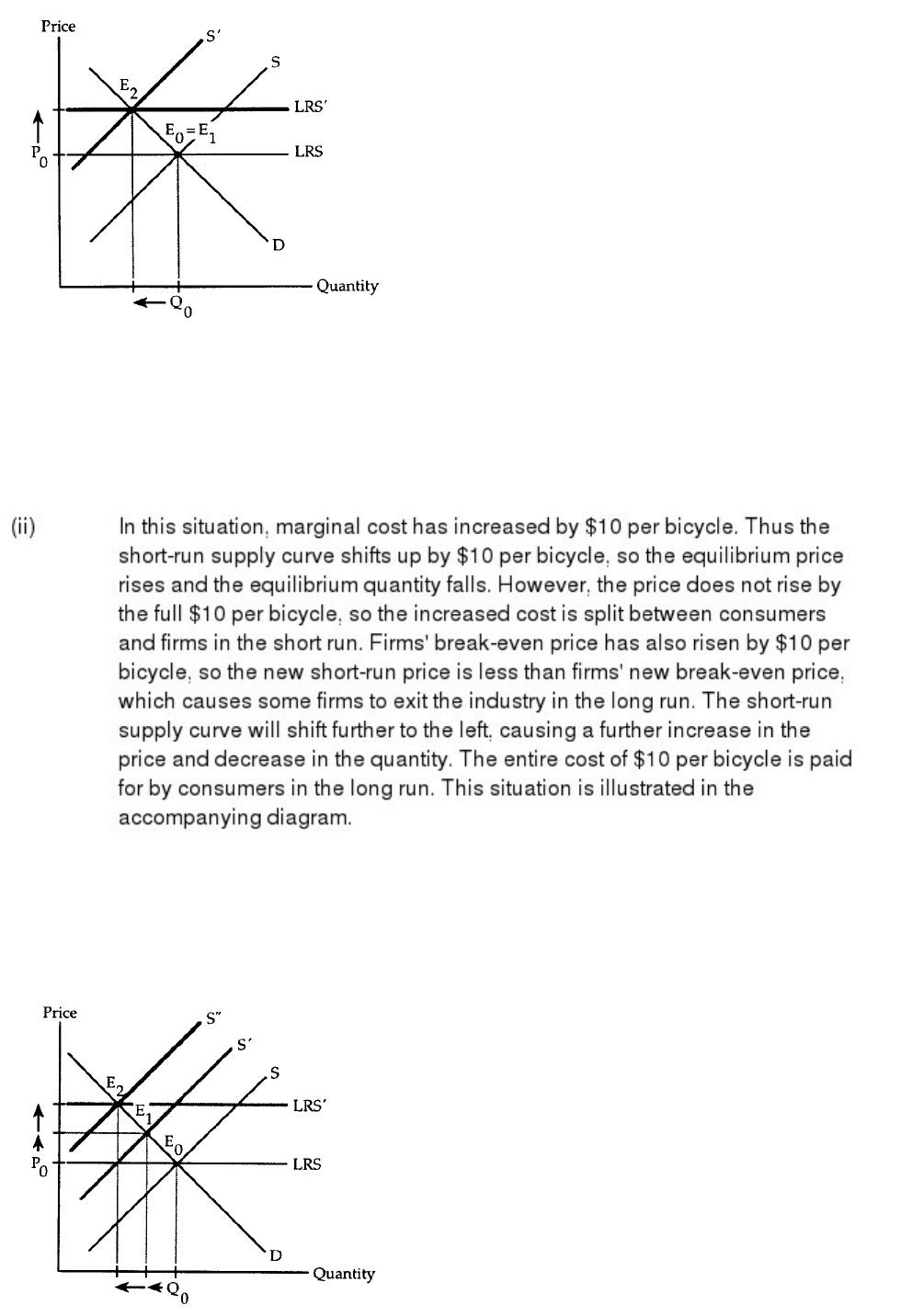
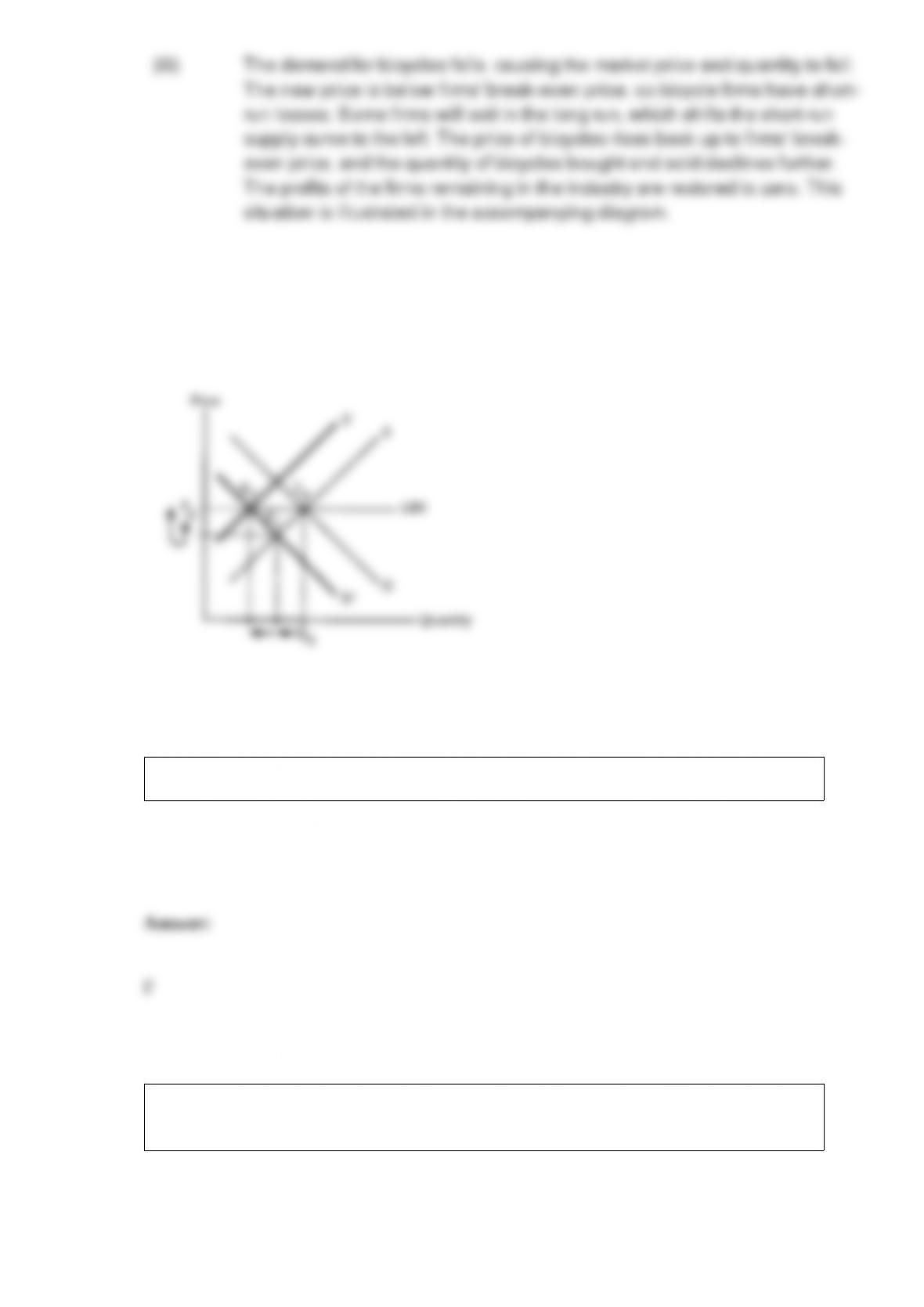
Suppose bicycles are produced by a competitive constant-cost industry, which is
initially in a long-run equilibrium. For each of the following situations, design a
supply-demand diagram that shows how market price and quantity will be affected in
both the short run and the long run. In your diagrams, show the short-run supply,
long-run supply, and demand curves, along with any shifts in these curves. Label the
initial long-run equilibrium E0, the new short-run equilibrium E1, and the new long-run
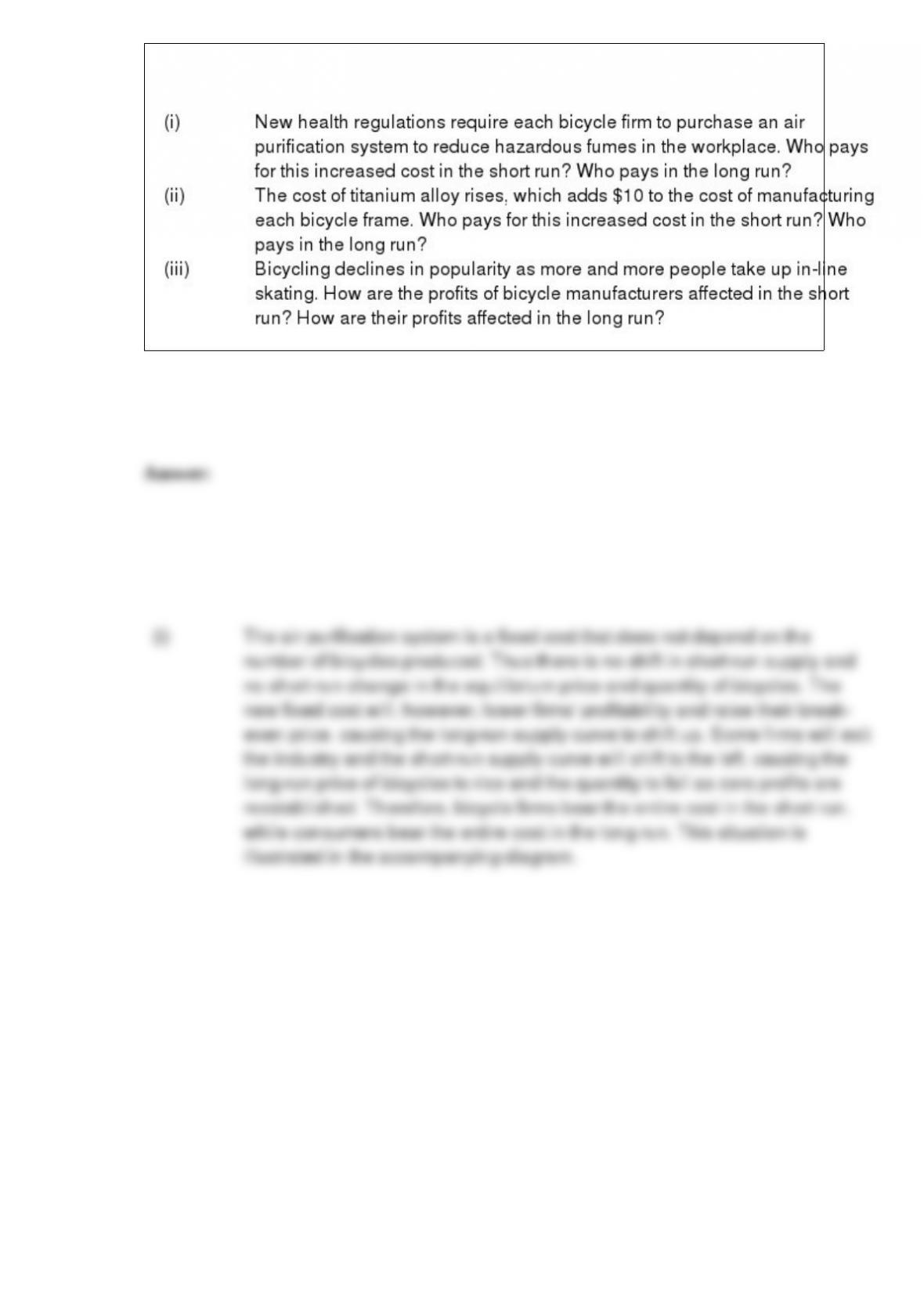
equilibrium E2.
The elasticity of supply is positive because prices and quantities are always positive.
If the indifference curve is not tangent to the budget line, then we can be sure that the
consumer is not at the optimum.

A monopoly’s supply curve is the portion of its marginal cost curve that lies above its
average variable cost curve.
If everyone had the same abilities, then no one could benefit from trade.
Risk aversion leads individuals to underinvest from a social point of view.
Taxes are bad for consumers unless the producers are the ones being taxed.
An economic problem can be defined as any problem involving money.
The Robinson-Patman Act was designed to stop resale price maintenance.
A cap on the interest rates charged by credit-card companies would benefit all the
people who use credit cards.

In order to compute the total cost of production when labor is the only variable, we
need only need to know the quantities of labor and the current wage rate.
A parallel shift in the budget line is caused by changes in the relative prices of the two
goods.