
Indirect finance includes the sale by a corporation of stocks or bonds, as well as
borrowing money from a bank.
As output increases, the distance between average total cost and average variable cost
increases.
Horizontal equity is achieved when taxes are collected from those who benefit from the
government expenditure of the tax revenue.
The income effect results in consumers increasing the quantity of normal goods
demanded when the price falls.

Merger guidelines developed by the Antitrust Division of the U.S. Department of
Justice use four-firm concentration ratios as measures of concentration.
Examining the conditions that could lead to unemployment in an economy is an
example of a microeconomics topic.
Each price-quantity combination on a consumer’s demand curve shows the
utility-maximizing quantity at the given price.

One problem with using a command-and-control approach to pollution reduction is that
the monitoring costs may be too high.
The income effect of a wage decrease examines the effect of the decrease in wage
income on a worker’s ability to purchase goods and services.
The term “market” refers to trading arrangements by which buyers and sellers come
together.
In a perfectly competitive market, in the long run, arbitrage profits will be bid away.

Net worth and stockholders’ equity are both equal to the difference between assets and
liabilities.
The short run is the time period during which a firm has at least one input constraint.
An increase in a firm’s fixed cost will not change the firm’s profit-maximizing output in
the short run.

An oligopolistic industry is characterized by a few large firms acting independently.
If a country produces only two goods, it is possible to have a comparative advantage in
the production of both those goods.
In the short run, if average product is at its maximum, then average variable cost is at its
minimum.
If it costs Sinclair $300 to produce 3 suede jackets and $420 to produce 4 suede jackets,
then the difference of $120 is the marginal cost of producing the 4th suede jacket.

When there are few substitutes available for a good, demand tends to be relatively
inelastic.
All consumption bundles along a given indifference curve are equally desirable.
Positive analysis is concerned with “what ought to be,” while normative analysis is
concerned with “what is.”

Each year, the United States exports about 50 percent of its wheat crop.
If demand for a product is perfectly inelastic, a change in price will not change total
revenue.
For a downward-sloping demand curve, marginal revenue decreases as quantity sold
increases.
If by purchasing more apples and fewer oranges you increase your total utility, then
apples must be cheaper than oranges.

A member of a cartel earns more profits by producing more than its quota and selling at
a price higher than the cartel’s price.
In the long run the relevant cost is total cost.
If the government wants to minimize the welfare loss of a tax, it should tax goods with
more inelastic demands or supplies.

If Tanisha can audit more tax returns in one hour than Libby, then Tanisha has an
absolute advantage in auditing tax returns.
Monopolistically competitive firms face a perfectly elastic demand curve.
When a firm experiences negative technological change it can produce the same output
with fewer inputs.
In the alcohol industry, both wine and spirits are considered to be substitutes for beer.

Using outlet stores to price discriminate has been successful for many companies, with
sales increasing faster than at conventional retail stores.
The processes a firm uses to turn inputs into outputs of goods and services is called
A) technology.
B) technological change.
C) marginal analysis.
D) positive economic analysis.
Table 14-2
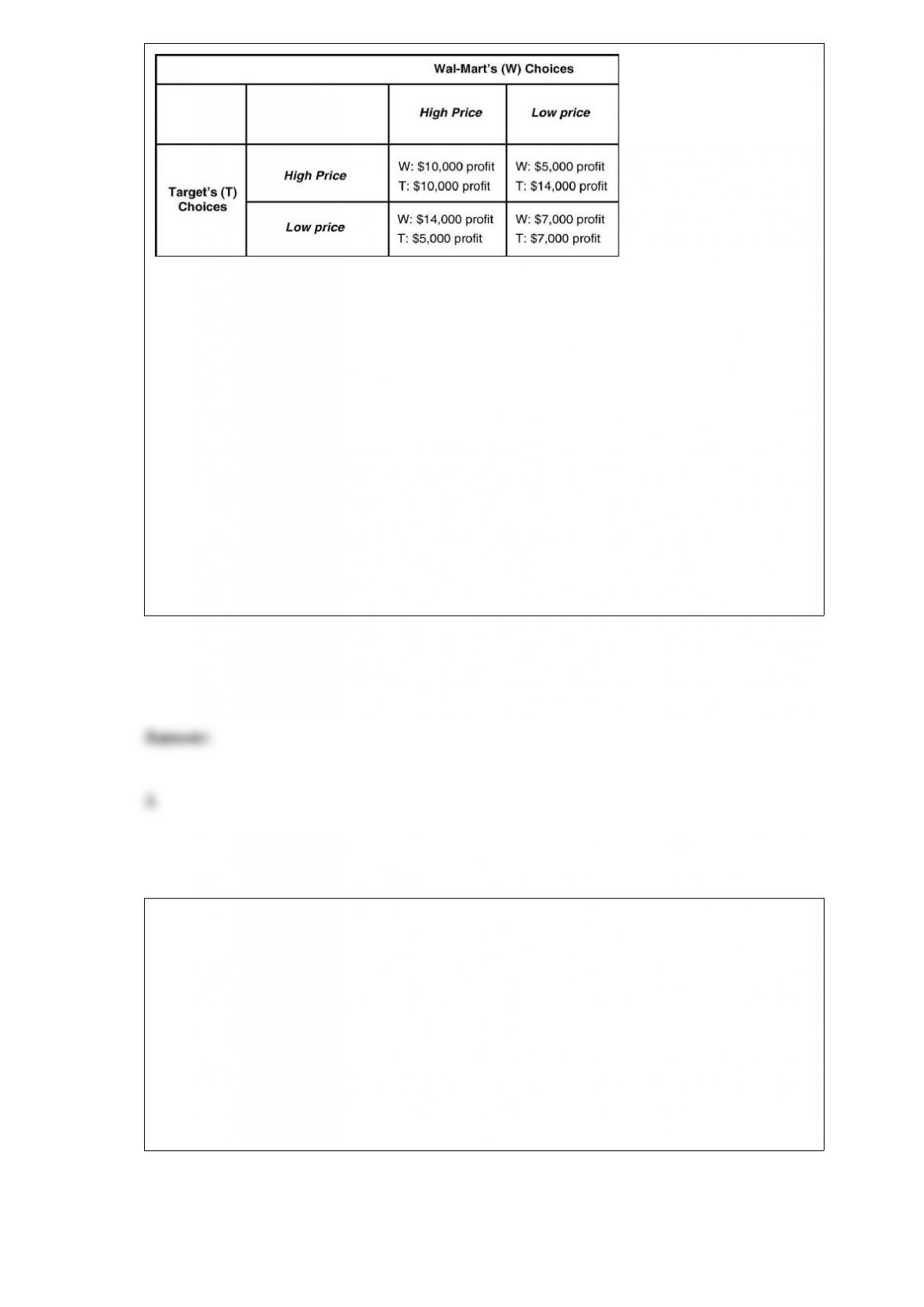
Table 14-2 shows the payoff matrix for Wal-Mart and Target from every combination of
pricing strategies for the popular PlayStation At the start of the game each firm charges
a low price and each earns a profit of $7,000.
Refer to Table 14-2. For each firm, is there a better outcome than the current situation
in which each firm charges the low price and earns a profit of $7,000?
A) Yes, the firms can implicitly collude and agree to charge a higher price.
B) No, there is no incentive for each firm to consider any other strategy.
C) No, any other strategy hurts consumers.
D) Yes, each firm can implicitly agree to increase output and not to deviate from a low
price.
The highest-valued alternative that must be given up to engage in an activity is the
definition of
A) utility.
B) implicit cost.
C) opportunity cost.
D) economic sacrifice.

For people who live near a bus route, a subway station, or a commuter rail line, public
transportation provides a substitute to driving their own cars. So, for these people, the
cross-price elasticity of demand between gasoline and public transportation is
A) positive.
B) negative.
C) zero.
D) infinity.
Figure 13-5
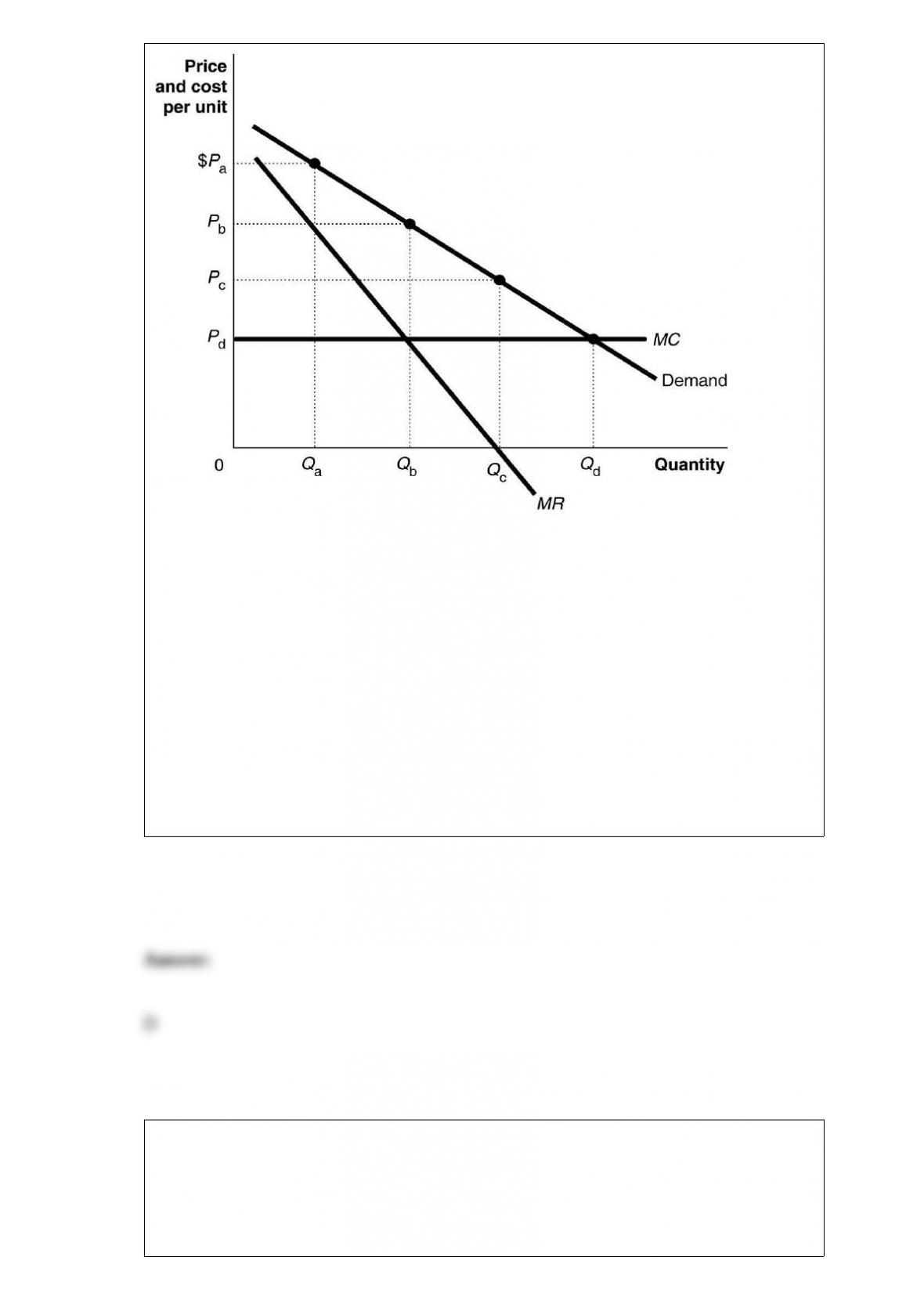
Refer to Figure 13-5. The candy store represented in the diagram is currently selling Qa
units of candy at a price of Pa. Is this candy store maximizing its profit and if it is not,
what would you recommend to the firm?
A) Yes, it is maximizing its profit by charging the highest price possible.
B) No, it is not; since its marginal cost is constant, it should produce and sell as much
candy as it can. It should sell Qd units at a price of Pd.
C) No, it is not; it should lower its price to Pc and sell Qc units.
D) No, it is not; it should lower its price to Pb and sell Qb units.
Marginal benefit is equal to the ________ benefit a consumer receives from consuming
one more unit of a good or service.
A) total

B) unintended
C) additional
D) surplus
The difference between a firm’s assets and liabilities is its
A) accounting profit.
B) economic profit.
C) net worth.
D) implicit costs.
According to an article in the Wall Street Journal, unlike airlines, even elite hotels don’t
have sophisticated systems that can react quickly to changes in demand. Even if they
could, many hoteliers say people don’t respond that much to lower rates. “We’ve tested
this, cutting our rates by $50 [per night], and we didn’t see an appreciable response in
occupancy,” says Jim Schultenover, a vice president for Ritz-Carlton.
Source: Jesse Drucker, “In Times of Belt-Tightening, We Seek Reasonable Rates,” Wall
Street Journal, April 6, 2001.
Based on the information above, the demand for hotel rooms is
A) elastic.
B) unit elastic.
C) inelastic.
D) perfectly elastic.
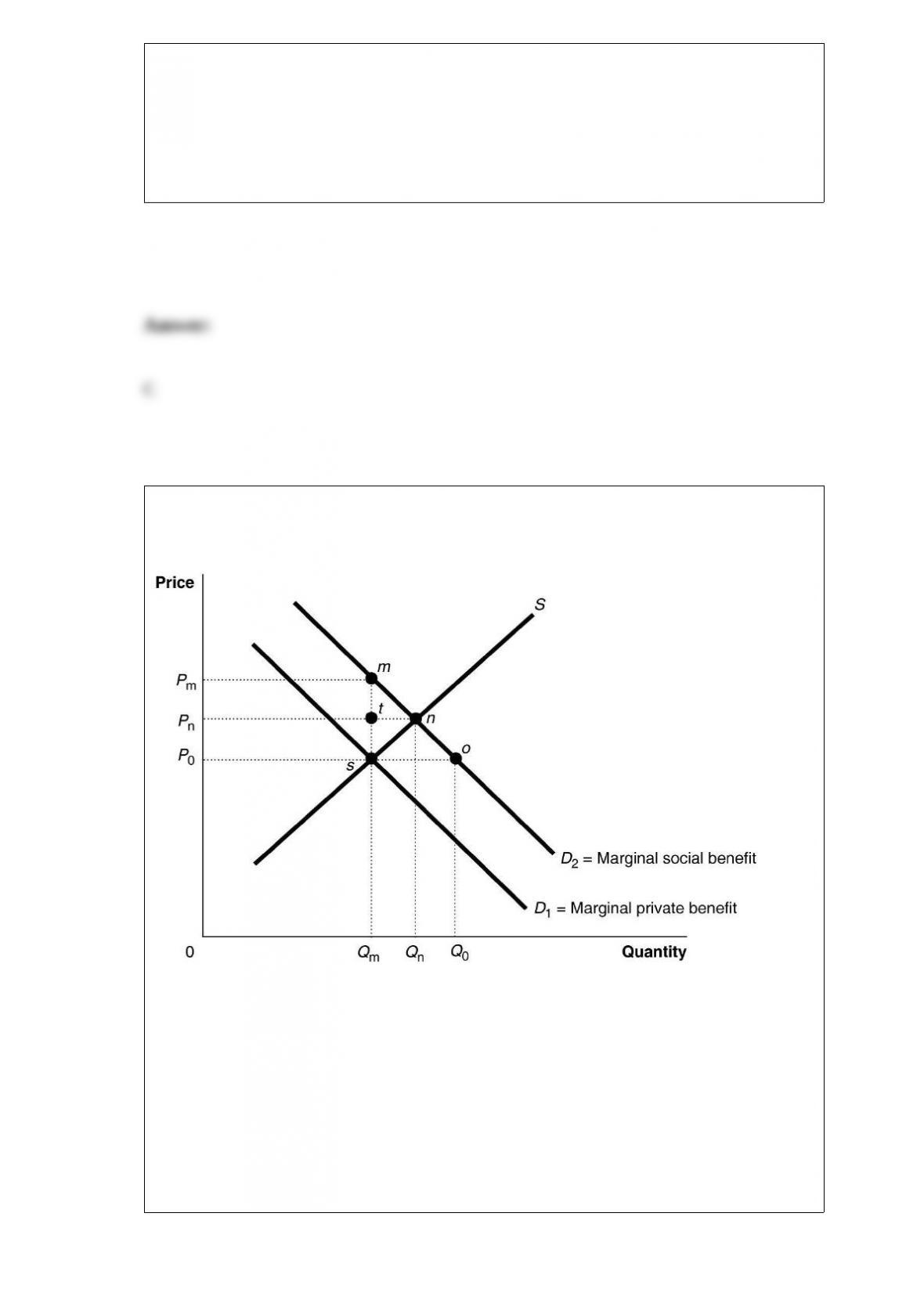
Figure 5-3
Refer to Figure 5-3. The size of marginal external benefits can be determined by
A) the demand curve D2.
B) D2+ D1 at each output level
C) D2– D1 at each output level.
D) the demand curve D1.
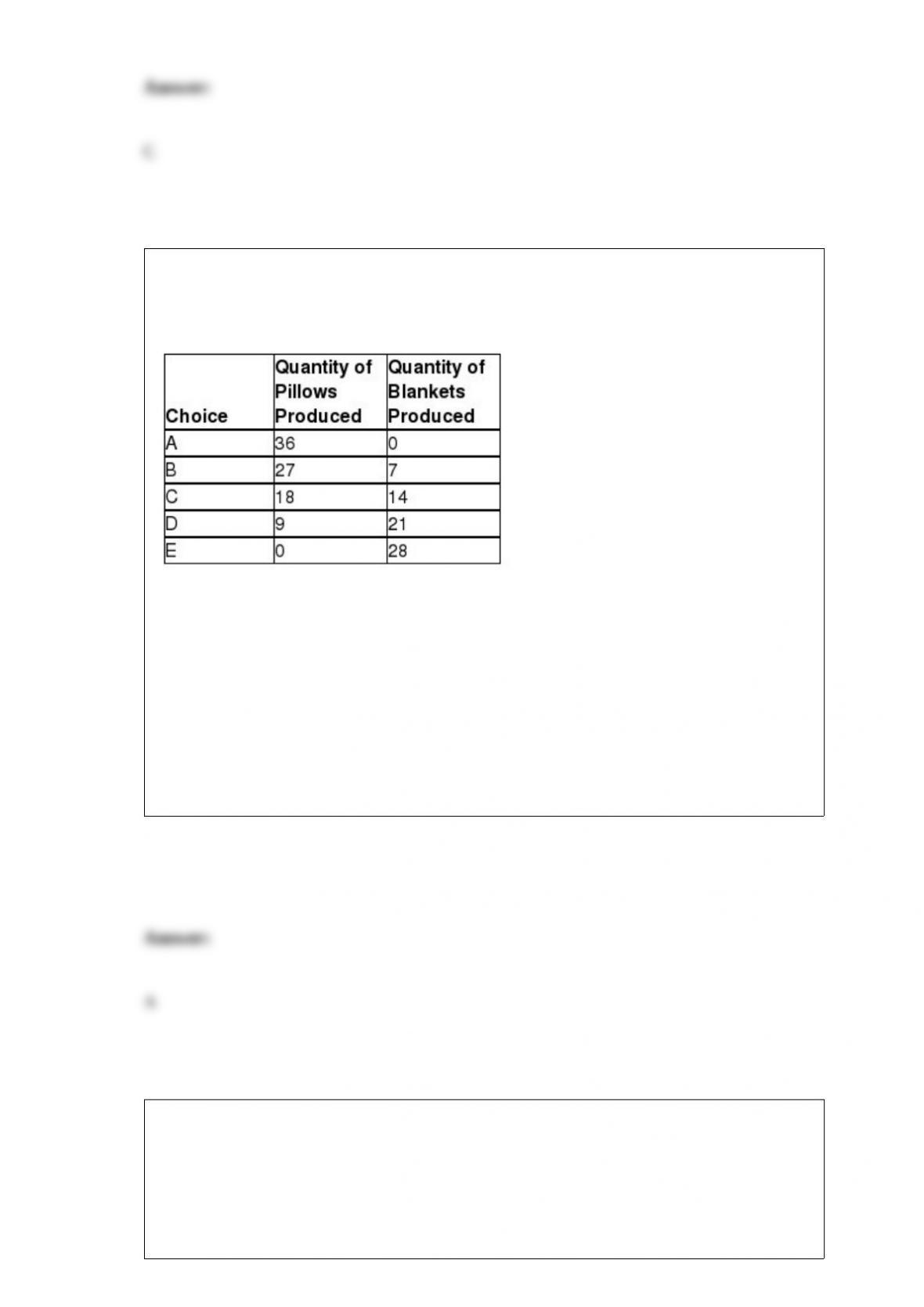
Table 2-2
Production choices for Billie’s Bedroom Shop
Refer to Table 2-2. Assume Billie’s Bedroom Shop only produces pillows and blankets.
A combination of 9 pillows and 21 blankets would appear
A) along Billie’s production possibilities frontier.
B) inside Billie’s production possibilities frontier.
C) outside Billie’s production possibilities frontier.
D) at the vertical intercept of Billie’s production possibilities frontier.
In situations where new technologies are considered complementary to workers,
demand for these workers will ________, resulting in ________ in the equilibrium
wage.
A) increase; a decrease

B) increase; an increase
C) decrease; a decrease
D) decrease; an increase
Select the phrase that correctly completes the following statement. “An increase in input
prices caused a decrease in the supply of baseballs. As a result ________.”
A) the price of baseballs increased and the demand for baseballs decreased
B) the equilibrium quantity of baseballs increased
C) the price of baseballs increased and the quantity demanded of baseballs decreased
D) the price of baseballs increased. The higher price caused the supply of baseballs to
increase
The term “early adopters” refers to
A) firms that are the first to implement a new technology that is used to produce new
goods or services.
B) book clubs that are first to recommend best-selling books to their members.
C) consumers who respond quickly to fads, seasonal changes, etc.

D) consumers who are willing to pay high prices to be among the first to own new
products.
If you burn your trash in the back yard in spite of regulations against it, then you are
A) acting economically irrationally and creating a social cost.
B) avoiding the private costs associated with disposing your trash some other way and
creating a social cost.
C) acting rationally and creating a positive externality.
D) saving landfill space and creating a social benefit.
Figure 5-6
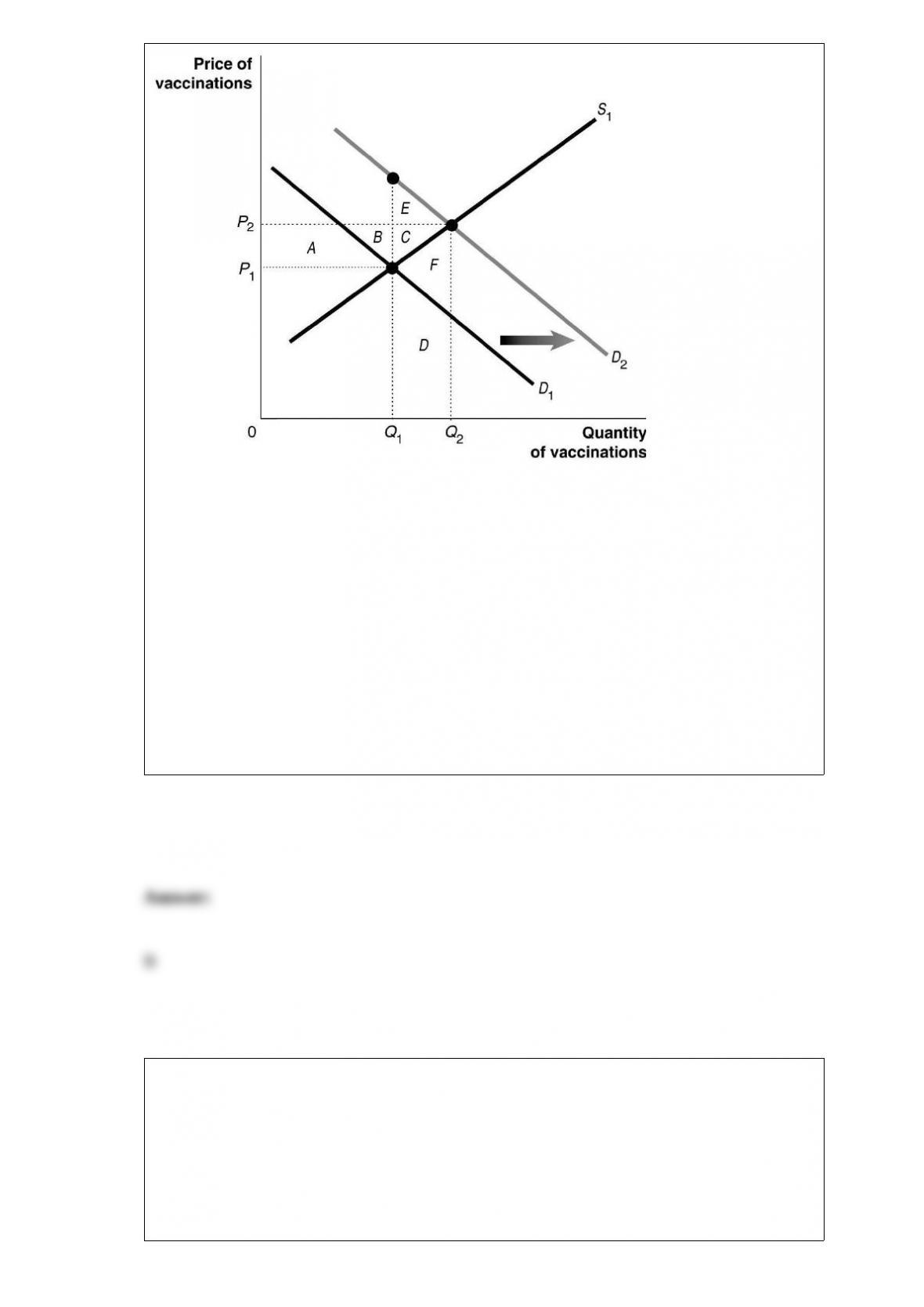
Figure 5-6 shows the market for measles vaccinations, a product whose use generates
positive externalities.
Refer to Figure 5-6. What is the deadweight loss resulting from producing at the
market equilibrium?
A) B + C
B) E + C
C) F
D) C
Trade between countries that is without restrictions is called
A) unobstructed commerce.
B) unabated trade.
C) free trade.

D) unencumbered trade.
A monopolistically competitive firm is producing an output level where marginal
revenue is greater than marginal cost. What should this firm do to increase its profit or
reduce its losses?
A) The firm should raise its price.
B) The firm should decrease its fixed costs.
C) The firm should increase its implicit costs.
D) The firm should lower its price.
Table 4-4
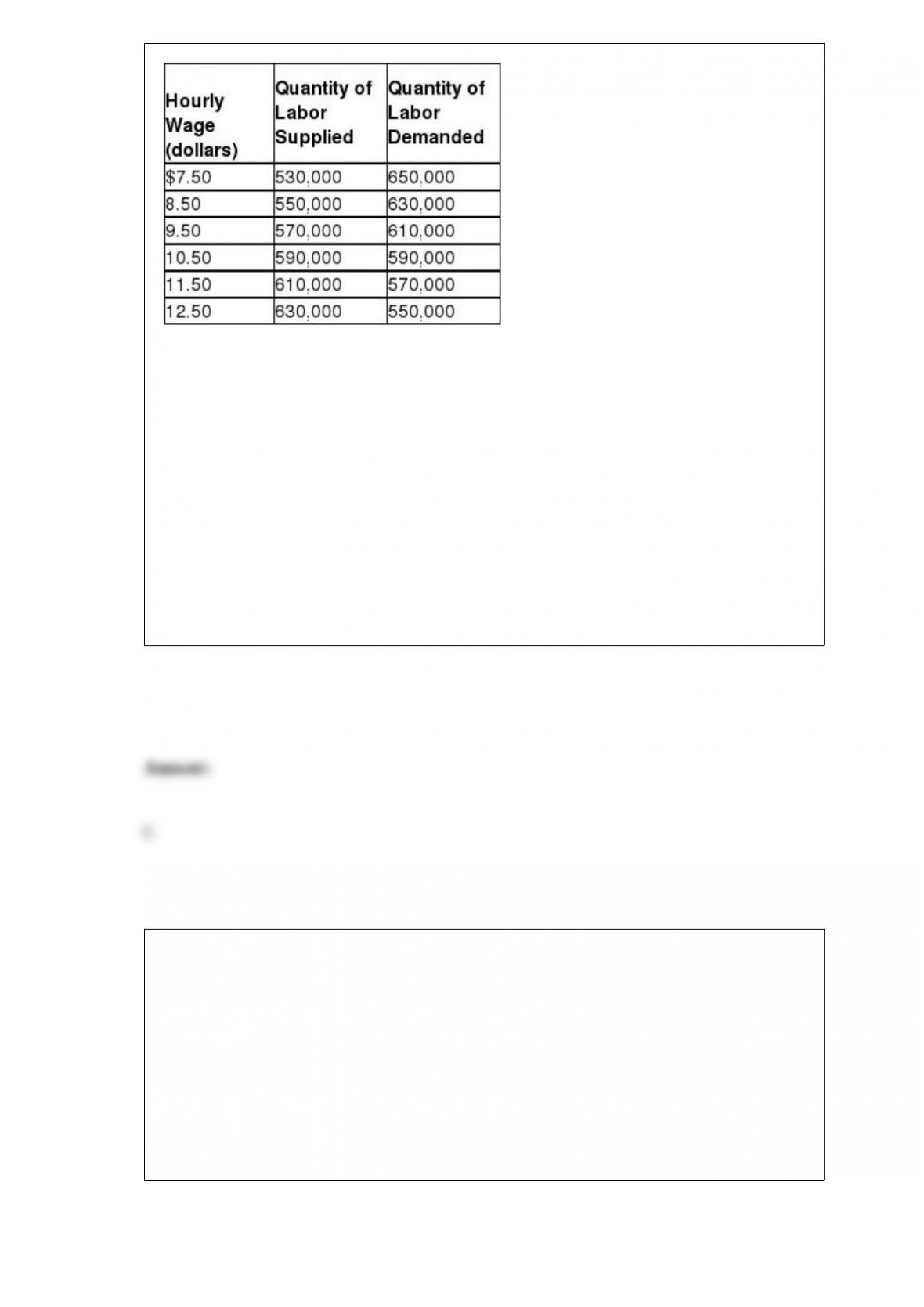
Table 4-4 shows the demand and supply schedules for the labor market in the city of
Pixley.
Refer to Table 4-4. If a minimum wage of $11.50 an hour is mandated, what is the
quantity of labor supplied?
A) 40,000
B) 570,000
C) 610,000
D) 1,180,000
If a 35 percent increase in price of golf balls led to an 42 percent decrease in quantity
demanded, then the demand for golf balls is
A) unit elastic.
B) perfectly elastic.
C) relatively inelastic.
D) relatively elastic.

Which of the following statements is true?
A) Input prices are one of the success factors that firms can control.
B) Consumers will buy a product only if its price is below that of its competitors.
C) Consumers will buy a product only if it meets a need not met by competing
products.
D) Sheer chance often plays a significant role in the success or failure of a business.
When firms price their products by adding a percentage markup to their average costs
of production, this is called
A) average cost pricing.
B) rounding up.
C) break-even pricing.
D) cost-plus pricing.
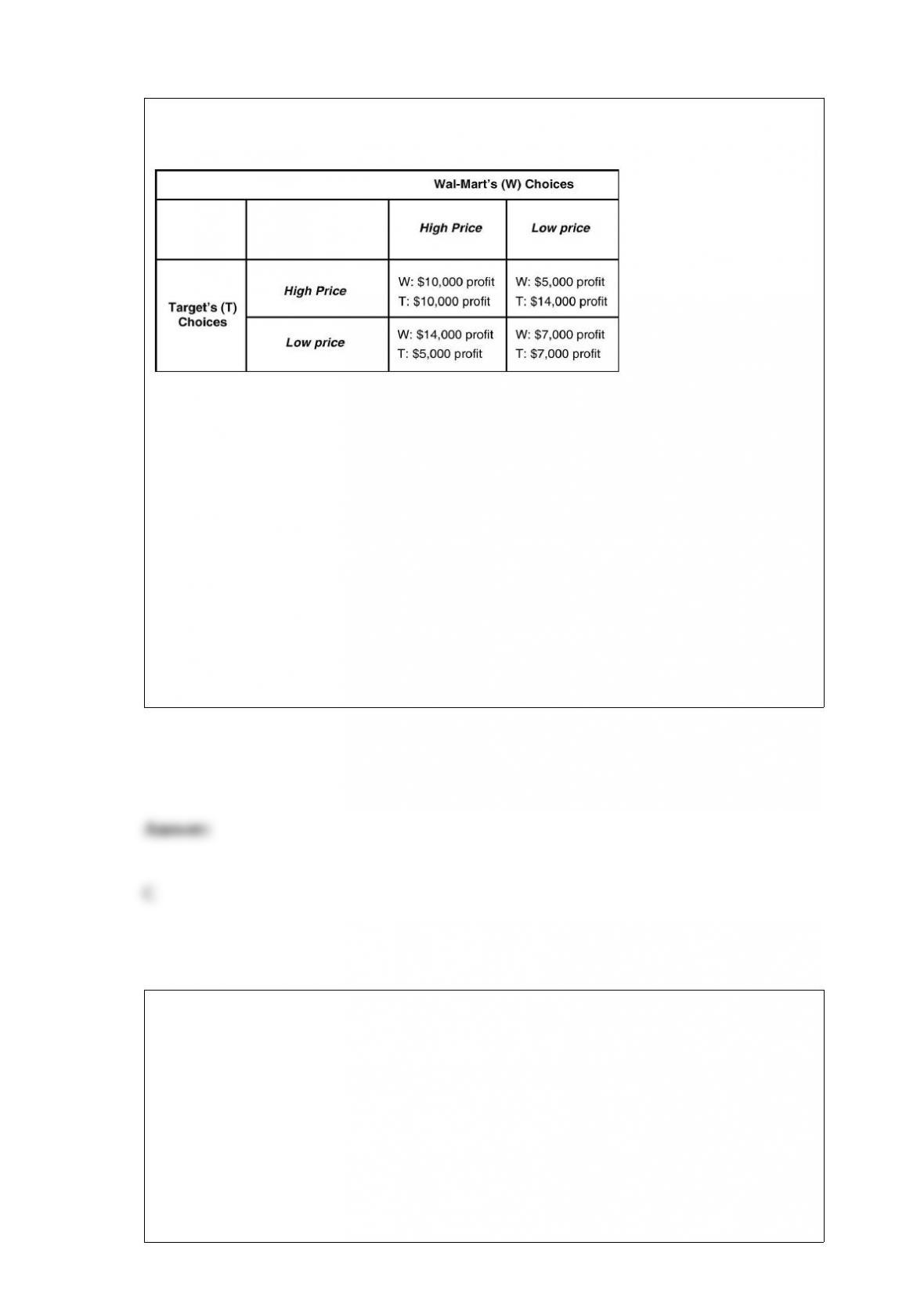
Table 14-2
Table 14-2 shows the payoff matrix for Wal-Mart and Target from every combination of
pricing strategies for the popular PlayStation At the start of the game each firm charges
a low price and each earns a profit of $7,000.
Refer to Table 14-2. Suppose Wal-Mart and Target both advertise that they will match
the lowest price offered by any competitor. What is the purpose of such a strategy?
A) to signal to each other not to charge below the current low price
B) to signal to each other that they will not hesitate to initiate a price war
C) to signal to each other that they intend to charge the high price
D) to signal to each other to share the market equally
Which of the following is not a characteristic of a perfectly competitive market
structure?
A) There are a very large number of firms that are small compared to the market.
B) All firms sell identical products.
C) There are no restrictions to entry by new firms.
D) There are restrictions on exit of firms.

A firm’s net income is also its
A) economic profit.
B) balance sheet.
C) accounting profit.
D) opportunity cost.
If a corporation retains all its profits and distributes none of the profit to owners, how
can owners benefit?
A) If the retained earnings are expected to create future profits, the market price of the
firm’s stock will increase and create a capital gain for stockholders if the stock is sold.
B) Shares of stock can be converted into bonds so stockholders will be able to earn
coupon payments.
C) Owners will only benefit if some profits are paid out in the form of dividends.
D) Owners will benefit by changing the board of directors.

Total utility is maximized in the consumption of two goods by
A) equating the marginal utility for each good consumed.
B) equating the marginal utility per dollar for each good consumed.
C) equating the total utility of each good divided by its price.
D) maximizing expenditure on each good.
Economists have used ________ and ________ in experiments designed to determine
whether consumers care about fairness when they make decisions.
A) Giffen goods; luxury goods
B) the income effect; the substitution effect
C) the ultimatum game; the dictator game
D) network externalities; the endowment effect
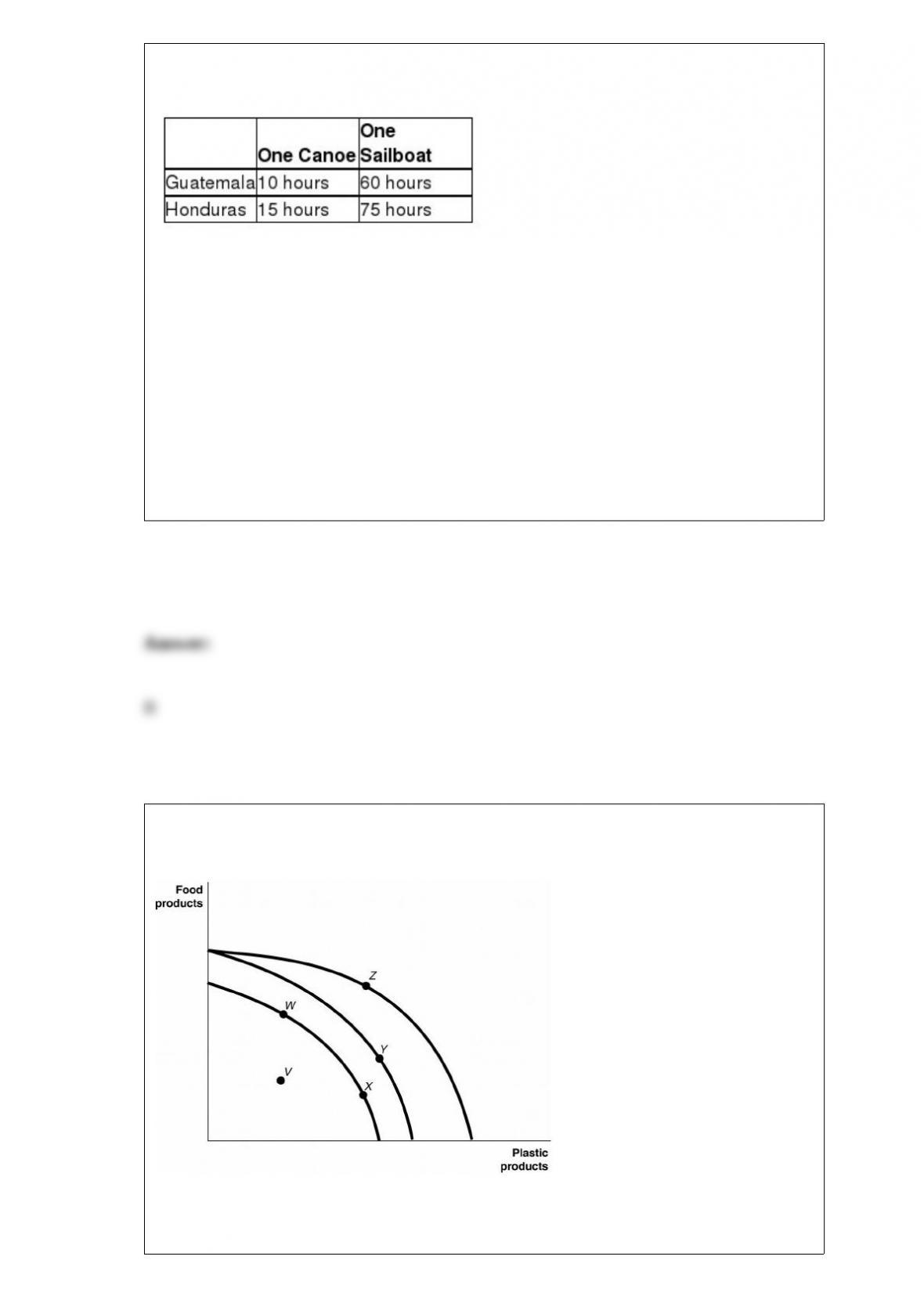
Table 2-9
Table 2-9 shows the number of labor hours required to produce a canoe and a sailboat in
Guatemala and Honduras.
Refer to Table 2-9. If the two countries specialize and trade, who should export canoes?
A) There is no basis for trade between the two countries.
B) Guatemala
C) Honduras
D) They should both be exporting canoes.
Figure 2-4
Figure 2-4 shows various points on three different production possibilities frontiers for
a nation.

Refer to Figure 2-4. Consider the following movements:
a. from point V to point W
b. from point W to point Y
c. from point Y to point Z
Which of the movements listed above represents advancements in technology with
respect to only plastic production?
A) a, b, and c
B) b and c only
C) b only
D) c only
The Bay Area subway system, BART, offers senior citizens discounted fares for BART
rides. This suggests that BART authorities believe that senior citizens have a ________
demand for subway rides.
A) more income elastic
B) less income elastic
C) more price elastic
D) less price elastic

The network of devices directly communicating data to a computer without a person
having to enter the data is known as
A) Big Data.
B) Artificial Intelligence.
C) the Internet of Things.
D) Synergistic Communications.
Between 1950 and 2015 the productivity of wheat farmers in the United States more
than doubled. This means that
A) the amount of land and other resources devoted to wheat production more than
doubled.
B) the incomes of wheat farmers more than doubled.
C) the total amount of wheat produced more than doubled.
D) the amount of wheat produced by the average farmer more than doubled.
Article Summary

Recent studies about wealth inequality and income inequality indicate that the
American public’s estimates of the distribution of wealth and income are quite different
than actual data suggests. With respect to wealth, the top 20 percent of households hold
more than 84% and the bottom 40 percent hold less than 1%, yet the public’s estimates
were 59% and 9%, respectively. In terms of income inequality, the public estimated that
the CEO-to-worker pay-ratio was 30-to-1, whereas data suggests the actual ratio is
354-to-1, up from 20-to-1 in the 1960s.
President Obama has referred to economic inequality as “the defining challenge of our
time,” and although Americans seem to recognize that income and wealth gaps have
widened, only 5 percent indicate that this inequality is a problem that needs to be
addressed.
Source: Nicholas Fitz, “Economic Inequality: It’s Far Worse Than You Think,”
Scientific American, March 31, 2015.
Refer to the Article Summary above. The article discusses wealth inequality, and for
some people this means a more equitable distribution of wealth is needed in the
economy. Would an equitable distribution of wealth necessarily be the most efficient
distribution of wealth?
A) Yes, equitable and efficient are two different words which have the same definition.
B) Yes, in order for the distribution to be equitable, it must also be efficient.
C) No, it is impossible to have an economically efficient distribution which is also an
equitable distribution.
D) No, an economically efficient distribution of wealth would not necessarily be
equitable.
According to the law of one price
A) if transaction costs are zero, identical goods should sell for the same price
everywhere.
B) if transactions costs are zero, firms must sell a product at a price equal to its
marginal cost.

C) if transactions costs are zero, all firms must earn the same profit margin.
D) there must be no differences in the cost of producing identical goods by different
producers.
What type of business has the potential for double taxation of profits and why?
List the five key determinants of price elasticity of demand and explain how each
determinant indicates if demand tends to be elastic or inelastic.

What are the five variables that will shift the demand curve?
Ronald Coase is famous for the Coase Theorem, which is based on the premise that
there is an economically efficient level of pollution reduction. Many economists believe
that the tradable emissions allowance program that has been used to deal with the
problem of acid rain has been successful in reducing emissions of sulfur dioxide in an
economically efficient manner. Why isn’t this program an example of the Coase
Theorem?

If your income is $40,000 and you pay taxes of $4,650, what is your average tax rate?
Show your work.
What three conditions must hold for a firm to successfully price discriminate?
What is a Pigovian tax? What happens to deadweight loss when a Pigovian tax is
implemented?

What do economists mean by an efficient tax?
Why would a company continue to operate for many years while never once turning a
profit rather than shut down immediately? Using revenue and cost analysis, explain
when the company would shut down.
What is producer surplus? What does producer surplus measure?

What is a tariff?
Are sellers who practice arbitrage taking advantage of buyers?
Explain how mandatory seat belt laws may reduce the negative externalities of risky
behavior.
How does a public good differ from a quasi-public good? In your answer give an
example of each type of good.
If firms do not earn economic profits in a competitive equilibrium, why would the firms
choose to stay in business?
Both the perfectly competitive firm and the monopolistically competitive firm produce
at the output where marginal revenue equals marginal cost (MR = MC) but only the
perfectly competitive firm achieves allocative efficiency. Explain why this is the case.
Table 18-3
Refer to Table 18-3. The table above outlines the rankings of three members of the U.S.
Senate on three spending alternatives. Assume that Congress can spend additional
revenue on only one of the three spending alternatives and that Bart, Lisa, and Maggie,
all members of the Senate, participate in a series of votes in which they are to determine
which of the spending alternatives should receive funding. Three votes will be taken:
(1) Immigration Reform and Unemployment Benefits (2) Immigration Reform and
Social Security Reform and (3) Unemployment Benefits and Social Security Reform.
Show the results of each vote and determine whether the voting paradox will occur as a
result of these votes.

From a supply perspective, what impact would an increase in the price of motorcycles
have on the market for motorcycles?
As the level of output increases, what happens to the value of average fixed cost, and
what happens to the difference between the value of average total cost and average
variable cost?
What is a production possibilities frontier? What do points along the frontier represent?
What do points inside and outside the frontier represent?