
1) Monetarists and rational expectations theorists generally agree that:
A.the Federal Reserve should adhere to a monetary rule.
B.the rate of interest and the price of bonds are positively or directly related.
C.the money supply cannot be measured and therefore cannot be controlled by the
Federal Reserve.
D.prices and wages are inflexible downward.
2) by summing the dollar value of all market transactions in the economy we would:
a.be determining the market value of all resources used in the production process.
b.obtain a sum substantially larger than the gdp.
c.be determining value added for the economy.
d.be measuring gdp.
3) Which of the following would most likely shift the aggregate demand curve to the
right?
A.An increase in stock prices that increases consumer wealth.
B.Increased fear that a recession will cause workers to lose their jobs.
C.An increase in personal income tax rates.
D.A reduction in household borrowing because of tighter lending practices.
4) The U.S. poverty rate for:
A.Hispanics is higher than that for African-Americans.
B.children under 18 years of age is higher than for the overall population.
C.African-Americans has increased since 1993.
D.foreign-born individuals who are not citizens is below the poverty rate for the general
population.
5) diminishing marginal utility explains why:
a.the income effect exceeds the substitution effect.
b.the substitution effect exceeds the income effect.
c.supply curves are upsloping.
d.demand curves are downsloping.

6) Suppose the economy is operating at its full-employment-noninflationary GDP and
the MPC is 0.75. The Federal government now finds that it must increase spending on
military goods by $21 billion in response to deterioration in the international political
situation. To sustain full-employment-noninflationary GDP government must:
A.reduce taxes by $28 billion.
B.reduce transfer payments by $21 billion.
C.increase taxes by $21 billion.
D.increase taxes by $28 billion.
7) the following table showing the demand schedule facing a nondiscriminating
monopolist:
refer to the above table. the monopolist will select its profit-maximizing level of output
somewhere within the:
a.3-5 unit range of output.
b.1-3 unit range of output.
c.1-4 unit range of output.
d.2-4 unit range of output.
8) The table below shows the marginal utility schedules for a soft drink (MUs) and an
energy drink (MUe). The price of the soft drink is $2 and the price of the energy drink
is $4. The consumers income is $10.
(a)If the consumer can only buy the soft drink, how much will the consumer buy and
what will be the total utility?
(b)If the consumer buys both the soft drink and the energy drink, how much will the
consumer buy to maximize utility? How much will total utility change?
Suppose another company decides to enter the energy drink market and the marginal
utility schedule for that firm is listed below. Their energy drink is price at $3.
(c)With the introduction of the new energy drink, what bundle will the consumer
choose to maximize utility? What will be the total level of utility?
(d)How do the results in (d) demonstrate possible benefits of diffusion for consumers?
9) Export supply curves are __________________; import demand curves are
___________________.
A.horizontal; vertical
B.vertical; horizontal
C.downsloping; upsloping
D.upsloping; downsloping
10) in national income accounting, g stands for:
a.government purchases.
b.gross investment.
c.government transfer payments.
d.gross saving.
11)
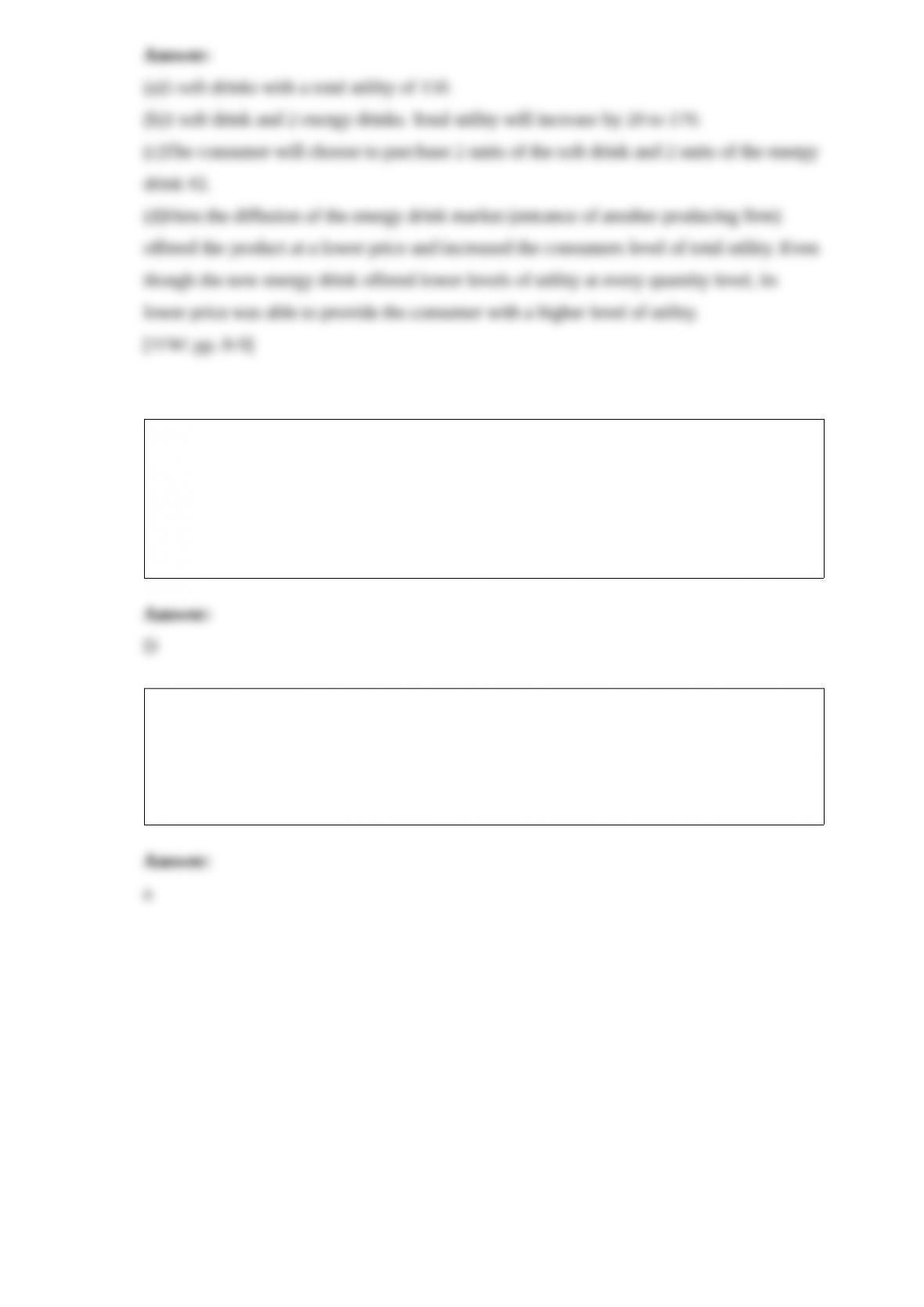
Which of the above diagrams best portrays the effects of a substantial reduction in
government spending?
A.A
B.B
C.C
D.D
12) Which of the following statements is correct?
A.Built-in stability only partially offsets fluctuations in economic activity.
B.Built-in stability works in halting inflation, but it cannot alleviate unemployment.
C.Built-in stability can be relied on to eliminate completely any fluctuation in economic
activity.
D.Built-in stability has eliminated the need for discretionary fiscal policy.
13) in the long run a pure monopolist will maximize profits by producing that output at
which marginal cost is equal to:
a.average total cost.
b.marginal revenue.
c.average variable cost.
d.average cost.
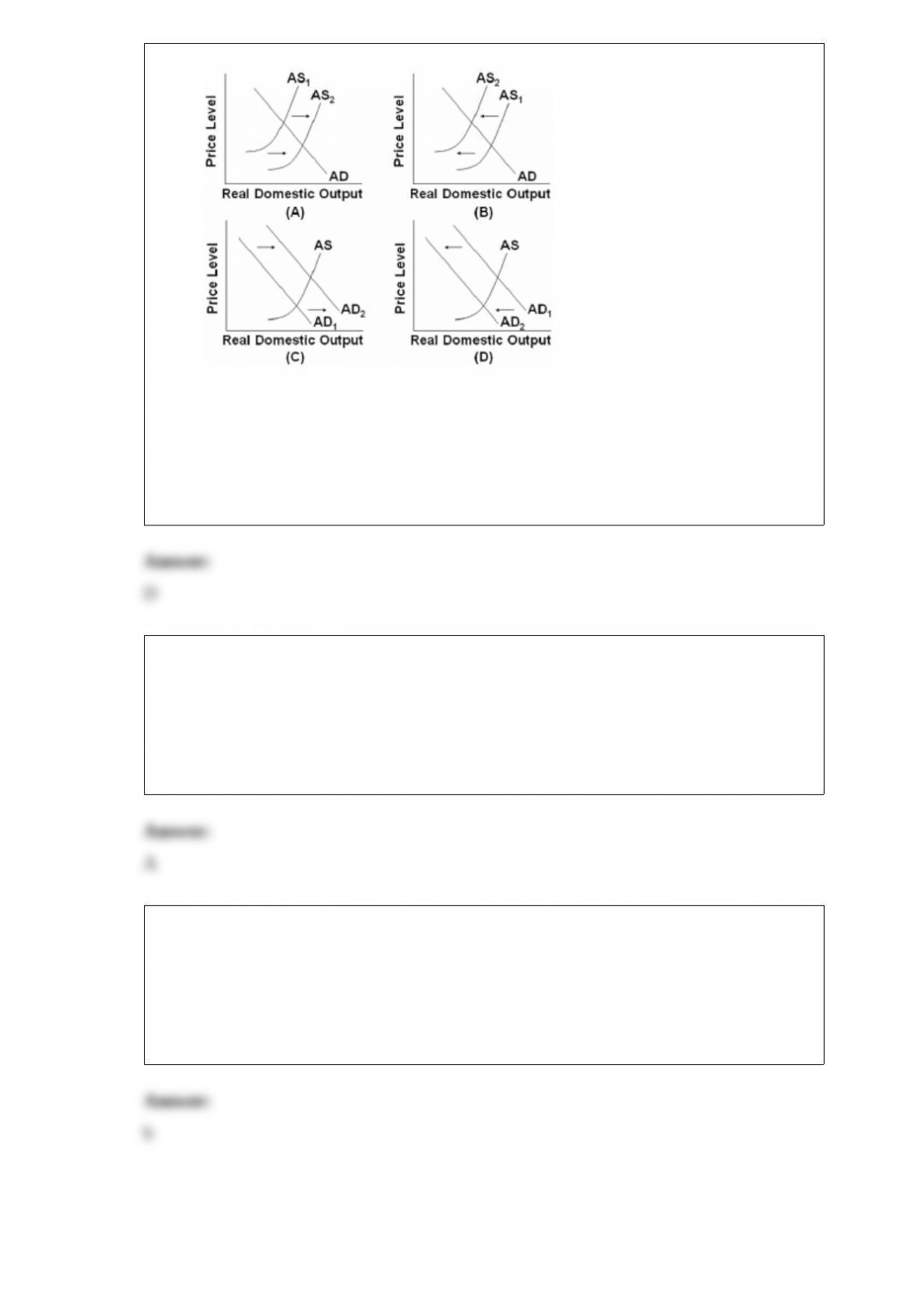
14)
The MB curves in the above diagram slope downward because of the law of:
A.conservation of matter and energy.
B.diminishing returns.
C.diminishing marginal utility.
D.increasing cost.
15)
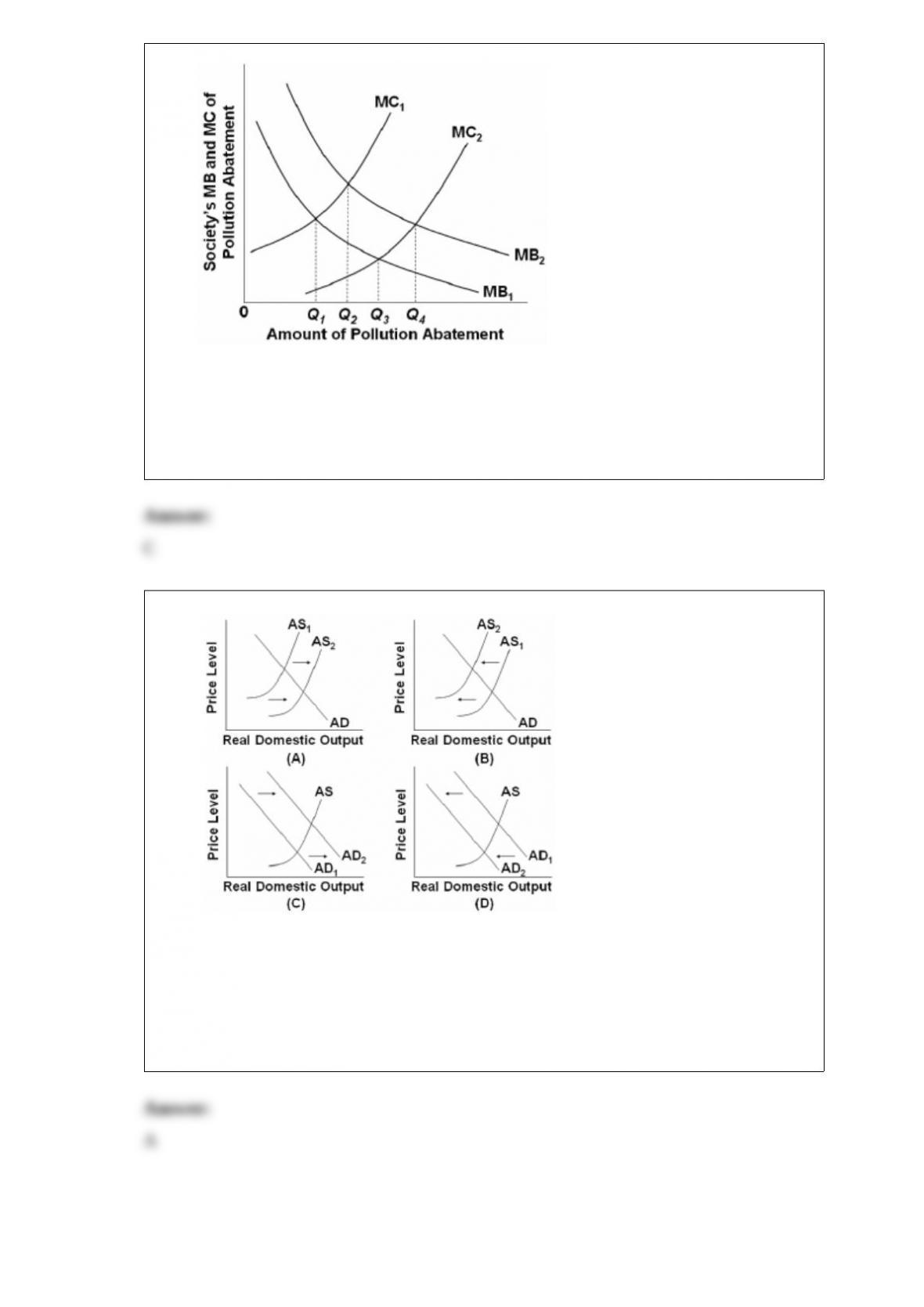
Which of the above diagrams best portrays the effects of declines in the prices of
imported resources?
A.A
B.B
C.C
D.D
16)
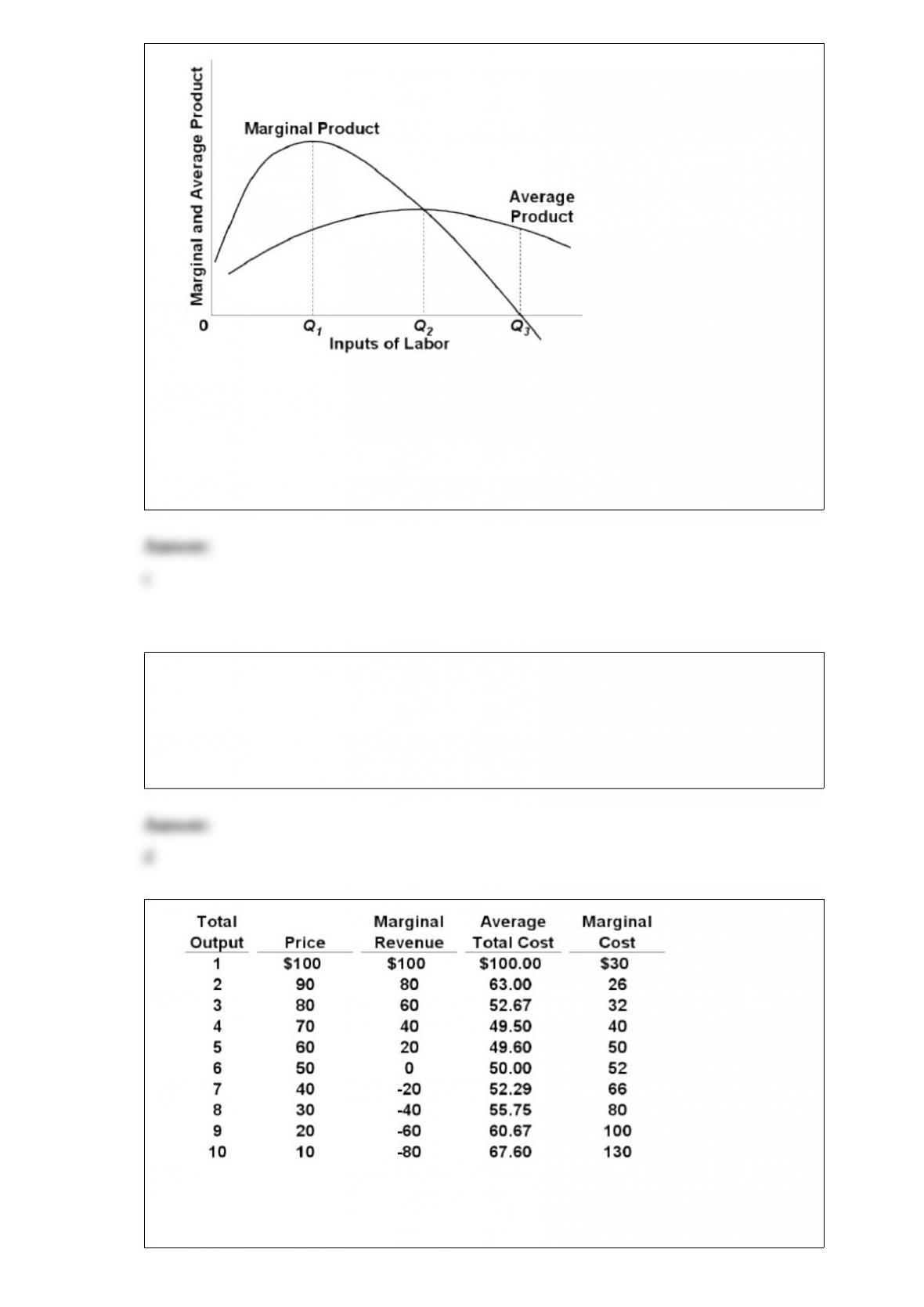
refer to the above diagram, where variable inputs of labor are being added to a constant
amount of property resources. the total output of this firm will cease to expand:
a.if a labor force in excess of q1 is employed.
b.if a labor force in excess of q2 is employed.
c.if a labor force in excess of q3 is employed.
d.only if the marginal product curve becomes negative at all levels of output.
17) in order to apply the concept of diminishing returns to study time:
a.the amount of study time available must be held constant.
b.study time must be considered a long-run production process.
c.all inputs to the learning process must be allowed to vary.
d.all inputs to the learning process except for study time must be assumed to be fixed.
18)
refer to the above data for a nondiscriminating monopolist. at its profit-maximizing
output, this firm’s total profit will be:
a.$82.

b.zero.
c.$54.
d.$27.