
A public franchise is a right granted
a. to one firm by another firm; for example, McDonald’s Corporation grants restaurant
owners a franchise to make its hamburgers.
b. to a firm by government that prevents other firms from producing the same product
or service.
c. to a cooperative of buyers that allows the group to purchase goods at wholesale
prices.
d. by government that enables a person to engage in arbitrage.
Resource allocative efficiency occurs when a firm
a. minimizes costs of production yet charges the highest possible price.
b. produces the quantity of output at which price exceeds average total cost by the
greatest amount.
c. produces the quantity of output at which price equals marginal cost.
d. produces the quantity of output at which price equals average total cost.
e. produces the quantity of output at which price equals average variable cost.
Suppose the current exchange rate between the U.S. dollar and the Mexican peso is

$0.12 = 1 peso. Furthermore, suppose the price level in the United States rises 25
percent at a time when the Mexican price level is stable. According to the purchasing
power parity theory, what will be the new equilibrium exchange rate?
a. $0.15 = 1 peso
b. $0.09 = 1 peso
c. $0.13 = 1 peso
d. $0.08 = 1 peso
Adverse selection exists when
a. the parties on one side of the market, who have information not known to others, self
select in a way that benefits the parties on the other side of the market.
b. the parties on one side of a market charge more for something than the parties on the
other side of the market want to pay.
c. one party to a transaction changes his or her behavior in a way that is hidden from
and costly to the other party.
d. the parties on one side of the market, who have information not known to others, self
select in a way that adversely affects the parties on the other side of the market.
e. none of the above

In reading the stock market quotes in the newspaper, the column with the heading
“Ticker” gives the
a. number of shares of the stock traded that day.
b. the full name of the company whose stock is being studied.
c. stock symbol for the company.
d. highest price the stock has sold for in the past year.
Marginal cost is the change in
a. total cost that results from a change in output.
b. total revenue that results from a change in output.
c. fixed cost that results from a change in output.
d. a and b
e. all of the above
Some monopolistic competitive firms earn positive economic profits in the long run
because
a. there are high barriers to entry in monopolistic competition.

b. they have successfully differentiated their products from their competitors’ products.
c. there is easy entry and exit.
d. b and c
e. none of the above
For a normal good, __________ falls as income __________; for an inferior good,
__________ rises as income __________.
a. demand; falls; demand; falls
b. demand; rises; demand; rises
c. supply; falls; demand; falls
d. supply; rises; supply; falls
Refer to Exhibit 28-11. The firm in the exhibit is a monopsony. We have deliberately
not identified the three curves in the exhibit. They are simply curves 1, 2, and 3. If
(union) collective bargaining with the monopsony guarantees the wage rate that
workers will be paid is W2, then the factor supply curve is
Exhibit 28-11
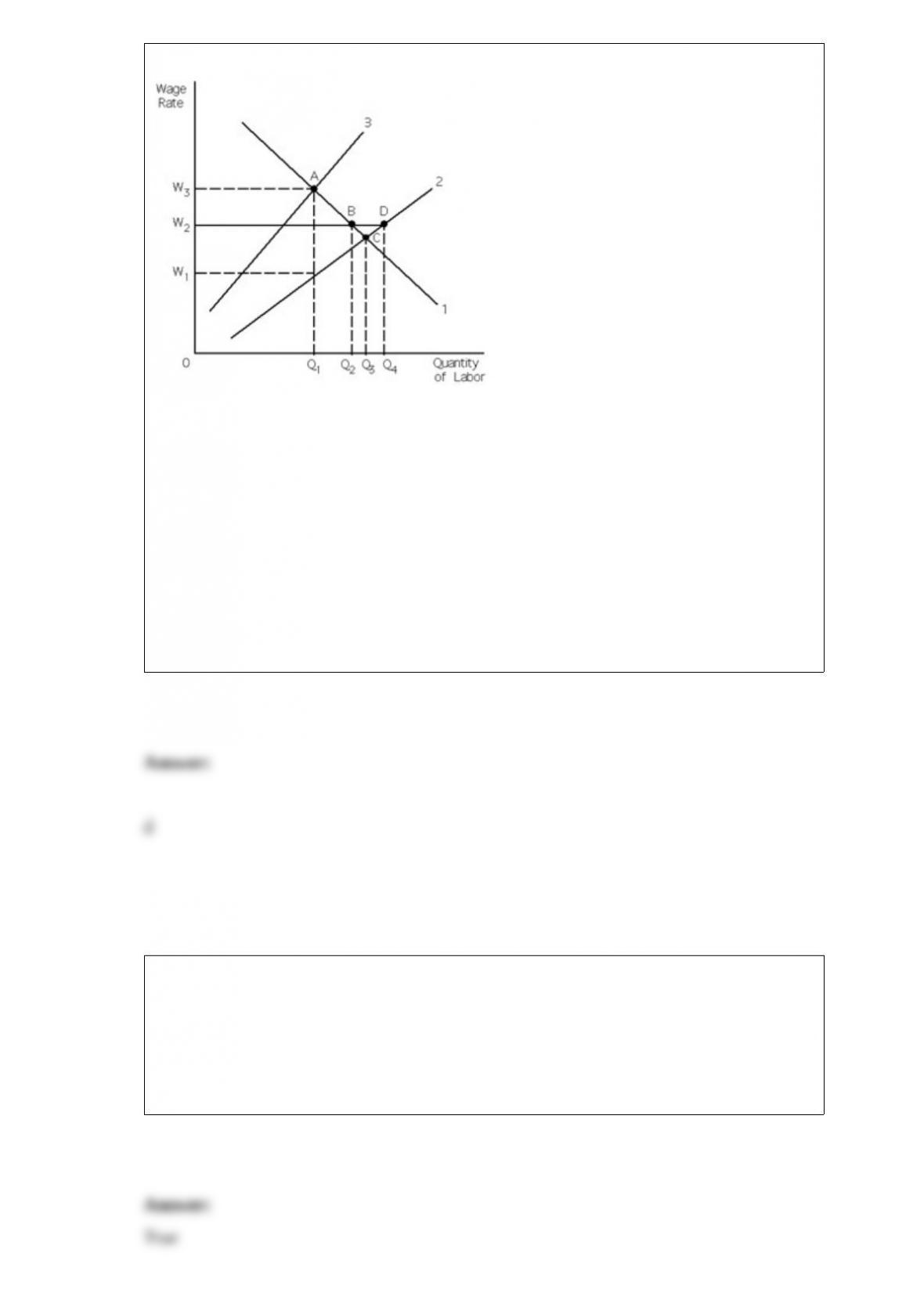
a. curve 2.
b. curve 3.
c. the curve that starts at W2, goes to point B, then down to point C, then moves up
curve 2.
d. the curve that starts at W2, goes to point D, and then moves up curve 2.
e. the curve that starts at W2 and goes to point D.
When people treat some dollars differently than others, they are said to be
compartmentalizing.
a. True
b. False
Suppose it has just been discovered that working for long periods of time at a computer
terminal causes eye strain, poor posture, and stress. We would expect, ceteris paribus,
that the supply curve of computer programmers would shift __________ and the wage
rate paid to programmers would __________.
a. rightward; decrease
b. rightward; increase
c. leftward; decrease
d. leftward; increase
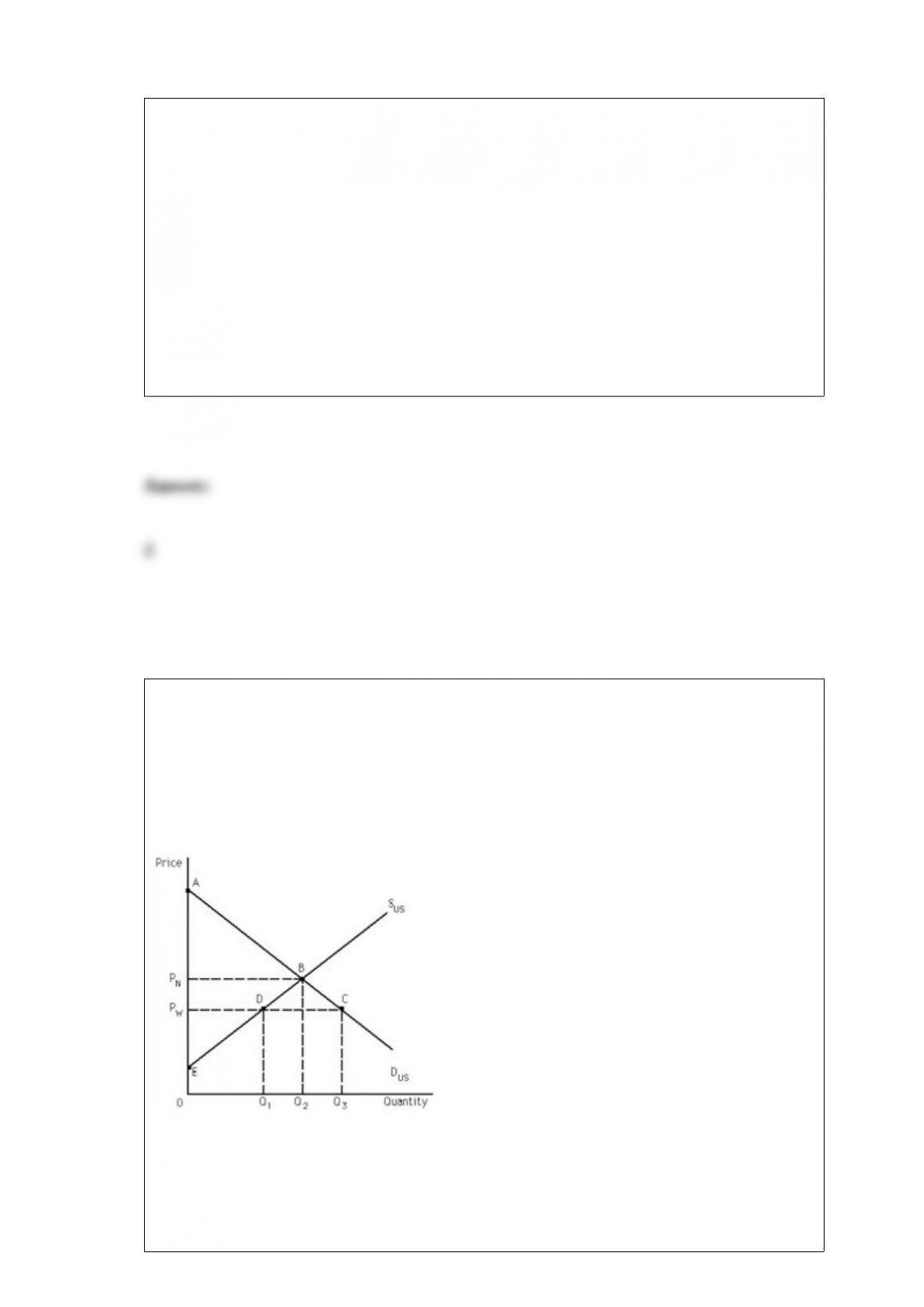
Refer to Exhibit 34-2. The U.S. demand and supply for a good are shown. Under a
policy of free trade, the world price is PW. At this price, what quantity of this good do
U.S. consumers buy from U.S. producers and what quantity do they import from
foreign producers?
Exhibit 34-2
a. Q1 from U.S. producers and (Q3 – Q1) from foreign producers
b. Q2 from U.S. producers and (Q3 – Q1) from foreign producers
c. (Q3 – Q1) from U.S. producers and Q1 from foreign producers
d. Q3 from U.S. producers and nothing from foreign producers
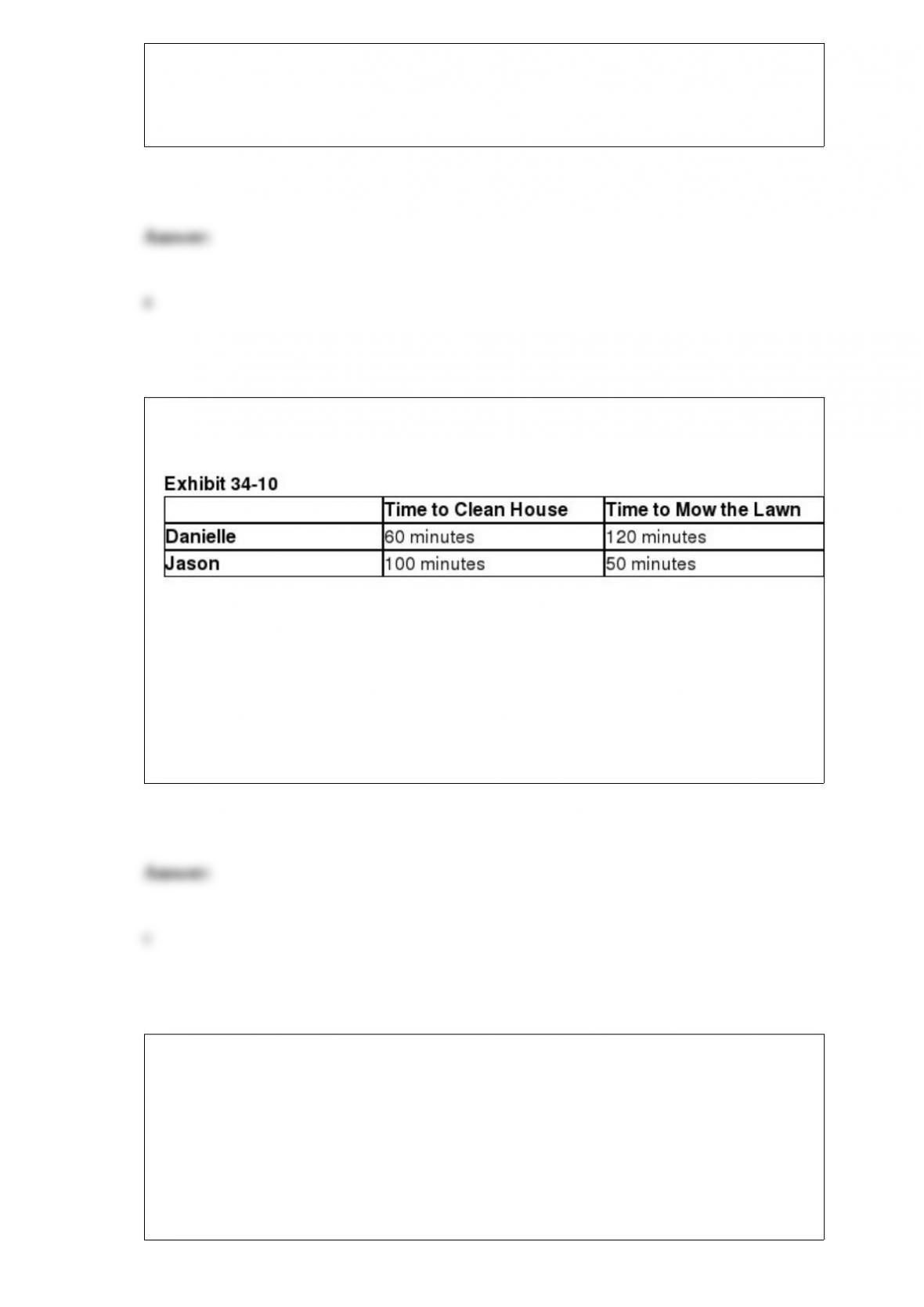
Refer to Exhibit 34-10.Jason’s opportunity cost of cleaning the house is
a. 0.50 mowed lawns.
b. 1.00 mowed lawns.
c. 2.00 mowed lawns.
d. 0.60 mowed lawns.
Consider two points on the PPF: point A, at which there are 50 oranges and 100
apricots, and point B, at which there are 51 oranges and 98 apricots. If the economy is
currently at point B, the opportunity cost of moving to point A is
a. 2 apricots.
b. 1 orange.

c. 98 apricots.
d. 3 oranges.
If, as a result of market forces, the exchange rate changes from $1 equals 11 pesos to $1
equals 9 pesos, then the dollar has
a. appreciated.
b. been revalued.
c. been devalued.
d. depreciated.
e. There is not enough information to answer the question.
Refer to Exhibit 4-8.Suppose that wheat producerslobby the government for a price
floor and receive one.This price floor is set at PF.What is the size of the producers’
surplus at PF?
Exhibit 4-8
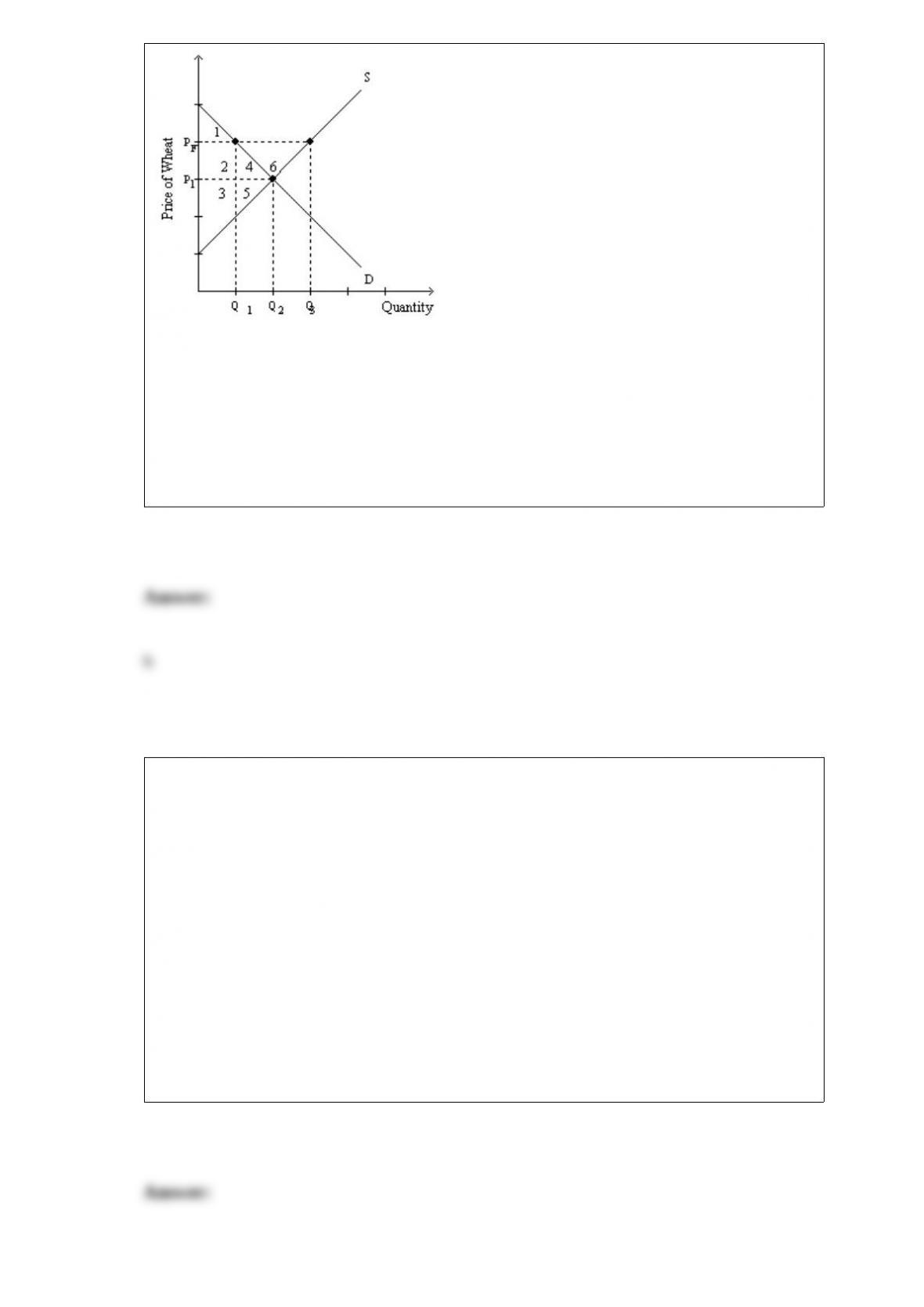
a. area 2 + 3 + 4 + 5
b. area 2 + 3
c. area 4
d. area 6
Assuming the wage-employment tradeoff exists, if labor in a particular geographic area
is homogeneous and the unionized workers successfully negotiate a higher wage rate,
then
a. nonunion workers will also experience an increase in their wages.
b. nonunion workers will not be affected by what happens in the unionized labor
market.
c. the nonunion labor market will experience an increase in the number of workers, and
this will cause wage rates to decrease in this market.
d. nonunion workers will become members of the union that has just negotiated a wage
increase because they want higher wages.
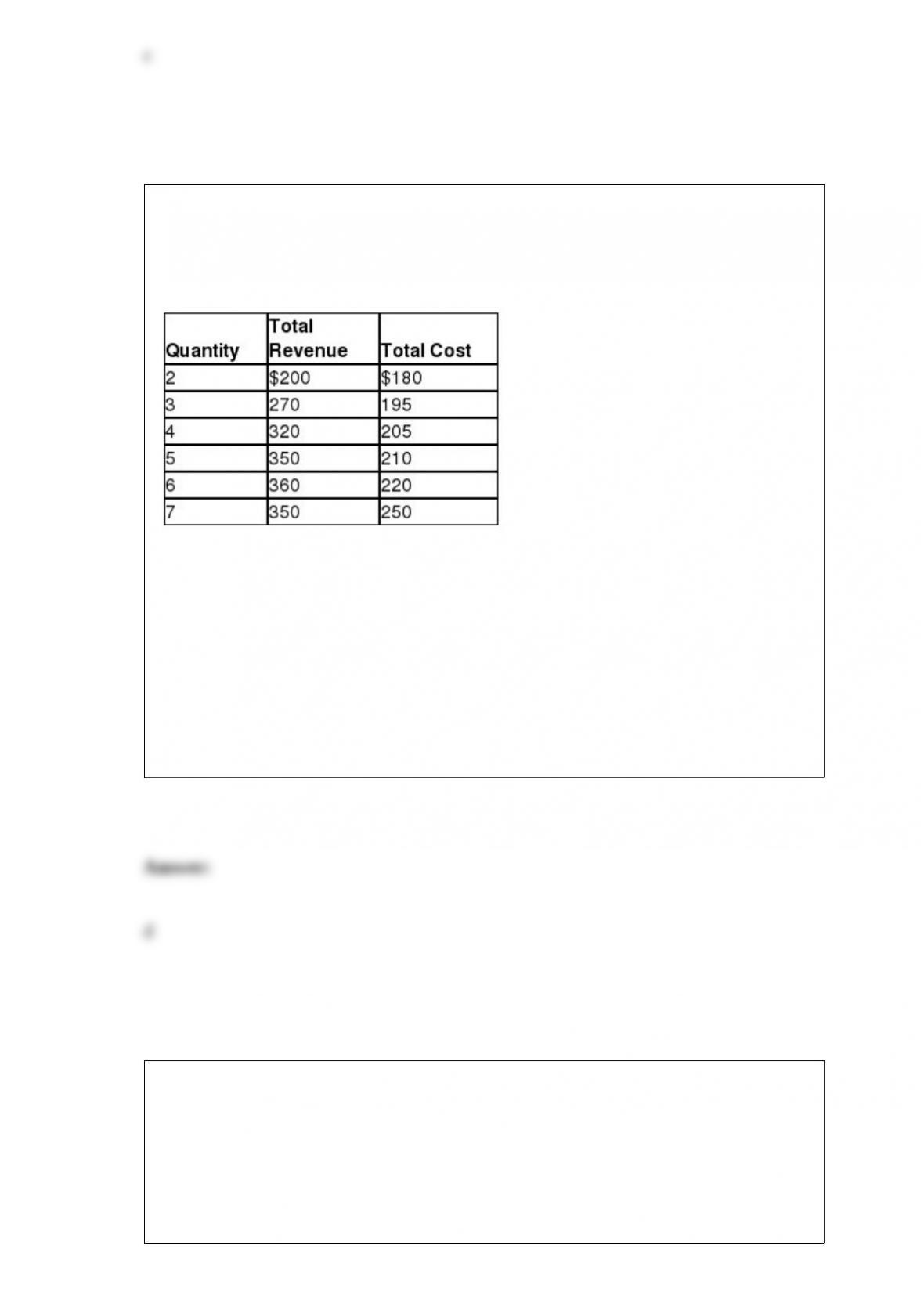
Refer to Exhibit 25-8. A profit-maximizing monopolistic competitive firm that produces
the level of output where MR = MC will produce ______________ units of output and
charge a price of ______________.
Exhibit 25-8
a. 3; $90
b. 4; $80
c. 5; $42
d. 6; $60
e. 7; $50
Through war, many of the factories in country 1 are destroyed and many of its people
are killed. As a result, the country’s
a. production possibilities frontier (PPF) after the war has probably shifted to the right
compared to its PPF prior to the war.
b. PPF after the war has probably shifted to the left compared to its PPF prior to the

war.
c. PPF after the war is probably the same PPF as before the war.
d. ability to produce goods and services has increased.
e. b and d
Simple majority voting will generate the same result whether taxes are equally divided
or unequally divided.
a. True
b. False
Profit helps to indicate where resources are best allocated.
a. True
b. False

Which of the following is not a condition of a contestable market?
a. There is easy entry into and costless exit from the market.
b. New firms entering the market can produce the product at the same cost as current
firms.
c. Firms exiting the market can easily dispose of their fixed assets by selling them
elsewhere.
d. New firms entering the market produce a higher-quality product than existing firms.
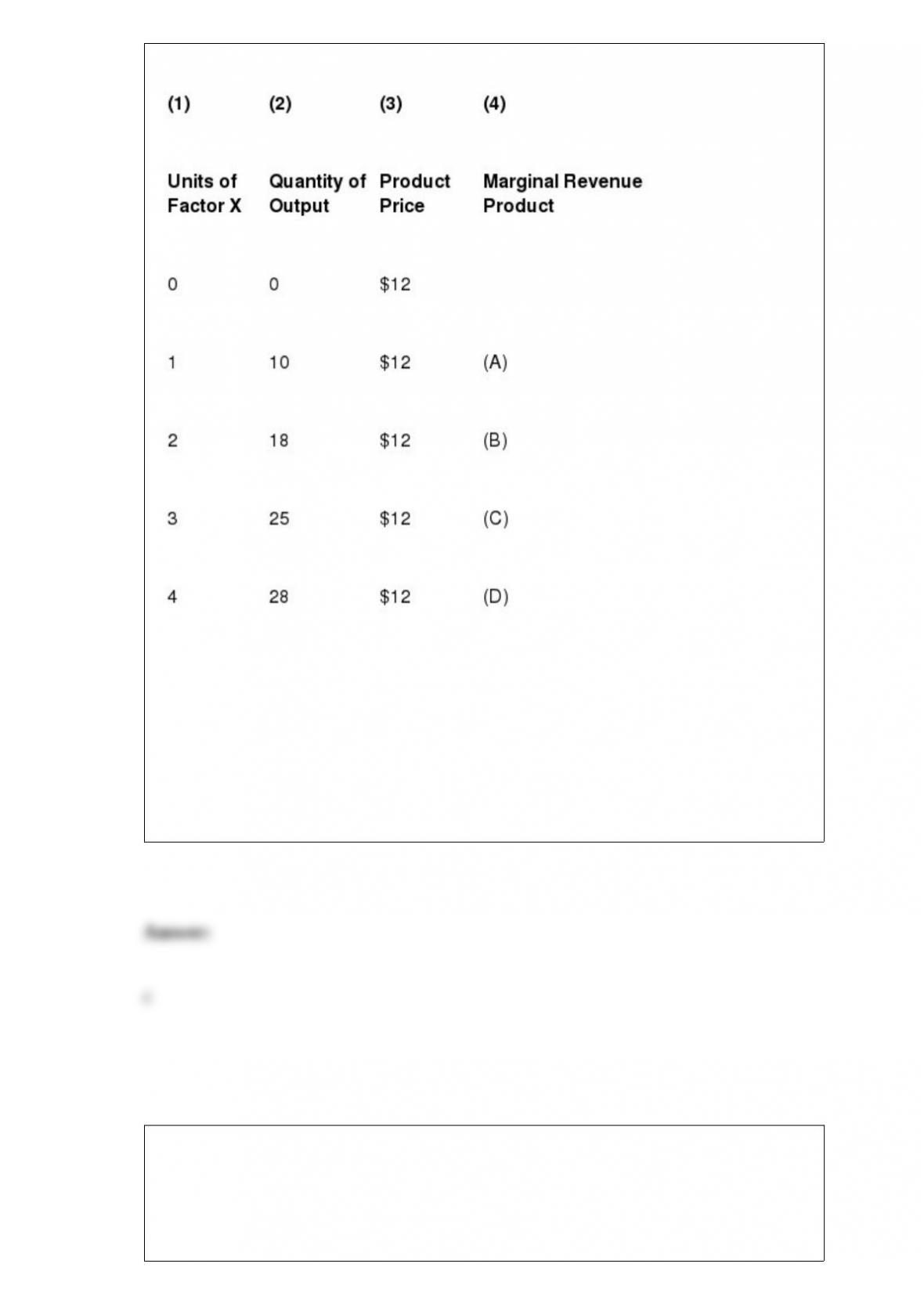
Refer to Exhibit 27-1. What dollar value goes in blank (D)?
Exhibit 27-1
a. $12
b. $28
c. $36
d. $18
The act that made tying contracts illegal was the
a. Clayton Act.
b. Robinson-Patman Act.

c. Federal Trade Commission Act.
d. Wheeler-Lea Act.
e. Celler-Kefauver Antimerger Act.
The point where the PPF intersects the horizontal axis is
a. unattainable.
b. attainable and productive efficient.
c. attainable but productive inefficient.
d. attainable and neither productive efficient nor productive inefficient.
Whatdoes the demand curve faced by a monopolistic competitive firm look like?
Explain why it is sloped this way, and what this implies about the relationship that
exists between price and marginal revenue under monopolistic competition.
Describe the law of diminishing marginal returns. How does it relate to the shape of the
marginal cost (MC) curve?
Define the term scarcity and discuss two of its consequences.

Explain how the purchase of futures contracts can help to insure a farmer against
adverse swings in the prices of the crops that he grows.
What is the difference between macroeconomics and microeconomics? Give an
example of a question that a macroeconomist might be interested in answering, then do
the same for a microeconomist.