1)
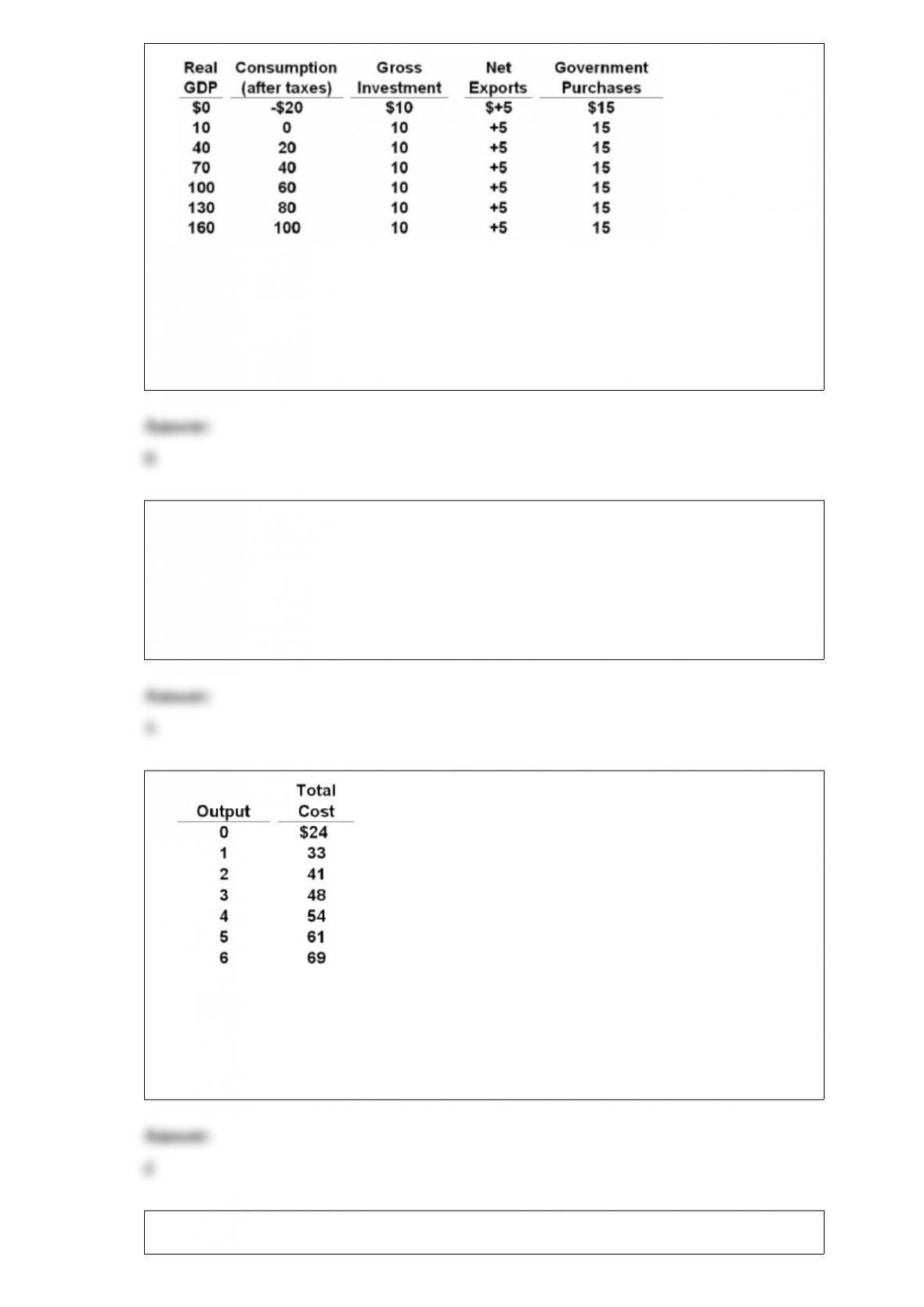
Refer to the above table. If the full-employment real GDP is $40 the:
A.inflationary expenditure gap is $20.
B.inflationary expenditure gap is $10.
C.recessionary expenditure gap is $30.
D.recessionary expenditure gap is $10.
2) A demand curve for a public good is determined by:
A.summing vertically the individual demand curves for the public good.
B.summing horizontally the individual demand curves for the public good.
C.combining the amounts of the public good that the individual members of society
demand at each price.
D.multiplying the per-unit cost of the public good by the quantity made available.
3)
refer to the above data. the marginal cost of producing the sixth unit of output is:
a.$24.
b.$12.
c.$16.
d.$8.
4) If the amount of money demanded exceeds the amount supplied, the:
A.demand-for-money curve will shift to the left.
B.money supply curve will shift to the right.
C.interest rate will rise.
D.interest rate will fall.
5) marginal product becomes negative with the hiring of the __________ unit of labor.
a.third
b.fourth
c.sixth
d.seventh
6)
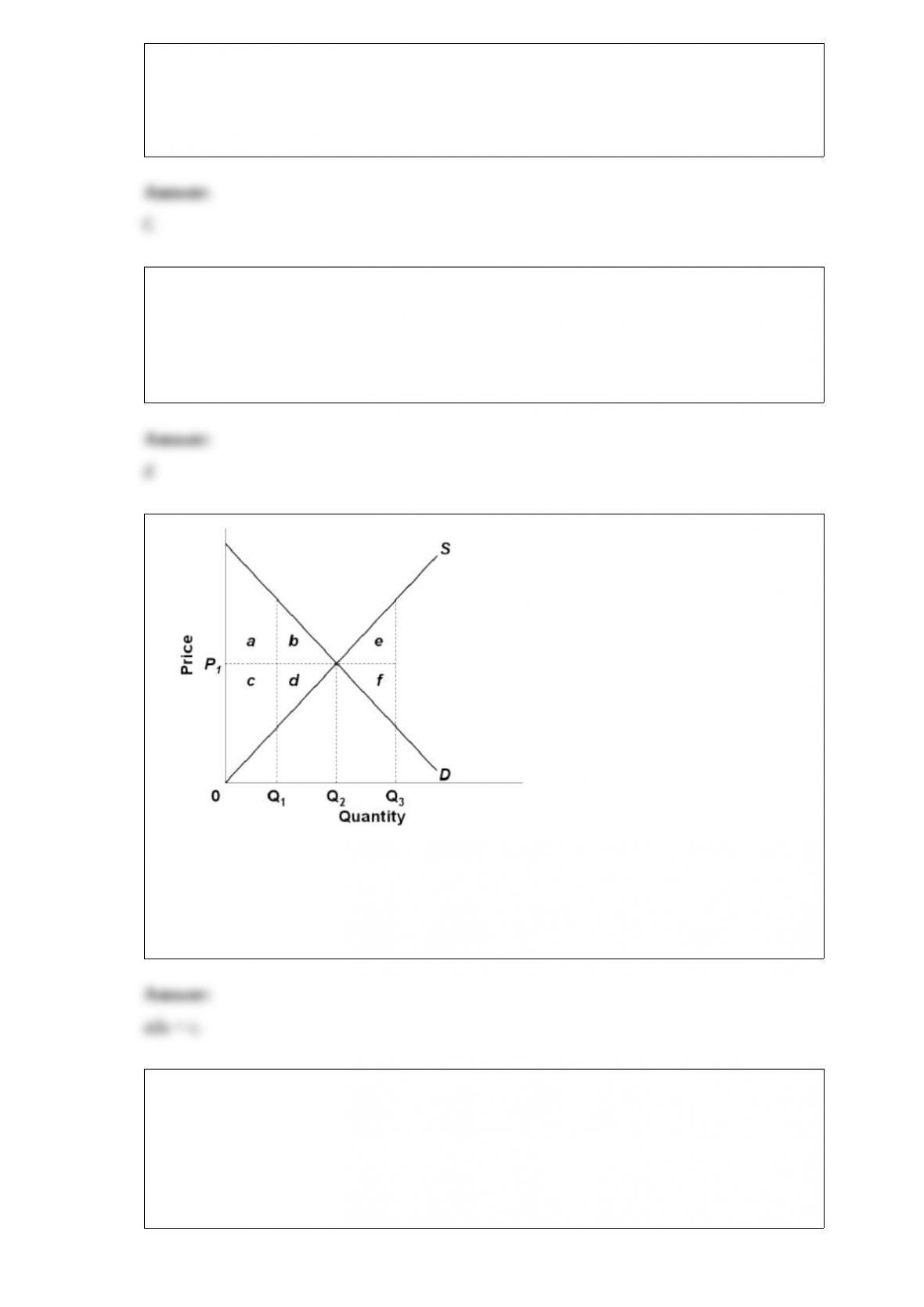
refer to the above diagram. assuming equilibrium price p1, consumer surplus is
represented by areas:
a.a + b.
b.a + b + c + d.
c.c + d.
7) the use of money contributes to economic efficiency because:
a.governmental direction of the production and distribution of output can be avoided by
using money.
b.roundabout production could not occur without the availability of money.
c.it is necessary for the creation of capital goods.
d.it promotes specialization by overcoming the problems with barter.

8) which of the following statements is true about price ceilings?
a.price ceilings cause goods to be rationed.
b.price ceilings cause goods to be rationed by some other means than legally
determined market prices.
c.ration coupons are the only way to ration goods when price ceilings are in place.
d.all of the above statements are correct.
9) suppose industry a is realizing substantial economic profit. which of the following
best describes what will happen in this competitive market?
a.firms will leave the industry and output will fall.
b.firms will enter the industry and output will fall.
c.firms will leave the industry and output will rise.
d.firms will enter the industry and output will rise.
10) When critics of U.S. farm policy say that it treats symptoms rather than causes, they
mean that the:
A.policy attempts to bolster low farm income, while the real problem is an
overallocation of resources to agriculture.
B.policy deals with the overallocation of resources to agriculture, while the basic farm
problem is low incomes.
C.policy attempts to bolster low farm incomes, while the real problem is an
underallocation of resources to agriculture.
D.restriction of output in the short run may reduce productive capacity in agriculture in
the long run.
11) national income measures:
a.nominal gdp after it has been inflated or deflated for changes in the value of the
dollar.
b.the after-tax income of resource suppliers.
c.the total of all sources of private income plus government revenue from taxes on
production and imports.
d.the amount of wage, rent, interest, and profits income actually received by
households.

12) Which one of the following, other things equal, will directly alter the United States
balance of trade?
A.an increase in the balance on capital account
B.a decrease in U.S. goods exports
C.an increase in net transfers
D.a decrease in U.S. purchases of assets abroad
13) (Consider This) Which of the following has been an effect of the U.S. government’s
ethanol program?
A.Prices for crops such as soybeans and sorghum have fallen dramatically.
B.Prices for beef, pork, and chicken have risen.
C.Water use has declined as corn is a less water-intensive crop.
D.All of these effects have resulted from the ethanol program.
14) The exercise of market power by suppliers in resource markets tends to:
A.reduce income inequality ensuring that all workers receive fair wages.
B.have little impact on the distribution of income.
C.increase income inequality by raising incomes of those able to “rig the market.”
D.increase income inequality but is offset by the exercise of market power in product
markets.
15) if a pure monopolist is producing at that output where p = atc, then:
a.its economic profits will be zero.
b.it will be realizing losses.
c.it will be producing less than the profit-maximizing level of output.
d.it will be realizing an economic profit.
16) for which of the following reasons do economic growth rates tend to understate the
growth of economic well-being?

a.products and services tend to improve over time.
b.leisure time increases over time.
c.new cleaner technologies often replace older, less environmentally-friendly
technology.
d.all of these.
17) which of the following will cause a decrease in market equilibrium price and an
increase in equilibrium quantity?
a.an increase in supply.
b.an increase in demand.
c.a decrease in supply.
d.a decrease in demand.
18) as a percentage of gdp, u.s. health care spending is:
a.higher than that for germany and japan, but lower than that of the united kingdom and
sweden.
b.higher than for any other major industrial country.
c.lower than that for canada.
d.nearly identical to that of the other major industrial nations.