
Which of the following explains why purchasing power parity may not hold perfectly in
the long run?
A) Most countries have free markets with limited government regulation.
B) Consumer preferences for goods and services across countries are very similar.
C) Most countries do not impost trade barriers.
D) Some goods and services produced in any country are not traded internationally.
Which of the following events would most likely be considered a macroeconomic
shock?
A) A drought destroys 25% of the strawberry crop in California.
B) Mismanagement results in a federal takeover of the largest credit union in the United
States.
C) OPEC unexpectedly announces a 40% reduction in oil production.
D) The Federal Reserve decides to increase the discount rate by 0.25% for the third
time in 12 months.
Jonathan quit his job as a shoe salesman and is actively searching for employment in
the field in which he has a bachelor’s degree, accounting. Jonathan would best be
categorized as

A) frictionally unemployed.
B) structurally unemployed.
C) cyclically unemployed.
D) seasonally unemployed.
The main fiscal policy challenge for the future in the United States is rising expenditure
on
A) transfer programs.
B) education.
C) national defense.
D) the net interest on the federal debt.
The supply curves for labor and capital are ________ and the demand curves for labor
and capital are ________.
A) upward sloping; downward sloping
B) vertical; horizontal

C) vertical; downward sloping
D) upward sloping; vertical
Other things equal, a decrease in the personal income tax rate will ________ disposable
income, which leads to ________ in output and employment.
A) increase; an increase
B) increase; a decrease
C) decrease; an increase
D) decrease; a decrease
Figure 10.9
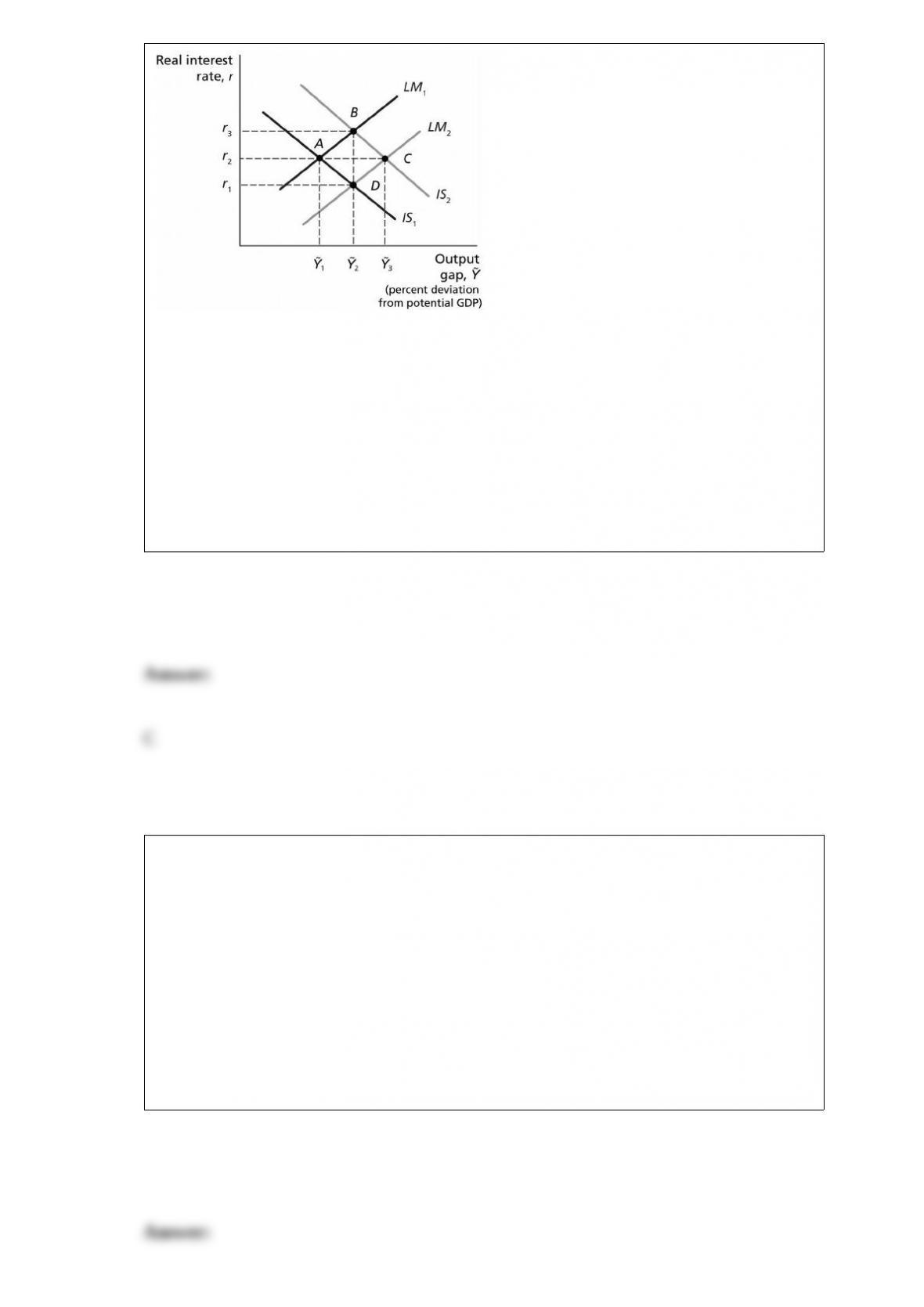
Refer to Figure 10.9. Other things equal, a decrease in the nominal money supply by
the Fed is best represented as a change in equilibrium from
A) point A to point B.
B) point A to point D.
C) point C to point B.
D) point C to point D.
The idea that additional spending on research and development will produce additional
knowledge that may further increase the productivity of capital is an argument used by
some economists to claim that knowledge is subject to ________ returns.
A) decreasing
B) increasing
C) constant
D) negative

Suppose that the production function for the economy is: Y = AK1/4L3/4. Assume that
real GDP is $8,000 billion, capital stock is $32,000 billion, and the labor supply is 120
million (or 0.120 billion) workers. An increase of one worker will increase real GDP by
A) $8.
B) $50,000.
C) $720,000.
D) $6,000,000.
The underlying fluctuations in real GDP due to the business cycle are reflected by
fluctuations in
A) inflation.
B) population growth.
C) the labor force.
D) real GDP per capita.

Figure 5.1
Refer to Figure 5.1. All else equal, an increase in the capital stock will cause a
A) shift from PF1 to PF2.
B) shift from PF2 to PF1.
C) movement up and to the right along PF1.
D) movement down and to the left along PF2.
Based on the conventional view of fiscal policy and potential GDP in the long run,
explain what happens to each of the following if the government runs a budget deficit:
a. the supply of loanable funds to the private sector
b. long-term real interest rates
c. the capital stock
d. the investment rate
e. potential GDP

If nominal GDP in 2012 was less than real GDP in 2012, we know for certain that
A) the price level in 2012 was greater than the price level in the base year.
B) real GDP in 2012 was greater than real GDP in the base year.
C) the price level in 2012 was less than the price level in the base year.
D) real GDP in 2012 was less than real GDP in the base year.
The marginal product of labor is always ________ and it ________ as the labor stock
increases.
A) positive; increases
B) positive; decreases
C) negative; increases
D) negative; decreases
The part of the balance of payments that records (generally) minor transactions such
migrant’s transfers, copyrights, and trademarks is the
A) capital account.
B) current account.
C) financial account.
D) statistical discrepancy account.
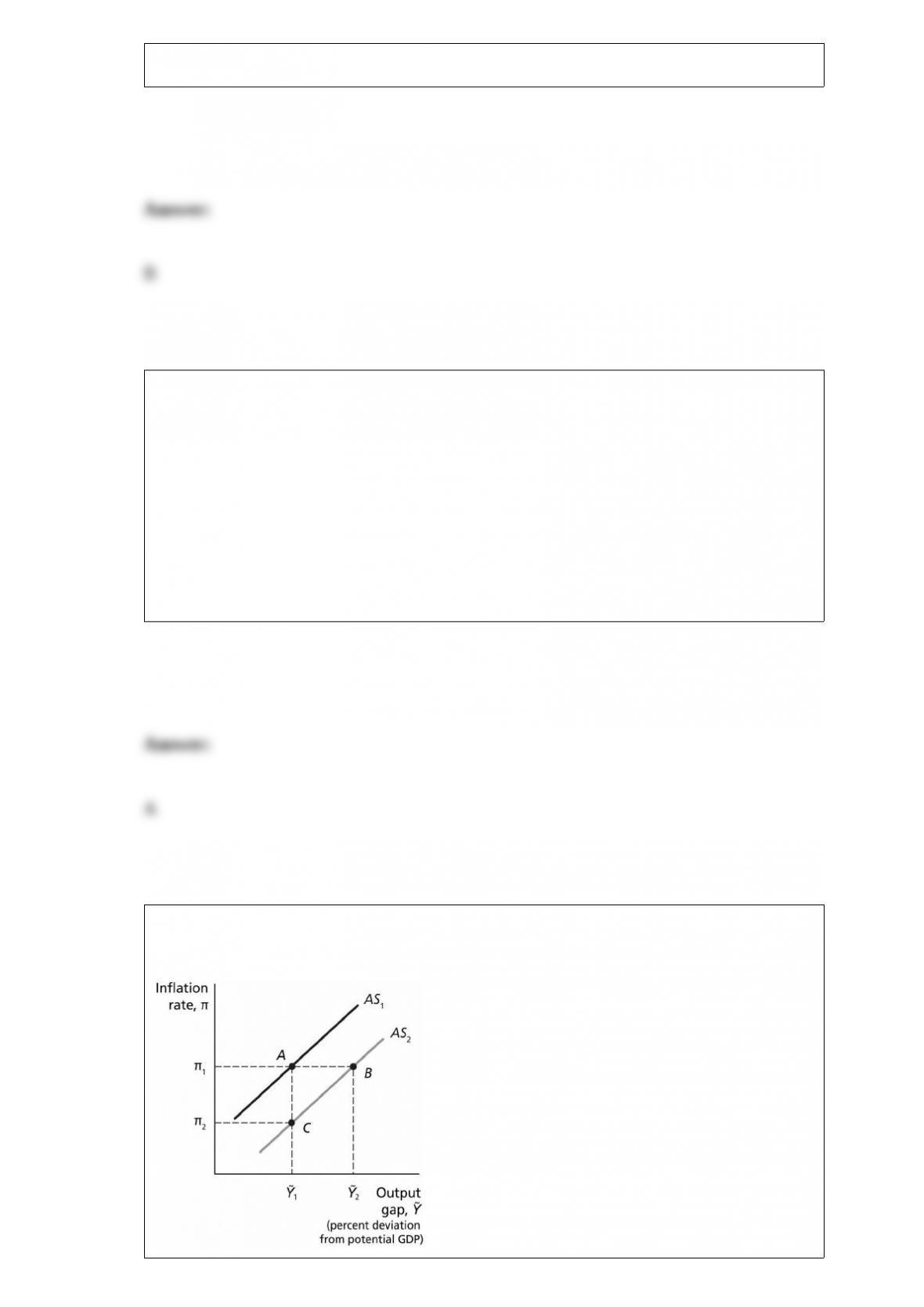
Figure 14.2

Refer to Figure 14.2. Other things equal, an increase in the expected price of an
important natural resource would best be represented by a movement from
A) point A to point B.
B) point B to point A.
C) point B to point C.
D) point A to point C.
In the Solow growth model, if the level of investment is less than depreciation at the
initial capital-labor ratio , then △k is ________ and the capital-labor ratio ________
toward the steady-state capital-labor ratio.
A) greater than zero; increases
B) greater than zero; decreases
C) less than zero; increases
D) less than zero; decreases
to decrease bank reserves, the Fed can
A) engage in an open market sale.

B) reduce reserve requirements.
C) lower the discount rate.
D) set a lower interest rate for term deposits.
Suppose that the production function for the economy is Y = AK1/4L3/4. Assume that
real GDP is $8,000 billion, capital stock is $32,000 billion, and the labor supply is 120
million (or 0.120 billion) workers. Total factor productivity for this economy is
A) 50
B) 1,016.52
C) 2,083.33
D) 2,933.65
All of the following are costs of expected inflation except
A) seigniorage.
B) menu costs.
C) velocity costs.
D) tax distortions.
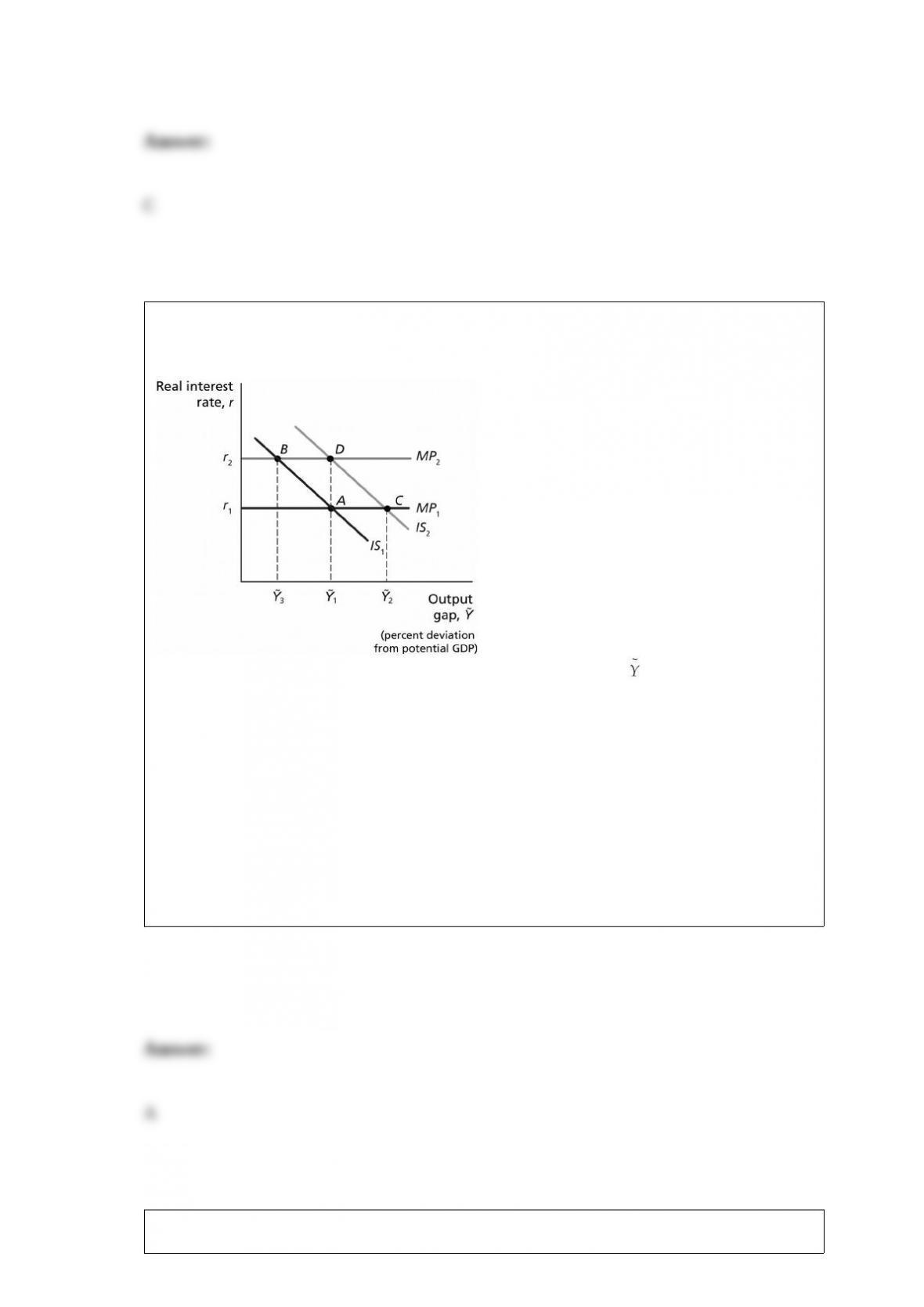
Figure 11.2
Refer to Figure 11.2. Assume the economy is in equilibrium at 1, where real GDP
equals potential GDP, and then the economy experiences a positive demand shock.
Other things equal, the positive demand shock is best represented by a(n)
A) movement up along the Phillips curve.
B) movement down along the Phillips curve.
C) upward shift of the Phillips curve.
D) downward shift of the Phillips curve.
The quantity theory of money predicts that, in the long run, inflation results from the

A) money supply growing at a slower rate than real GDP.
B) money supply growing at a faster rate than real GDP.
C) velocity of money growing at a slower rate than real GDP.
D) velocity of money growing at a faster rate than real GDP.
Which of the following is an example of a fiscal policy?
A) The Federal Reserve takes action to increase the money supply during an economic
recession.
B) The federal government increases infrastructure spending during an economic
recession.
C) The Federal Reserve decreases interest rates during an economic recession.
D) Businesses begin to lay off employees and cut back on spending during an economic
recession.
By acting as a lender of last resort during a banking panic, a central bank allows
commercial banks to
A) encourage the public to borrow directly from the central bank, taking pressure of the
banking system.

B) satisfy customer withdrawal needs and eventually restore the public’s faith in the
banking system.
C) call in their loans to their customers and eventually restore the public’s faith in the
banking system.
D) make additional loans to increase the assets on their balance sheets.
Suppose the economy is in equilibrium with an output gap equal to zero and the actual
inflation rate equals the expected inflation rate. If the economy experiences a positive
demand shock, the output gap will ________ and the inflation rate will ________.
A) increase; increase
B) increase; decrease
C) decrease; increase
D) decrease; decrease
The effects of tax incentive programs such as IRAs and 401(k) accounts suggest that
these government programs designed to increase saving lead to ________ in the private
capital stock.
A) virtually no change
B) a slight decrease
C) a slight increase
D) a significant increase
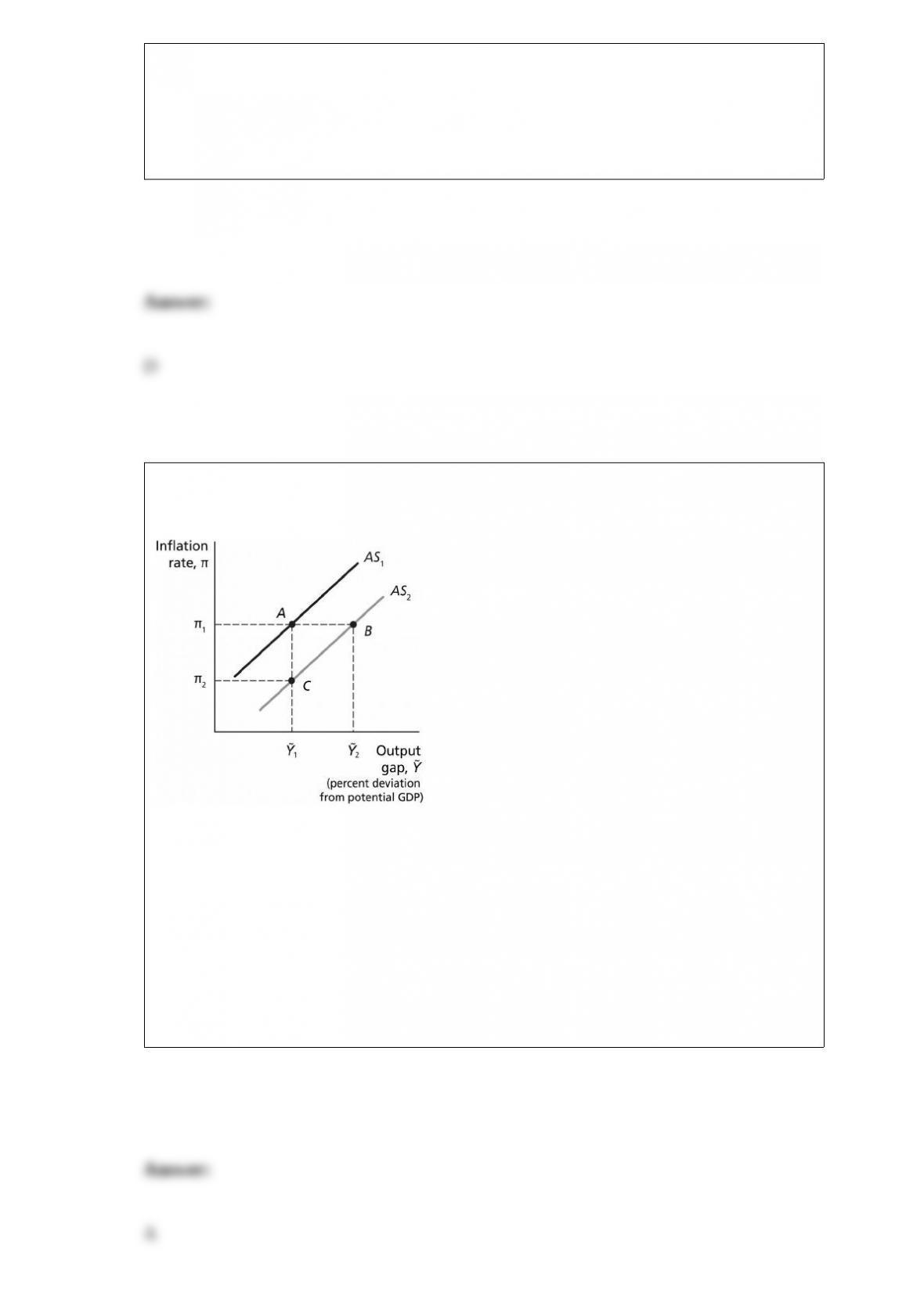
Figure 14.2
Refer to Figure 14.2. Other things equal, a decrease in inflationary expectations would
best be represented by a movement from
A) point A to point B.
B) point B to point A.
C) point C to point B.
D) point B to point C.

Labor productivity refers to the quantity of goods and services that can be produced
A) by the entire labor force.
B) by one worker or one hour of work.
C) in the entire economy in one year.
D) by all employed workers.
Which of the following best explains the cause of the change in the unemployment rate
at the end of a recession?
A) Firms rapidly hire new workers at the first sign of an increase in demand for their
goods.
B) Firms are hesitant to rehire laid-off workers as they continue to operate below
capacity.
C) Discouraged workers begin to return to the labor force, causing the unemployment
rate to fall.
D) Frictionally unemployed workers find it easier to gain employment, lowering the
natural rate of unemployment.
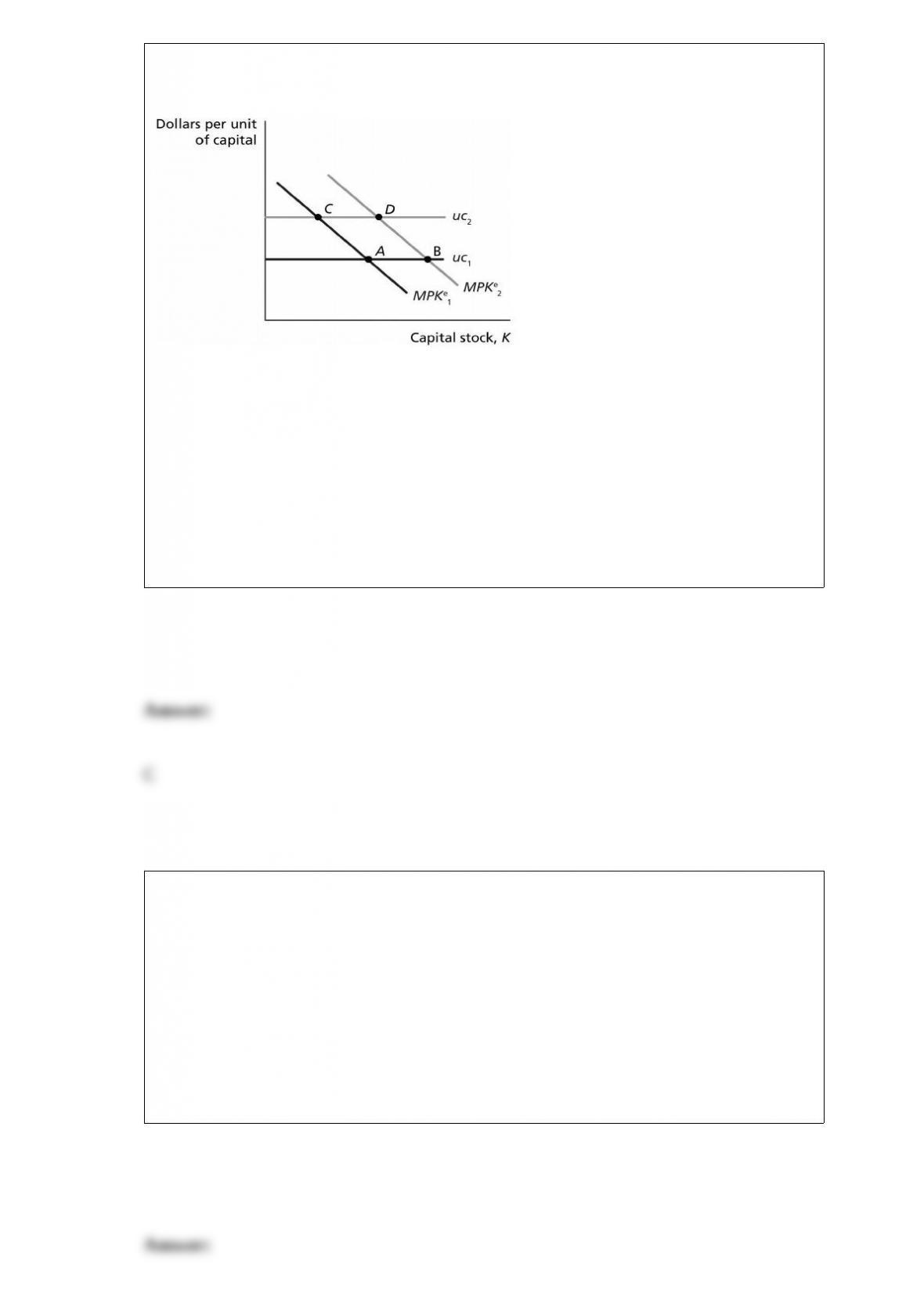
Figure 16.1
Refer to Figure 16.1. An increase in the real interest rate is best represented by a
movement from
A) point A to point B.
B) point B to point A.
C) point A to point C.
D) point C to point A.
If you were building a macroeconomic model that explores the effect of an increase in
income tax rates on the size of the labor force, the endogenous variable(s) would be
A) income tax rates.
B) the size of the labor force.
C) both income tax rates and the size of the labor force.
D) neither income tax rates nor the size of the labor force.

Suppose consumer confidence declines and as a result, consumer spending decreases by
$4 billion dollars. Other things equal, if households spend $0.75 of each extra dollar of
income and save the remaining $0.25, by how much will spending decrease during the
first round through the circular flow?
A) $1 billion
B) $2.25 billion
C) $3 billion
D) $4 billion