How does a decrease in value of a country’s currency relative to other currencies affect
its balance of trade?
A) A decrease in value of a country’s currency relative to other currencies raises
imports, reduces exports, and reduces the balance of trade.
B) A decrease in value of a country’s currency relative to other currencies reduces
imports, raises exports, and reduces the balance of trade.
C) A decrease in value of a country’s currency relative to other currencies reduces
imports, raises exports, and increases the balance of trade.
D) A decrease in value of a country’s currency relative to other currencies raises
imports, reduces exports, and increases the balance of trade.
The 1994 agreement that eliminated most tariffs among the United States, Canada, and
Mexico is known as
A) the Pacific Trade Association.
B) Trade Without Borders.
C) NAFTA.
D) the Western Trade Union.
Suppose that real GDP for 2012 was $10,000 billion and real GDP for 2013 was
$11,000 billion. What is the rate of growth of real GDP between 2012 and 2013?
A) 1%
B) 2%
C) 5%
D) 10%
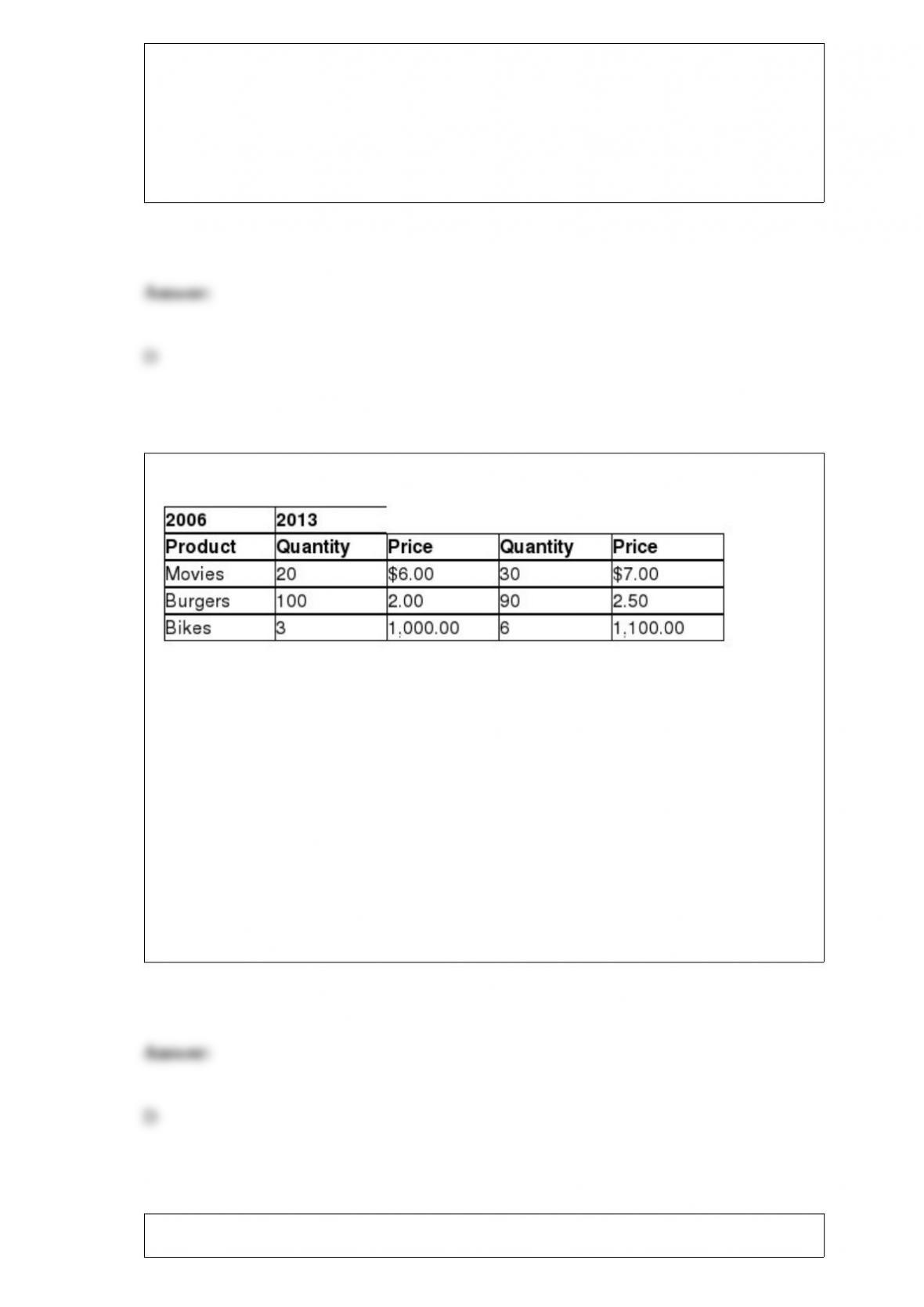
Table 8-17
A very simple economy produces three goods: movies, burgers, and bikes. The
quantities produced and their corresponding prices for 2006 and 2013 are shown in the
table above.
Refer to Table 8-17. What is nominal GDP in 2013?
A) $3,320
B) $3,690
C) $6,360
D) $7,035
If an American firm opens a production facility in India, the total value of the
production will be included in the
A) gross domestic product of the United States.
B) national income of the United States.
C) gross domestic product of India.
D) national income of India.
Money’s most narrow definition is based on its function as a
A) store of value.
B) unit of account.
C) standard of deferred payment.
D) medium of exchange.
E) standard of barter.
Figure 13-3
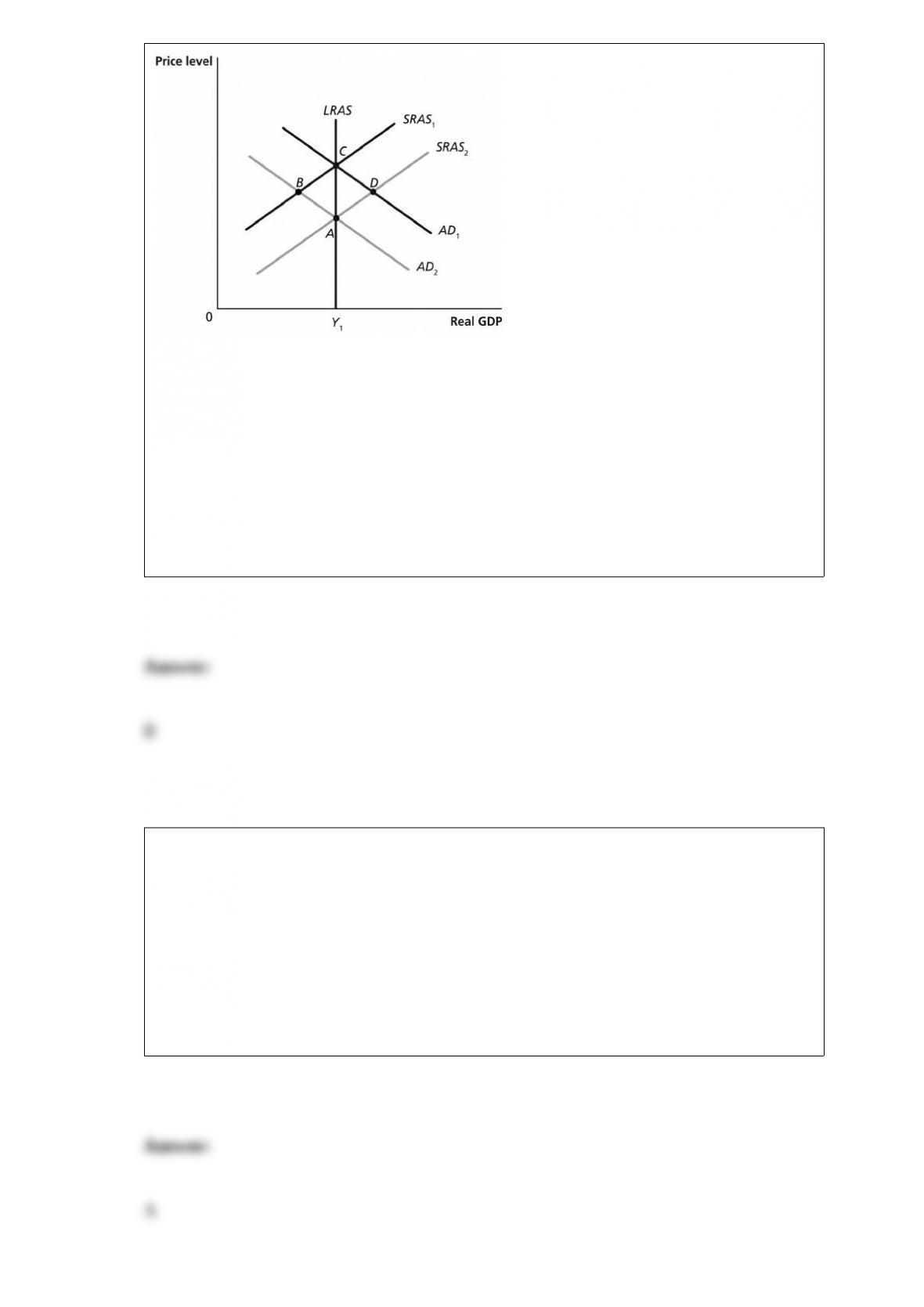
Refer to Figure 13-3. Suppose the economy is at point A. If the economy experiences a
supply shock, where will the eventual short-run equilibrium be?
A) A
B) B
C) C
D) D
The resource income earned by those who supply labor services is called
A) wages and salaries.
B) stock options.
C) profit.
D) bonus.
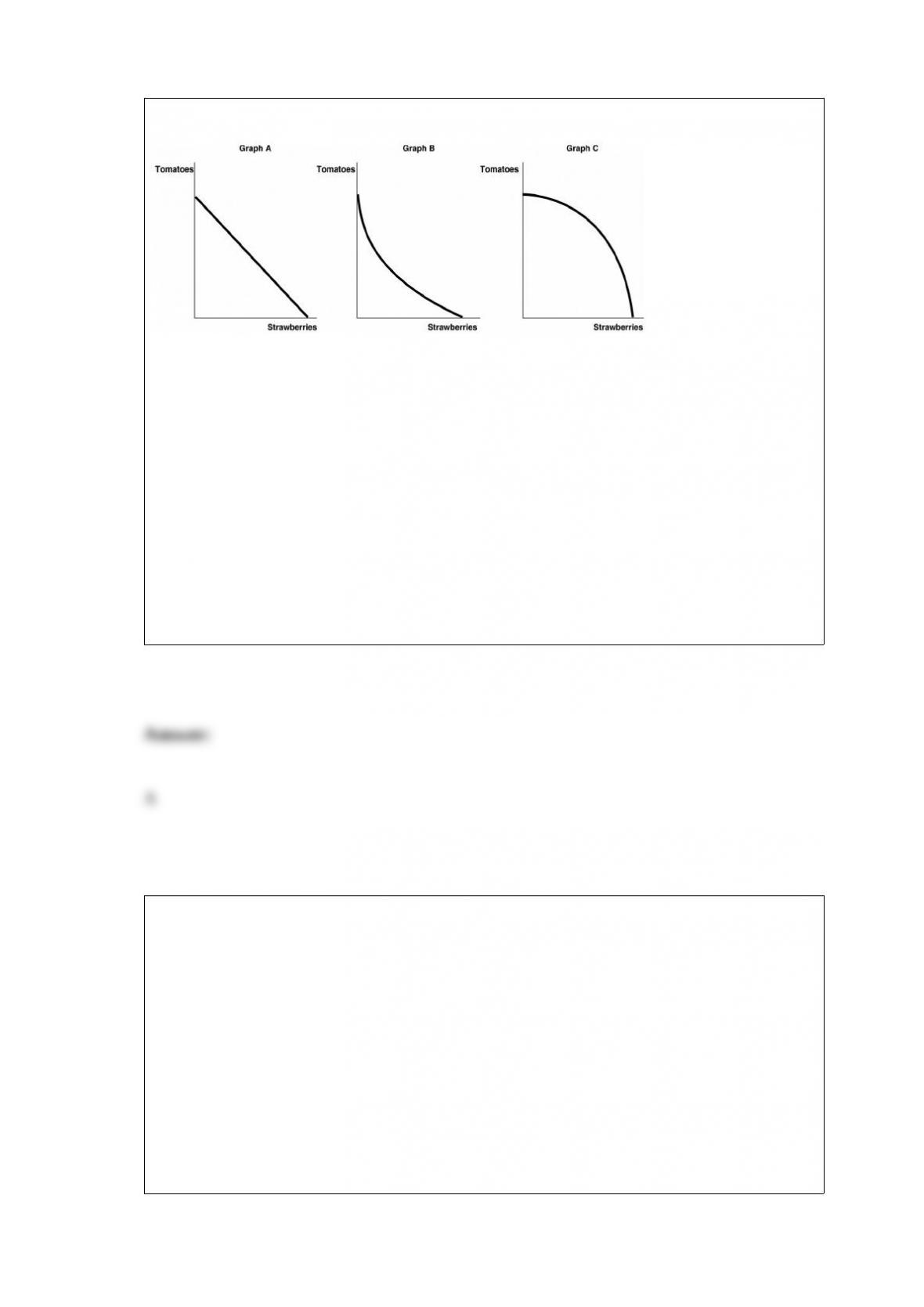
Figure 2-3
Refer to Figure 2-3. Carlos Vanya grows tomatoes and strawberries on his land. His
land is equally suited for growing either fruit. Which of the graphs in Figure 2-3
represents his production possibilities frontier?
A) Graph A
B) Graph B
C) Graph C
D) either Graph A or Graph B
E) either Graph B or Graph C
The use of fiscal policy to stabilize the economy is limited because
A) changes in government spending and tax rates have a small effect on aggregate
demand.
B) changes in government spending and tax rates have a small effect on interest rates.
C) the legislative process can be slow, which means that it is difficult to make fiscal
policy actions in a timely way.
D) the Internal Revenue Service (IRS) resists changes in tax rates because of all the
changes they would have to make to the tax code.
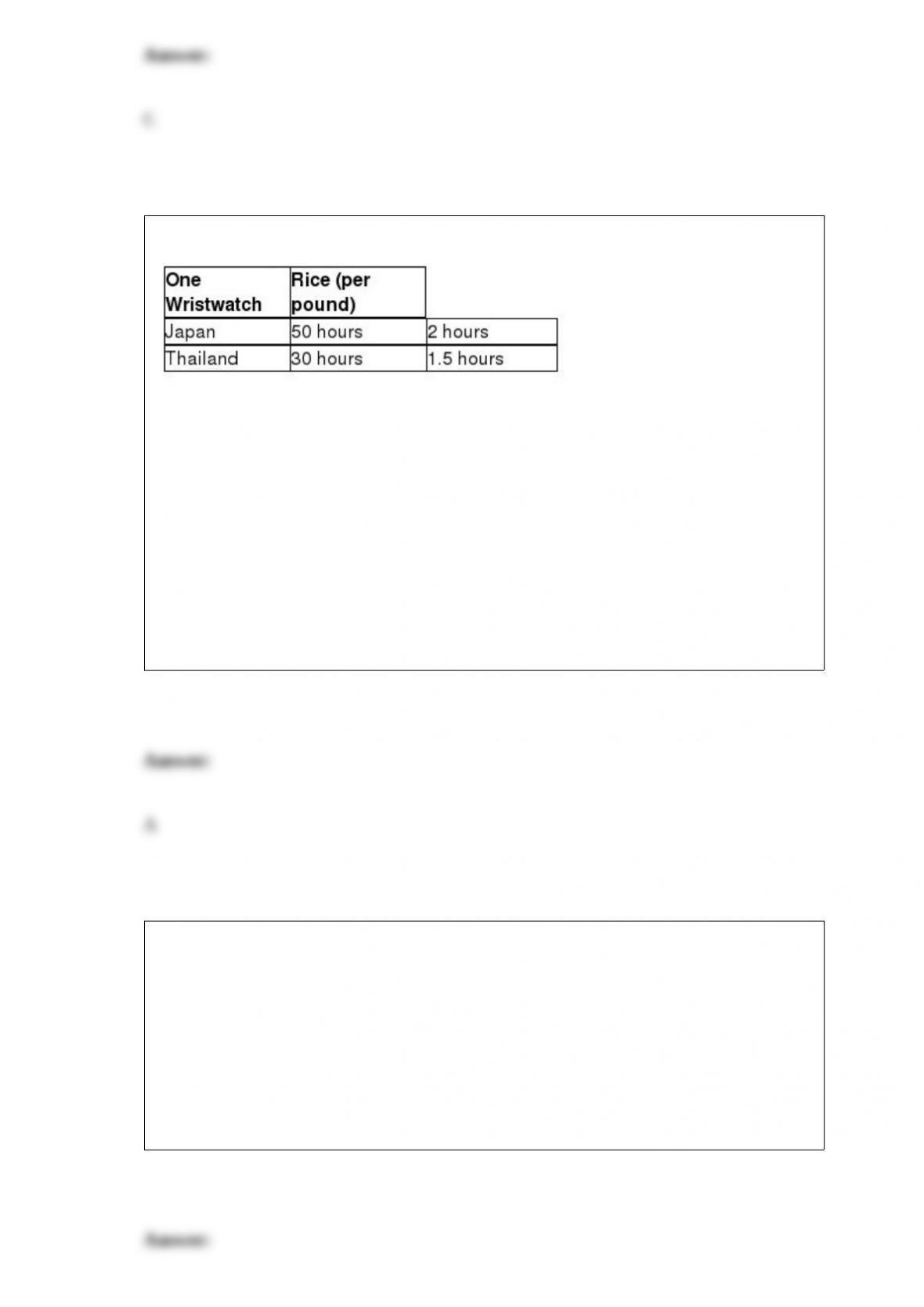
Table 2-9
Table 2-9 shows the number of labor hours required to produce a wristwatch and a
pound of rice in Japan and Thailand.
Refer to Table 2-9. Japan has a comparative advantage in the production of
A) rice.
B) wristwatches.
C) both products.
D) neither product.
The costs to firms of changing prices are called
A) redistribution costs.
B) menu costs.
C) anticipation costs.
D) money illusion costs.

One result of the financial meltdown of the late 2000s was that mortgage institutions
________ and ________ were brought under direct control of the government.
A) Fannie Mae; Freddie Mac
B) Glass Steagall; Sarbanes Oxley
C) Goldman Sachs; Morgan Stanley
D) Lehman Brothers; FDIC
Why did the United States abandon the gold standard in the 1930s?
A) The government wanted to rapidly expand the money supply in response to the
Great Depression.
B) The government wanted to move away from a floating exchange rate system to a
fixed exchange rate system.
C) The Treasury Department in the United States found it was cheaper to print paper
money instead of gold coins.
D) New sources of gold were discovered, so the price of gold plummeted, dramatically
reducing the value of the dollar.